

Indonesian live captions and productivity tool for communicating with deaf & HoH
For deaf and hard of hearing people.
Download for free


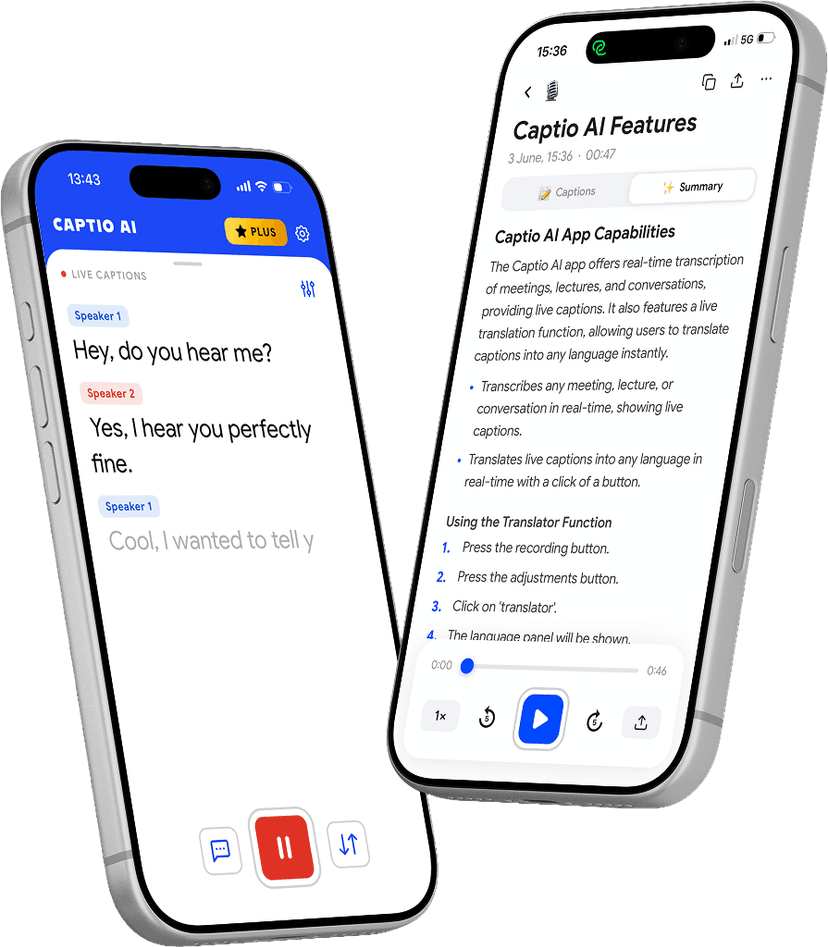
Everything you need to follow Indonesian communicating with deaf & HoH
Four tools built for deaf and hard of hearing Indonesian speakers.
You speak. They read.
- Your words appear on their screen word by word
- No sign language required from you
- Works at home, at work, anywhere
- Any accent, any pace
When language is also a barrier
- You speak your language, they read in theirs
- Translates in real time as you speak
- 60+ languages, no setup
- Handles mid-sentence switches
Save the conversation for them
- Record and transcribe any exchange
- They can review everything at their own pace
- Organised by speaker
- Any length, any format
Make sure nothing important was missed
- Key points extracted from any transcript
- Useful after appointments, meetings, or important conversations
- Organised into clear sections
- Works on any saved recording
Download for free
Every situation covered
Designed for the real moments that matter — not just quiet controlled environments.
A family gathering, a Lebaran celebration, a multigenerational meal at home. You speak at your natural pace — your regional accent and all — and your deaf or hard of hearing family member reads every word in real time without anyone having to slow down.
Office conversations, quick questions across the desk, corridor exchanges in an Indonesian-speaking workplace. You talk normally and Captio AI makes sure your deaf or hard of hearing colleague follows every word without either of you having to adapt.
When your partner is deaf or hard of hearing and you are not. You speak naturally — whether that is Jakartan, Javanese-accented, or Surabayan Indonesian — and they read every word as you say it. No more using gestures between you in the same room.
Morning conversations, questions from the other room, catching up in the evening. Captio AI covers the everyday low-stakes exchanges of shared home life — the moments that feel small but add up to genuine closeness.
A relative visiting from another island, a new colleague from a different region, a neighbour you have not properly met. You set up Captio AI and the conversation starts without any awkward preamble about how to communicate.
Family gatherings, arisan events, work socials where some people are deaf or hard of hearing and some are not. Captio AI captions whoever is speaking so nobody is left watching the conversation happen around them.
Most accurate and fastest models
word accuracy
independent benchmark, 2025
real-time captions
first word appears as you speak
Download for free
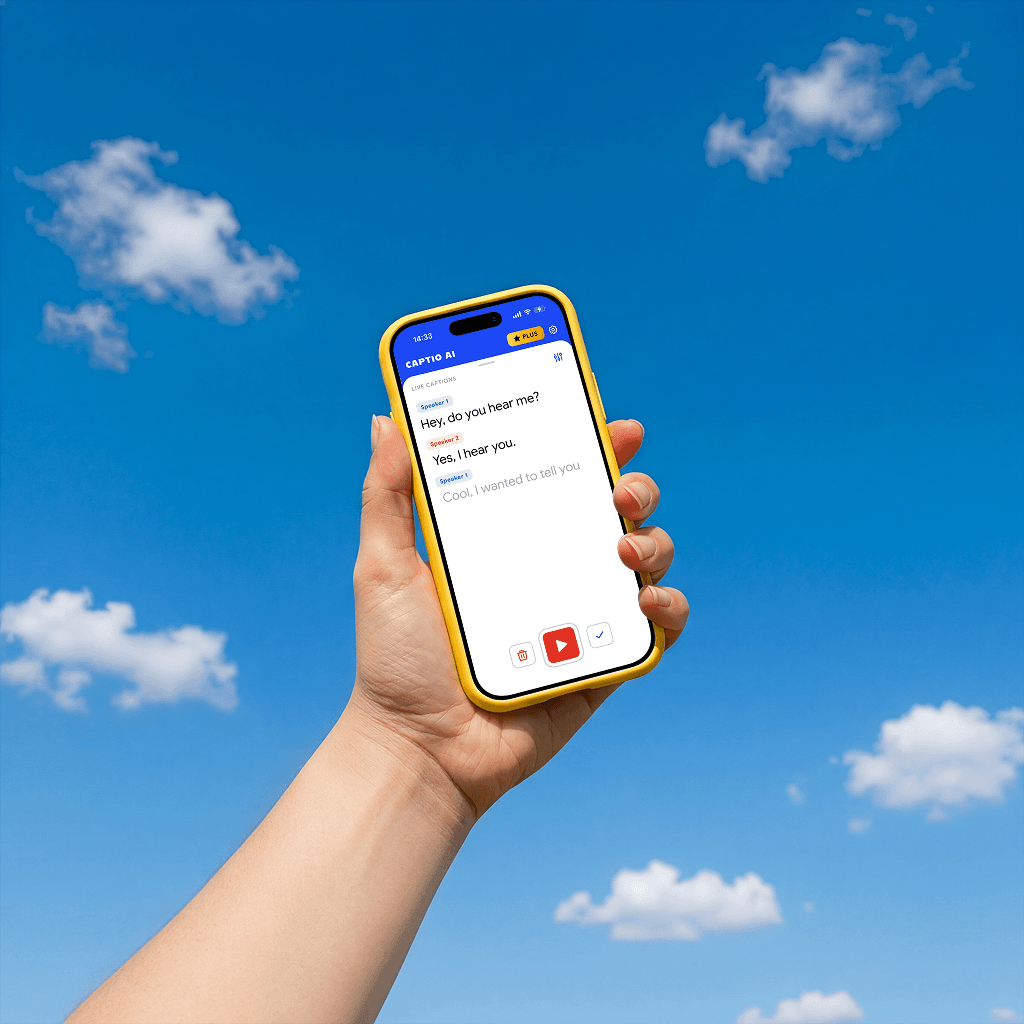
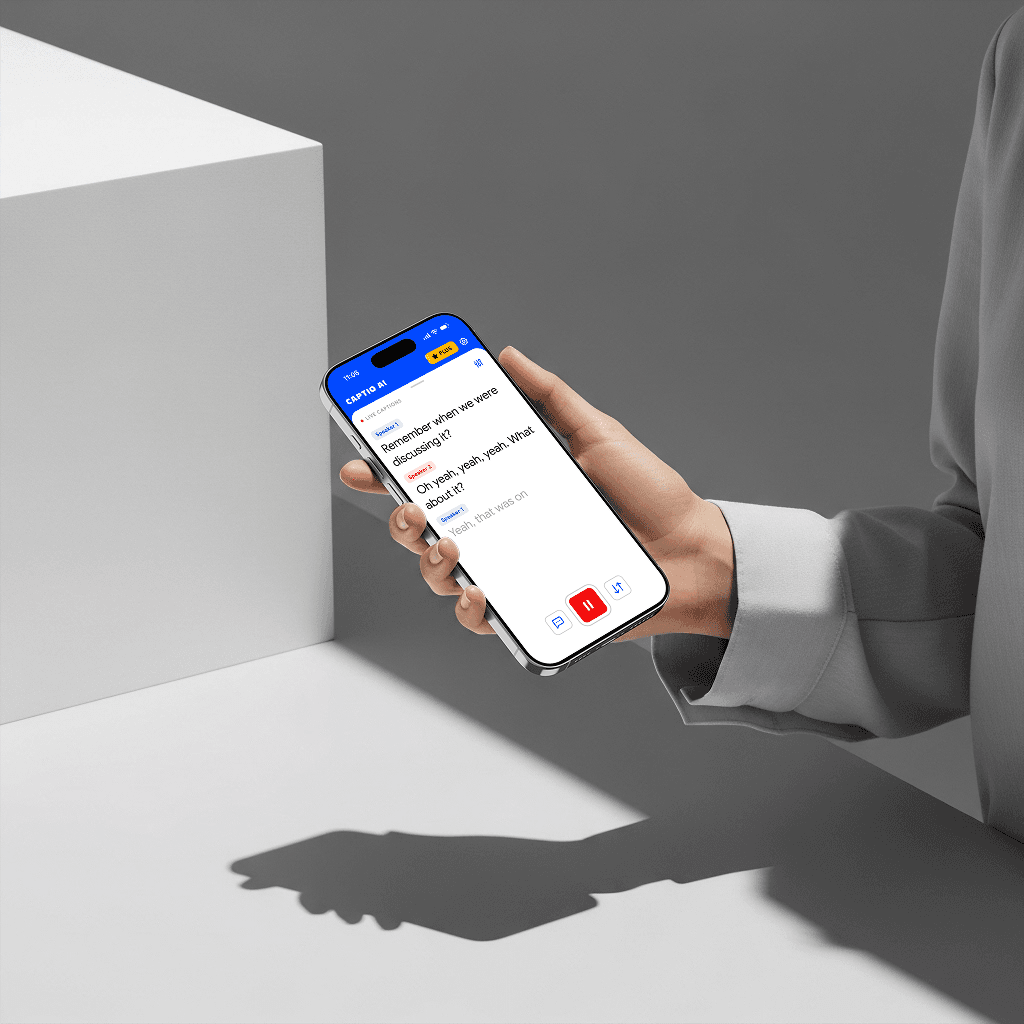
You talk. They follow. No adjustment needed.
You speak naturally
No slowing down, no special phrasing, no training required. Captio AI handles everything — you just talk the way you always do.
They read as you speak
Your words appear on their screen word by word while you are still talking. Not a summary after — the full sentence, in real time.
Works wherever you both are
Living rooms, offices, restaurants, social gatherings. No venue setup, no special conditions. Captio AI works anywhere you have a conversation.
No sign language from either side
You do not need to learn anything new. Neither do they. Captio AI bridges the gap without requiring any change to how either of you communicates.
Works with how you actually speak
Fast, accented, casual. Captio AI handles real speech — not just slow, clear dictation. You do not need to perform clarity for it to work.
Private by default
Your conversations are never recorded, stored, or shared. Audio is processed in real time and discarded immediately — nothing is kept.
Why Indonesian is hard to understand
Regional dialect overlay
- Every region's Indonesian sounds different — each is a different lip-reading challenge
- Indonesia has over 700 local languages, and every region produces its own variety of Indonesian. Javanese-Indonesian has distinct dental stops and vowel qualities; Sundanese-Indonesian has different prosody; Batak-Indonesian has distinctive consonant realisations. A deaf or hard of hearing person trying to follow a hearing family member or colleague speaks Indonesian with the phonological overlay of whichever local language they grew up with — and each overlay creates a different visual signal.
Jakarta informal speech
- Bahasa Gaul — the urban informal Indonesian that dominates daily life — is heavily contracted
- The informal Jakartan variety that dominates urban popular culture, office life, and social media uses heavy contractions, deletions, and slang: 'tidak' becomes 'nggak', 'begitu' becomes 'gitu', 'sudah' becomes 'udah'. The lip pattern of fast casual Jakartan Indonesian bears little resemblance to standard written Bahasa Indonesia. A deaf person who learned lip-reading from formal Indonesian will find conversational urban speech near-unreadable without additional tools.
Javanese transfer
- The largest language community in Indonesia carries its phonology into Indonesian
- Javanese speakers are the largest language community in Indonesia, and Javanese phonological features transfer strongly into Javanese-accented Indonesian — distinct vowel qualities, dental stop realisations, and prosodic patterns. Java is also home to the largest urban deaf population in Indonesia. The majority of deaf Indonesians navigate daily life with hearing family members and colleagues whose Indonesian carries Javanese phonological overlay.
Code-switching with local languages
- Many Indonesian households switch between Indonesian and a local language mid-sentence
- In Javanese households, Sundanese communities, Batak families, and many others across the archipelago, everyday conversation switches between Indonesian and the local language — sometimes within a single exchange. For a deaf or hard of hearing person following a hearing family member, each switch changes the phonological system they are trying to read without any signal that the switch has happened.
Low-visibility consonants
- Indonesian's most distinctive sounds produce minimal visible lip movement
- Indonesian's phonologically distinctive consonants — nasals /ŋ/ and /ɲ/, the glottal stop /ʔ/ at word boundaries (common in fast speech), and the voiced fricative /v/ in loanwords — all produce minimal visible lip movement. In fast conversational speech, word boundaries blur and these sounds pass without any reliable visual anchor. The phonological information that distinguishes words is in the audio, not on the lips.
Download for free
9 million Indonesians with hearing difficulty. One-third of provinces have no deaf schools.
Indonesia's Central Statistics Agency (BPS) found that approximately 9 million Indonesians over the age of 10 had difficulty hearing as of 2015 — in a country of over 270 million people spread across 17,000 islands. Only 79 deaf schools exist for an estimated 2 million deaf students. One-third of Indonesia's provinces have no schools for the deaf at all, meaning a significant portion of deaf Indonesians have no access to formal deaf education regardless of where they grow up.
Indonesia recognises two sign language systems — BISINDO (Indonesian Sign Language) and SIBI (the Signed System for Indonesian, a manual code) — creating confusion in deaf education and community settings. No special government subsidies exist for the deaf. Research documents significant discrimination affecting deaf Indonesians across education, employment, and access to public facilities. Until 2016, many deaf students in Indonesian schools were formally required to lip-read and speak rather than use sign language — a policy driven by cultural bias rather than accessibility evidence.
For the deaf and hard of hearing Indonesians who navigate daily family and social life, the communication gap is compounded by the country's extraordinary geographic and linguistic diversity. A hearing family member in Java speaks Indonesian with Javanese phonological features; one in Sulawesi or Sumatra with entirely different regional features. The deaf or hard of hearing person trying to follow a hearing speaker must navigate both the phonological challenges of Indonesian and the regional overlay of whichever local language dominates where they live. Captio AI captions any hearing speaker's Indonesian in real time — across regional accents and code-switching with local languages — so a deaf or hard of hearing person reads every word wherever they are in this archipelago.
Download for free
What you hear stays with you.
Gone the moment it ends
Captio AI processes your audio in real time and discards it immediately. Nothing is recorded. Nothing is kept.
Not a product
Your conversations are not something Captio AI sells, shares, or monetizes — to anyone, for any reason.
Not used to train anything
What you say in a doctor's appointment or a job interview never ends up in a training dataset. Not ours. Not anyone else's.

Private by default
Captio AI supports 60+ languages
Download for free
Frequently asked questions
Make every conversation work — for both sides in Indonesian.
Captio AI is free to start
Download for free