

Thai live captions and productivity tool for communicating with deaf & HoH
For deaf and hard of hearing people.
Download for free


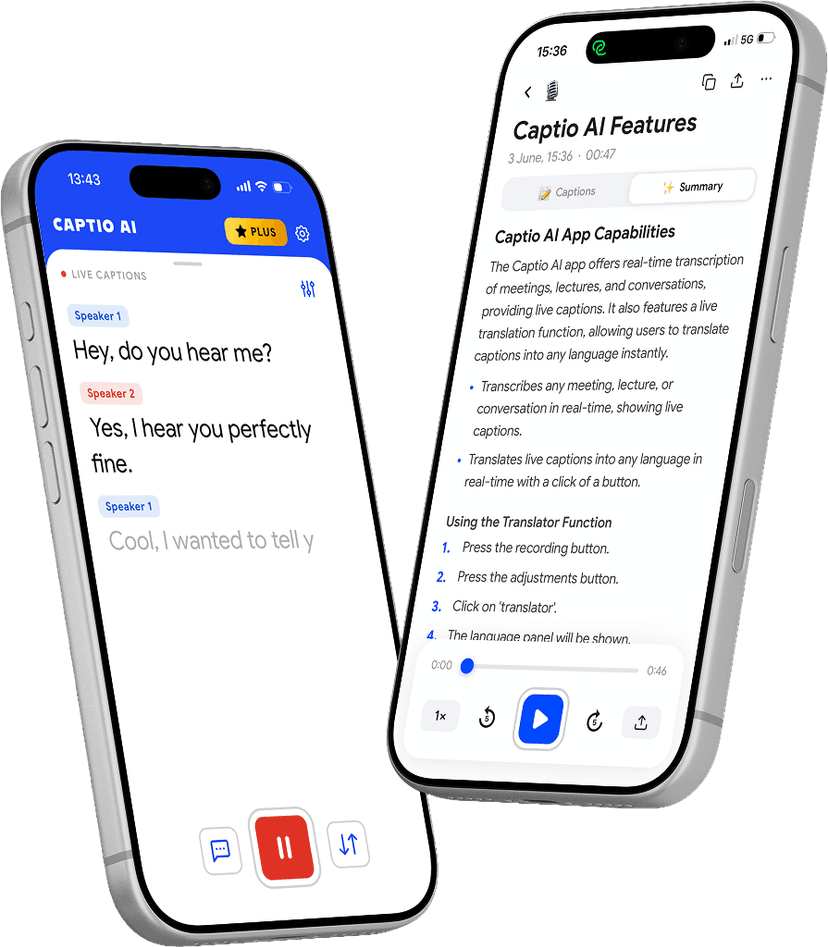
Everything you need to follow Thai communicating with deaf & HoH
Four tools built for deaf and hard of hearing Thai speakers.
You speak. They read.
- Your words appear on their screen word by word
- No sign language required from you
- Works at home, at work, anywhere
- Any accent, any pace
When language is also a barrier
- You speak your language, they read in theirs
- Translates in real time as you speak
- 60+ languages, no setup
- Handles mid-sentence switches
Save the conversation for them
- Record and transcribe any exchange
- They can review everything at their own pace
- Organised by speaker
- Any length, any format
Make sure nothing important was missed
- Key points extracted from any transcript
- Useful after appointments, meetings, or important conversations
- Organised into clear sections
- Works on any saved recording
Download for free
Every situation covered
Designed for the real moments that matter — not just quiet controlled environments.
Thai family meals — in Bangkok, Chiang Mai, or a family home in a provincial town — are warm and busy, with hearing family members speaking naturally in regional Thai at full conversational pace. Captio AI captions what each person says in real time so a deaf or hard of hearing family member follows without asking anyone to repeat.
Thai workplaces run in standard Thai for most exchanges, with English mixed in for technical and formal contexts. A hearing colleague speaks at their normal pace. Captio AI captions what they say so a deaf or hard of hearing colleague follows desk conversations, instructions, and corridor exchanges without missing a word.
When your partner is deaf or hard of hearing and Thai is the language you speak at home. You talk naturally — at your normal pace, in the casual Thai of daily life. Captio AI puts every word on their screen as you say it so nothing is lost between you.
Everyday home life in a Thai household — calling from another room, talking while cooking, quick questions before leaving the house. Captio AI covers the continuous thread of home conversation that a deaf or hard of hearing family member might otherwise piece together from fragments.
When a deaf or hard of hearing person meets a new hearing Thai speaker — at a family gathering, a temple event, or through a mutual friend. Set up Captio AI and the conversation begins naturally, without anyone needing to adjust how they speak.
Group settings — a Songkran family gathering, a large family meal, or a mixed social event — where some people are deaf or hard of hearing and some are not. Captio AI captions whoever is speaking so every person in the group is fully included in the conversation.
Most accurate and fastest models
character accuracy
independent benchmark, 2025
real-time captions
first word appears as you speak
Download for free

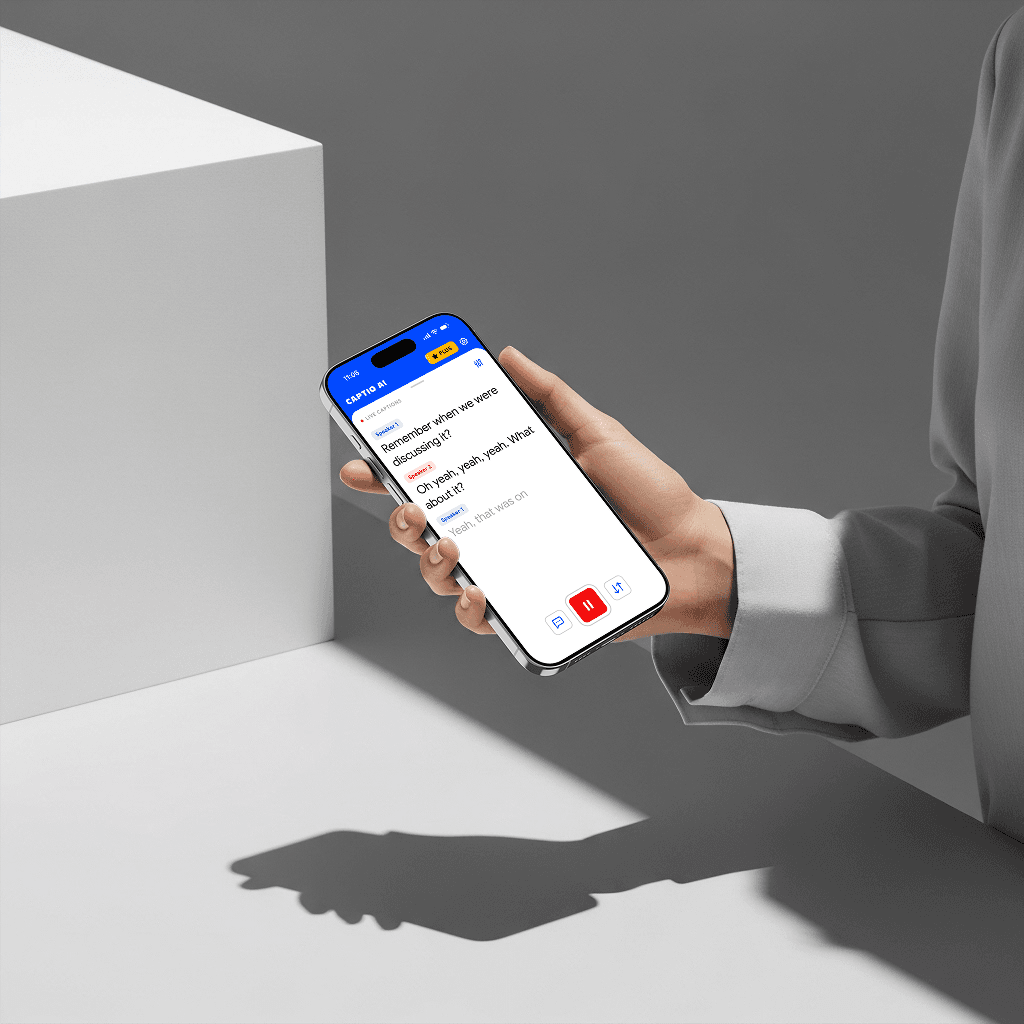
You talk. They follow. No adjustment needed.
You speak naturally
No slowing down, no special phrasing, no training required. Captio AI handles everything — you just talk the way you always do.
They read as you speak
Your words appear on their screen word by word while you are still talking. Not a summary after — the full sentence, in real time.
Works wherever you both are
Living rooms, offices, restaurants, social gatherings. No venue setup, no special conditions. Captio AI works anywhere you have a conversation.
No sign language from either side
You do not need to learn anything new. Neither do they. Captio AI bridges the gap without requiring any change to how either of you communicates.
Works with how you actually speak
Fast, accented, casual. Captio AI handles real speech — not just slow, clear dictation. You do not need to perform clarity for it to work.
Private by default
Your conversations are never recorded, stored, or shared. Audio is processed in real time and discarded immediately — nothing is kept.
Why Thai is hard to understand
Five tones, zero visual signal
- The same Thai syllable means five different things — all look identical at the lips
- Thai has five lexical tones (mid, low, falling, high, rising) that completely change word meaning. The syllable 'maa' can mean horse, dog, come, or have depending on pitch contour. Pitch is entirely auditory — the lips produce the same shape for all five tones. A deaf lip-reader has no visual access to the primary disambiguation tool of Thai.
Aspiration contrast
- Aspirated and plain Thai stops look identical at the lips
- Thai systematically distinguishes aspirated stops /pʰ/, /tʰ/, /kʰ/ from their unaspirated counterparts /p/, /t/, /k/. The contrast is acoustic — a burst of air — with no lip-visible equivalent. At the lips, both produce the same closure. This contrast appears throughout everyday Thai vocabulary and collapses completely for a deaf lip-reader.
Unreleased final stops
- Thai word endings close the mouth but give no visible signal
- Thai allows only a restricted set of final consonants, and stop codas (/p/, /t/, /k/) are unreleased in natural speech — the mouth closes without a burst. For a deaf lip-reader, word endings produce a closed mouth with no further information, making it impossible to distinguish between the possible final consonants that change word meaning.
Northern, Isan, and Southern Thai
- Bangkok Thai and regional Thai are different lip-reading tasks
- Standard Thai (Bangkok) is the national language, but Northern Thai (Kham Mueang), Isan (closely related to Lao), and Southern Thai are distinct dialect clusters with different vowel systems and tonal patterns. A deaf person who lip-reads a Bangkok-speaking family member finds that a hearing relative from Chiang Mai or Khon Kaen speaks a different phonological profile.
Thai–English code-switching
- Urban Bangkok Thai switches to English with no visual warning
- In Bangkok and other major cities, educated Thai speakers regularly code-switch between Thai and English — English technical terms, brand names, and phrases inserted into Thai speech. For a deaf lip-reader, English words produced with Thai phonological influence add another visual category to navigate without any auditory cue to signal the language switch.
Download for free
Hearing loss in Thailand: a common condition with limited daily support
A 2024 hearing health survey of the Bangkok population found that hearing loss prevalence was 53.02%, and that moderate or greater hearing impairment affected 2.8% of participants — with adults aged 65 and over showing 8.56 times greater hearing loss than younger adults (PMC11015571). More than 2 million people in Thailand hold disability cards, and 18% of registered disabled people are hearing impaired — approximately 360,000 people with formally recognised hearing disability. Older adults are significantly less likely to seek hearing care, with a 2023 Frontiers in Digital Health study identifying strong attitudinal barriers including normalisation of hearing loss as a part of ageing and concerns about stigma (PMC10806058).
Thai Sign Language was acknowledged as the national language of deaf people in Thailand in August 1999, and the 2007 Persons with Disabilities Empowerment Act strengthened legal protections. Schools for deaf and hearing-disabled students have been established across Thailand's regions. Despite these structural steps, daily life for a deaf or hard of hearing Thai person who lives with hearing family members remains largely unaided — sign language interpretation is not available at family meals, in workplaces, or at social gatherings. The formal accessibility framework stops well short of the informal settings where most communication happens.
An earlier national cohort study of 87,134 adults found that approximately 8.5% reported some trouble hearing (PMC3529921). Thailand's population is ageing rapidly — the share of people over 60 is growing faster than most East and Southeast Asian neighbours — and age-related hearing loss is concentrated in exactly this group. As multi-generational Thai families increasingly include elderly members with significant hearing loss, the communication gap at family tables grows. Captio AI captions natural Thai speech in real time, at a Songkran table in Bangkok or a family meal in Chiang Mai, so a deaf family member reads what their hearing relatives are saying.
Download for free
What you hear stays with you.
Gone the moment it ends
Captio AI processes your audio in real time and discards it immediately. Nothing is recorded. Nothing is kept.
Not a product
Your conversations are not something Captio AI sells, shares, or monetizes — to anyone, for any reason.
Not used to train anything
What you say in a doctor's appointment or a job interview never ends up in a training dataset. Not ours. Not anyone else's.

Private by default
Captio AI supports 60+ languages
Download for free
Frequently asked questions
Make every conversation work — for both sides in Thai.
Captio AI is free to start
Download for free