

Catalan live captions and productivity tool for communicating with deaf & HoH
For deaf and hard of hearing people.
Download for free


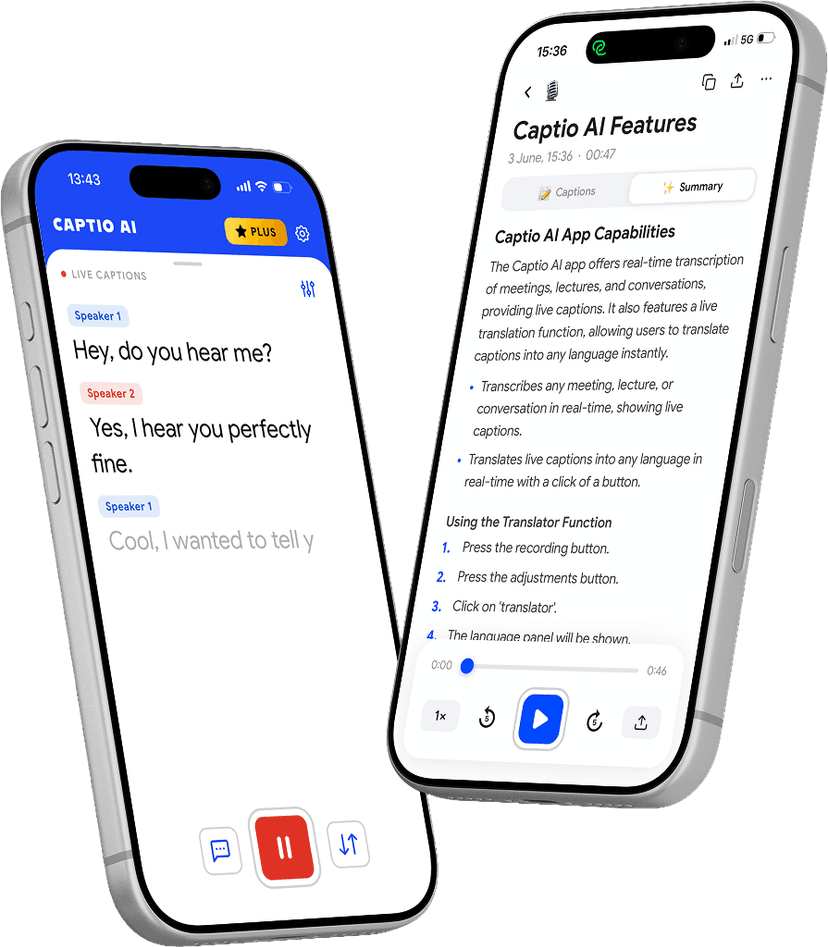
Everything you need to follow Catalan communicating with deaf & HoH
Four tools built for deaf and hard of hearing Catalan speakers.
You speak. They read.
- Your words appear on their screen word by word
- No sign language required from you
- Works at home, at work, anywhere
- Any accent, any pace
When language is also a barrier
- You speak your language, they read in theirs
- Translates in real time as you speak
- 60+ languages, no setup
- Handles mid-sentence switches
Save the conversation for them
- Record and transcribe any exchange
- They can review everything at their own pace
- Organised by speaker
- Any length, any format
Make sure nothing important was missed
- Key points extracted from any transcript
- Useful after appointments, meetings, or important conversations
- Organised into clear sections
- Works on any saved recording
Download for free
Every situation covered
Designed for the real moments that matter — not just quiet controlled environments.
A Catalan family meal in Barcelona or Valencia where some relatives speak Catalan, others mix in Spanish, and grandparents use a strong regional variety. Captio AI captions every voice at the table.
A Catalan-speaking neighbourhood in Catalonia where conversations at the corner market or between neighbours move fast and switch between languages. Captio AI keeps a deaf or hard of hearing person part of it.
At home with a hearing partner who speaks Catalan as a first language, including family video calls from the Balearics or Andorra. Captio AI captions the conversation so home life does not require extra effort from either side.
Spontaneous household exchanges — morning questions, remarks from another room, quick questions to hearing children who grew up switching between Catalan and Spanish. Captio AI keeps a deaf or hard of hearing person connected.
Meeting a hearing partner's Catalan family, or being introduced to new neighbours who speak Catalan. Captio AI captions the first conversation in real time.
At a Catalan neighbourhood celebration, local market, or community gathering where several people are speaking and dialect varieties mix. Captio AI captions the conversation so a deaf or hard of hearing person is part of the event.
Most accurate and fastest models
word accuracy
independent benchmark, 2025
real-time captions
first word appears as you speak
Download for free
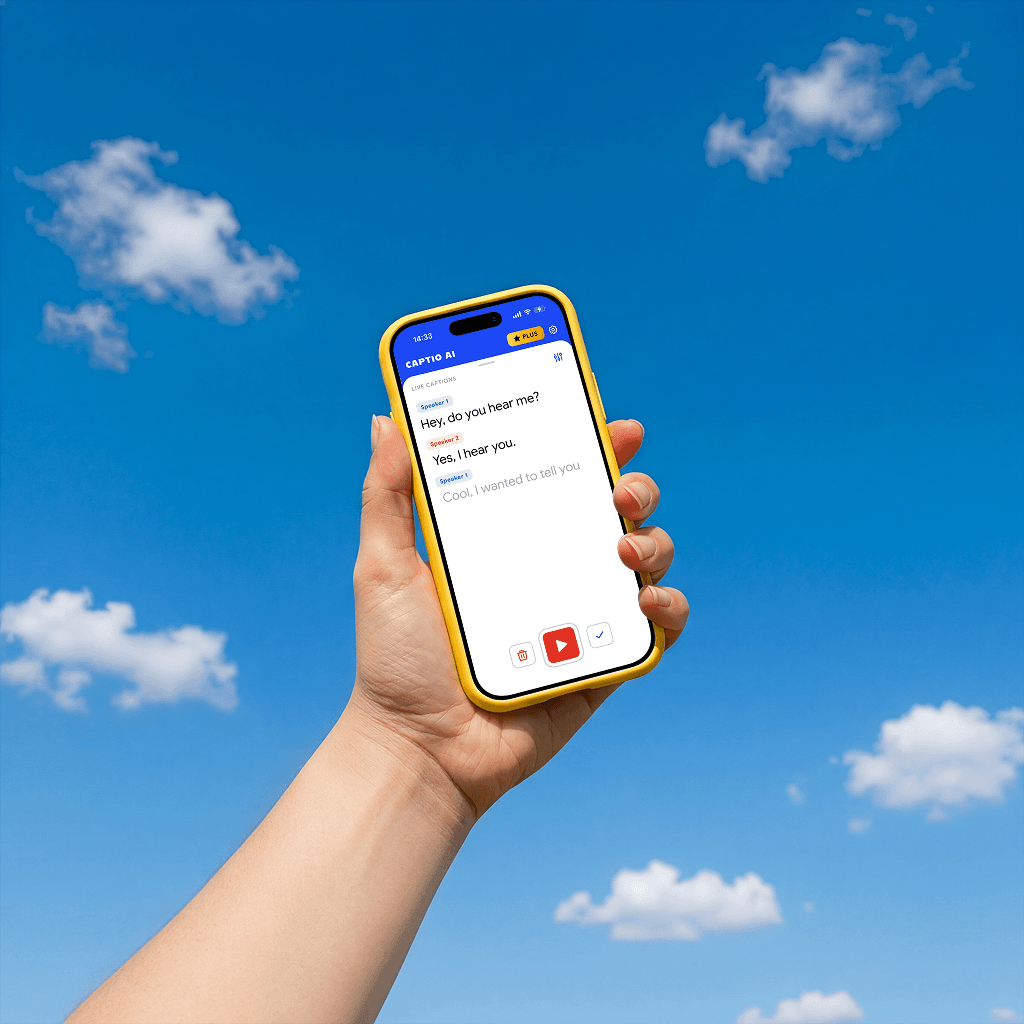
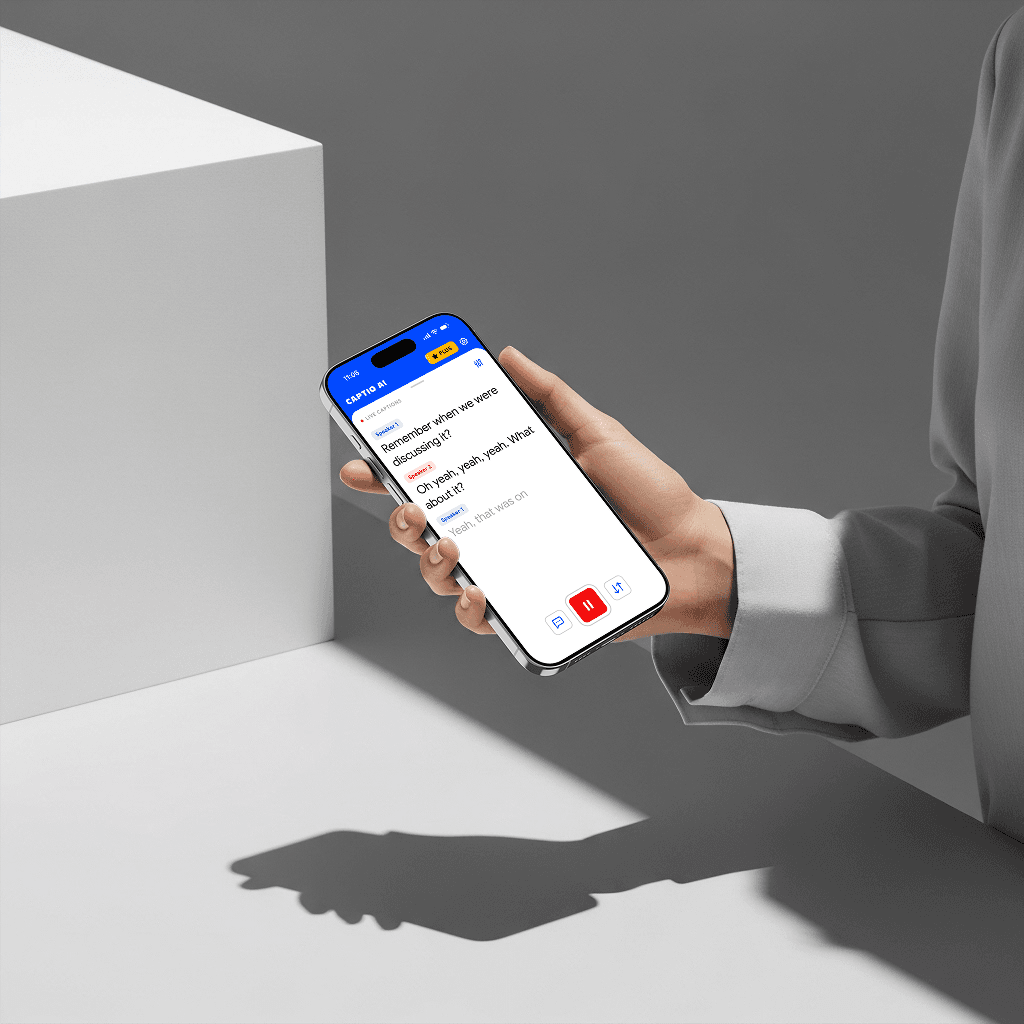
You talk. They follow. No adjustment needed.
You speak naturally
No slowing down, no special phrasing, no training required. Captio AI handles everything — you just talk the way you always do.
They read as you speak
Your words appear on their screen word by word while you are still talking. Not a summary after — the full sentence, in real time.
Works wherever you both are
Living rooms, offices, restaurants, social gatherings. No venue setup, no special conditions. Captio AI works anywhere you have a conversation.
No sign language from either side
You do not need to learn anything new. Neither do they. Captio AI bridges the gap without requiring any change to how either of you communicates.
Works with how you actually speak
Fast, accented, casual. Captio AI handles real speech — not just slow, clear dictation. You do not need to perform clarity for it to work.
Private by default
Your conversations are never recorded, stored, or shared. Audio is processed in real time and discarded immediately — nothing is kept.
Why Catalan is hard to understand
Vowel reduction split
- Eastern and Western Catalan reduce vowels differently — the same word looks different by region
- Eastern Catalan reduces unstressed /a/ and /e/ to a schwa /ə/, while Western Catalan and Valencian keep them distinct. The same word sounds different depending on whether the speaker is from Barcelona or Valencia — and both versions produce different lip profiles. A deaf lip reader calibrated to one variety encounters systematic mismatches with the other.
Sibilant variation
- Seven sibilants in Barcelona, three in Valencia — the same written word sounds completely different
- Standard Catalan has seven or eight sibilant phonemes while Valencian and Ribagorçan dialects use only three or four. The same written word can be pronounced with an entirely different sibilant in Barcelona, Valencia, or the Balearics. A lip reader sees similar tongue-tip and teeth positions across the sibilant series — the distinctions are acoustic.
Catalan–Spanish switching
- Everyday conversations switch between Catalan and Spanish mid-sentence
- In everyday Barcelona or Valencia conversations, speakers shift between Catalan and Spanish fluidly, often mid-sentence. A deaf or hard of hearing person calibrated to either language encounters an unpredictable alternation of two phonological systems. Catalan consonant clusters and Spanish prosody appear in rapid sequence within a single utterance.
Fast casual reduction
- Conversational Catalan drops unstressed syllables and merges words at the edges
- Conversational Catalan in Barcelona drops unstressed vowels, merges words across syllable boundaries, and runs vowel-initial words into preceding consonants at speed. Standard written Catalan does not prepare a lip reader for how fast Catalan is actually spoken at a family dinner or on the street.
Dialect gap
- Mallorcan, Andorran, and Valencian each have features absent from Standard Catalan
- Balearic Catalan preserves archaic vowel distinctions and uses different personal articles. Andorran Catalan has strong northern features. Valencian has distinct prosody and additional vowel contrasts. A deaf person familiar with Barcelona Catalan encounters different phonological patterns from every other variety.
Download for free
Over a million deaf and hard of hearing people in Spain navigate daily Catalan life without consistent communication access.
According to Spain's National Statistics Institute (INE) EDAD 2008 survey, 1,064,000 people in Spain are deaf or have a hearing disability — 2.3% of the national population. EuroTrak Spain data show that approximately one in ten people across Spain live with hearing loss, yet fewer than 40% of those are using hearing aids, leaving the majority managing daily communication without support. In Catalonia alone, population projections suggest over 150,000 people are navigating everyday life with significant hearing loss.
Law 27/2007 gave formal recognition to Spanish Sign Language (LSE) across Spain; Catalan Sign Language (LSC) is recognised separately by the Catalan government through its own legislative framework. Despite this recognition, the law's reach extends primarily to formal settings — education, public services, media. Family dinner tables, neighbourhood conversations, and everyday exchanges in Catalan-speaking communities remain outside any interpreter mandate.
Social inclusion for deaf people in Catalonia is further complicated by the bilingual communication environment. Deaf individuals navigate a community where everyday speech shifts between Catalan and Spanish, often mid-sentence. A 2021 CNSE monograph on deaf education in Spain documented persistent gaps in language accessibility, particularly in informal settings where the spoken language is not predictable.
Download for free
What you hear stays with you.
Gone the moment it ends
Captio AI processes your audio in real time and discards it immediately. Nothing is recorded. Nothing is kept.
Not a product
Your conversations are not something Captio AI sells, shares, or monetizes — to anyone, for any reason.
Not used to train anything
What you say in a doctor's appointment or a job interview never ends up in a training dataset. Not ours. Not anyone else's.

Private by default
Captio AI supports 60+ languages
Download for free
Frequently asked questions
Make every conversation work — for both sides in Catalan.
Captio AI is free to start
Download for free