

Bengali live captions and productivity tool for communicating with deaf & HoH
For deaf and hard of hearing people.
Download for free


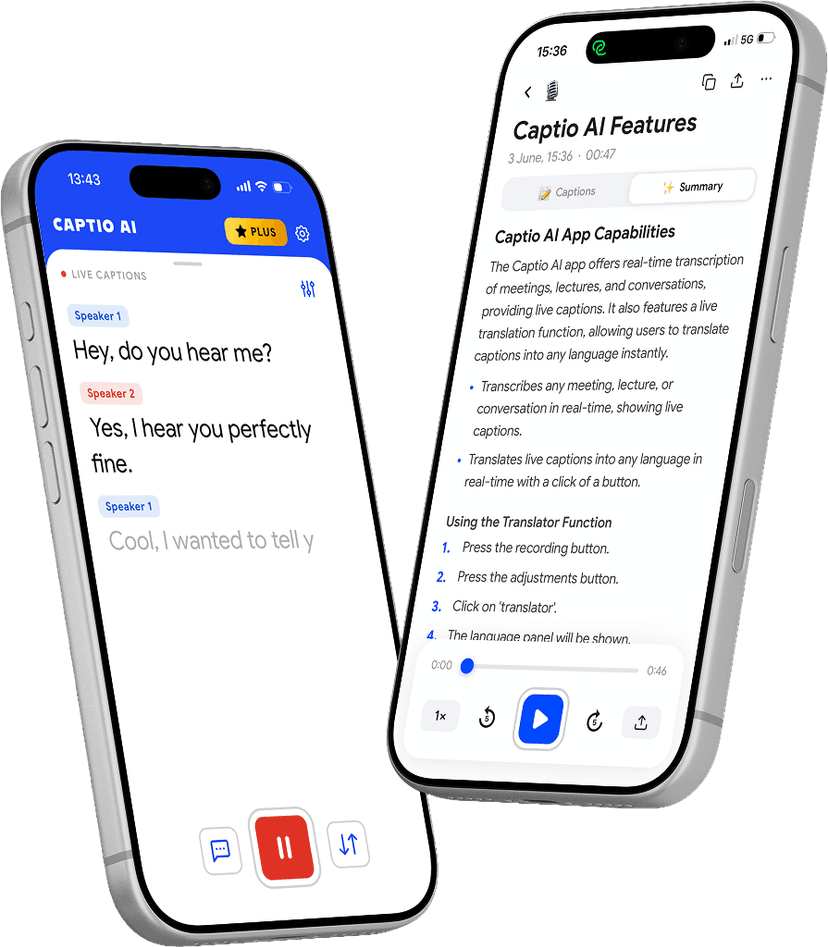
Everything you need to follow Bengali communicating with deaf & HoH
Four tools built for deaf and hard of hearing Bengali speakers.
You speak. They read.
- Your words appear on their screen word by word
- No sign language required from you
- Works at home, at work, anywhere
- Any accent, any pace
When language is also a barrier
- You speak your language, they read in theirs
- Translates in real time as you speak
- 60+ languages, no setup
- Handles mid-sentence switches
Save the conversation for them
- Record and transcribe any exchange
- They can review everything at their own pace
- Organised by speaker
- Any length, any format
Make sure nothing important was missed
- Key points extracted from any transcript
- Useful after appointments, meetings, or important conversations
- Organised into clear sections
- Works on any saved recording
Download for free
Every situation covered
Designed for the real moments that matter — not just quiet controlled environments.
A family meal, an Eid gathering, a multigenerational dinner at home. You speak at your natural pace — your regional variety and Benglish mix — and your deaf or hard of hearing family member reads every word in real time without anyone having to slow down.
Quick questions across the desk, corridor conversations, informal exchanges in a Bengali-speaking workplace. You talk normally and Captio AI makes sure your deaf or hard of hearing colleague follows every word without either of you having to adapt.
When your partner is deaf or hard of hearing and you are not. You speak naturally — whether that is Dhaka Bengali, Kolkata Bengali, or Benglish — and they read every word as you say it. No more typing messages to each other across the same room.
Questions from the kitchen, conversations across the corridor, catching up after work. Captio AI covers the everyday low-stakes exchanges of shared home life — the ones that feel small but add up to genuine connection.
A relative arriving from another district, a new colleague joining the team, a neighbour you have not properly met. You set up Captio AI and the conversation starts without any awkward briefing about how to communicate.
Family gatherings, puja celebrations, office events where some people are deaf or hard of hearing and some are not. Captio AI captions whoever is speaking so nobody is left watching the conversation happen around them.
Most accurate and fastest models
word accuracy
independent benchmark, 2025
real-time captions
first word appears as you speak
Download for free
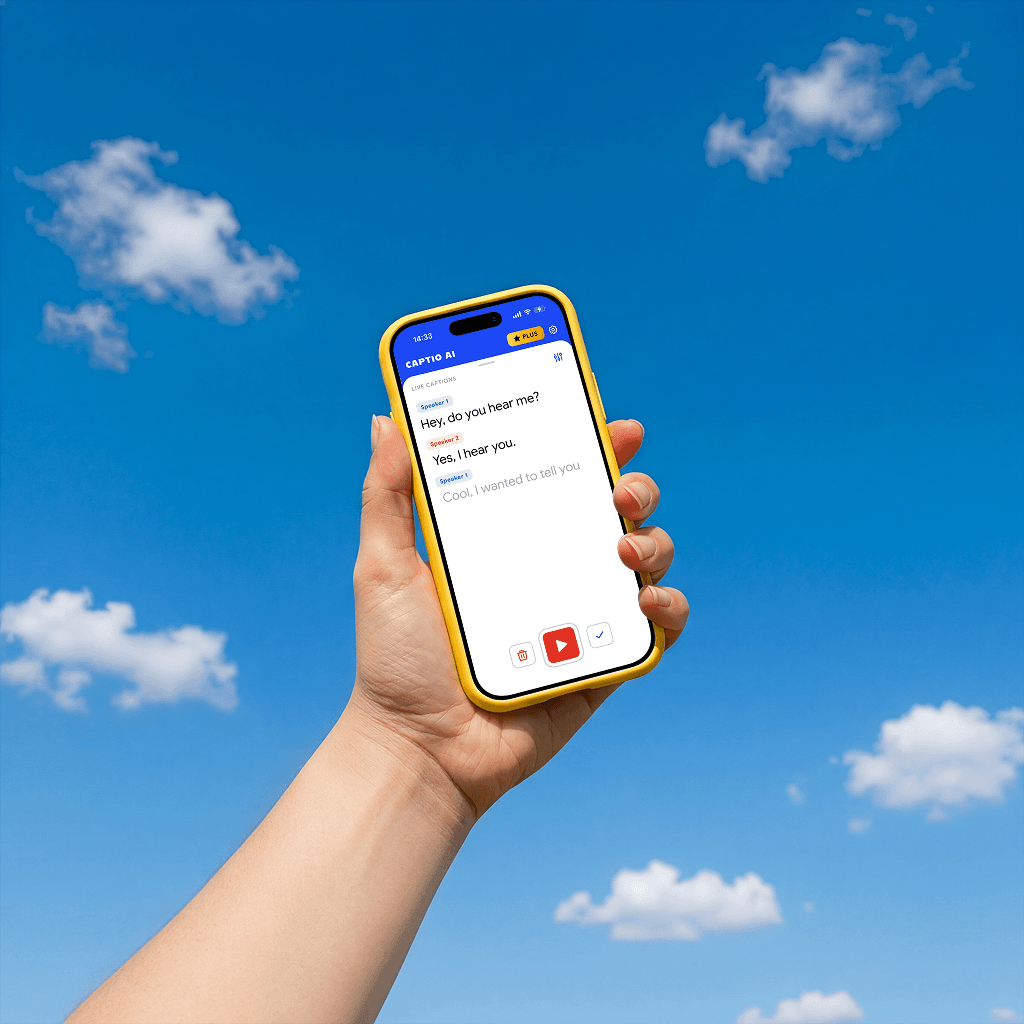
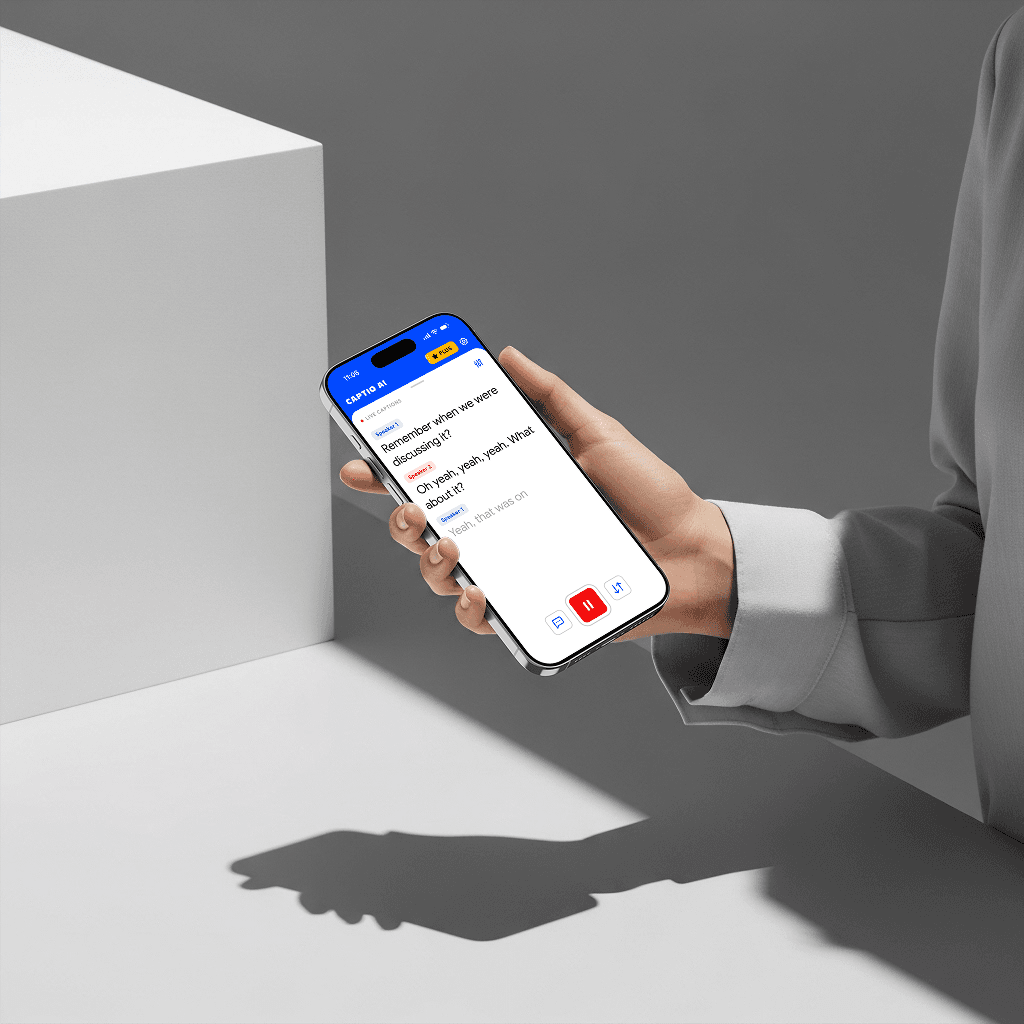
You talk. They follow. No adjustment needed.
You speak naturally
No slowing down, no special phrasing, no training required. Captio AI handles everything — you just talk the way you always do.
They read as you speak
Your words appear on their screen word by word while you are still talking. Not a summary after — the full sentence, in real time.
Works wherever you both are
Living rooms, offices, restaurants, social gatherings. No venue setup, no special conditions. Captio AI works anywhere you have a conversation.
No sign language from either side
You do not need to learn anything new. Neither do they. Captio AI bridges the gap without requiring any change to how either of you communicates.
Works with how you actually speak
Fast, accented, casual. Captio AI handles real speech — not just slow, clear dictation. You do not need to perform clarity for it to work.
Private by default
Your conversations are never recorded, stored, or shared. Audio is processed in real time and discarded immediately — nothing is kept.
Why Bengali is hard to understand
Voiced aspiration
- Bengali's breathy consonants are acoustic — invisible on the lips
- Bengali has breathy-voiced (murmured) stops — /bʱ/, /dʱ/, /gʱ/ — where breathiness is a purely acoustic feature superimposed on the articulation. The lip and jaw position does not change between /b/ and /bʱ/, or between /d/ and /dʱ/. These contrasts appear throughout Bengali vocabulary, are phonologically significant, and are entirely absent from what a deaf or hard of hearing person can see when a hearing family member or colleague speaks.
Post-alveolar contrast
- The dental–post-alveolar distinction is produced inside the mouth
- Bengali has a dental versus post-alveolar (near-retroflex) consonant contrast — the tongue tip moves between the teeth and a point behind the alveolar ridge. This difference is made entirely inside the mouth with no visible change at the lips. The contrast carries meaning throughout Bengali and is completely absent from the lip-reading signal.
Regional dialect gap
- Chittagong and Sylheti Bengali are different languages to lip-read
- Bengali has significant regional dialect variation. Chittagong Bengali and Sylheti are phonologically and lexically distinct from standard Dhaka Bengali — different vowel systems, different consonant realisations, different prosody. A deaf person who has learned to lip-read standard Bangladeshi or Kolkata Bengali will find a hearing family member from Chittagong or Sylhet near-impossible to follow.
Benglish switching
- Urban Bengali switches to English mid-sentence without any signal
- Urban Bengali in Dhaka, Kolkata, and diaspora communities switches freely between Bengali and English — sometimes within a single phrase. A hearing colleague or family member in an urban setting naturally blends both languages. For a deaf or hard of hearing person, each switch resets the phonological system they are trying to read, without any warning that the switch has happened.
Fast casual register
- Bengali between hearing people who know each other is fast and compressed
- The gap between formal Standard Bengali and the fast, reduced speech a hearing partner or family member uses at home is large. Vowels shorten, syllables compress, and sentence boundaries disappear in natural conversation between hearing speakers. The pace a deaf person needs to follow bears little resemblance to what actually happens at a family meal or across a shared desk.
Download for free
13.7 million in Bangladesh alone. The gap runs deepest in family and social life.
Around 9.6% of Bangladesh's population — approximately 13.7 million people — have hearing loss of 40 dB or more. If any degree of hearing loss is counted, the figure rises to 34.6% of the population, or 49.2 million people. A 2025 policy brief found that while 3.4 million persons with disabilities are registered in Bangladesh's Disability Information System, the Household Income and Expenditure Survey 2022 puts the real figure at approximately 9.4 million — a gap of six million unregistered people who receive no formal support.
Most hearing loss in Bangladesh arises in adulthood, with people over 60 and those of lower socioeconomic status most affected. The contributing causes — congenital deafness, excessive urban noise, and ototoxic drug use — are well documented but inadequately addressed at a policy level. Sign language interpretation in Bangladesh is concentrated in major cities and institutional settings. In rural areas and in the informal settings where most daily life happens, the deaf or hard of hearing person navigates without any system behind them.
Across the Bengali-speaking world — Bangladesh, West Bengal, and a significant diaspora in the UK — the communication gap is most acutely felt in ordinary daily settings. The hearing family members and colleagues who want to connect do not lack goodwill. They lack a practical tool that works in a household conversation, at a family gathering, or in an office exchange, in whichever Bengali variety they speak. Captio AI captions any hearing speaker's Bengali in real time — Dhaka, Kolkata, Chittagong, or Sylheti varieties — so a deaf or hard of hearing person follows every word wherever they are.
Download for free
What you hear stays with you.
Gone the moment it ends
Captio AI processes your audio in real time and discards it immediately. Nothing is recorded. Nothing is kept.
Not a product
Your conversations are not something Captio AI sells, shares, or monetizes — to anyone, for any reason.
Not used to train anything
What you say in a doctor's appointment or a job interview never ends up in a training dataset. Not ours. Not anyone else's.

Private by default
Captio AI supports 60+ languages
Download for free
Frequently asked questions
Make every conversation work — for both sides in Bengali.
Captio AI is free to start
Download for free