

Afrikaans live captions and productivity tool for communicating with deaf & HoH
For deaf and hard of hearing people.
Download for free


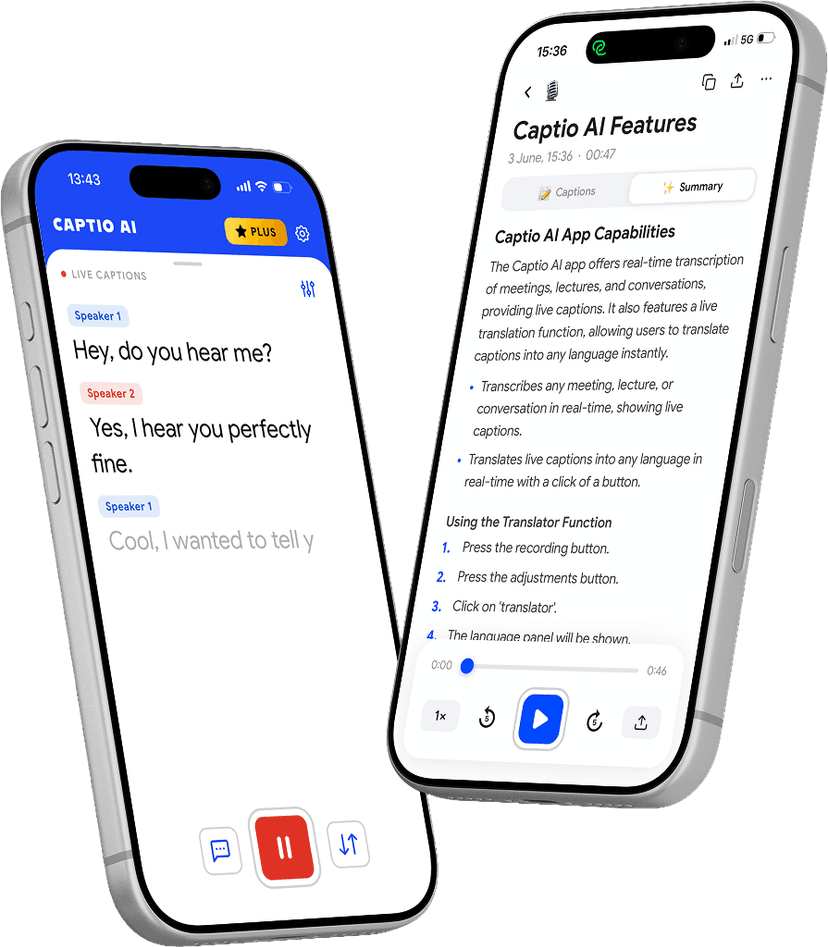
Everything you need to follow Afrikaans communicating with deaf & HoH
Four tools built for deaf and hard of hearing Afrikaans speakers.
You speak. They read.
- Your words appear on their screen word by word
- No sign language required from you
- Works at home, at work, anywhere
- Any accent, any pace
When language is also a barrier
- You speak your language, they read in theirs
- Translates in real time as you speak
- 60+ languages, no setup
- Handles mid-sentence switches
Save the conversation for them
- Record and transcribe any exchange
- They can review everything at their own pace
- Organised by speaker
- Any length, any format
Make sure nothing important was missed
- Key points extracted from any transcript
- Useful after appointments, meetings, or important conversations
- Organised into clear sections
- Works on any saved recording
Download for free
Every situation covered
Designed for the real moments that matter — not just quiet controlled environments.
An Afrikaans family gathering where grandparents speak Cape Afrikaans, parents mix in English on some words, and young family members shift fully into English-Afrikaans switching. Captio AI follows every voice.
South African workplaces often run on English officially but Afrikaans informally. Captio AI lets a deaf colleague follow the corridor conversations, team lunches, and informal banter that shape working relationships.
A hearing partner who grew up speaking Namaqualand Afrikaans or Cape Afrikaans can speak naturally at home. Captio AI captions their speech in real time so conversation does not require switching languages or writing.
Morning conversation over coffee, household logistics, and spontaneous remarks from another room — Captio AI keeps a deaf or hard of hearing person connected to everyday home life in an Afrikaans-speaking household.
Meeting a hearing Afrikaans-speaking family member, friend's partner, or new neighbour. Captio AI captures their speech in real time so the introduction can be natural.
At a braai, a rugby gathering, or a church community event where multiple people talk across each other in Afrikaans, Captio AI captions the conversation so a deaf or hard of hearing person is part of the room.
Most accurate and fastest models
word accuracy
independent benchmark, 2025
real-time captions
first word appears as you speak
Download for free
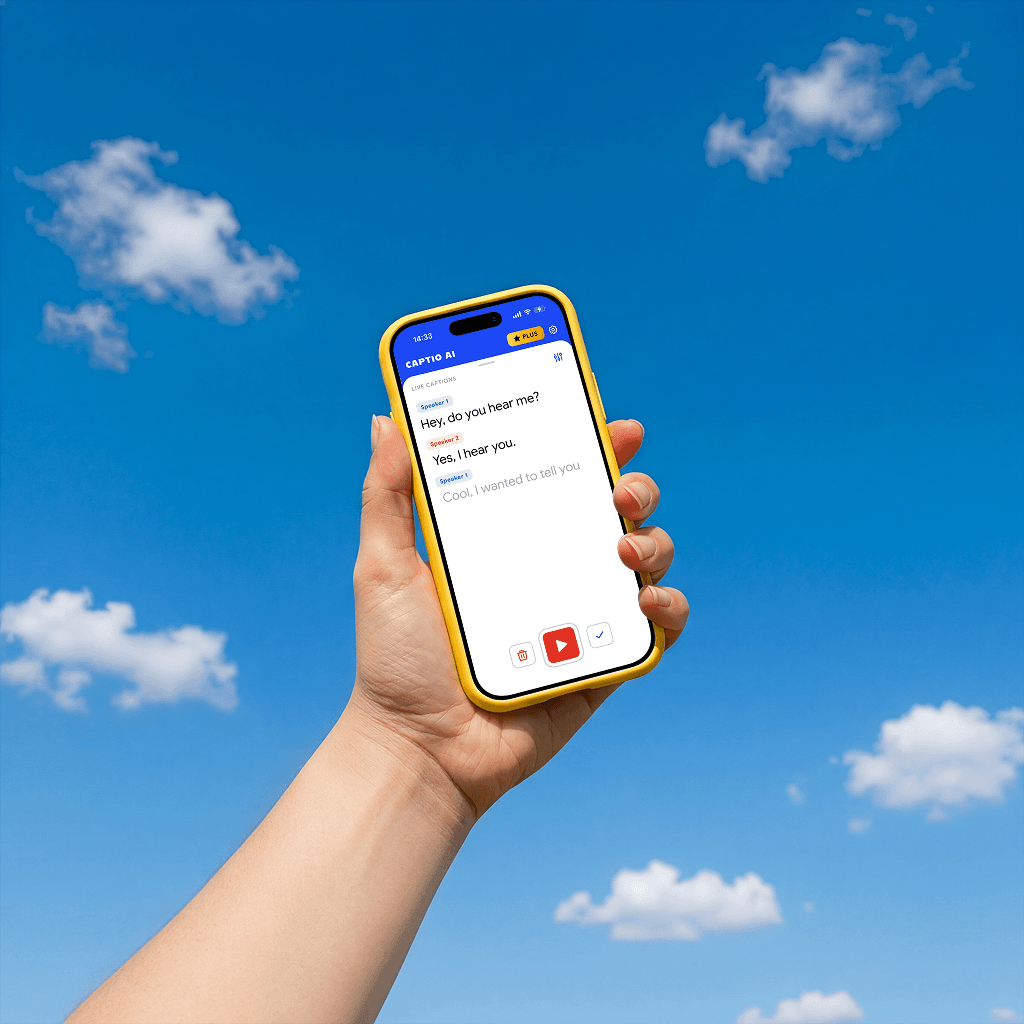
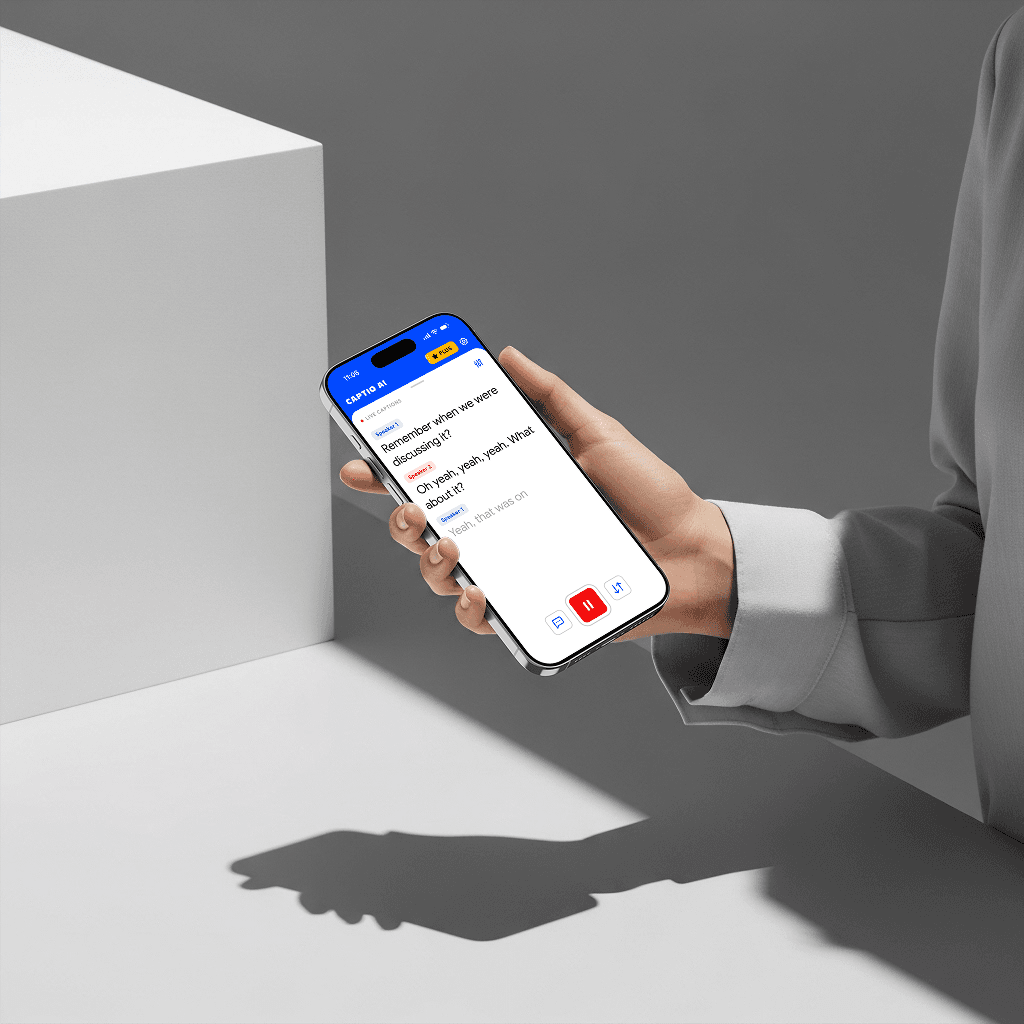
You talk. They follow. No adjustment needed.
You speak naturally
No slowing down, no special phrasing, no training required. Captio AI handles everything — you just talk the way you always do.
They read as you speak
Your words appear on their screen word by word while you are still talking. Not a summary after — the full sentence, in real time.
Works wherever you both are
Living rooms, offices, restaurants, social gatherings. No venue setup, no special conditions. Captio AI works anywhere you have a conversation.
No sign language from either side
You do not need to learn anything new. Neither do they. Captio AI bridges the gap without requiring any change to how either of you communicates.
Works with how you actually speak
Fast, accented, casual. Captio AI handles real speech — not just slow, clear dictation. You do not need to perform clarity for it to work.
Private by default
Your conversations are never recorded, stored, or shared. Audio is processed in real time and discarded immediately — nothing is kept.
Why Afrikaans is hard to understand
Velar fricative /x/
- The Afrikaans 'g' is produced deep in the throat
- The iconic Afrikaans 'g' sound — in 'gaan' (go), 'dag' (day), 'goed' (good) — is a velar or uvular fricative produced at the back of the mouth with no lip movement. It is one of the most phonemically loaded consonants in Afrikaans, and one of the least visible. A deaf or hard of hearing lip reader gets nothing from this consonant.
17-vowel inventory
- Diphthongs with overlapping lip positions
- Afrikaans has 17 vowel phonemes including 7 diphthongs and 7 marginal monophthongs found mainly in loanwords. Several contrasts — particularly among back and central monophthongs — produce nearly identical lip positions. A lip reader faces repeated near-homophone situations with no visual way to distinguish them.
Final devoicing
- Voiced and voiceless distinctions collapse at word ends
- Like Dutch, Afrikaans systematically devoices final obstruents — 'dag' and 'dak' become homophones at word boundaries. These minimal pairs are critical for meaning but invisible to a lip reader: the stop position looks identical for voiced and voiceless consonants.
Four accent varieties
- Cape, Namaqualand, Standard, and rural Afrikaans have distinct vowel patterns
- Afrikaans is spoken with four distinct regional accent patterns. Cape Afrikaans, associated with historically Coloured communities in the Western Cape, differs substantially from the prestige standard heard in Pretoria broadcasting. A deaf or hard of hearing person calibrated to one variety encounters unfamiliar vowel realizations from speakers of another.
Afrikaans–English switching
- Urban speakers shift mid-sentence between two phonological systems
- In Cape Town, Stellenbosch, and Johannesburg, Afrikaans and English co-occur mid-sentence throughout everyday conversation. The phonological system changes with each switch — different vowel inventory, different consonant inventory. A lip reader tracking one language finds the other lands without warning.
Download for free
Between 4 and 5 million South Africans live with hearing impairment — in a country where sign language only gained constitutional recognition in 2023.
The National Council for Persons with Disabilities (NCPD) of South Africa reports that between 4 and 5 million South Africans live with hearing impairment, of whom approximately 600,000 are Deaf and use South African Sign Language (SASL) as their primary means of communication. The prevalence of hearing impairment at public primary health clinics was documented at 26.7% in one study (PMC6306974), reflecting a high underlying burden especially in communities with limited access to specialist ear care. In 2023, SASL was added to the South African constitution as the country's twelfth official language — the first African country to grant a sign language official constitutional status.
Despite this milestone, the gap between constitutional recognition and daily reality is substantial. For deaf and hard of hearing South Africans who are Afrikaans-speaking, the challenge is layered: they navigate a linguistic minority language that operates as an informal primary language across much of the Western Cape and Northern Cape, where interpreter services are sparsest and formal deaf education infrastructure is thinnest.
Research into the impact of COVID-19 pandemic response measures on deaf adults in Cape Town (PMC11219557) documented acute social exclusion: mask mandates eliminated lip reading as a strategy, and digital communication tools were inconsistently accessible. The study highlights the fragility of deaf South Africans' communication access when the informal compensatory strategies they rely on are suddenly unavailable.
[1]NCPD South Africa – Prevalence and impact of hearing loss in South Africa
[2]Prevalence of hearing loss at primary health care clinics in South Africa – PMC6306974
[3]COVID-19 response measures and deaf adults in Cape Town – PMC11219557
[4]GBD 2019 Hearing Loss Collaborators – global hearing loss burden / PMC7960691
Download for free
What you hear stays with you.
Gone the moment it ends
Captio AI processes your audio in real time and discards it immediately. Nothing is recorded. Nothing is kept.
Not a product
Your conversations are not something Captio AI sells, shares, or monetizes — to anyone, for any reason.
Not used to train anything
What you say in a doctor's appointment or a job interview never ends up in a training dataset. Not ours. Not anyone else's.

Private by default
Captio AI supports 60+ languages
Download for free
Frequently asked questions
Make every conversation work — for both sides in Afrikaans.
Captio AI is free to start
Download for free