

Portuguese live captions and productivity tool for communicating with deaf & HoH
For deaf and hard of hearing people.
Download for free


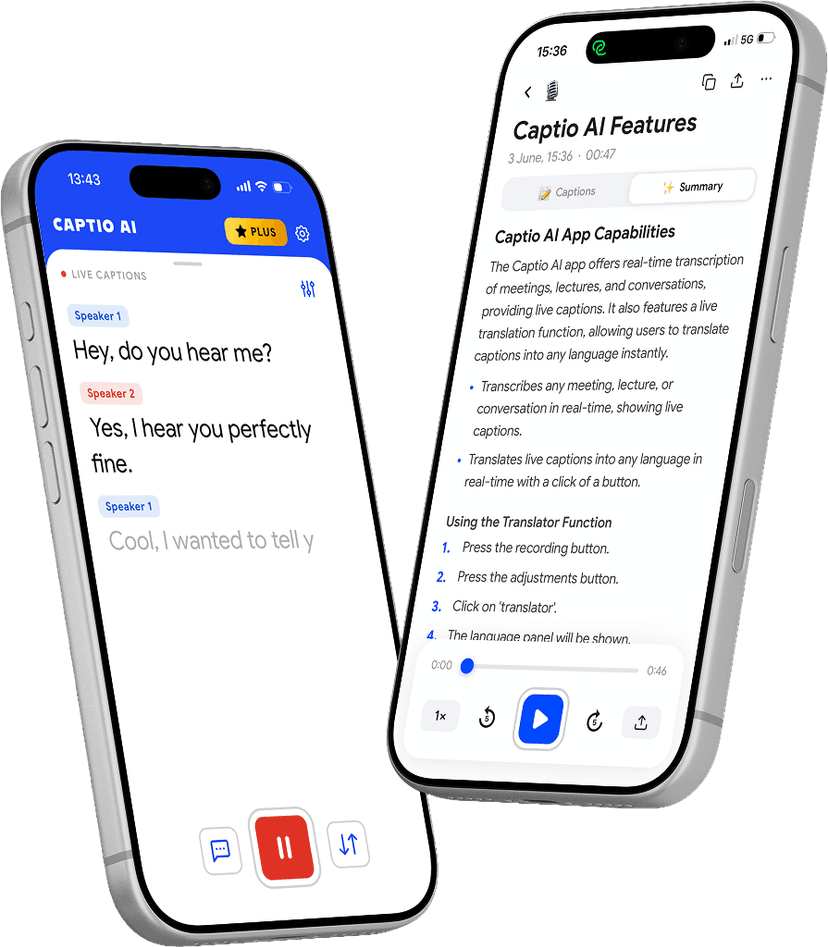
Everything you need to follow Portuguese communicating with deaf & HoH
Four tools built for deaf and hard of hearing Portuguese speakers.
You speak. They read.
- Your words appear on their screen word by word
- No sign language required from you
- Works at home, at work, anywhere
- Any accent, any pace
When language is also a barrier
- You speak your language, they read in theirs
- Translates in real time as you speak
- 60+ languages, no setup
- Handles mid-sentence switches
Save the conversation for them
- Record and transcribe any exchange
- They can review everything at their own pace
- Organised by speaker
- Any length, any format
Make sure nothing important was missed
- Key points extracted from any transcript
- Useful after appointments, meetings, or important conversations
- Organised into clear sections
- Works on any saved recording
Download for free
Every situation covered
Designed for the real moments that matter — not just quiet controlled environments.
A family almoço, a weekend gathering, a video call with relatives in Porto or São Paulo. You speak at your natural pace — your regional variety and all — and your deaf or hard of hearing family member reads every word in real time without anyone having to slow down.
Office conversations, corridor exchanges, quick questions at someone's desk. You talk normally and Captio AI makes sure your deaf or hard of hearing colleague follows every word without either of you having to adapt.
When your partner is deaf or hard of hearing and you are not. You speak naturally — whether that is Lisbon Portuguese, carioca, or nordestino — and they read every word as you say it. No more typing messages between you in the same flat.
Morning exchanges, questions across the room, catching up over dinner. Captio AI covers the ordinary low-stakes moments of shared home life — the ones that feel small but add up to real connection over time.
A relative visiting from another city or country, a new flatmate, a neighbour you have not properly met. You set up Captio AI and the conversation starts without any awkward preamble about how to communicate.
Family barbecues, birthday gatherings, work socials where some people are deaf or hard of hearing and some are not. Captio AI captions whoever is speaking so nobody is left watching the conversation happen around them.
Most accurate and fastest models
word accuracy
independent benchmark, 2025
real-time captions
first word appears as you speak
Download for free
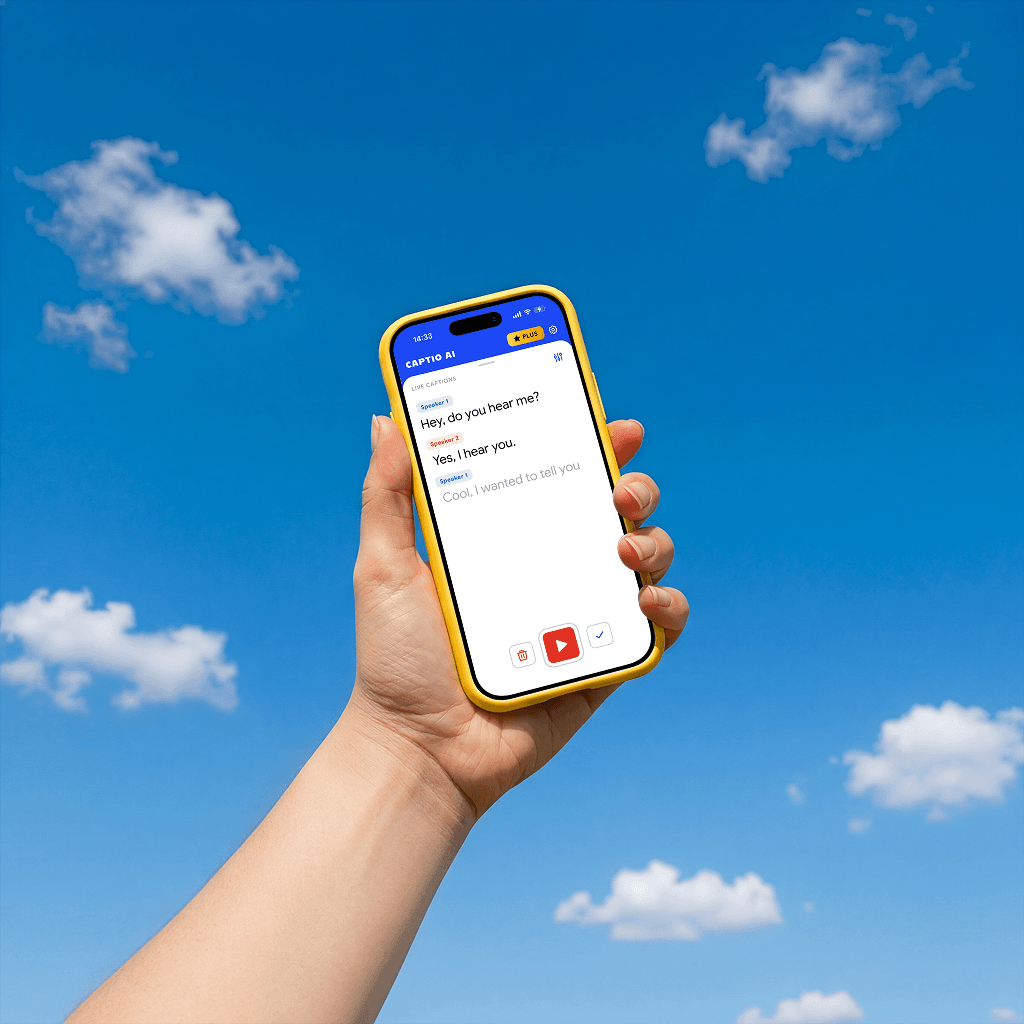
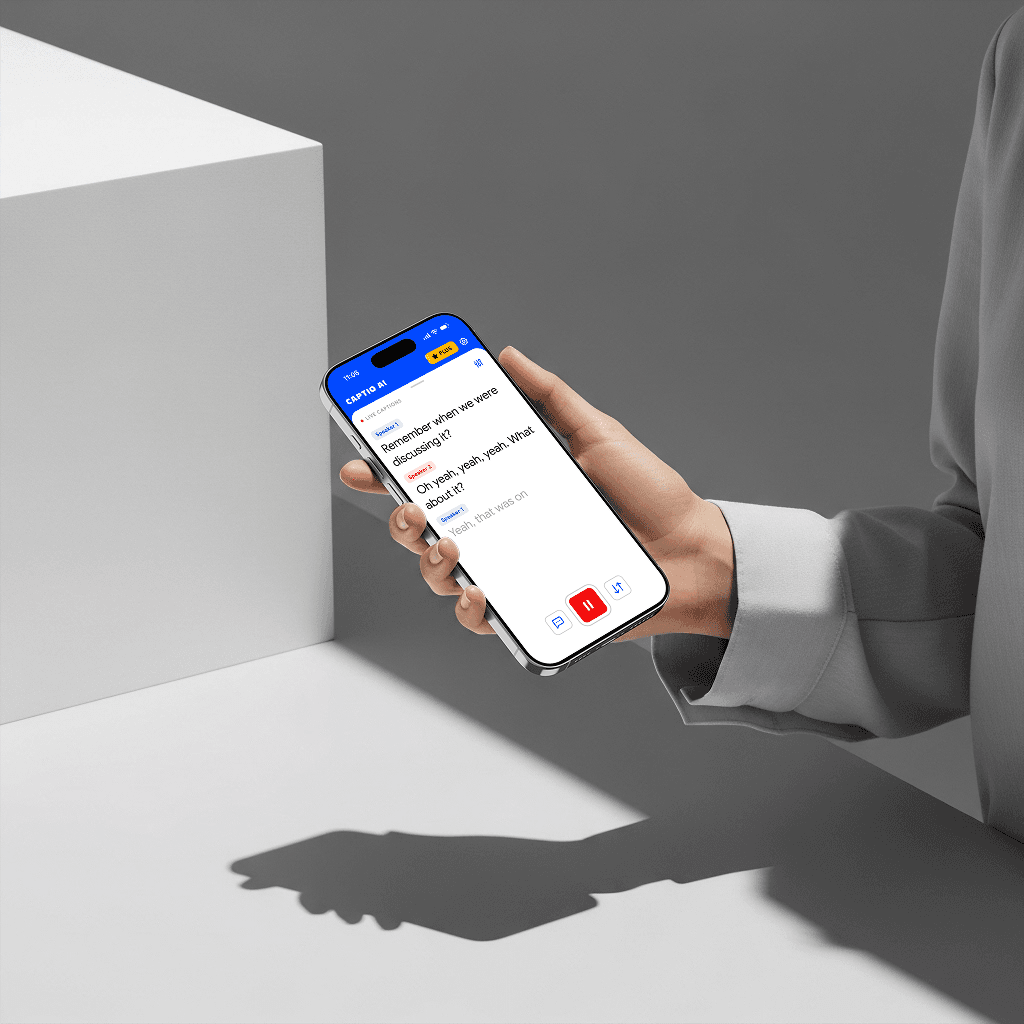
You talk. They follow. No adjustment needed.
You speak naturally
No slowing down, no special phrasing, no training required. Captio AI handles everything — you just talk the way you always do.
They read as you speak
Your words appear on their screen word by word while you are still talking. Not a summary after — the full sentence, in real time.
Works wherever you both are
Living rooms, offices, restaurants, social gatherings. No venue setup, no special conditions. Captio AI works anywhere you have a conversation.
No sign language from either side
You do not need to learn anything new. Neither do they. Captio AI bridges the gap without requiring any change to how either of you communicates.
Works with how you actually speak
Fast, accented, casual. Captio AI handles real speech — not just slow, clear dictation. You do not need to perform clarity for it to work.
Private by default
Your conversations are never recorded, stored, or shared. Audio is processed in real time and discarded immediately — nothing is kept.
Why Portuguese is hard to understand
EP vowel swallowing
- European Portuguese reduces most of its unstressed vowels to near-silence
- European Portuguese is among the most aggressively vowel-reducing languages in the world. Unstressed vowels are reduced, centralised, or deleted entirely in fast natural speech. 'Obrigado' sounds like 'brigadu'; 'estar' like 'tar'. The lip patterns visible when a hearing family member or colleague from Portugal speaks naturally at home have almost no relationship to the written word — making European Portuguese one of the hardest European languages to lip-read.
BP vowel diversity
- Brazilian Portuguese varies significantly between regions — each a different challenge
- Brazilian Portuguese has more stable, open vowels than European Portuguese — easier to read on the lips. But Brazilian varieties differ significantly: carioca Portuguese (Rio de Janeiro) is fast with nasal colouring; nordestino (Northeast) has distinct vowel qualities and stress; gaúcho (South) has different prosody. A deaf or hard of hearing person in a household with hearing members from different Brazilian regions faces multiple phonological systems in the same room.
Nasal vowels
- Portuguese nasal vowels have no equivalent in most other languages — and are hard to read
- Portuguese has a distinctive nasal vowel system (ã, ẽ, õ, im, um) that occurs throughout everyday vocabulary. Nasal vowels require simultaneous airflow through the nose — the full articulation is partly invisible externally. In natural speech between hearing people, nasal vowels occur frequently and add a layer of phonological ambiguity to the visual signal that does not exist in most other European languages.
Fast carioca rate
- Rio and São Paulo speech between hearing people is very fast
- Informal Brazilian Portuguese — particularly carioca and paulistano varieties — is characterised by high speech rates, linking, vowel reduction, and syllable compression. Between hearing friends or family members in familiar settings, the natural pace is significantly faster than careful or formal speech. A deaf or hard of hearing person trying to follow a hearing partner or family member at home faces this speed as the first barrier, before any phonological complexity.
EP vs BP divide
- European and Brazilian Portuguese are different lip-reading challenges
- European and Brazilian Portuguese have diverged enough that comprehension across the dialect boundary is sometimes effortful even for fluent hearing speakers. For a deaf or hard of hearing person, the difference in vowel system, prosody, and reduction patterns between a hearing family member raised in Lisbon and one raised in São Paulo creates two entirely distinct visual languages. A deaf person who has learned one faces near-total reset with the other.
Download for free
10.7 million in Brazil. 60,000 deaf sign language users in Portugal. Most of the gap is at home.
In Brazil, 10.7 million people have some degree of hearing loss, with 2.3 million experiencing severe or profound loss. Of those who are deaf, only 22.4% know Libras (Brazilian Sign Language) — meaning more than three-quarters of profoundly deaf Brazilians rely on spoken language access alone. In Portugal, around 60,000 people are deaf sign language users, supported by approximately 100 registered interpreters — a ratio that makes spontaneous or informal interpreter access almost impossible in practice.
Brazil's public health system formally covers hearing aids and audiological support, but in practice, people with hearing loss face years of bureaucratic process to access devices and services. Research published in SciELO documents systematic barriers deaf Brazilians encounter in accessing health services — a structural gap between legal recognition and practical access that applies equally to communication support. Libras has been recognised as an official language since 2002, yet the majority of deaf Brazilians navigate daily life without consistent access to interpretation.
Across both countries, the communication gap is most acutely felt in homes and social settings — not in formal institutions. The hearing family members who want to connect with a deaf or hard of hearing person do not lack goodwill. They lack a practical tool that works in a household conversation, at a family gathering, or in a workplace exchange, in whichever Portuguese variety they speak. Captio AI captions any hearing speaker's Portuguese in real time — European, Brazilian, or other varieties — so a deaf or hard of hearing person reads every word wherever they are.
Download for free
What you hear stays with you.
Gone the moment it ends
Captio AI processes your audio in real time and discards it immediately. Nothing is recorded. Nothing is kept.
Not a product
Your conversations are not something Captio AI sells, shares, or monetizes — to anyone, for any reason.
Not used to train anything
What you say in a doctor's appointment or a job interview never ends up in a training dataset. Not ours. Not anyone else's.

Private by default
Captio AI supports 60+ languages
Download for free
Frequently asked questions
Make every conversation work — for both sides in Portuguese.
Captio AI is free to start
Download for free