

Hebrew live captions and productivity tool for communicating with deaf & HoH
For deaf and hard of hearing people.
Download for free


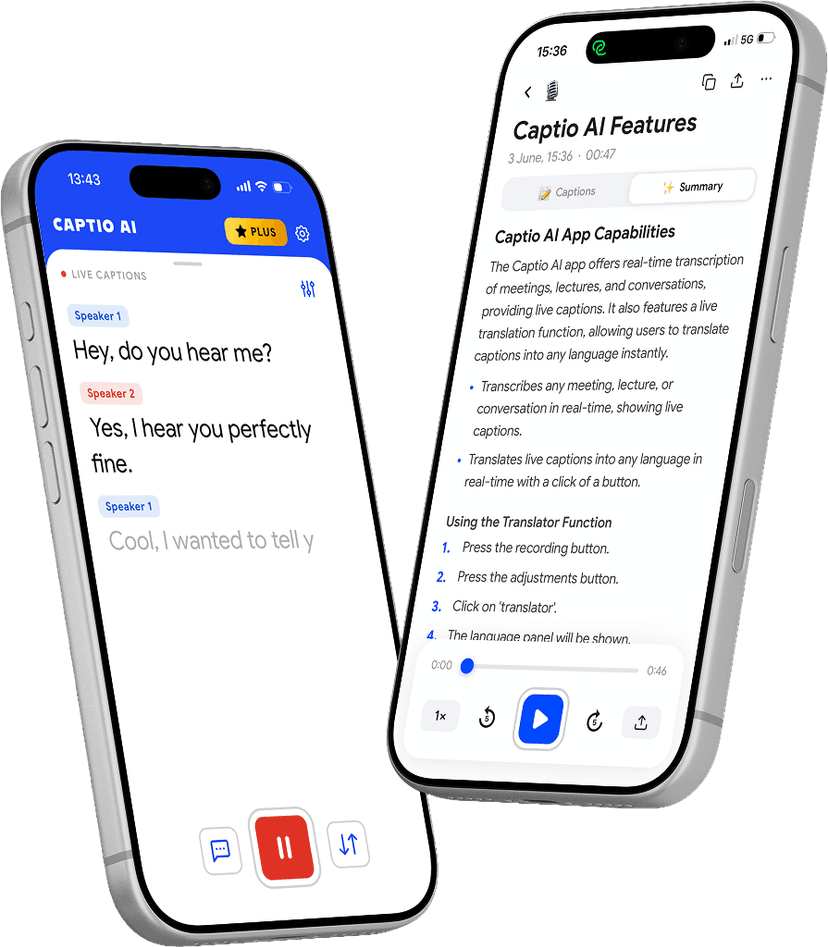
Everything you need to follow Hebrew communicating with deaf & HoH
Four tools built for deaf and hard of hearing Hebrew speakers.
You speak. They read.
- Your words appear on their screen word by word
- No sign language required from you
- Works at home, at work, anywhere
- Any accent, any pace
When language is also a barrier
- You speak your language, they read in theirs
- Translates in real time as you speak
- 60+ languages, no setup
- Handles mid-sentence switches
Save the conversation for them
- Record and transcribe any exchange
- They can review everything at their own pace
- Organised by speaker
- Any length, any format
Make sure nothing important was missed
- Key points extracted from any transcript
- Useful after appointments, meetings, or important conversations
- Organised into clear sections
- Works on any saved recording
Download for free
Every situation covered
Designed for the real moments that matter — not just quiet controlled environments.
Israeli families talk at the table with warmth and volume — Shabbat dinners, holiday meals, weekday evenings. Captio AI captions your hearing family's Hebrew in real time so you follow the full conversation without asking anyone to repeat or slow down.
In a Tel Aviv or Jerusalem office, colleagues exchange quick questions in the fast, informal Hebrew of everyday Israeli work life. Captio AI captions whoever is speaking so your deaf or hard of hearing colleague follows desk-side conversations and hallway exchanges.
When your partner speaks Hebrew naturally and you are deaf or hard of hearing, Captio AI closes the gap. They talk at their normal pace; you read every word. The daily conversation at home is something you have fully.
Morning exchanges over breakfast, questions from the other room, comments about the news. Captio AI covers the small daily Hebrew moments that make home feel connected — in Tel Aviv, Jerusalem, Haifa, or a town in the periphery.
When you meet a hearing Israeli for the first time, Captio AI starts immediately. They speak; you read. No awkward explanation, no searching for a pen and paper.
At a Shabbat gathering, a family holiday meal, or a neighbourhood event, people talk over each other and the room fills with the sound of a Hebrew conversation in full flow. Captio AI captions whoever you point your phone at so you are fully part of it.
Most accurate and fastest models
word accuracy
independent benchmark, 2025
real-time captions
first word appears as you speak
Download for free
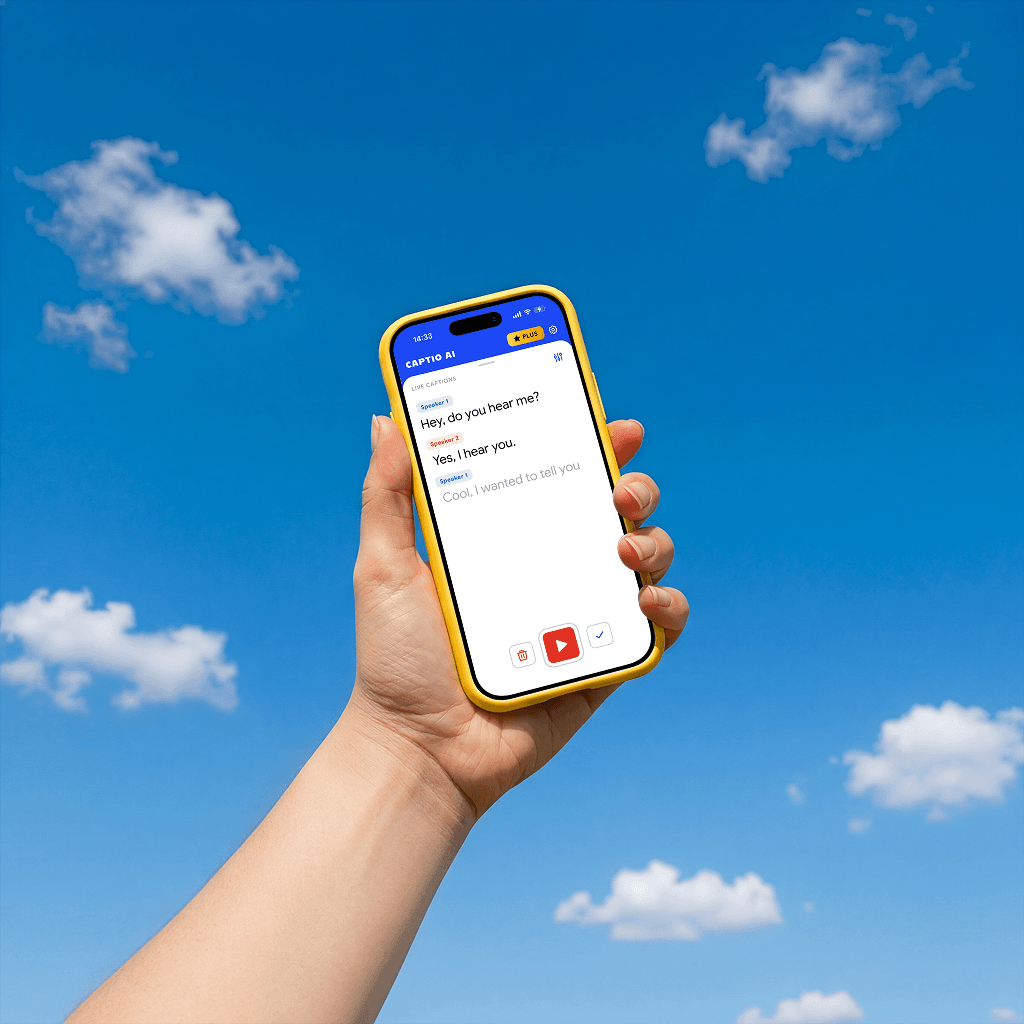
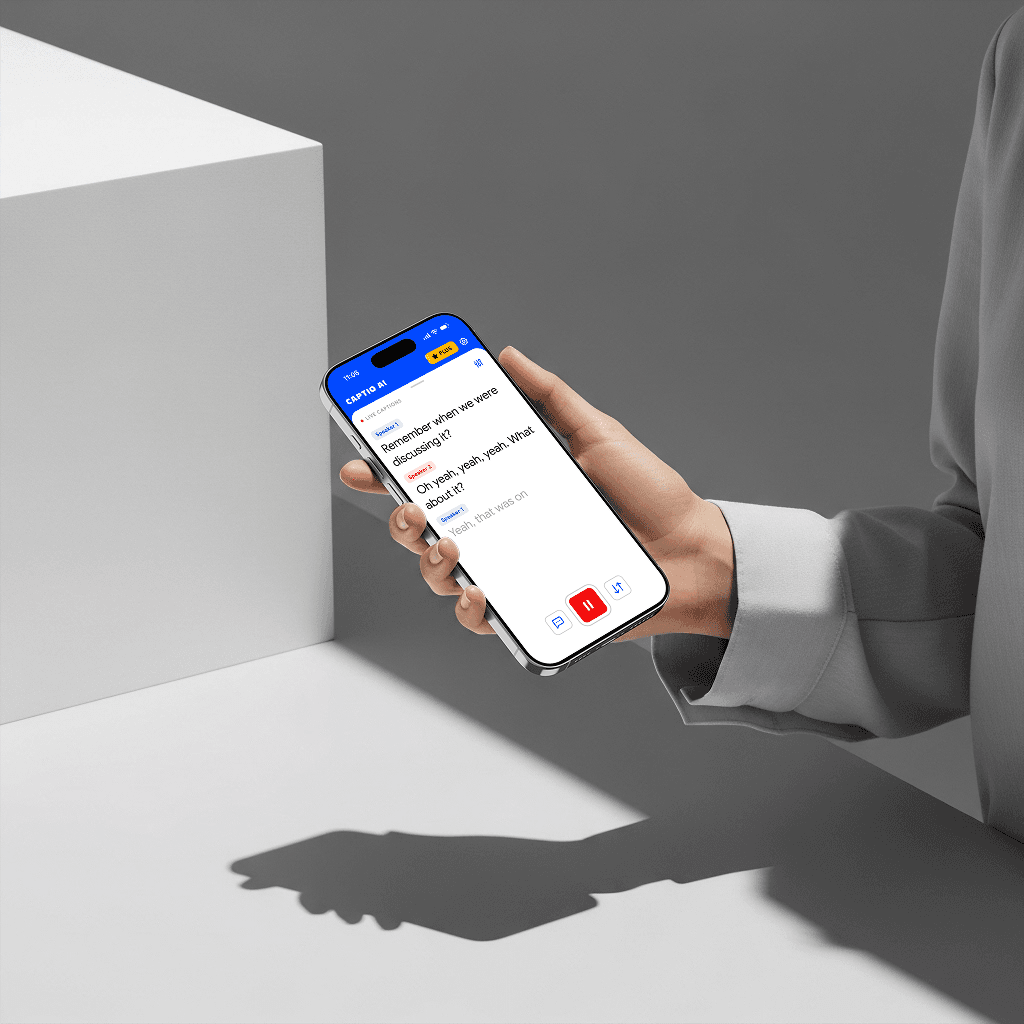
You talk. They follow. No adjustment needed.
You speak naturally
No slowing down, no special phrasing, no training required. Captio AI handles everything — you just talk the way you always do.
They read as you speak
Your words appear on their screen word by word while you are still talking. Not a summary after — the full sentence, in real time.
Works wherever you both are
Living rooms, offices, restaurants, social gatherings. No venue setup, no special conditions. Captio AI works anywhere you have a conversation.
No sign language from either side
You do not need to learn anything new. Neither do they. Captio AI bridges the gap without requiring any change to how either of you communicates.
Works with how you actually speak
Fast, accented, casual. Captio AI handles real speech — not just slow, clear dictation. You do not need to perform clarity for it to work.
Private by default
Your conversations are never recorded, stored, or shared. Audio is processed in real time and discarded immediately — nothing is kept.
Why Hebrew is hard to understand
Pharyngeal consonants at the throat
- Traditional Hebrew pharyngeal sounds ħ and ʕ are produced deep in the throat with no visible lip movement
- Classical and Mizrahi Hebrew preserve two pharyngeal consonants — ħ (the ⟨ח⟩) and ʕ (the ⟨ע⟩) — produced by constricting the pharynx, far behind the tongue and completely invisible at the lips. Older Mizrahi speakers and religious contexts maintain these distinctions. For a deaf or HoH person in a family setting that includes speakers from these traditions, pharyngeal consonants are among the most completely invisible phonemes in any language — the face changes almost nothing.
Consonantal root system
- Hebrew roots are three or four consonants — missing one pharyngeal or uvular consonant means losing the entire semantic anchor of the word
- Hebrew morphology is built on triconsonantal roots — k-t-v defines 'writing', b-y-t defines 'house'. The consonants are the semantic core; the vowels around them are grammatical patterns. For a deaf or HoH person lip-reading, the consonants are the most important signals to catch — but several Hebrew consonants (pharyngeals, the uvular resh, and the aleph) produce almost no labial trace, leaving the root itself opaque.
Mizrahi–Ashkenazi phonological gap
- Mizrahi and Ashkenazi Hebrew differ in pharyngeal and uvular realizations — creating different lip-reading expectations within the same family
- Hebrew is spoken differently depending on community background: Mizrahi (Middle Eastern and North African) speakers preserve pharyngeal consonants and often use an alveolar trill; Ashkenazi (European) speakers have merged most gutturals into a uvular or velar fricative. In a multi-background Israeli family, the same word may be pronounced in ways that look different on the lips, requiring the deaf or HoH reader to maintain multiple phonological models simultaneously.
Casual vowel elision
- In fast conversational Israeli Hebrew, vowels reduce or disappear, removing the visual anchors between consonants
- Modern Hebrew spoken at natural conversational pace elides many vowels in unstressed syllables — amar (he said) becomes 'mar', ze ma (what is this) collapses. For a deaf or HoH person reading lips, vowels are among the most visually informative segments. Their reduction leaves only consonant frames, many of which overlap visually with other words.
Hebrew–Arabic code-switching
- In mixed Hebrew–Arabic household and community settings, language boundaries shift mid-conversation with no visible signal
- In Arab-Israeli households, Druze and Bedouin communities, and mixed Jewish-Arab urban neighbourhoods, conversation frequently shifts between Hebrew and Arabic. Arabic phonology introduces emphatic consonants and a different vowel system. For a deaf or HoH person lip-reading in either language, the phonological shift is signalled in the sound, not the face — the switch is auditory only.
Download for free
Hearing loss in Israel: scale, ISL recognition, and emergency access gaps
In 2022, more than 55,000 people with hearing impairments lived in Israel. Of those aged 18 and over, approximately 10,000 are profoundly deaf and an estimated 150,000 to 200,000 are hard of hearing. Israeli Sign Language (ISL) is the primary language of the country's deaf community and is used across Jewish, Muslim, Christian Arab, Druze, and Bedouin communities — a notable breadth of use for a sign language that developed organically over the twentieth century without formal recognition until very recently.
ISL has not yet received formal legal recognition as a language, though the process has been advancing. In November 2020, the Israeli government decided to establish a unit at the Hebrew Language Academy to preserve and develop ISL, and a Knesset bill for formal ISL recognition was advancing as of 2025 (Jerusalem Post). The bill would require the state to preserve, develop, and promote ISL. In the absence of formal recognition, there is no statutory right to ISL interpretation in public or private settings — interpreter provision is ad hoc and variable.
A PMC study (PMC5314894) specifically documented communication obstacles for deaf people in Israel during emergency situations: the deaf community faces serious barriers to accessing emergency information, public announcements, and crisis communication. The study made specific recommendations to the Israeli government about improving accessible emergency communication — recommendations that reflect a broader access gap that extends into everyday life. The same barriers that prevent a deaf Israeli from following an emergency broadcast prevent them from following a hearing family member's conversation at the Shabbat table.
Download for free
What you hear stays with you.
Gone the moment it ends
Captio AI processes your audio in real time and discards it immediately. Nothing is recorded. Nothing is kept.
Not a product
Your conversations are not something Captio AI sells, shares, or monetizes — to anyone, for any reason.
Not used to train anything
What you say in a doctor's appointment or a job interview never ends up in a training dataset. Not ours. Not anyone else's.

Private by default
Captio AI supports 60+ languages
Download for free
Frequently asked questions
Make every conversation work — for both sides in Hebrew.
Captio AI is free to start
Download for free