

Arabic live captions and productivity tool for communicating with deaf & HoH
For deaf and hard of hearing people.
Download for free


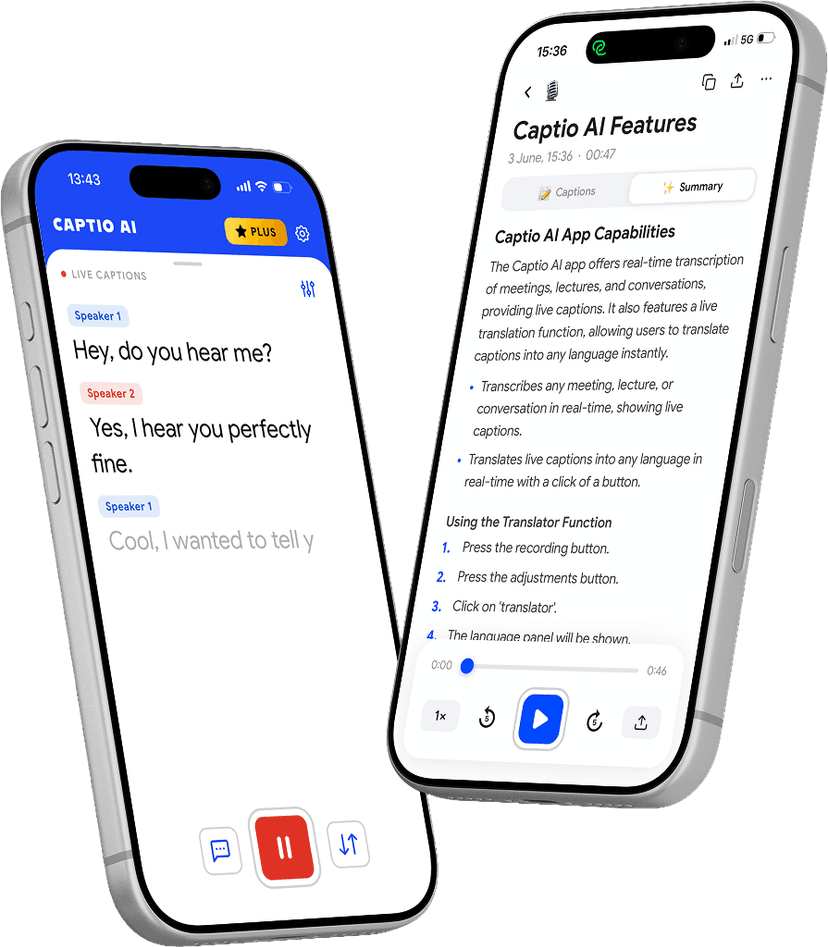
Everything you need to follow Arabic communicating with deaf & HoH
Four tools built for deaf and hard of hearing Arabic speakers.
You speak. They read.
- Your words appear on their screen word by word
- No sign language required from you
- Works at home, at work, anywhere
- Any accent, any pace
When language is also a barrier
- You speak your language, they read in theirs
- Translates in real time as you speak
- 60+ languages, no setup
- Handles mid-sentence switches
Save the conversation for them
- Record and transcribe any exchange
- They can review everything at their own pace
- Organised by speaker
- Any length, any format
Make sure nothing important was missed
- Key points extracted from any transcript
- Useful after appointments, meetings, or important conversations
- Organised into clear sections
- Works on any saved recording
Download for free
Every situation covered
Designed for the real moments that matter — not just quiet controlled environments.
A family gathering, an iftar meal, a multigenerational conversation at home. You speak in your natural dialect — Egyptian, Levantine, Gulf, or Moroccan — and your deaf or hard of hearing family member reads every word in real time without anyone having to slow down.
Office conversations, quick exchanges at someone's desk, corridor catch-ups in an Arabic-speaking workplace. You talk at your normal pace and Captio AI makes sure your deaf or hard of hearing colleague follows every word.
When your partner is deaf or hard of hearing and you are not. You speak naturally — in whichever Arabic dialect you grew up with — and they read every word as you say it. No more typing messages between you when you are in the same room.
Morning conversations, questions across the house, catching up in the evening. Captio AI covers the everyday low-stakes exchanges of shared home life — the moments that add up to closeness over time without anyone having to work for them.
A relative visiting from another country, a new colleague joining the team, a neighbour you have not properly met. You set up Captio AI and the conversation starts without any awkward preamble about how to communicate.
Family gatherings, social dinners, workplace celebrations where some people are deaf or hard of hearing and some are not. Captio AI captions whoever is speaking — in whichever dialect — so nobody is left out of the conversation.
Most accurate and fastest models
word accuracy
independent benchmark, 2025
real-time captions
first word appears as you speak
Download for free
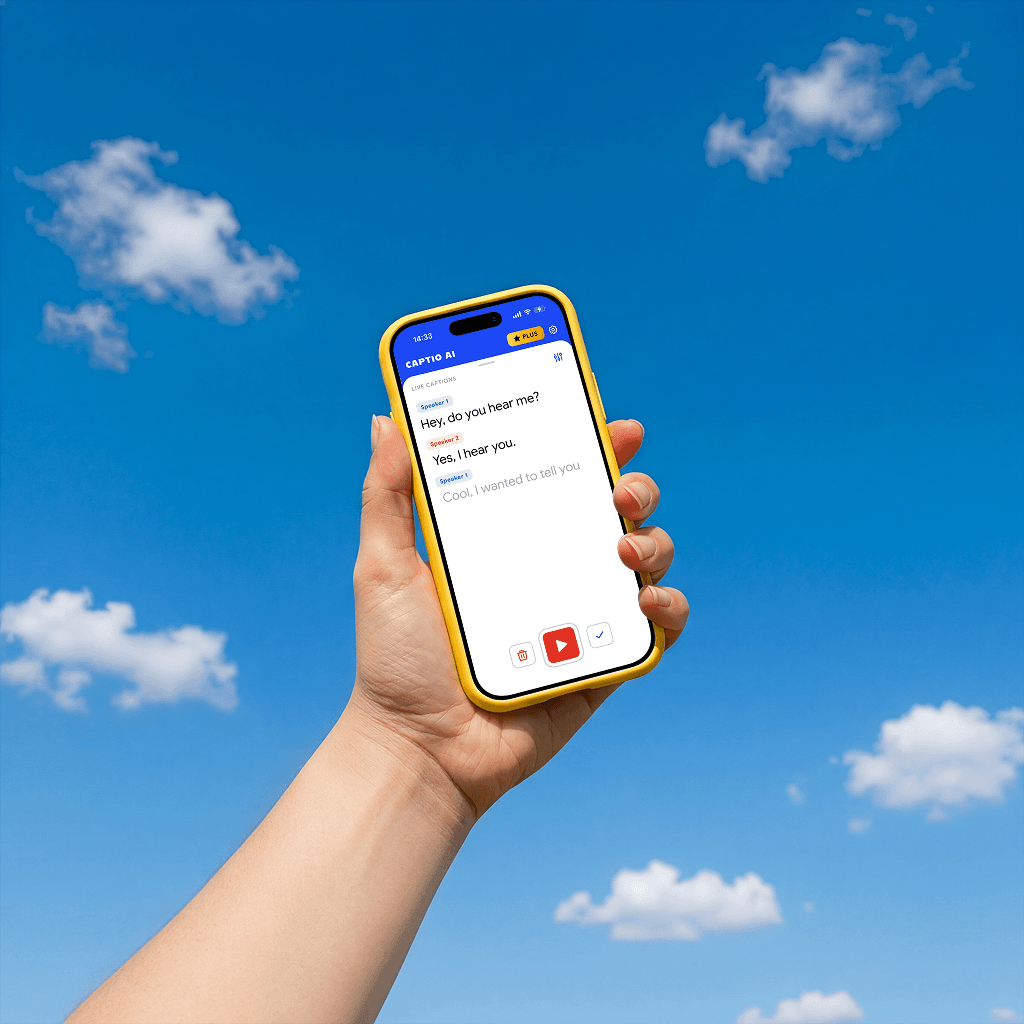
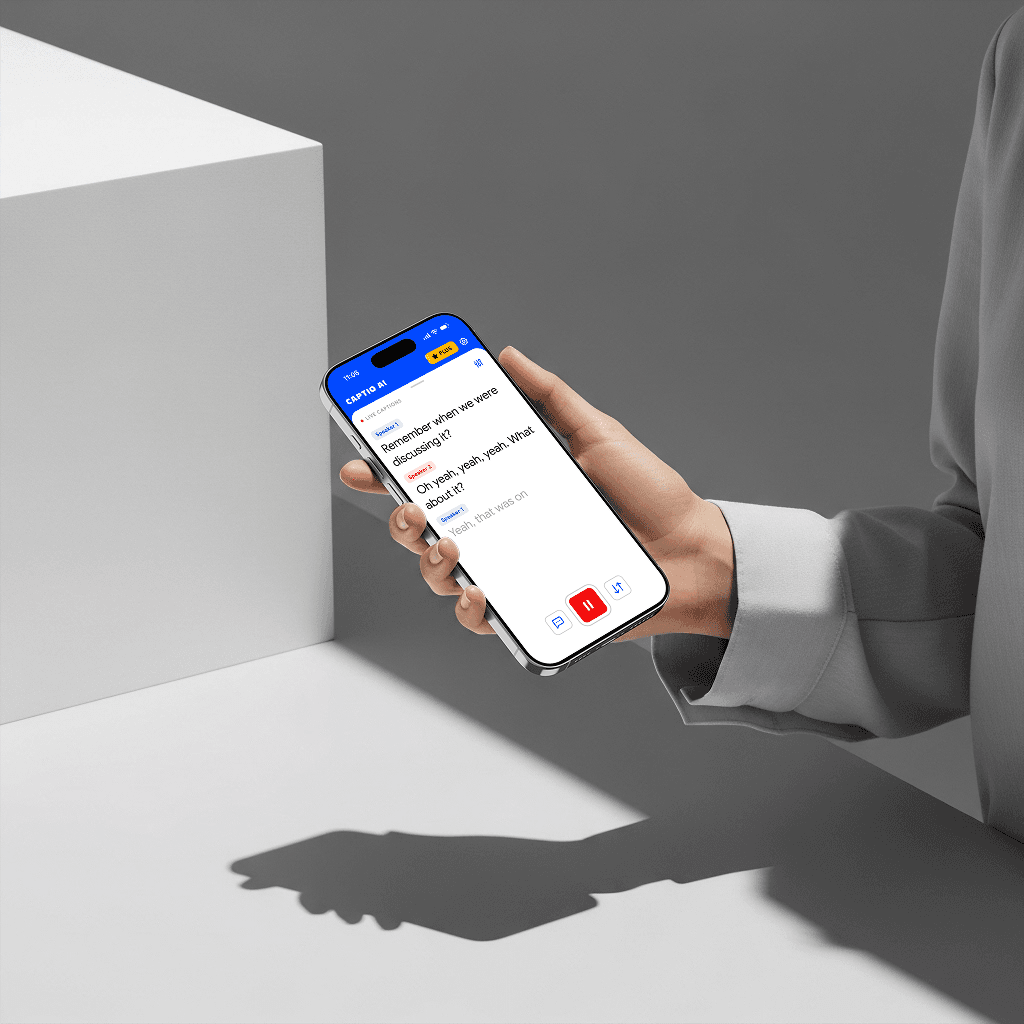
You talk. They follow. No adjustment needed.
You speak naturally
No slowing down, no special phrasing, no training required. Captio AI handles everything — you just talk the way you always do.
They read as you speak
Your words appear on their screen word by word while you are still talking. Not a summary after — the full sentence, in real time.
Works wherever you both are
Living rooms, offices, restaurants, social gatherings. No venue setup, no special conditions. Captio AI works anywhere you have a conversation.
No sign language from either side
You do not need to learn anything new. Neither do they. Captio AI bridges the gap without requiring any change to how either of you communicates.
Works with how you actually speak
Fast, accented, casual. Captio AI handles real speech — not just slow, clear dictation. You do not need to perform clarity for it to work.
Private by default
Your conversations are never recorded, stored, or shared. Audio is processed in real time and discarded immediately — nothing is kept.
Why Arabic is hard to understand
Pharyngeal invisibility
- Arabic's most distinctive sounds are produced entirely behind the visible mouth
- Arabic has two pharyngeal consonants (/ħ/ and /ʕ/) produced deep in the throat, plus uvular consonants (/q/, /ʁ/) and the glottal stop (/ʔ/) — all articulated entirely behind the lips. These sounds occur throughout Arabic vocabulary, are phonologically distinctive, and are completely invisible to a lip-reader. No change at the lips distinguishes them from one another or from silence. A deaf or hard of hearing person following a hearing family member or colleague speaking Arabic faces a phonological system where a significant class of its most characteristic sounds are absent from the visual signal.
Emphatic consonants
- Emphatic consonants look identical to plain ones — but mean different words
- Arabic has a set of pharyngealised consonants (ṣ, ḍ, ṭ, ẓ) distinguished from their plain counterparts by tongue root retraction — a movement entirely inside the mouth. The lips produce no visible difference between /s/ and /sˤ/, /t/ and /tˤ/. Yet these contrasts distinguish many Arabic word pairs. The phonological information that separates them is acoustically present and visually absent. In fast natural speech between hearing people, these distinctions pass without any visible signal.
Diglossia
- Hearing family and colleagues speak a dialect — which differs fundamentally from formal Arabic
- Arabic has a deep diglossia: Modern Standard Arabic (MSA) is used in formal speech and media, while each country has its own spoken dialect — Egyptian, Levantine, Gulf, Moroccan Darija. A hearing partner, parent, or colleague speaks in their regional dialect at home and in everyday settings. These dialects differ not just in accent but in vocabulary, grammar, and phoneme inventory. A deaf person familiar with formal Arabic faces an entirely different phonological system in ordinary household and social conversation.
Vowel omission in stream
- Fast Arabic speech drops the vowels that carry grammatical meaning
- Arabic grammar is built on consonantal roots whose meanings are modified by vocalic patterns. In fast casual speech — the speed a hearing family member uses at home — short vowels are often omitted entirely. A deaf person following a hearing speaker sees consonant clusters with uncertain vowel content, which means grammatical distinctions — verb tense, noun case, active versus passive — are frequently lost from the visual signal.
Dialect incomprehensibility
- Moroccan Darija and Gulf Arabic are near-mutually unintelligible — and look different too
- Moroccan Darija and Gulf Arabic are near-mutually unintelligible to speakers of other Arabic varieties — the phoneme inventories, vocabulary, and prosody diverge enough that communication across dialect groups is genuinely difficult even for hearing people. For a deaf person, a household with hearing members from Egypt and Saudi Arabia presents two distinct phonological systems. The lip-reading challenge for Darija is entirely different from the challenge for Egyptian or Levantine Arabic.
Download for free
78 million with hearing loss in the Eastern Mediterranean. The gap runs deepest at home.
The WHO Eastern Mediterranean Region — covering 22 Arab countries and adjacent states — has 78.1 million people with hearing loss of any degree, of whom 22.1 million have disabling hearing loss. One of the documented structural contributors is consanguineous marriage, which has been common in Arab societies for centuries and is associated with higher rates of hereditary hearing loss. A genetic epidemiological review across 22 Arab countries, published in Otology & Neurotology (2020), confirmed that hearing loss prevalence in the Arab world is disproportionately high relative to global averages — making the deaf and hard of hearing population proportionally larger than in comparable non-consanguineous populations.
Audiological infrastructure across the region is critically limited. A 2026 systematic review conducted for the WHO found that most countries in the Eastern Mediterranean have between 1 and 10 audiologists per million people, with some reporting fewer than 5. Hearing care systems in the region lack the workforce, equipment, and integration into primary healthcare to meet current need — let alone the projected growth in hearing loss as populations age. Formal accessibility infrastructure exists in some urban centres, but in most Arabic-speaking countries, the daily communication support that exists for deaf and hard of hearing people in richer regions is simply absent.
For the deaf and hard of hearing people living within Arabic-speaking households, the communication gap is intensified by the structural distance between the Arabic of formal life and the Arabic of the home. Hearing family members speak in their regional dialect — Egyptian, Levantine, Gulf, or Moroccan Darija — not in Modern Standard Arabic. The deaf person must follow a speech variety they may have had limited formal exposure to, in a phonological system that is structurally different from the formal language they learned. Captio AI captions any hearing speaker's Arabic dialect in real time — so a deaf or hard of hearing person reads every word at an iftar gathering, across a desk, or in any daily exchange across the Arabic-speaking world.
Download for free
What you hear stays with you.
Gone the moment it ends
Captio AI processes your audio in real time and discards it immediately. Nothing is recorded. Nothing is kept.
Not a product
Your conversations are not something Captio AI sells, shares, or monetizes — to anyone, for any reason.
Not used to train anything
What you say in a doctor's appointment or a job interview never ends up in a training dataset. Not ours. Not anyone else's.

Private by default
Captio AI supports 60+ languages
Download for free
Frequently asked questions
Make every conversation work — for both sides in Arabic.
Captio AI is free to start
Download for free