

Malayalam live captions and productivity tool for communicating with deaf & HoH
For deaf and hard of hearing people.
Download for free


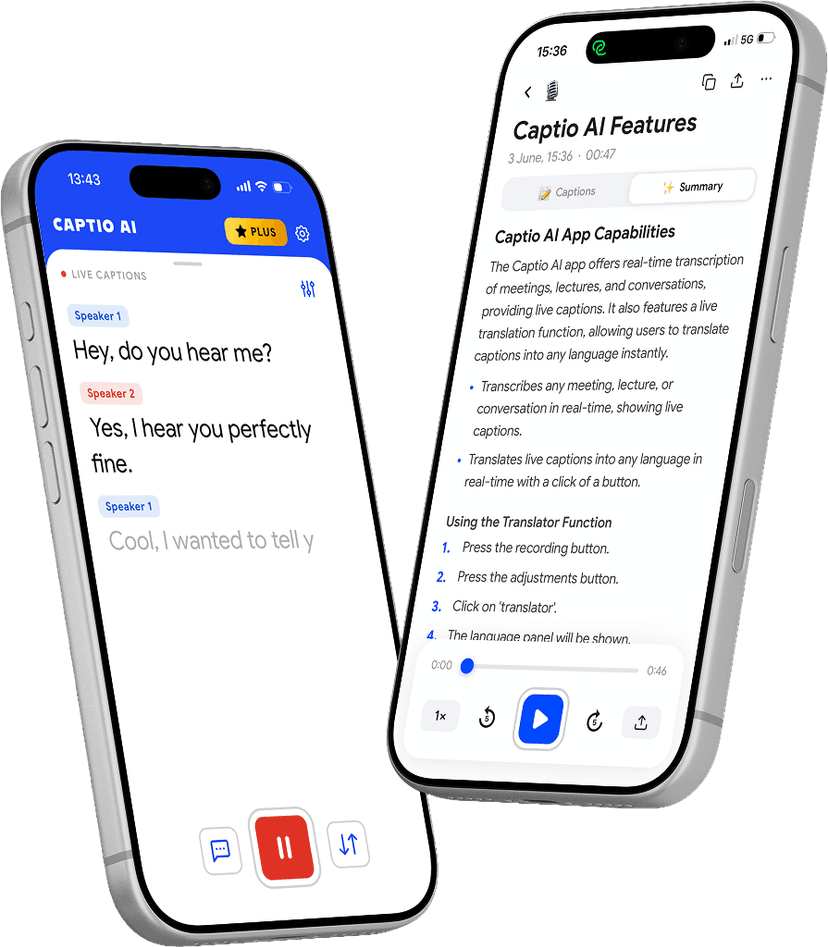
Everything you need to follow Malayalam communicating with deaf & HoH
Four tools built for deaf and hard of hearing Malayalam speakers.
You speak. They read.
- Your words appear on their screen word by word
- No sign language required from you
- Works at home, at work, anywhere
- Any accent, any pace
When language is also a barrier
- You speak your language, they read in theirs
- Translates in real time as you speak
- 60+ languages, no setup
- Handles mid-sentence switches
Save the conversation for them
- Record and transcribe any exchange
- They can review everything at their own pace
- Organised by speaker
- Any length, any format
Make sure nothing important was missed
- Key points extracted from any transcript
- Useful after appointments, meetings, or important conversations
- Organised into clear sections
- Works on any saved recording
Download for free
Every situation covered
Designed for the real moments that matter — not just quiet controlled environments.
Malayalam family meals — in Thiruvananthapuram, Kochi, Kozhikode, or a Malayali family home abroad — are warm and dense with conversation, often mixing generations speaking at full speed in colloquial Malayalam. Captio AI captions what they say so a deaf or hard of hearing family member follows without asking anyone to repeat.
Workplaces in Kerala run in Malayalam for everyday exchanges and English for formal contexts. A hearing colleague speaks naturally in whichever blend fits the moment. Captio AI captions what they say so a deaf or hard of hearing colleague follows desk conversations, instructions, and corridor talk without missing a word.
When your partner is deaf or hard of hearing and Malayalam is the language you speak at home. You talk naturally — the casual, fast Malayalam of daily life. Captio AI puts every word on their screen as you say it so nothing is lost between you.
Everyday home life in a Kerala household — calling across the house, talking during the evening news, quick exchanges over a family meal. Captio AI covers the continuous thread of home conversation that a deaf or hard of hearing family member might otherwise piece together from fragments.
When a deaf or hard of hearing person meets a new hearing Malayalam speaker — at a family function, an onam celebration, or through a mutual friend. Set up Captio AI and the conversation begins naturally, without anyone needing to adjust how they speak.
Group settings — an onam family gathering, a large multi-generation household, or a community event — where some people are deaf or hard of hearing and some are not. Captio AI captions whoever is speaking so every person in the group is fully part of the conversation.
Most accurate and fastest models
word accuracy
independent benchmark, 2025
real-time captions
first word appears as you speak
Download for free
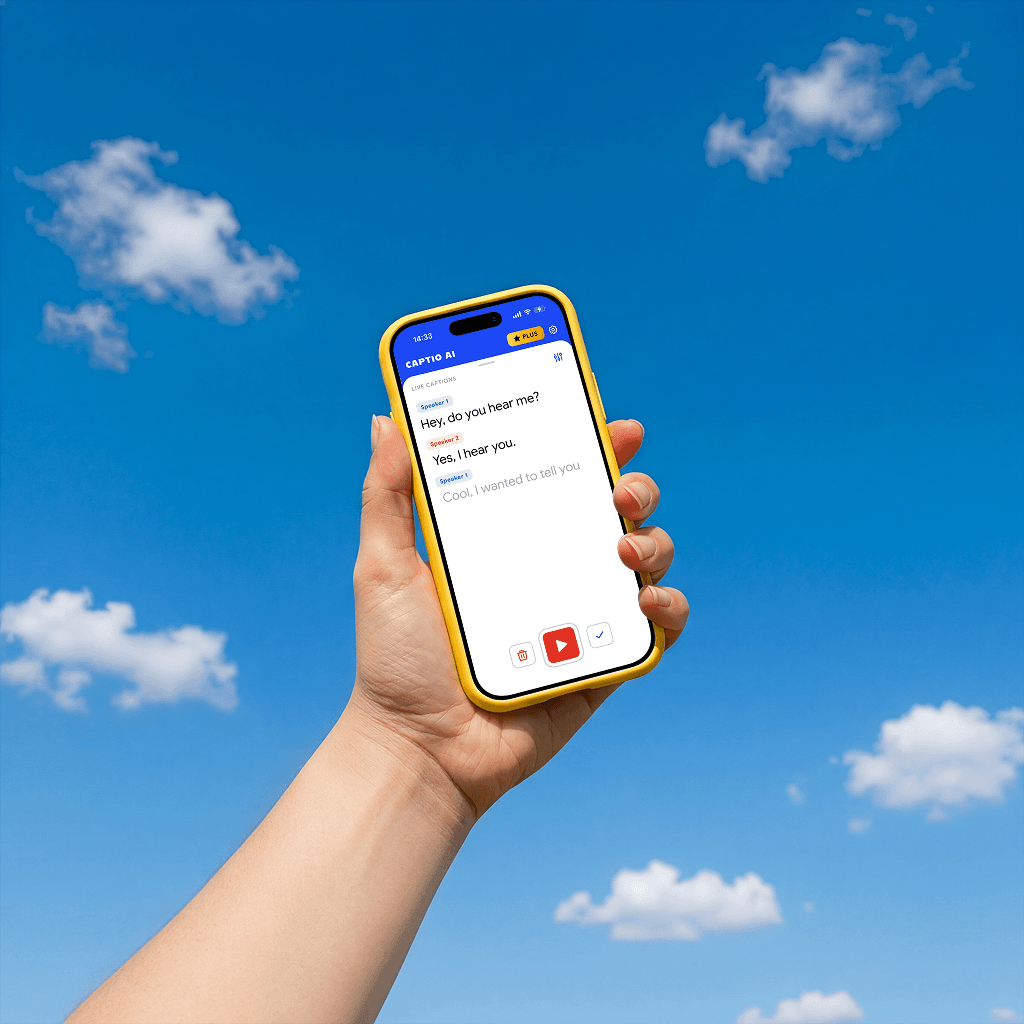
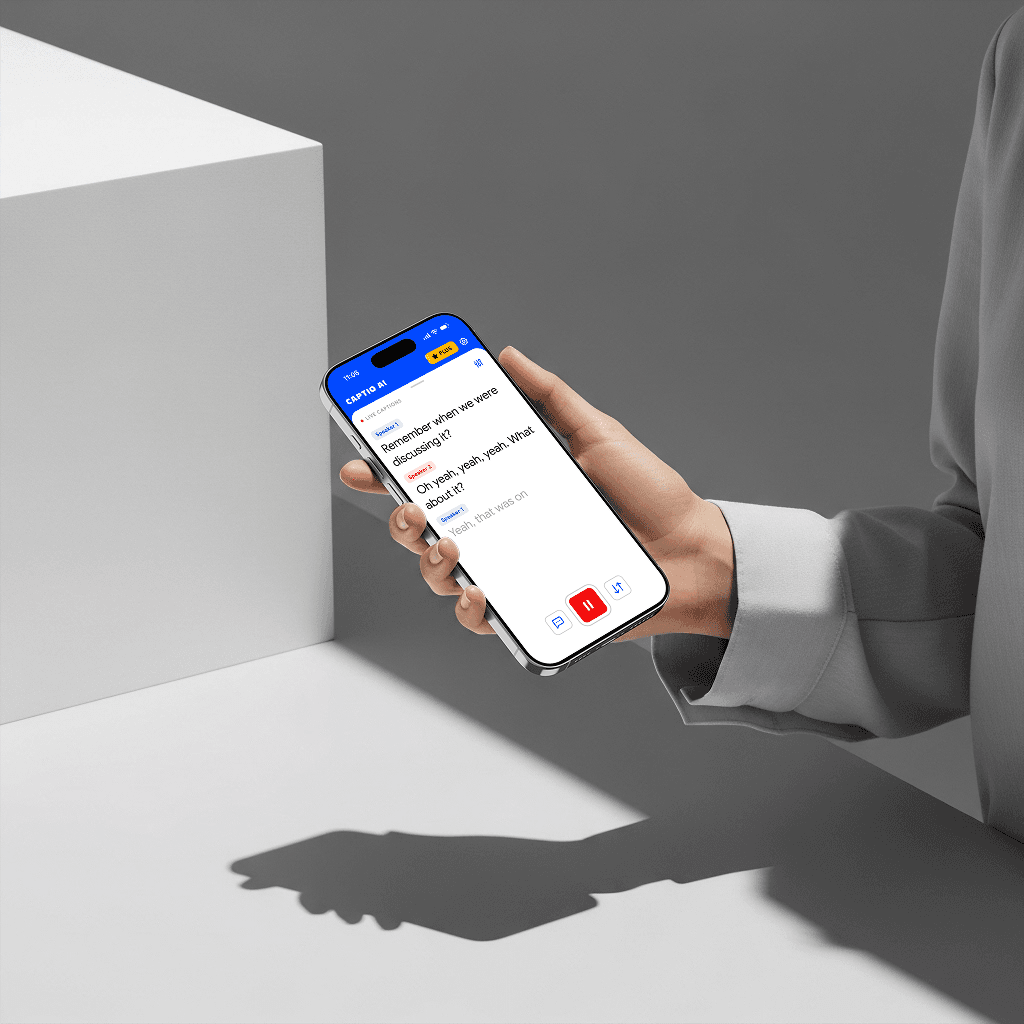
You talk. They follow. No adjustment needed.
You speak naturally
No slowing down, no special phrasing, no training required. Captio AI handles everything — you just talk the way you always do.
They read as you speak
Your words appear on their screen word by word while you are still talking. Not a summary after — the full sentence, in real time.
Works wherever you both are
Living rooms, offices, restaurants, social gatherings. No venue setup, no special conditions. Captio AI works anywhere you have a conversation.
No sign language from either side
You do not need to learn anything new. Neither do they. Captio AI bridges the gap without requiring any change to how either of you communicates.
Works with how you actually speak
Fast, accented, casual. Captio AI handles real speech — not just slow, clear dictation. You do not need to perform clarity for it to work.
Private by default
Your conversations are never recorded, stored, or shared. Audio is processed in real time and discarded immediately — nothing is kept.
Why Malayalam is hard to understand
Largest Dravidian consonant inventory
- Malayalam has more consonant distinctions than almost any other language — all produced behind the lips
- Malayalam has one of the most complex consonant inventories in the world, including three-way distinctions for both liquids (dental /l̪/, alveolar /l/, retroflex /ɭ/) and rhotic sounds (dental /r̪/, alveolar /r/, retroflex /ɻ/). All six are produced with the tongue in positions invisible behind the lips. Everyday Malayalam speech carries these contrasts throughout its vocabulary — all of them entirely inaccessible to a deaf lip-reader.
Vowel length contrast
- Malayalam's twelve vowels include long-short pairs invisible at the lips
- Malayalam distinguishes 12 vowel sounds including long-short pairs (/a/ vs. /aː/, /i/ vs. /iː/, etc.). Research published in 2024 (PMC11639911) specifically found that vowel recognition in Malayalam is significantly impaired in individuals with hearing loss. For deaf lip-readers, short and long vowels of the same quality look identical — a distinction that carries meaning throughout the language.
Malabar vs. Thiruvananthapuram dialect
- North Kerala and South Kerala Malayalam use different vowel realisations
- Malayalam has significant regional dialect variation: Malabar (Northern Kerala) preserves different phonological features from Central Kerala (Kochi/Ernakulam) and Southern Kerala (Thiruvananthapuram). A deaf person who lip-reads one regional variety finds that a hearing family member from another part of Kerala produces some vowels and consonants at different positions.
Diglossic gap
- Formal written Malayalam and colloquial spoken Malayalam are almost different languages
- Like Tamil, Malayalam has a deep diglossia between formal and literary Malayalam and the colloquial spoken varieties used at home. Hearing families speak only the colloquial variety. A deaf person who learned Malayalam from formal written resources — textbooks, formal media — encounters different vocabulary, different verb forms, and different phonological patterns in everyday family speech.
Manglish code-switching
- Kerala's high English literacy creates constant Manglish code-switching in family speech
- Kerala has one of India's highest literacy rates and a very high rate of English proficiency. Hearing family members — especially younger and urban — routinely mix Malayalam and English within sentences (Manglish). For a deaf lip-reader, code-switching between two phonological systems without an auditory signal means the mouth shapes suddenly don't map to any Malayalam word.
Download for free
Hearing loss in Kerala: high literacy, limited accessibility
India has approximately 63 million people with significant hearing loss — 6.3% of the population (WHO) — and hearing disability is the second most common form of disability in the country. Kerala stands out nationally for its high literacy, strong healthcare infrastructure, and advanced newborn hearing screening programme (Ernakulam District has had centralised screening for over a decade). Yet state-level hearing intervention coverage in Kerala, while among India's better-resourced examples, still leaves large gaps in rural districts and among older populations. A 2024 study specifically investigated vowel identification in Malayalam for individuals with hearing loss (PMC11639911) — confirming that Malayalam's complex vowel inventory creates particular challenges for hearing-impaired speakers.
Indian Sign Language (ISL) has a formal community in Kerala — there are deaf schools and ISL training programmes in Thiruvananthapuram and Kochi — but ISL reach into the broader Malayali population, including diaspora communities in the Gulf, the UK, the US, and Canada, is very limited. Most deaf and hard of hearing Malayali people communicate with hearing family members without any structural support: no shared sign language, no interpreter, no real-time captioning. The Malayalam-speaking diaspora presents an additional layer — Gulf Malayalis, UK Malayalis, and North American Malayalis may use a language variety that blends Malayalam with Arabic, English, or other local languages, adding code-switching that formal accessibility systems cannot handle.
Kerala's ageing rural population carries the highest rates of undiagnosed hearing loss in the state. As multi-generational Malayali families increasingly include elderly members with significant hearing impairment, the communication gap at family tables grows. Captio AI captions natural Malayalam speech in real time — colloquial, Manglish, regional varieties included — so a deaf family member reads exactly what their hearing relatives are saying at an onam table in Kochi or an evening at home in Kozhikode.
Download for free
What you hear stays with you.
Gone the moment it ends
Captio AI processes your audio in real time and discards it immediately. Nothing is recorded. Nothing is kept.
Not a product
Your conversations are not something Captio AI sells, shares, or monetizes — to anyone, for any reason.
Not used to train anything
What you say in a doctor's appointment or a job interview never ends up in a training dataset. Not ours. Not anyone else's.

Private by default
Captio AI supports 60+ languages
Download for free
Frequently asked questions
Make every conversation work — for both sides in Malayalam.
Captio AI is free to start
Download for free