

Basque live captions and productivity tool for communicating with deaf & HoH
For deaf and hard of hearing people.
Download for free


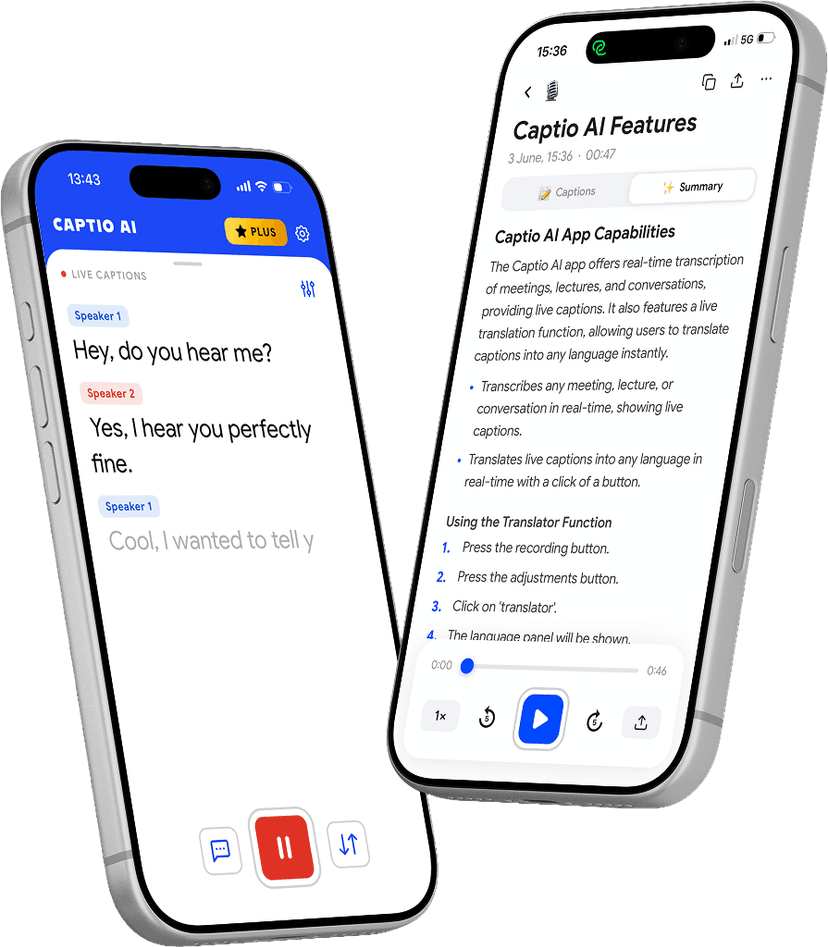
Everything you need to follow Basque communicating with deaf & HoH
Four tools built for deaf and hard of hearing Basque speakers.
You speak. They read.
- Your words appear on their screen word by word
- No sign language required from you
- Works at home, at work, anywhere
- Any accent, any pace
When language is also a barrier
- You speak your language, they read in theirs
- Translates in real time as you speak
- 60+ languages, no setup
- Handles mid-sentence switches
Save the conversation for them
- Record and transcribe any exchange
- They can review everything at their own pace
- Organised by speaker
- Any length, any format
Make sure nothing important was missed
- Key points extracted from any transcript
- Useful after appointments, meetings, or important conversations
- Organised into clear sections
- Works on any saved recording
Download for free
Every situation covered
Designed for the real moments that matter — not just quiet controlled environments.
A Basque family meal in Bilbao, San Sebastián, or a village in Navarre where grandparents speak a regional Basque variety and younger family members mix Basque and Spanish. Captio AI captions every voice at the table.
A Basque household where conversations happen spontaneously — morning exchanges in Basque, remarks in Spanish, and quick switches between the two. Captio AI keeps a deaf or hard of hearing person in those moments.
At home with a hearing partner whose family comes from a different Basque region and speaks a distinct dialect variety. Captio AI captions their speech correctly so home life does not require extra effort from either side.
Meeting a partner's Basque family, or being introduced to new neighbours in a Basque-speaking town. Captio AI captures the first conversation in real time so the meeting can be natural.
A Basque neighbourhood gathering or family celebration where people speak fast Basque with strong regional character. Captio AI captions the conversation so a deaf or hard of hearing person is part of it.
Spontaneous exchanges at the local market, corner shop, or pharmacy where the vendor switches between Basque and Spanish. Captio AI captions what the person at the counter is saying in real time.
Most accurate and fastest models
word accuracy
independent benchmark, 2025
real-time captions
first word appears as you speak
Download for free
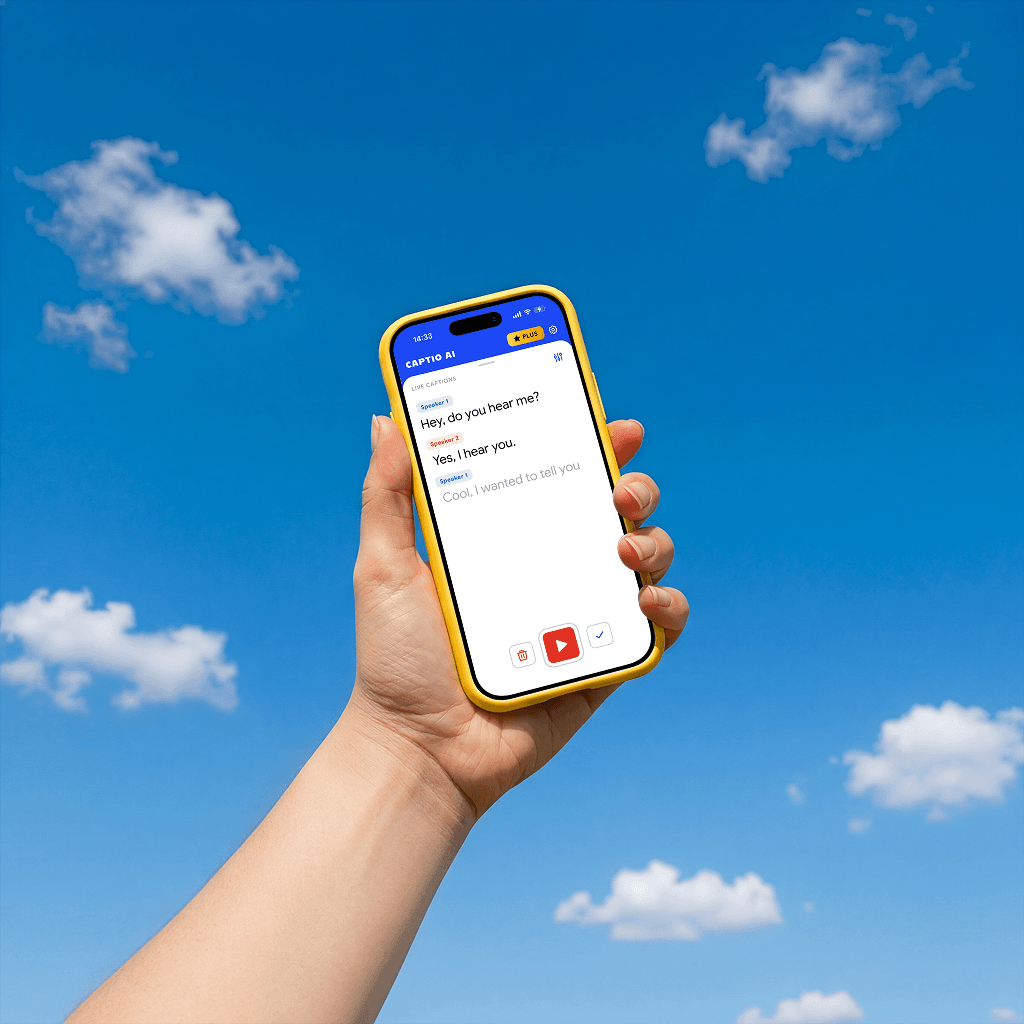
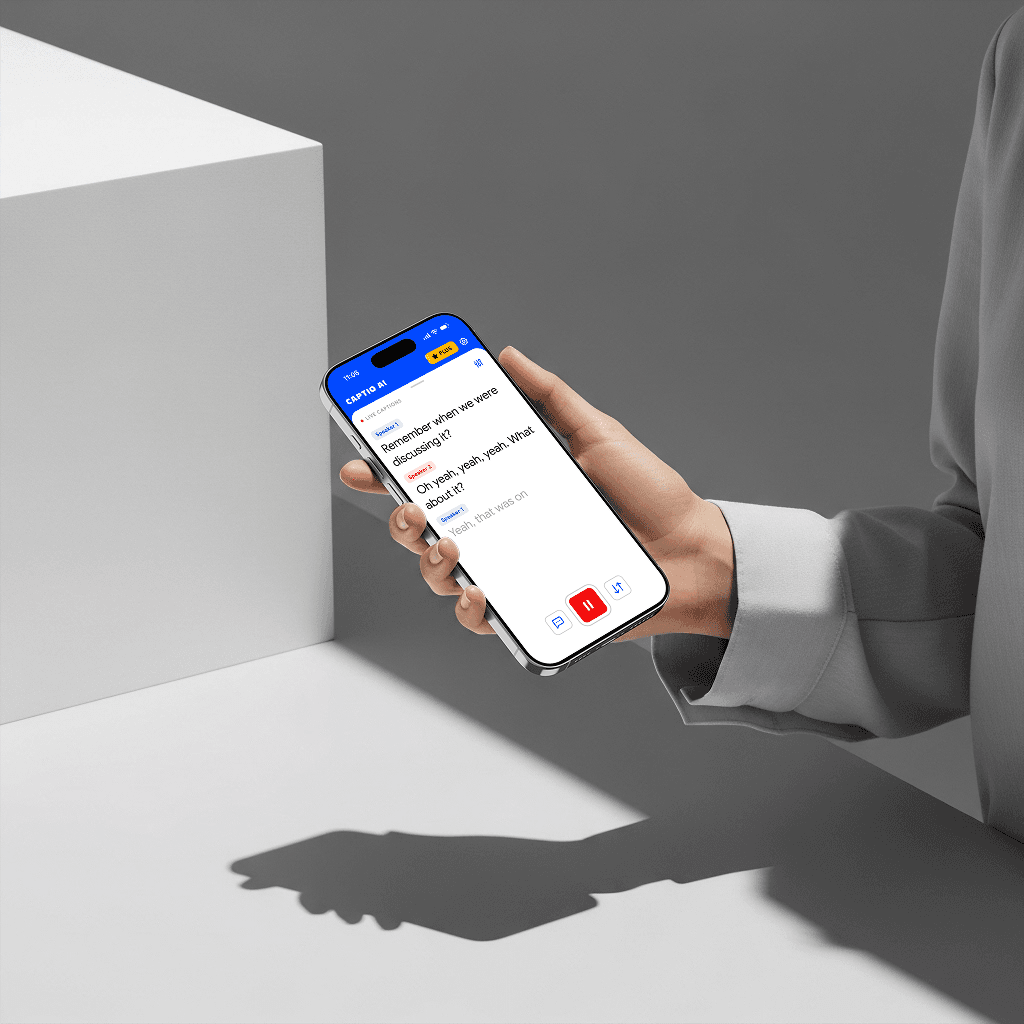
You talk. They follow. No adjustment needed.
You speak naturally
No slowing down, no special phrasing, no training required. Captio AI handles everything — you just talk the way you always do.
They read as you speak
Your words appear on their screen word by word while you are still talking. Not a summary after — the full sentence, in real time.
Works wherever you both are
Living rooms, offices, restaurants, social gatherings. No venue setup, no special conditions. Captio AI works anywhere you have a conversation.
No sign language from either side
You do not need to learn anything new. Neither do they. Captio AI bridges the gap without requiring any change to how either of you communicates.
Works with how you actually speak
Fast, accented, casual. Captio AI handles real speech — not just slow, clear dictation. You do not need to perform clarity for it to work.
Private by default
Your conversations are never recorded, stored, or shared. Audio is processed in real time and discarded immediately — nothing is kept.
Why Basque is hard to understand
Language isolate
- Basque is unrelated to any other language — a deaf lip reader gets zero transfer from Spanish or French
- Basque is a language isolate — unrelated to any other known language. A deaf or hard of hearing person with experience in Romance or Germanic languages gets zero phonological transfer when lip-reading Basque. The phonological inventory, word structure, and prosodic patterns all look and feel different from any other language in the region.
Two accent systems
- Western Basque uses tonal accent, eastern uses stress — the same word has different prosody by region
- Western Basque dialects (Biscayan, Gipuzkoan) use a tonal accent system where pitch contour distinguishes words at the level of the phonological phrase — not the individual syllable. Eastern Basque dialects use a stress-based accent. A deaf person calibrated to the western tonal system encounters a different prosodic logic entirely in eastern Basque speech.
/j/ variation across dialects
- The same word is pronounced as [j], [ʒ], [ʃ], or [x] depending on the dialect
- The grapheme 'j' in Basque is pronounced as [j, ʝ, ɟ, ʒ, ʃ, x] depending on the speaker's dialect. The same word — 'jan' (to eat), 'jaun' (lord) — sounds completely different in Biscayan versus Gipuzkoan versus Souletin Basque. A deaf lip reader built on one variety will misread words in another.
Souletin divergence
- The easternmost dialect has nasal vowels, voiced sibilants, and an extra vowel not found in the west
- Souletin (Zuberoan) — the easternmost Basque dialect in the French Basque Country — is regarded as the most divergent Basque variety. It has acquired nasal vowels, voiced sibilants, and a sixth oral vowel not present in Spanish Basque Country varieties. For a deaf person from Bilbao, Souletin Basque presents a completely different phonological profile.
Batua vs regional speech
- Standard Written Basque (Batua) covers schools and media, but everyday speech remains strongly regional
- Standard Written Basque (Euskara Batua) was unified in 1968, but everyday spoken Basque remains strongly regional. A deaf person who has calibrated lip-reading to Batua encounters significantly different phonological patterns from speakers using their natural Biscayan, Gipuzkoan, or Navarrese variety in family conversation.
Download for free
Spain's 1,064,000 deaf and hard of hearing people — including an estimated 50,000 in the Basque Country — navigate a language isolate in a bilingual daily environment without consistent informal communication access.
According to Spain's National Statistics Institute (INE) EDAD 2008 survey, 1,064,000 people in Spain are deaf or have a hearing disability — 2.3% of the national population. EuroTrak Spain data show that fewer than 40% of those with hearing loss across Spain use hearing aids. Within the Autonomous Community of the Basque Country (approximately 2.2 million people), this implies roughly 50,000 people with hearing loss navigating a bilingual daily environment where Basque and Spanish are both in active use.
Spanish Sign Language (LSE) was formally recognized across Spain by Law 27/2007. The Basque Country, which administers its own health system through Osakidetza and has significant devolved powers, has developed regional deaf support structures. However, formal recognition and interpreter provision cover institutional settings — education, courts, public services. Everyday informal communication — family meals, neighbourhood conversations, and local gatherings — remains outside the scope of any formal accessibility framework.
A 2023 study on the perception of COVID-19's impact on Spanish people with hearing disabilities (PMC9859572) documented acute barriers created by face masks, which eliminated lip-reading as a coping strategy, and by the rapid shift to video-based communication platforms. In a Basque context, where everyday speech already presents the specific challenge of navigating a language isolate across multiple dialect systems, the elimination of lip-reading cues was acutely felt by deaf and hard of hearing people in the Basque Country.
[1]INE EDAD 2008 — Spain disability survey: 1,064,000 deaf/hard of hearing
[2]EuroTrak Spain — 10% with hearing loss, fewer than 40% use hearing aids
[3]Perception of the impact of COVID-19 on Spaniards with hearing disabilities — PMC9859572
[4]Studies on the situation of deaf students in Spain — CNSE monograph 2021
Download for free
What you hear stays with you.
Gone the moment it ends
Captio AI processes your audio in real time and discards it immediately. Nothing is recorded. Nothing is kept.
Not a product
Your conversations are not something Captio AI sells, shares, or monetizes — to anyone, for any reason.
Not used to train anything
What you say in a doctor's appointment or a job interview never ends up in a training dataset. Not ours. Not anyone else's.

Private by default
Captio AI supports 60+ languages
Download for free
Frequently asked questions
Make every conversation work — for both sides in Basque.
Captio AI is free to start
Download for free