

Belarusian live captions and productivity tool for communicating with deaf & HoH
For deaf and hard of hearing people.
Download for free

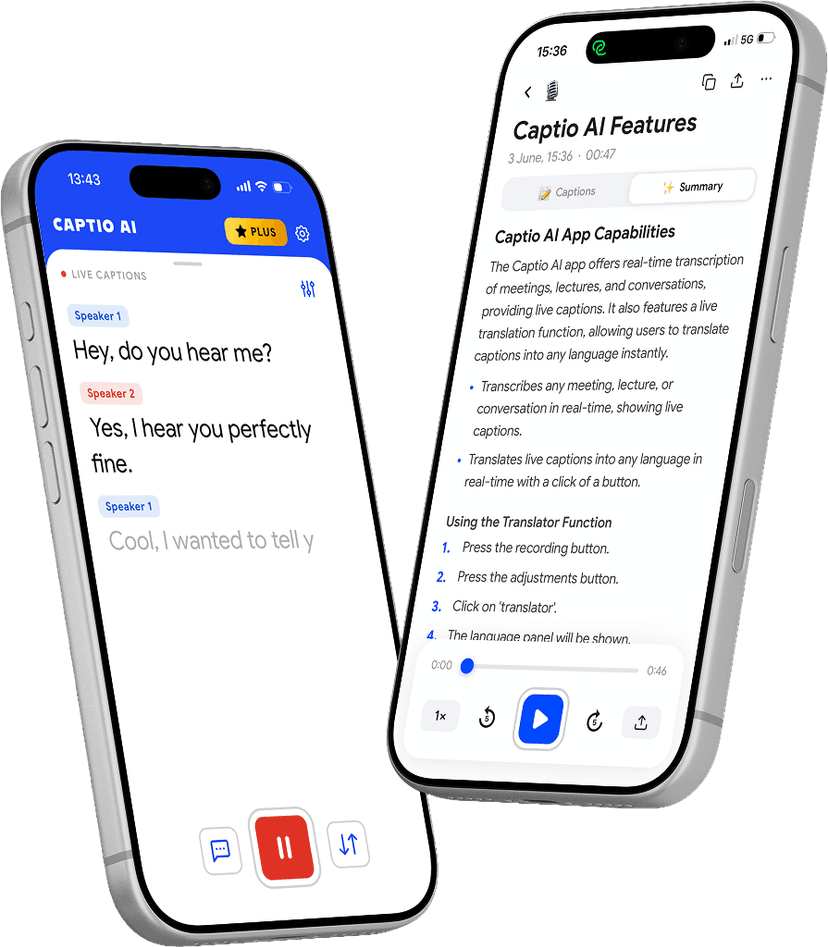
Everything you need to follow Belarusian communicating with deaf & HoH
Four tools built for deaf and hard of hearing Belarusian speakers.
You speak. They read.
- Your words appear on their screen word by word
- No sign language required from you
- Works at home, at work, anywhere
- Any accent, any pace
When language is also a barrier
- You speak your language, they read in theirs
- Translates in real time as you speak
- 60+ languages, no setup
- Handles mid-sentence switches
Save the conversation for them
- Record and transcribe any exchange
- They can review everything at their own pace
- Organised by speaker
- Any length, any format
Make sure nothing important was missed
- Key points extracted from any transcript
- Useful after appointments, meetings, or important conversations
- Organised into clear sections
- Works on any saved recording
Download for free
Every situation covered
Designed for the real moments that matter — not just quiet controlled environments.
A Belarusian family where older relatives speak standard Belarusian, parents mix Belarusian and Russian in everyday trasianka, and younger family members drift toward Russian. Captio AI follows across all varieties.
Belarusian workplaces run on Russian for formal communication but shift into Belarusian informally. Captio AI lets a deaf colleague follow the full conversation across whichever language the team is using.
A hearing partner who code-switches between Belarusian and Russian can speak naturally at home. Captio AI captions their speech in real time so conversation does not depend on writing.
Morning small talk, household logistics, and spontaneous remarks from the next room — Captio AI keeps a deaf or hard of hearing person connected to everyday home life in a Belarusian household.
Meeting a hearing Belarusian family member, neighbour, or new acquaintance. Captio AI captures their speech in real time so the introduction can be natural.
At a Belarusian family gathering, village celebration, or group dinner where conversation moves between Belarusian and Russian, Captio AI captions the room so a deaf or hard of hearing person stays part of it.
Most accurate and fastest models
word accuracy
independent benchmark, 2025
real-time captions
first word appears as you speak
Download for free
You talk. They follow. No adjustment needed.
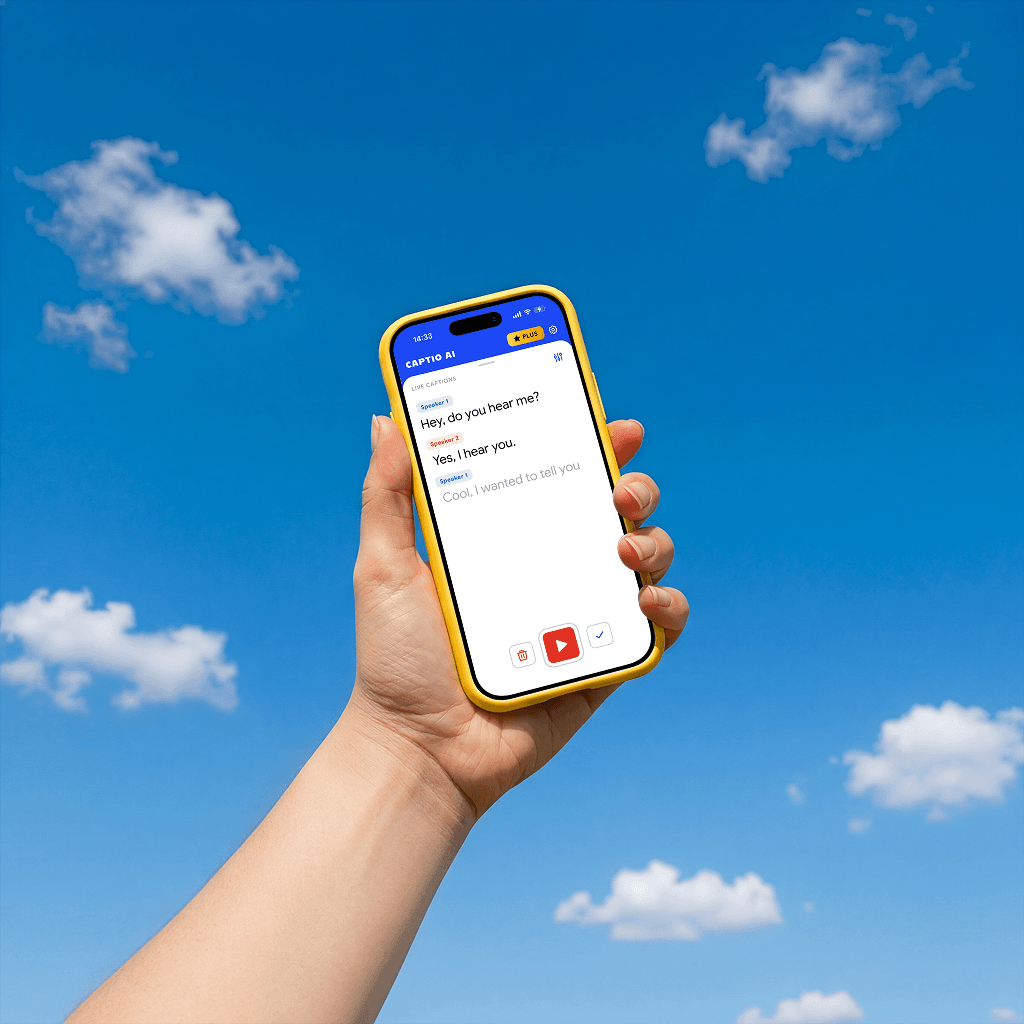
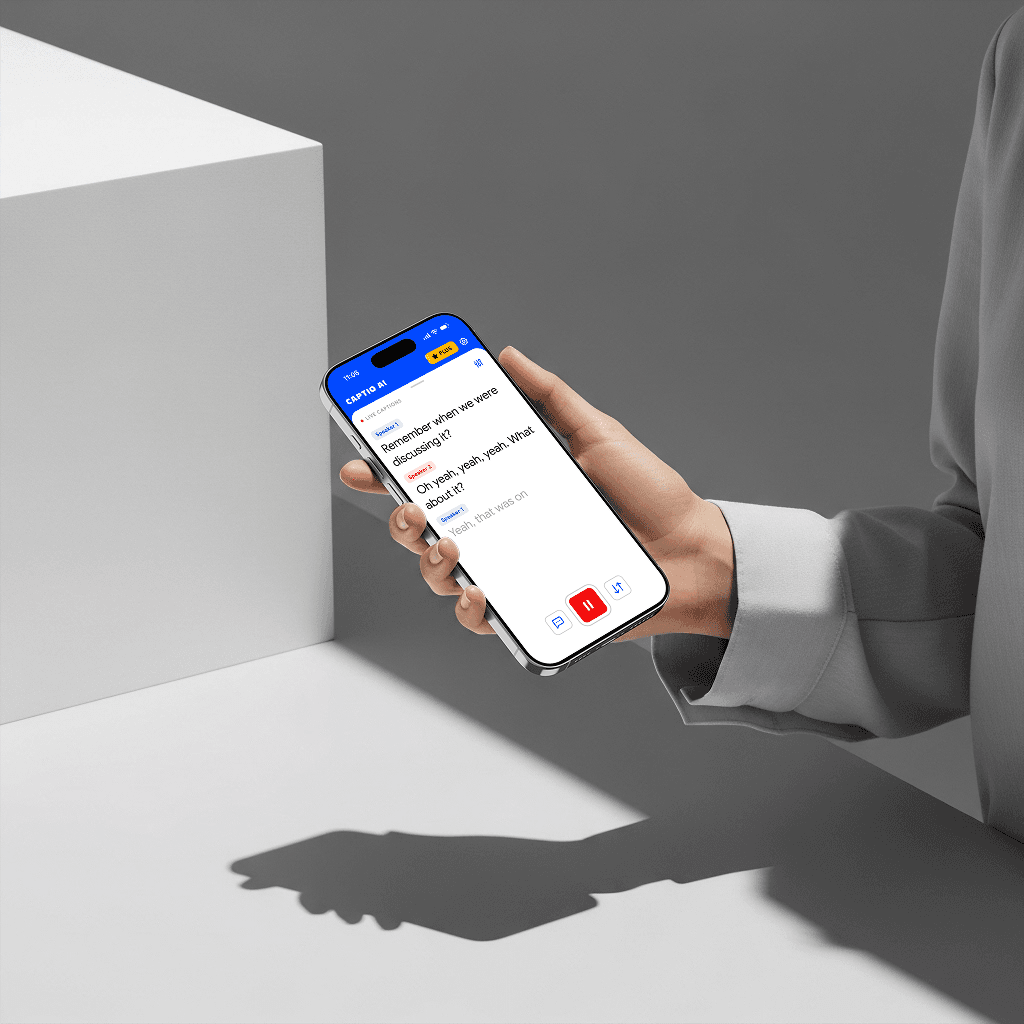
You speak naturally
No slowing down, no special phrasing, no training required. Captio AI handles everything — you just talk the way you always do.
They read as you speak
Your words appear on their screen word by word while you are still talking. Not a summary after — the full sentence, in real time.
Works wherever you both are
Living rooms, offices, restaurants, social gatherings. No venue setup, no special conditions. Captio AI works anywhere you have a conversation.
No sign language from either side
You do not need to learn anything new. Neither do they. Captio AI bridges the gap without requiring any change to how either of you communicates.
Works with how you actually speak
Fast, accented, casual. Captio AI handles real speech — not just slow, clear dictation. You do not need to perform clarity for it to work.
Private by default
Your conversations are never recorded, stored, or shared. Audio is processed in real time and discarded immediately — nothing is kept.
Why Belarusian is hard to understand
Akanye and yakanye
- Unstressed vowels shift to different sounds with no lip change
- Belarusian has obligatory akanye — unstressed /o/ becomes /a/ — and yakanye — unstressed /e/ becomes /ja/. The same vowel letter is pronounced differently depending on stress, but the lip shape for the reduced and unreduced vowels can look identical. A deaf or hard of hearing person using text as a scaffold finds spoken Belarusian regularly diverges from the written form.
Palatalization pairs
- Soft and hard consonants look the same on the lips
- Belarusian has a large consonant inventory with hard and soft (palatalized) pairs that are phonemically distinctive. The softening is achieved by the tongue arching toward the hard palate — a movement invisible from outside. Two words differing only in consonant softness have identical lip profiles.
Trasianka code-switching
- Belarusian and Russian mix mid-sentence in most urban speech
- Trasianka — the mixed Belarusian-Russian vernacular spoken by most urban Belarusians — switches between two phonological systems unpredictably mid-sentence. A lip reader calibrated to Belarusian encounters Russian phonological patterns without warning, and vice versa. Neither language's rules reliably apply throughout a single utterance.
Northeast–Southwest dialect gap
- Hard R vs soft R changes word-level rhythm across regions
- Northeastern Belarusian dialects have a distinctive soft R, while southwestern dialects use a hard R — plus differences in the intensity of akanye. A deaf or hard of hearing person who has learned lip-reading from a speaker of one dialect encounters different consonant-vowel patterns from a speaker of another.
High genetic deafness rate
- Highest GJB2 carrier frequency in Europe — often without community support
- Belarus has the highest documented carrier frequency of the GJB2 35delG deafness-causing mutation in Europe (PMC3342211). This means a disproportionately high number of deaf people are born into hearing families, navigating everyday Belarusian and Russian conversation without family members who share their language or communication method.
Download for free
Belarus has the highest GJB2 deafness-gene carrier rate in Europe — and no officially recognised sign language.
A study published in PMC (PMC3342211) found that the carrier frequency of the 35delG GJB2 mutation — the most common genetic cause of congenital sensorineural hearing loss in European populations — exceeds 6% in Belarus, the highest rate documented among European countries studied. This means that roughly one in sixteen Belarusians carries the gene variant that causes deafness when inherited from both parents. The practical consequence is a country with an unusually high rate of deaf births distributed across the general population, many into hearing families with no prior experience of deaf communication.
Despite this elevated prevalence, Belarusian Sign Language (BeSL) has no official legal recognition in Belarus. Unlike several neighbouring countries that have formalised sign language rights in national legislation, Belarus has not codified BeSL as a protected language, leaving the deaf community without statutory entitlement to interpreter services, accessible education delivered in sign language, or government information in a sign-accessible format.
The combination of high genetic deafness prevalence and absent legal infrastructure creates particular challenges for everyday communication. Deaf Belarusians navigate a linguistically complex environment — trasianka code-switching, Russian-dominated formal domains, and regional Belarusian dialects — without the interpreter access or technology deployment that equivalent countries in Western and Northern Europe provide. Global hearing loss burden data (PMC7960691) confirms that the weight of hearing loss falls disproportionately on countries with fewer established support systems.
Download for free
What you hear stays with you.
Gone the moment it ends
Captio AI processes your audio in real time and discards it immediately. Nothing is recorded. Nothing is kept.
Not a product
Your conversations are not something Captio AI sells, shares, or monetizes — to anyone, for any reason.
Not used to train anything
What you say in a doctor's appointment or a job interview never ends up in a training dataset. Not ours. Not anyone else's.
Private by default
Captio AI supports 60+ languages
Download for free
Frequently asked questions
Make every conversation work — for both sides in Belarusian.
Captio AI is free to start
Download for free