

Tagalog live captions and productivity tool for communicating with deaf & HoH
For deaf and hard of hearing people.
Download for free


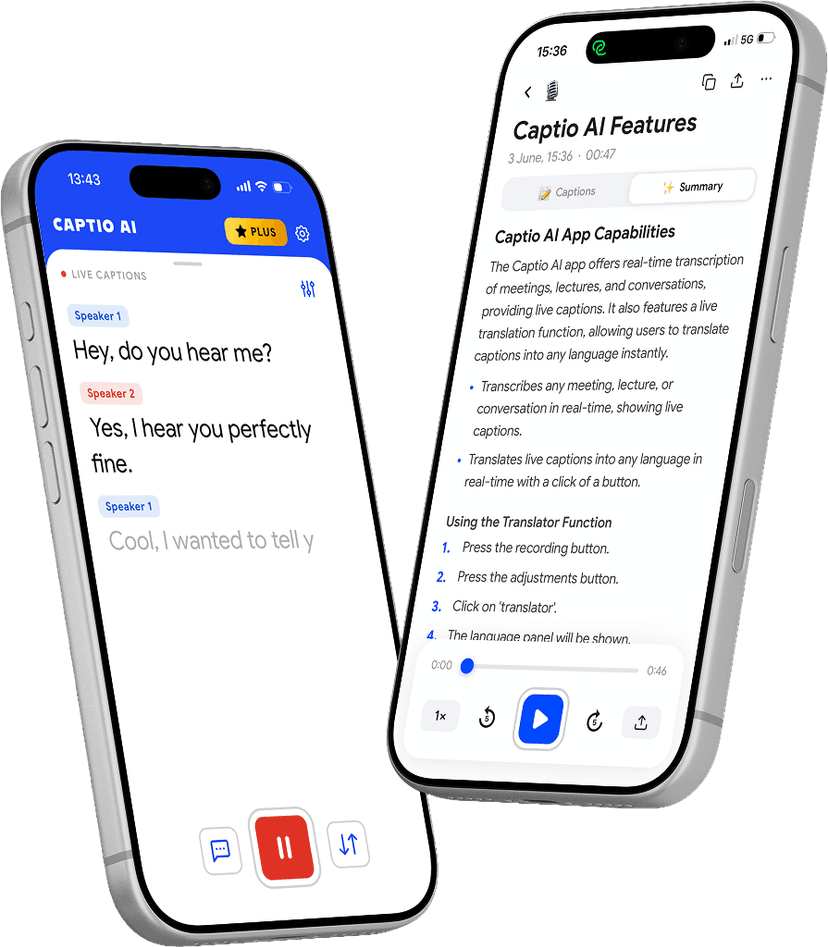
Everything you need to follow Tagalog communicating with deaf & HoH
Four tools built for deaf and hard of hearing Tagalog speakers.
You speak. They read.
- Your words appear on their screen word by word
- No sign language required from you
- Works at home, at work, anywhere
- Any accent, any pace
When language is also a barrier
- You speak your language, they read in theirs
- Translates in real time as you speak
- 60+ languages, no setup
- Handles mid-sentence switches
Save the conversation for them
- Record and transcribe any exchange
- They can review everything at their own pace
- Organised by speaker
- Any length, any format
Make sure nothing important was missed
- Key points extracted from any transcript
- Useful after appointments, meetings, or important conversations
- Organised into clear sections
- Works on any saved recording
Download for free
Every situation covered
Designed for the real moments that matter — not just quiet controlled environments.
Filipino families gather around the table and talk at full pace — parents, siblings, cousins, all at once. Captio AI captions your hearing family's Tagalog in real time so you follow the conversation without asking anyone to slow down or repeat.
In a Manila or provincial office, colleagues talk across desks in the rapid informal Tagalog of everyday work. Captio AI captions whoever is speaking so your deaf or hard of hearing colleague follows quick questions, corridor chats, and side conversations.
When your partner is hearing and you are not, the end-of-day conversation — what do you want for dinner, how was the commute — is exactly what you deserve to have without effort. Captio AI captions your partner's Tagalog naturally, at home pace.
Morning conversations over breakfast, questions called from another room, comments over the news. Captio AI covers the small daily Tagalog exchanges that add up to connection — in a Manila apartment, a family home in Cebu, or a house in the provinces.
When you meet a hearing Filipino for the first time, Captio AI bridges the gap immediately. They speak Tagalog naturally; you read. No awkward explanations, no pen and paper.
At a family reunion, a birthday party, or a neighbourhood fiesta, Tagalog speakers talk over each other and noise fills the room. Captio AI captions whoever you point your phone at so you are part of the celebration, not watching from the edge.
Most accurate and fastest models
word accuracy
independent benchmark, 2025
real-time captions
first word appears as you speak
Download for free
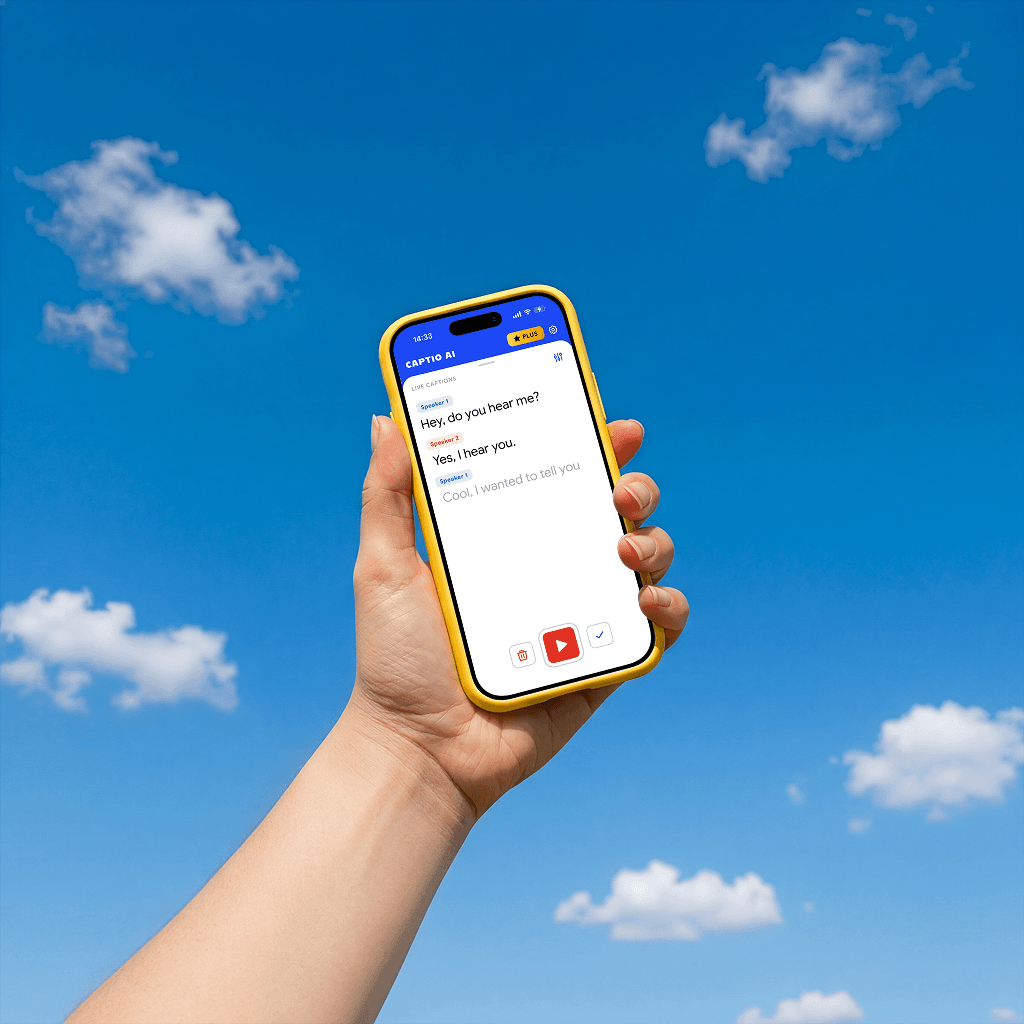
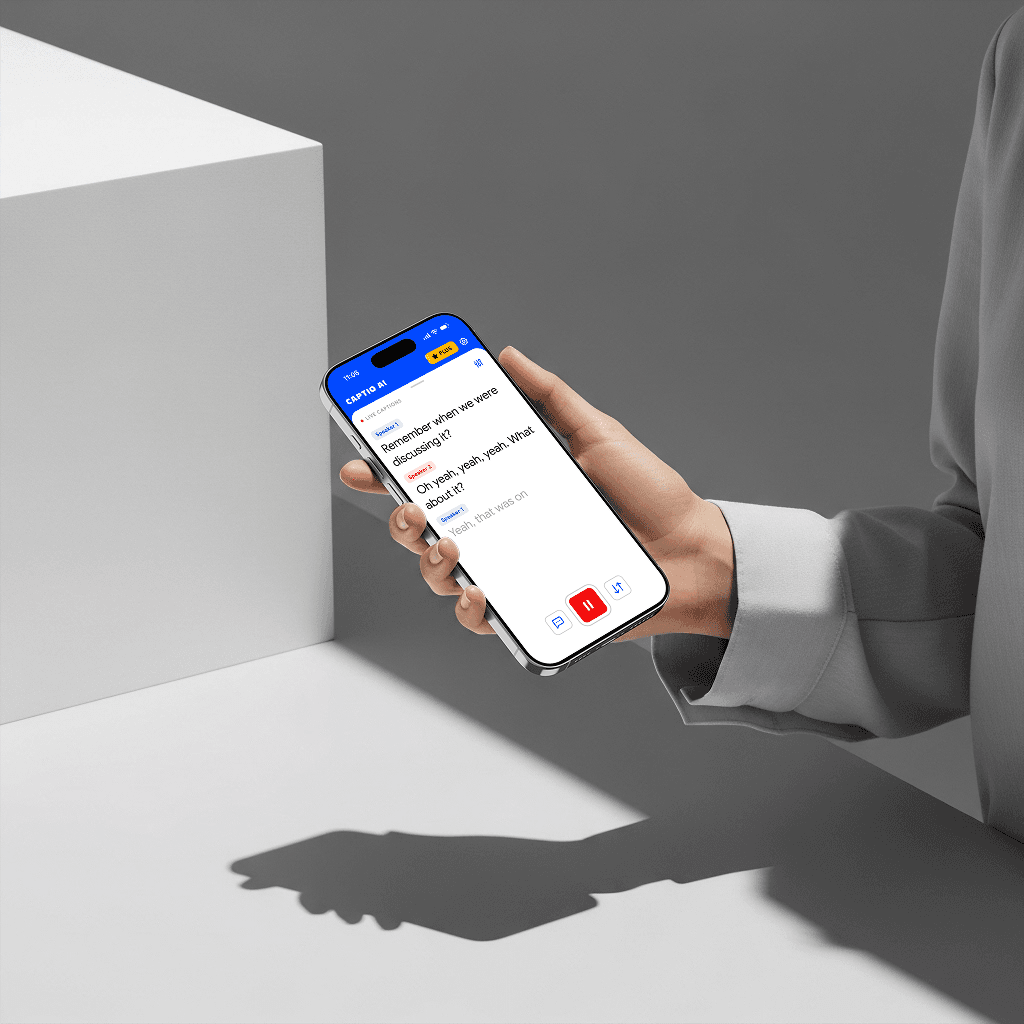
You talk. They follow. No adjustment needed.
You speak naturally
No slowing down, no special phrasing, no training required. Captio AI handles everything — you just talk the way you always do.
They read as you speak
Your words appear on their screen word by word while you are still talking. Not a summary after — the full sentence, in real time.
Works wherever you both are
Living rooms, offices, restaurants, social gatherings. No venue setup, no special conditions. Captio AI works anywhere you have a conversation.
No sign language from either side
You do not need to learn anything new. Neither do they. Captio AI bridges the gap without requiring any change to how either of you communicates.
Works with how you actually speak
Fast, accented, casual. Captio AI handles real speech — not just slow, clear dictation. You do not need to perform clarity for it to work.
Private by default
Your conversations are never recorded, stored, or shared. Audio is processed in real time and discarded immediately — nothing is kept.
Why Tagalog is hard to understand
Glottal stop contrast
- Tagalog pairs words by a final glottal stop — produced at the throat, invisible on the lips
- Pairs like báta (robe) and batà (child) differ only by a final glottal stop — articulated far behind the visible mouth, at the glottis. In a family living room or at a dinner table, these contrasts are phonologically significant but leave no labial trace. A deaf or HoH person reading mouth shapes has no visual cue that the distinction was even made.
Taglish switching
- Tagalog and English alternate mid-sentence without pause or warning
- Urban Filipino households routinely mix Tagalog and English in the same breath — "Kumain ka na ba ng breakfast?" — with no predictable boundary. The two languages have different phonological systems producing different lip shapes, and the switch is signalled only in sound. A deaf or HoH person calibrated to Tagalog phonology suddenly encounters English phonemes with no visible transition.
Stress-meaning contrast
- Stress position changes meaning in Tagalog but leaves no visible trace on the face
- Tagalog uses phonemic stress to mark grammatical focus. The position of stress on a morpheme changes what a sentence means, and this distinction is entirely auditory — identical lip shapes can carry completely different meanings. In a fast family conversation, a deaf or HoH person reading lips has no way to recover stress placement from visual information alone.
Regional accent diversity
- Cebuano, Ilocano, and Bicolano accents reshape the Tagalog heard at home
- The Philippines has over 180 languages, and speakers of regional languages carry phonological features into their Tagalog — different vowel quality, different consonant realizations, different intonation patterns. For a deaf or HoH person calibrated to Manila Tagalog, a relative's regional accent makes familiar words look different on the lips.
Fast casual reduction
- Colloquial Tagalog drops syllables and contracts words at a pace that removes lip-reading anchors
- In everyday family speech, Tagalog reduces syllables and contracts common words — hindi becomes di, mag-aaral compresses, particles run together across word boundaries. These reductions are standard for fluent speakers but remove the full syllable shapes that a deaf or HoH family member depends on to recognize words.
Download for free
Hearing loss in the Philippines: scale, access, and the gap in daily life
The Philippines carries one of the highest burdens of hearing loss in Southeast Asia. A national survey published in 2020 found that moderate or worse hearing loss affects approximately 15% of the Philippine population — around 17 million people. Among adults aged 18 to 65 the figure is 14.7%; among those over 65 it reaches 49.1%. The study identified middle-ear conditions, cerumen impaction, and lower socioeconomic status as the primary contributing factors, reflecting structural inequalities in preventive healthcare access across the archipelago.
Filipino Sign Language (FSL) received legal recognition in 2018 under Republic Act 11106. But recognition has not translated into widespread access. The Philippines is an archipelago of over 7,100 islands and interpreter services remain concentrated in Metro Manila and provincial capitals. In rural barangays, trained FSL interpreters are virtually absent. A deaf Filipino in a rural province cannot access what a deaf Filipino in Manila can — and even in cities, formal FSL provision does not reach everyday family life.
Deaf and hard of hearing Filipinos from low-income households — a disproportionate majority given the correlation with socioeconomic status — often rely entirely on hearing family members to navigate daily life: at the sari-sari store, at the health centre, and at home. In all these settings, no interpreter is present. The conversation happens in Tagalog, at Filipino pace, in the ambient noise of a Filipino home, and the deaf or HoH family member either follows or does not.
Download for free
What you hear stays with you.
Gone the moment it ends
Captio AI processes your audio in real time and discards it immediately. Nothing is recorded. Nothing is kept.
Not a product
Your conversations are not something Captio AI sells, shares, or monetizes — to anyone, for any reason.
Not used to train anything
What you say in a doctor's appointment or a job interview never ends up in a training dataset. Not ours. Not anyone else's.

Private by default
Captio AI supports 60+ languages
Download for free
Frequently asked questions
Make every conversation work — for both sides in Tagalog.
Captio AI is free to start
Download for free