

Norwegian live captions and productivity tool for communicating with deaf & HoH
For deaf and hard of hearing people.
Download for free


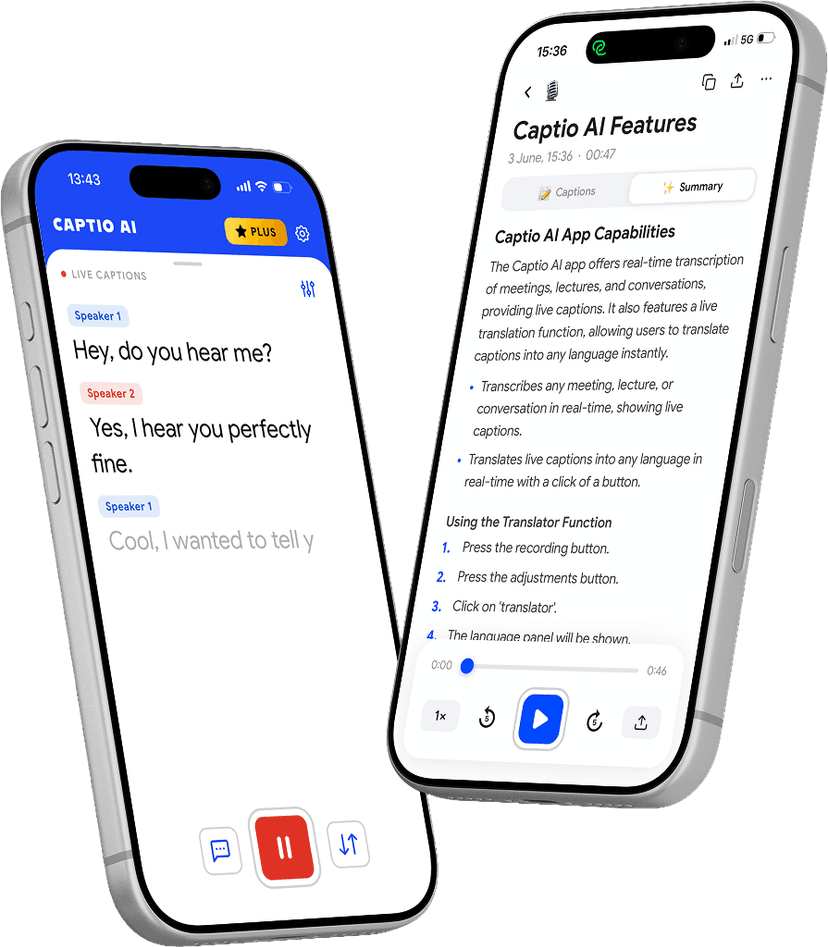
Everything you need to follow Norwegian communicating with deaf & HoH
Four tools built for deaf and hard of hearing Norwegian speakers.
You speak. They read.
- Your words appear on their screen word by word
- No sign language required from you
- Works at home, at work, anywhere
- Any accent, any pace
When language is also a barrier
- You speak your language, they read in theirs
- Translates in real time as you speak
- 60+ languages, no setup
- Handles mid-sentence switches
Save the conversation for them
- Record and transcribe any exchange
- They can review everything at their own pace
- Organised by speaker
- Any length, any format
Make sure nothing important was missed
- Key points extracted from any transcript
- Useful after appointments, meetings, or important conversations
- Organised into clear sections
- Works on any saved recording
Download for free
Every situation covered
Designed for the real moments that matter — not just quiet controlled environments.
A Norwegian family dinner where grandparents speak Trøndelag dialect, parents use Oslo Norwegian, and teenagers mix in English. Captio AI keeps up with every voice across the table.
Norwegian workplaces run informally and everyone uses their own dialect. Captio AI lets a deaf colleague follow team meetings, coffee-break conversation, and the corridor discussions that shape how Norwegian offices actually work.
A hearing partner who grew up speaking Bergen Norwegian or a northern dialect can speak naturally at home. Captio AI captions every word in real time so home conversation does not require extra effort from either side.
Morning questions, household logistics, and spontaneous remarks from another room — Captio AI keeps a deaf or hard of hearing person connected to everyday Norwegian home life.
Meeting a hearing Norwegian family member, partner's parents, or new neighbour. Captio AI captures their speech in real time so the first conversation can be natural.
At a Norwegian cabin weekend, family gathering, or neighbourhood celebration where people from different parts of Norway all speak their own dialects, Captio AI captions the conversation so a deaf or hard of hearing person is part of it.
Most accurate and fastest models
word accuracy
independent benchmark, 2025
real-time captions
first word appears as you speak
Download for free
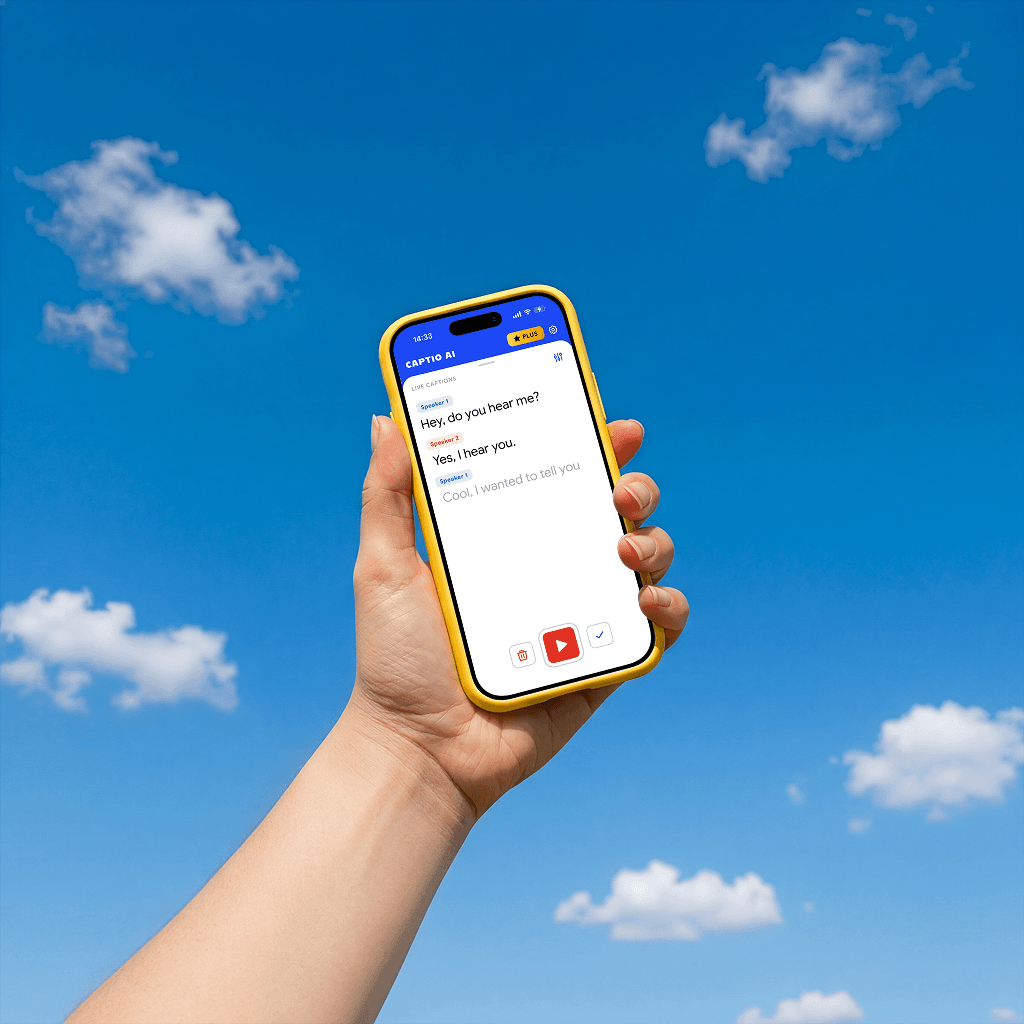
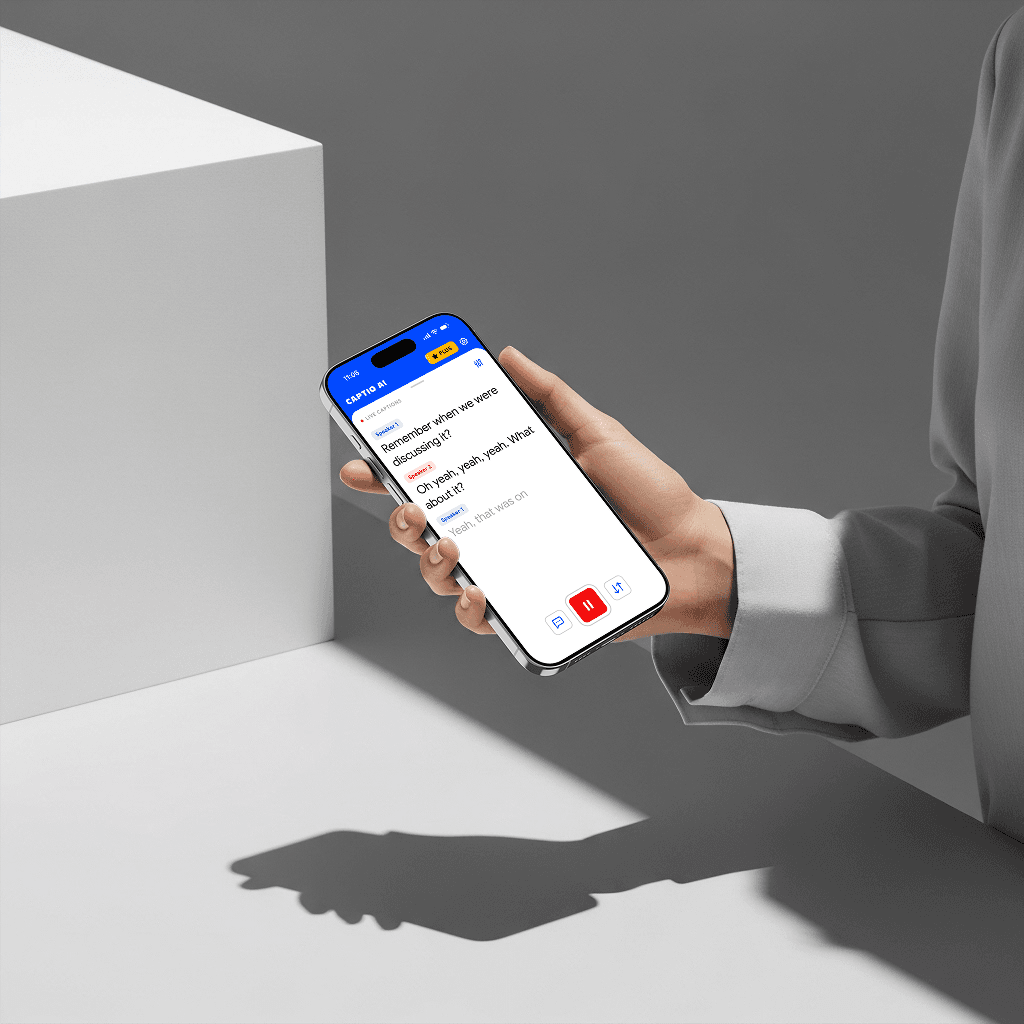
You talk. They follow. No adjustment needed.
You speak naturally
No slowing down, no special phrasing, no training required. Captio AI handles everything — you just talk the way you always do.
They read as you speak
Your words appear on their screen word by word while you are still talking. Not a summary after — the full sentence, in real time.
Works wherever you both are
Living rooms, offices, restaurants, social gatherings. No venue setup, no special conditions. Captio AI works anywhere you have a conversation.
No sign language from either side
You do not need to learn anything new. Neither do they. Captio AI bridges the gap without requiring any change to how either of you communicates.
Works with how you actually speak
Fast, accented, casual. Captio AI handles real speech — not just slow, clear dictation. You do not need to perform clarity for it to work.
Private by default
Your conversations are never recorded, stored, or shared. Audio is processed in real time and discarded immediately — nothing is kept.
Why Norwegian is hard to understand
Pitch accents
- Two tonal accents distinguish words with identical lip shapes
- Norwegian has two pitch accents — Accent 1 (rising-falling) and Accent 2 (falling-rising) — that distinguish word pairs with identical lip profiles. 'Bønder' (farmers) vs 'bønner' (beans), 'huset' (the house) vs 'huse' (houses) differ only in pitch contour. A deaf or hard of hearing lip reader receives no visual signal for these distinctions.
No standard spoken form
- Every region speaks its own dialect — there is no reference point
- Unlike most European languages, Norwegian has no standardised spoken form — no normative broadcast accent that speakers must approximate. Trøndelag, Bergen, Stavanger, and Tromsø dialects are all legitimate spoken Norwegian. A deaf or hard of hearing person who has learned lip-reading from Oslo speech regularly encounters phonological patterns from other dialects that look different on the lips and follow different rules.
Retroflex consonants
- Eastern Norwegian retroflexes are formed deep inside the mouth
- Eastern Norwegian, including Oslo, has retroflex consonants formed by curling the tongue backward — arising when /r/ precedes /d/, /l/, /n/, or /s/. These sounds are articulated behind the alveolar ridge, with no lip involvement and no surface visibility. A deaf or hard of hearing person sees the same lip position for retroflex and non-retroflex consonants.
Vowel quantity
- Long and short vowels look the same from outside
- Norwegian distinguishes phonemically between short and long vowels — 'tak' (roof) vs 'tåk' (fog, with long vowel). The duration difference is entirely acoustic; both versions position the lips in the same way. A lip reader faces repeated near-homophone situations where the only distinction is one they cannot see.
Fast casual reduction
- Everyday Norwegian compresses rapidly in informal speech
- Everyday conversational Norwegian drops syllables, reduces 'ikke' to 'itte' or 'ij', contracts pronoun-verb sequences, and runs words together at speed. A deaf or hard of hearing person calibrated to broadcast Bokmål speech encounters a very different sound stream in a family kitchen or a work coffee break.
Download for free
Norwegian Sign Language gained legal recognition in 2022 — but 11,000 users still face gaps in everyday communication access.
Norwegian Sign Language (NSL, or NTS) was granted full legal recognition under Norway's Language Act on 1 January 2022, making it one of the most recently legislated sign language rights in Northern Europe. The Norwegian deaf and hard of hearing community numbers approximately 11,000 NSL users. Despite Norway's strong welfare state, hearing aid use among adults with disabling hearing loss — tracked longitudinally in the HUNT study (PMC10867996) — reached only 64.4% by 2018, meaning more than a third of those who clinically needed hearing aids were not using them.
The gap between formal recognition and everyday access is visible in informal communication settings. Legal recognition covers educational and governmental contexts, but family dinners, neighbourhood conversations, workplace coffee breaks, and spontaneous social situations are outside the scope of any interpreter mandate. Norway's 11,000 deaf users must navigate these everyday moments — where a dialect shift from Trondheim to Bergen can mean a completely different phonological pattern — without formal support.
Global hearing loss burden data (GBD 2019, PMC7960691) estimates that 1.5 billion people live with some form of hearing loss globally. In a Norwegian context, the significance is not mass underservice but the persistent gap between strong formal systems and informal daily life — a gap that formal policy cannot close because it operates precisely in the spontaneous, unscheduled moments that make up most of human communication.
Download for free
What you hear stays with you.
Gone the moment it ends
Captio AI processes your audio in real time and discards it immediately. Nothing is recorded. Nothing is kept.
Not a product
Your conversations are not something Captio AI sells, shares, or monetizes — to anyone, for any reason.
Not used to train anything
What you say in a doctor's appointment or a job interview never ends up in a training dataset. Not ours. Not anyone else's.

Private by default
Captio AI supports 60+ languages
Download for free
Frequently asked questions
Make every conversation work — for both sides in Norwegian.
Captio AI is free to start
Download for free