

Swahili live captions and productivity tool for communicating with deaf & HoH
For deaf and hard of hearing people.
Download for free

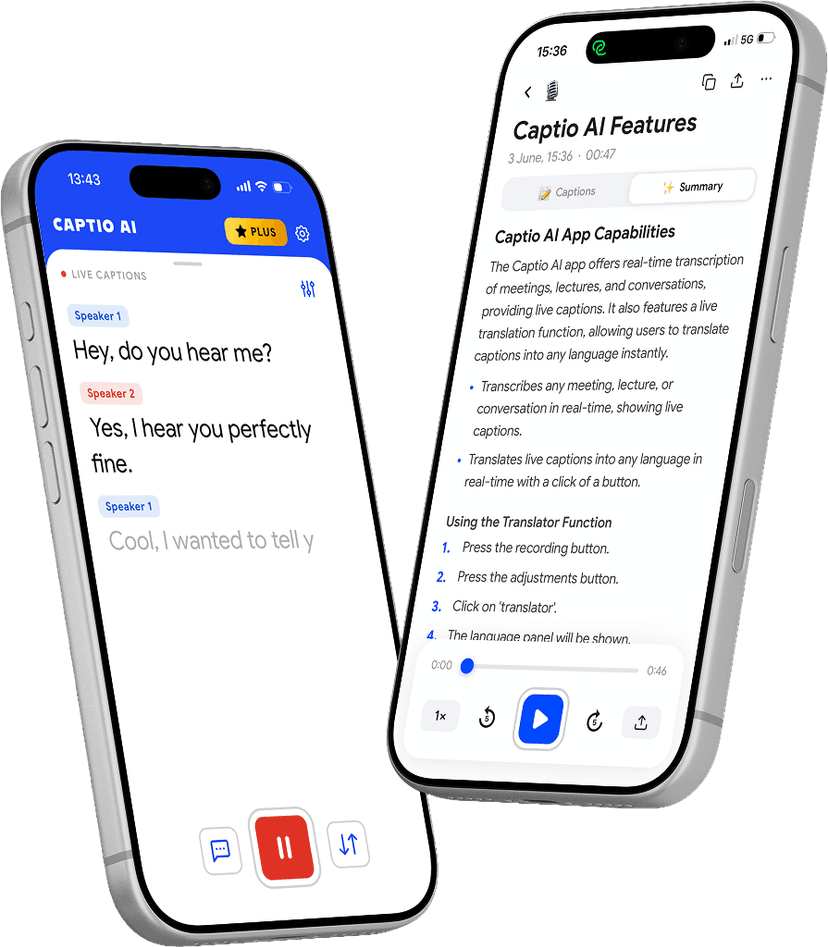
Everything you need to follow Swahili communicating with deaf & HoH
Four tools built for deaf and hard of hearing Swahili speakers.
You speak. They read.
- Your words appear on their screen word by word
- No sign language required from you
- Works at home, at work, anywhere
- Any accent, any pace
When language is also a barrier
- You speak your language, they read in theirs
- Translates in real time as you speak
- 60+ languages, no setup
- Handles mid-sentence switches
Save the conversation for them
- Record and transcribe any exchange
- They can review everything at their own pace
- Organised by speaker
- Any length, any format
Make sure nothing important was missed
- Key points extracted from any transcript
- Useful after appointments, meetings, or important conversations
- Organised into clear sections
- Works on any saved recording
Download for free
Every situation covered
Designed for the real moments that matter — not just quiet controlled environments.
Swahili family meals in Nairobi, Dar es Salaam, or Mombasa often involve multiple generations switching between Swahili, English, and a home language like Kikuyu or Dholuo. A hearing family member speaks at their normal pace in whatever mix comes naturally. Captio AI captions the Swahili speech in real time so a deaf or hard of hearing family member follows without asking anyone to stop and explain.
Kenyan and Tanzanian workplaces run in Swahili for everyday exchanges and English for formal documents. A hearing colleague speaks in whichever register fits the moment — casual Swahili, Sheng, or more formal speech. Captio AI captions what they say so a deaf or hard of hearing colleague follows corridor conversations and quick instructions without missing a word.
When your partner is deaf or hard of hearing and Swahili is the language you use at home. You speak naturally — Sheng, casual Swahili, or whatever blend you normally use. Captio AI puts your words on their screen word by word so you stay connected without either of you adjusting how you speak.
Daily home life in a Nairobi or Dar es Salaam household — calling across the courtyard, talking over a shared meal, quick questions on the way out the door. Captio AI covers the continuous low-level conversation that connects a household through the day.
When a deaf or hard of hearing person meets a new hearing Swahili speaker — at a church service, a neighbourhood meeting, or a family introduction. Captio AI captions the conversation so the first meeting is not defined by the communication gap.
Group settings — a family kichumbani gathering, a baraza, a mixed work and social event — where some people are deaf or hard of hearing and some are not. Captio AI captions whoever is speaking so every person in the circle is fully included.
Most accurate and fastest models
word accuracy
independent benchmark, 2025
real-time captions
first word appears as you speak
Download for free
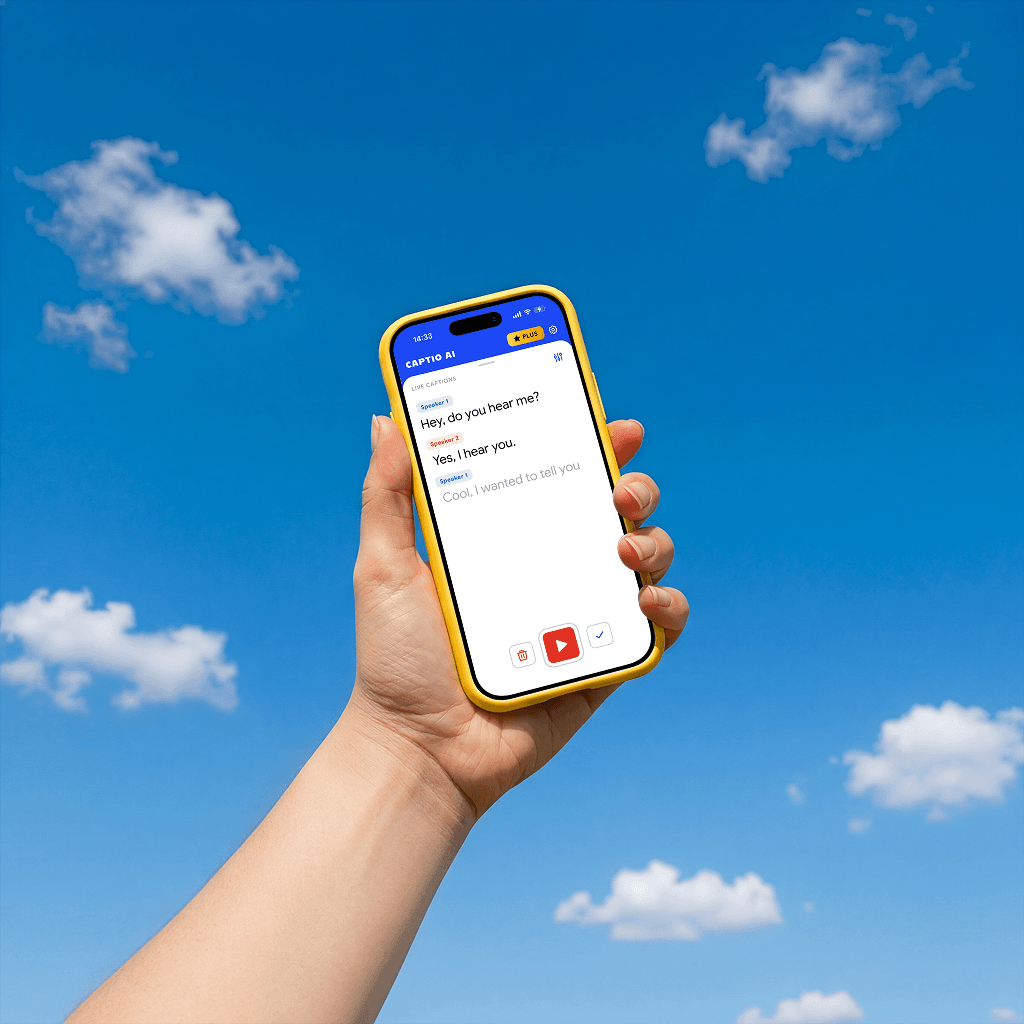
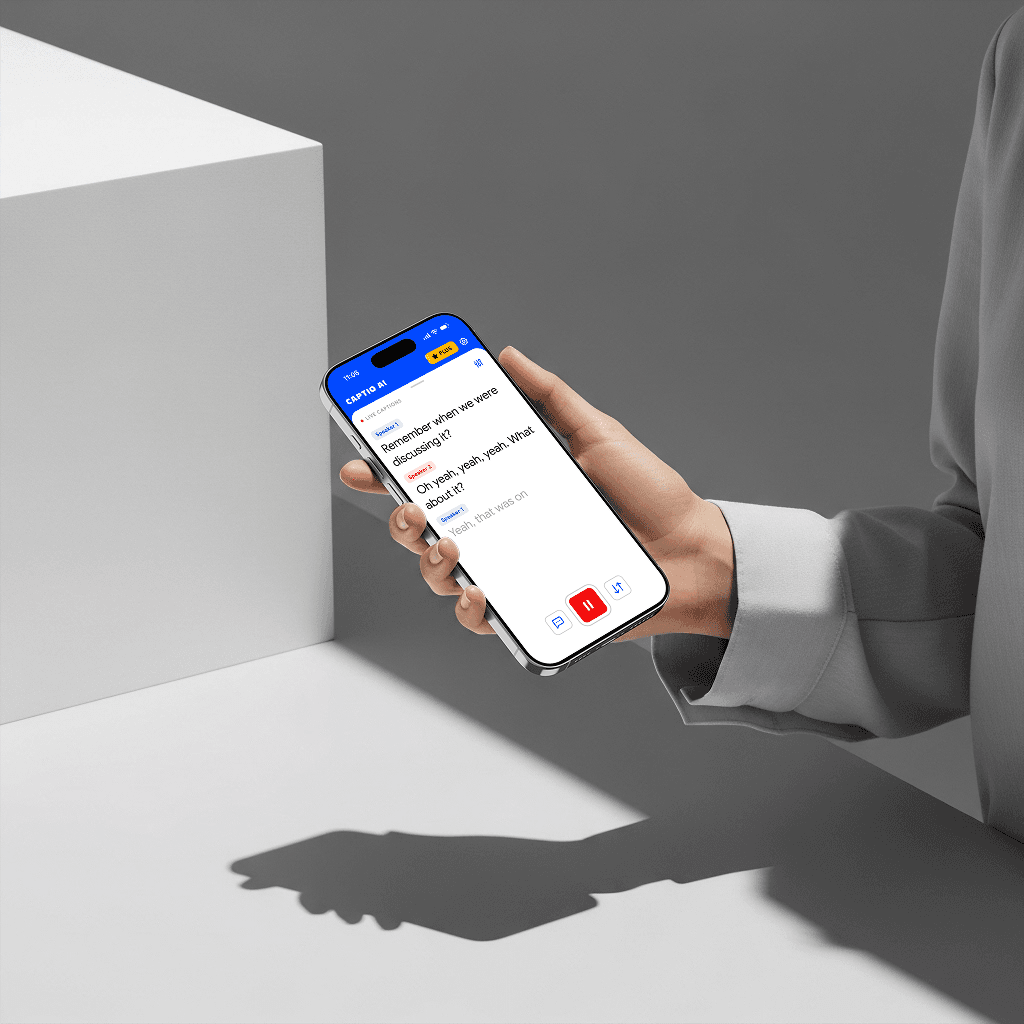
You talk. They follow. No adjustment needed.
You speak naturally
No slowing down, no special phrasing, no training required. Captio AI handles everything — you just talk the way you always do.
They read as you speak
Your words appear on their screen word by word while you are still talking. Not a summary after — the full sentence, in real time.
Works wherever you both are
Living rooms, offices, restaurants, social gatherings. No venue setup, no special conditions. Captio AI works anywhere you have a conversation.
No sign language from either side
You do not need to learn anything new. Neither do they. Captio AI bridges the gap without requiring any change to how either of you communicates.
Works with how you actually speak
Fast, accented, casual. Captio AI handles real speech — not just slow, clear dictation. You do not need to perform clarity for it to work.
Private by default
Your conversations are never recorded, stored, or shared. Audio is processed in real time and discarded immediately — nothing is kept.
Why Swahili is hard to understand
Nasal onset clusters
- Swahili words that start with ng', nj, nd are almost invisible at the lips
- Swahili has word-initial nasal clusters (ng', nj, nd, mb, mv) that create very brief, merged mouth shapes. Words like 'nchi', 'ngoja', 'nzuri' — the nasal onset is barely visible before the main vowel. A deaf lip-reader misses the initial consonant entirely and must guess from context.
Nairobi vs. Tanzanian Swahili
- Urban Nairobi Swahili and Standard Tanzanian Swahili are two different lip-reading tasks
- Standard Swahili (based on the Zanzibar/Unguja dialect) differs from Nairobi's urban variety in phonology, vocabulary, and contracted forms. Hearing family members in Nairobi speak a mixed urban variety; the lip shapes for common contractions and slang don't map to what a deaf person may have learned from formal Swahili.
Sheng code-switching
- Urban Kenyan speech switches languages faster than a lip-reader can track
- In Kenya, urban Swahili-English code-switching (Sheng) is so pervasive that a hearing family member may speak a sentence that is partly Swahili, partly English, and partly Sheng slang. For a deaf lip-reader, unexpected language switching without auditory cues makes tracking meaning nearly impossible.
L1-influenced prosody
- Every hearing family member's Swahili sounds different depending on their first language
- Many Swahili speakers' first language is Kikuyu, Dholuo, Luhya, Chagga, or another Bantu or Nilotic language. Each carries distinct prosodic patterns into Swahili. A deaf person who lip-reads one hearing family member's Swahili cannot fully transfer that skill to another family member from a different L1 background.
Vowel length contrast
- Swahili long and short vowels look identical at the lips
- Swahili distinguishes phonemically short and long vowels — a contrast that is entirely durational and auditory. Lip movements for short and long vowels look almost identical. A deaf lip-reader loses the vowel length distinction that changes word meaning in everyday Swahili.
Download for free
Hearing loss in Kenya and Tanzania: scale, access, and the daily gap
Kenya's 2019 National Population Census recorded 153,381 Deaf people aged above 5 — but that figure represents only the most severe cases. Broader hearing impairment data is more striking: 14 in every 1,000 Kenyan children have moderate or severe hearing loss, a rate approximately 10 times higher than in the United States (PMC10854416). By 2030, if current prevalence holds, an estimated 3.6 million Kenyans will have hearing loss — a figure that will more than double by 2100 as the population grows. Most of these people live in rural areas with no access to audiological services, hearing aids, or formal deaf education.
Kenya's 2010 Constitution recognised Kenyan Sign Language (KSL) as an official language — a landmark legal step that has not yet translated into meaningful daily access. Sign language interpretation is available at national television broadcasts and some government services, but family homes, workplaces, and neighbourhood conversations remain entirely unaided. The gap between constitutional recognition and daily reality is wide. In Tanzania, overall disability prevalence was 11% in the 2022 Demographic and Health Survey (PMC12257763), but deaf-specific services — schools, interpreters, community support — remain concentrated in Dar es Salaam and a few larger cities.
For a deaf or hard of hearing person in Kenya or Tanzania, communication with hearing family members typically depends on what the hearing person can offer: slowing down, writing, or improvising gestures. There is no widely available technology suited to everyday Swahili family conversation — particularly when the Swahili being spoken is urban, mixed with English and local languages, and delivered at the natural pace of a meal or a walk to the market. Captio AI captions that speech in real time, giving a deaf family member access to the conversation their hearing relatives are already having.
Download for free
What you hear stays with you.
Gone the moment it ends
Captio AI processes your audio in real time and discards it immediately. Nothing is recorded. Nothing is kept.
Not a product
Your conversations are not something Captio AI sells, shares, or monetizes — to anyone, for any reason.
Not used to train anything
What you say in a doctor's appointment or a job interview never ends up in a training dataset. Not ours. Not anyone else's.
Private by default
Captio AI supports 60+ languages
Download for free
Frequently asked questions
Make every conversation work — for both sides in Swahili.
Captio AI is free to start
Download for free