

Japanese live captions and productivity tool for communicating with deaf & HoH
For deaf and hard of hearing people.
Download for free


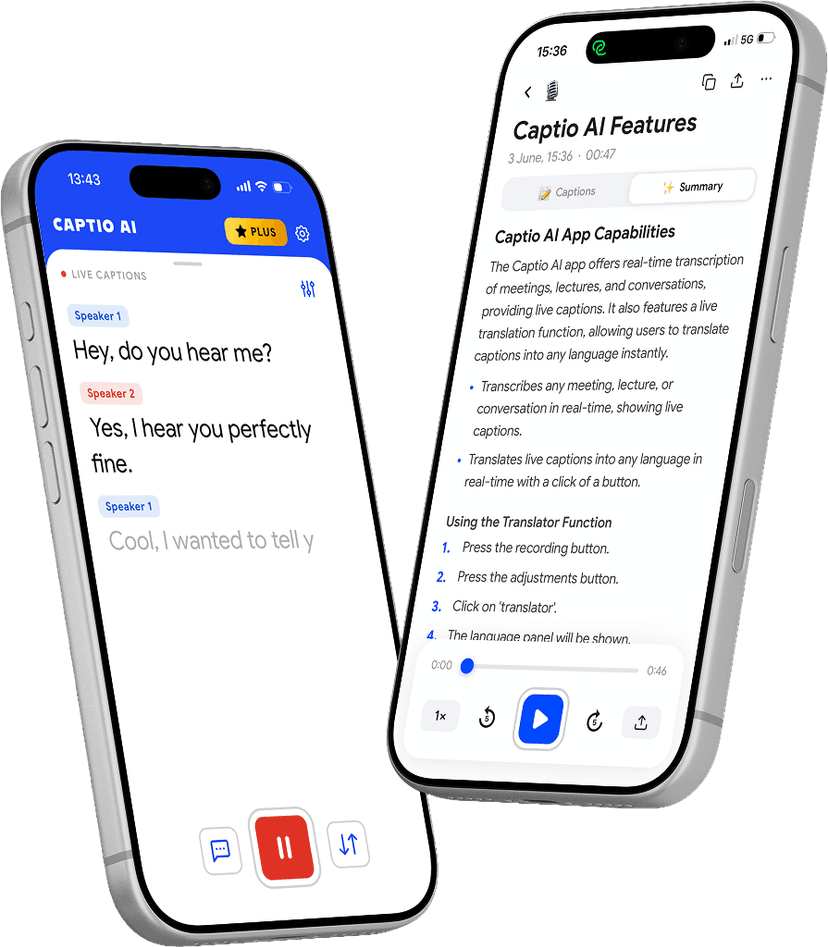
Everything you need to follow Japanese communicating with deaf & HoH
Four tools built for deaf and hard of hearing Japanese speakers.
You speak. They read.
- Your words appear on their screen word by word
- No sign language required from you
- Works at home, at work, anywhere
- Any accent, any pace
When language is also a barrier
- You speak your language, they read in theirs
- Translates in real time as you speak
- 60+ languages, no setup
- Handles mid-sentence switches
Save the conversation for them
- Record and transcribe any exchange
- They can review everything at their own pace
- Organised by speaker
- Any length, any format
Make sure nothing important was missed
- Key points extracted from any transcript
- Useful after appointments, meetings, or important conversations
- Organised into clear sections
- Works on any saved recording
Download for free
Every situation covered
Designed for the real moments that matter — not just quiet controlled environments.
Japanese family gatherings — a holiday meal at a grandparent's house, an evening at home — often move between polite and very casual registers. Hearing family members speak naturally in whatever form fits who they are talking to. Captio AI captions every word so a deaf or hard of hearing family member follows the full table conversation.
Japanese workplaces layer keigo for seniors over casual speech for close colleagues. A hearing colleague moves naturally between these layers. Captio AI captions what they say in real time so a deaf or hard of hearing colleague follows desk conversations, corridor exchanges, and informal team talk without interrupting the flow.
When your partner is deaf or hard of hearing and Japanese is the language you use together. You use the casual speech you always use with each other — no adjustments needed. Captio AI puts your words on their screen word by word so nothing is missed between you.
Everyday home life in a Japanese household — questions across the engawa, talking while cooking in the kitchen, quick exchanges over dinner. Captio AI covers the daily thread of conversation that builds a shared life together.
When a deaf or hard of hearing person meets a hearing Japanese speaker for the first time — at a family event, an enkai dinner, or a neighbourhood gathering. Captio AI captions what the new person says naturally, without any explanation of how to speak carefully.
Mixed group settings — a family reunion, an enkai, a neighbourhood association meeting — where some people are deaf or hard of hearing and some are not. Captio AI captions whoever is speaking so every member of the group is part of the same conversation.
Most accurate and fastest models
character accuracy
independent benchmark, 2025
real-time captions
first word appears as you speak
Download for free
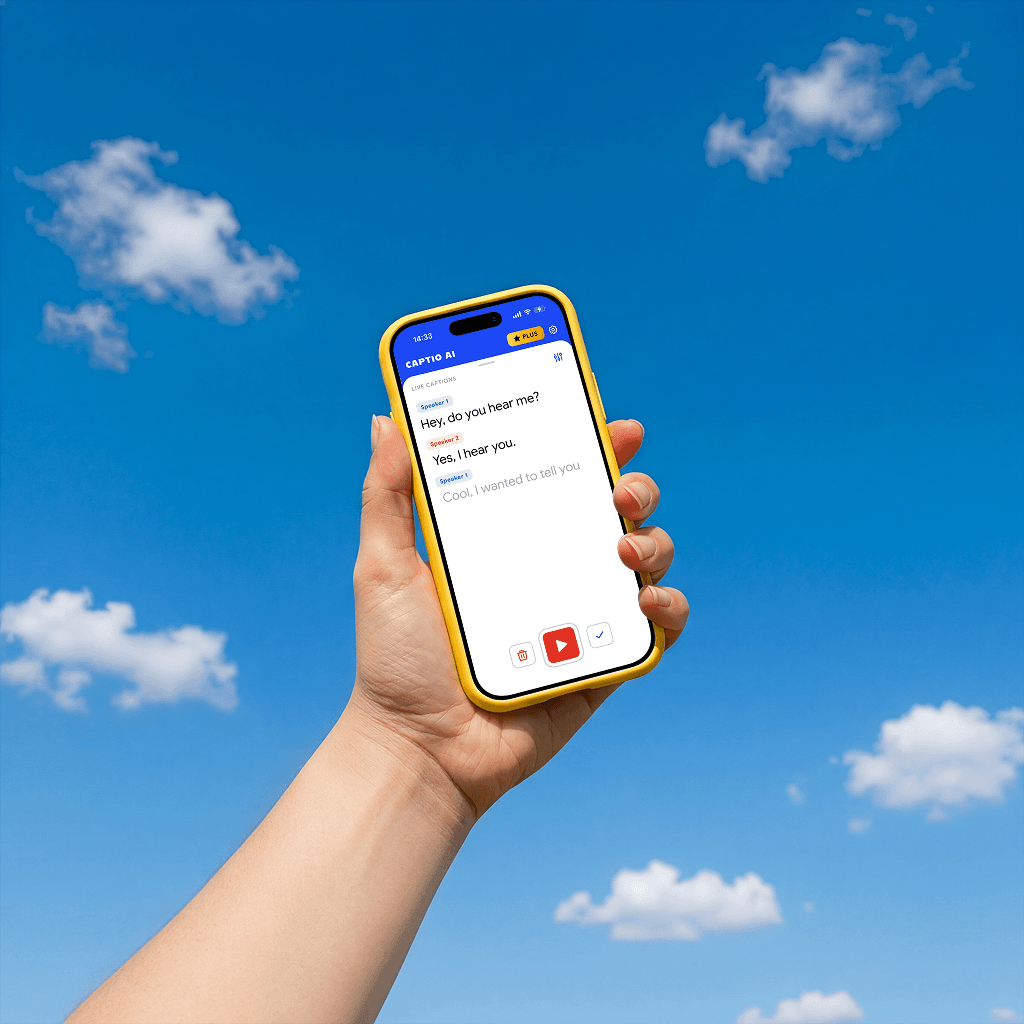
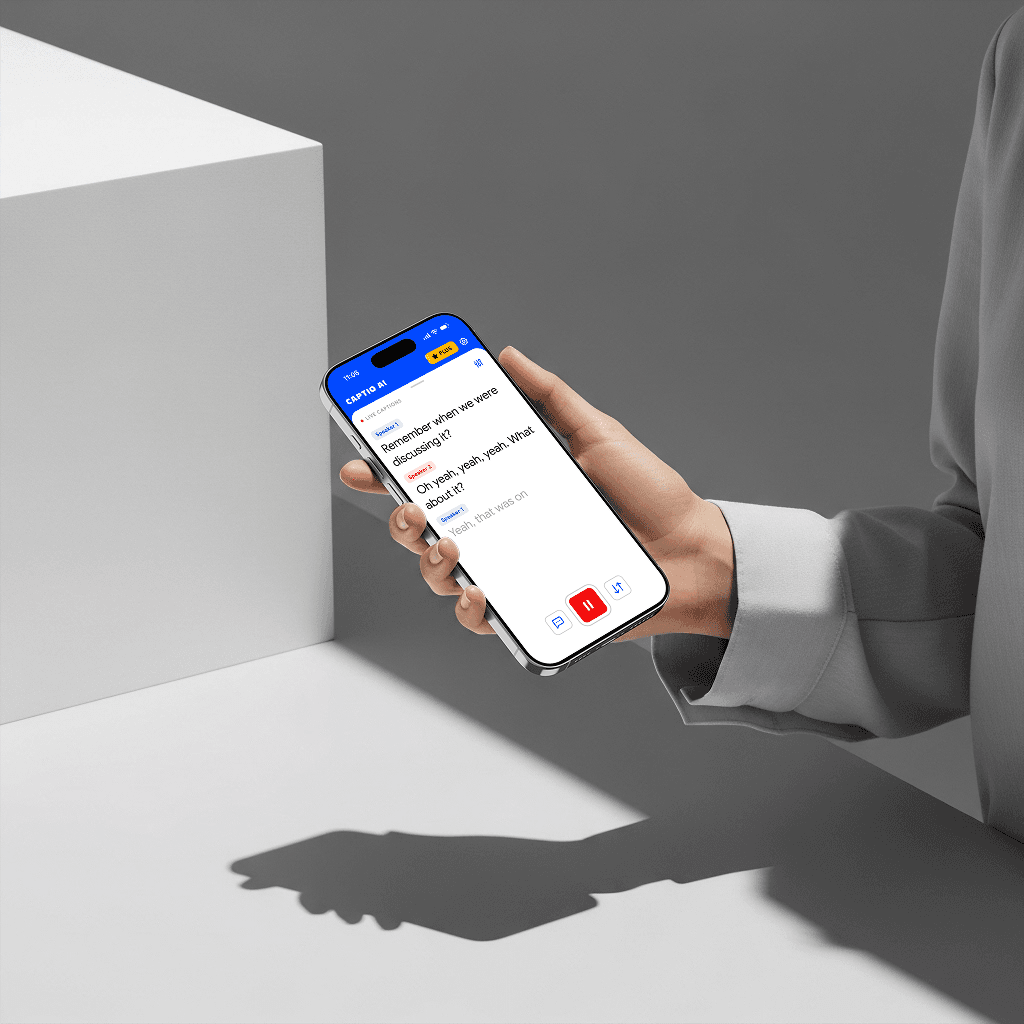
You talk. They follow. No adjustment needed.
You speak naturally
No slowing down, no special phrasing, no training required. Captio AI handles everything — you just talk the way you always do.
They read as you speak
Your words appear on their screen word by word while you are still talking. Not a summary after — the full sentence, in real time.
Works wherever you both are
Living rooms, offices, restaurants, social gatherings. No venue setup, no special conditions. Captio AI works anywhere you have a conversation.
No sign language from either side
You do not need to learn anything new. Neither do they. Captio AI bridges the gap without requiring any change to how either of you communicates.
Works with how you actually speak
Fast, accented, casual. Captio AI handles real speech — not just slow, clear dictation. You do not need to perform clarity for it to work.
Private by default
Your conversations are never recorded, stored, or shared. Audio is processed in real time and discarded immediately — nothing is kept.
Why Japanese is hard to understand
Pitch accent invisibility
- The same lip shape can mean bridge, chopsticks, or edge
- Japanese uses pitch accent where the same sequence of morae with a different pitch contour means different words — 'hashi' can mean bridge, chopsticks, or edge depending on pitch. Pitch is entirely auditory. At the family dinner table, a deaf lip-reader has no visual access to the tonal information that separates meanings.
Extreme homophone density
- Japanese has more homophones than almost any other language
- Japanese has an extraordinarily high number of homophones: /ki/ can map to 気, 木, 機, 来, 記, and many more. Hearing speakers use context, intonation, and kanji to resolve the ambiguity. Lip-readers see the same mouth shape for all of them and must rely on context alone — a far heavier cognitive load in a fast family conversation.
Kanto–Kansai prosody split
- Tokyo and Osaka Japanese are lip-read as two different languages
- Standard Tokyo Japanese and Kansai (Osaka, Kyoto) Japanese use completely different pitch accent systems. A deaf person who lip-reads a Tokyo-speaking partner cannot transfer those skills to a hearing Kansai family member, even when the vocabulary is identical — the prosodic pattern underneath the words is different.
Moraic rhythm
- Japanese speech flows without the stress peaks that help lip-reading
- Japanese speech is delivered in equal-weight morae, creating an even, rapid rhythm without strong stress boundaries. Syllable boundaries are less visible than in stress-timed languages. A lip-reader cannot use rhythm to segment where one word ends — every mora looks as prominent as the next.
Register gap
- Keigo and casual Japanese look different even when the words are the same
- The gulf between teineigo (polite speech), sonkeigo (honorific), and casual speech is wide in Japanese. At a family gathering, a hearing person shifts register continuously — formal with elders, casual with siblings. Each register produces different verb endings and rhythmic patterns, making lip-reading across the register gap especially disorienting.
Download for free
Hearing loss in Japan: scale, ageing, and daily isolation
Japan has the oldest population of any country in the world, and hearing loss rises steeply with age. Among men aged 75–79, prevalence reaches 71.4%; among those over 80, it reaches 84.3%. An estimated 16.5 million people over 65 in Japan have some form of hearing impairment (PMC9220865). This is not a rare condition — it is a defining feature of daily life for a large share of the population, and it is concentrated in the grandparent and parent generations who sit at the centre of Japanese family life.
A 2015 PLOS One study examining Japanese women with hearing loss found what researchers called a 'triple difficulty': hearing loss was associated with lower marriage rates, higher smoking rates, and significantly elevated mental health burden compared to the general population (PLOS One, PMC 0116648). The social cost of hearing loss in Japan is not limited to communication — it reshapes the social participation, relationships, and daily choices of the people who live with it. Family gatherings, workplace socialising, and neighbourhood life all carry a higher cost.
Japan's disability policy framework provides cochlear implant support and hearing aid subsidies through welfare programmes, but the threshold for qualification is high, and many people with moderate hearing loss fall below the eligibility line. Nihon Shuwa (Japanese Sign Language) users number in the tens of thousands — a fraction of the millions with significant hearing loss. For the vast majority, the only way to follow a hearing family member's natural speech is to ask them to repeat, to slow down, or to write things out — an ongoing asymmetry that accumulates over years of daily interaction.
Download for free
What you hear stays with you.
Gone the moment it ends
Captio AI processes your audio in real time and discards it immediately. Nothing is recorded. Nothing is kept.
Not a product
Your conversations are not something Captio AI sells, shares, or monetizes — to anyone, for any reason.
Not used to train anything
What you say in a doctor's appointment or a job interview never ends up in a training dataset. Not ours. Not anyone else's.

Private by default
Captio AI supports 60+ languages
Download for free
Frequently asked questions
Make every conversation work — for both sides in Japanese.
Captio AI is free to start
Download for free