

Urdu live captions and productivity tool for communicating with deaf & HoH
For deaf and hard of hearing people.
Download for free


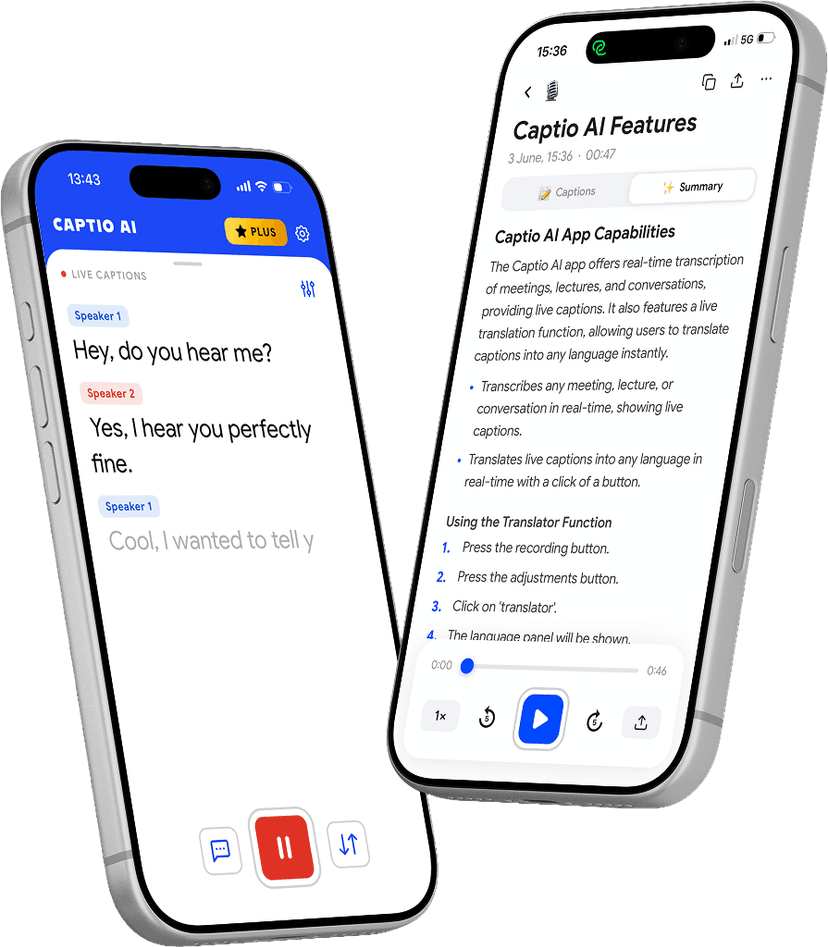
Everything you need to follow Urdu communicating with deaf & HoH
Four tools built for deaf and hard of hearing Urdu speakers.
You speak. They read.
- Your words appear on their screen word by word
- No sign language required from you
- Works at home, at work, anywhere
- Any accent, any pace
When language is also a barrier
- You speak your language, they read in theirs
- Translates in real time as you speak
- 60+ languages, no setup
- Handles mid-sentence switches
Save the conversation for them
- Record and transcribe any exchange
- They can review everything at their own pace
- Organised by speaker
- Any length, any format
Make sure nothing important was missed
- Key points extracted from any transcript
- Useful after appointments, meetings, or important conversations
- Organised into clear sections
- Works on any saved recording
Download for free
Every situation covered
Designed for the real moments that matter — not just quiet controlled environments.
A family dinner, an Eid gathering, a multigenerational conversation at home. You speak in natural Urdu — your regional variety, your Urdish mix — and your deaf or hard of hearing family member reads every word in real time without anyone having to slow down.
Office conversations, quick questions across the desk, corridor exchanges in an Urdu-speaking workplace. You talk normally and Captio AI makes sure your deaf or hard of hearing colleague follows every word without either of you having to adapt.
When your partner is deaf or hard of hearing and you are not. You speak naturally — whether that is Lahori Urdu, Karachi Urdu, or Urdish — and they read every word as you say it. No more typing messages to each other in the same room.
Questions from across the house, conversations in the kitchen, catching up after work. Captio AI covers the ordinary low-stakes moments of shared home life — the ones that feel small but add up to connection over time.
A relative visiting from another city, a new colleague joining the team, a neighbour you have not properly met. You set up Captio AI and the conversation starts without any awkward briefing about how to communicate.
Family functions, office gatherings, social events where some people are deaf or hard of hearing and some are not. Captio AI captions whoever is speaking so nobody is left watching the conversation happen around them.
Most accurate and fastest models
word accuracy
independent benchmark, 2025
real-time captions
first word appears as you speak
Download for free
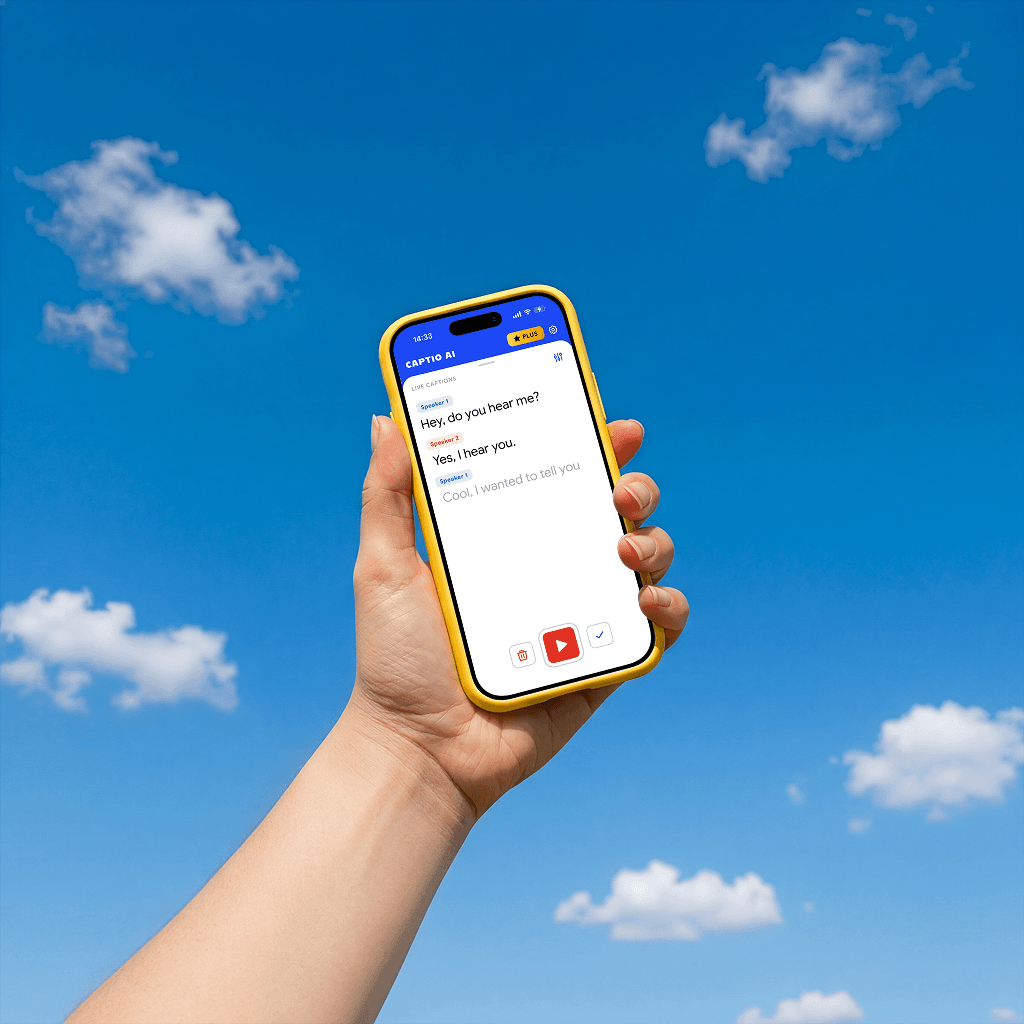
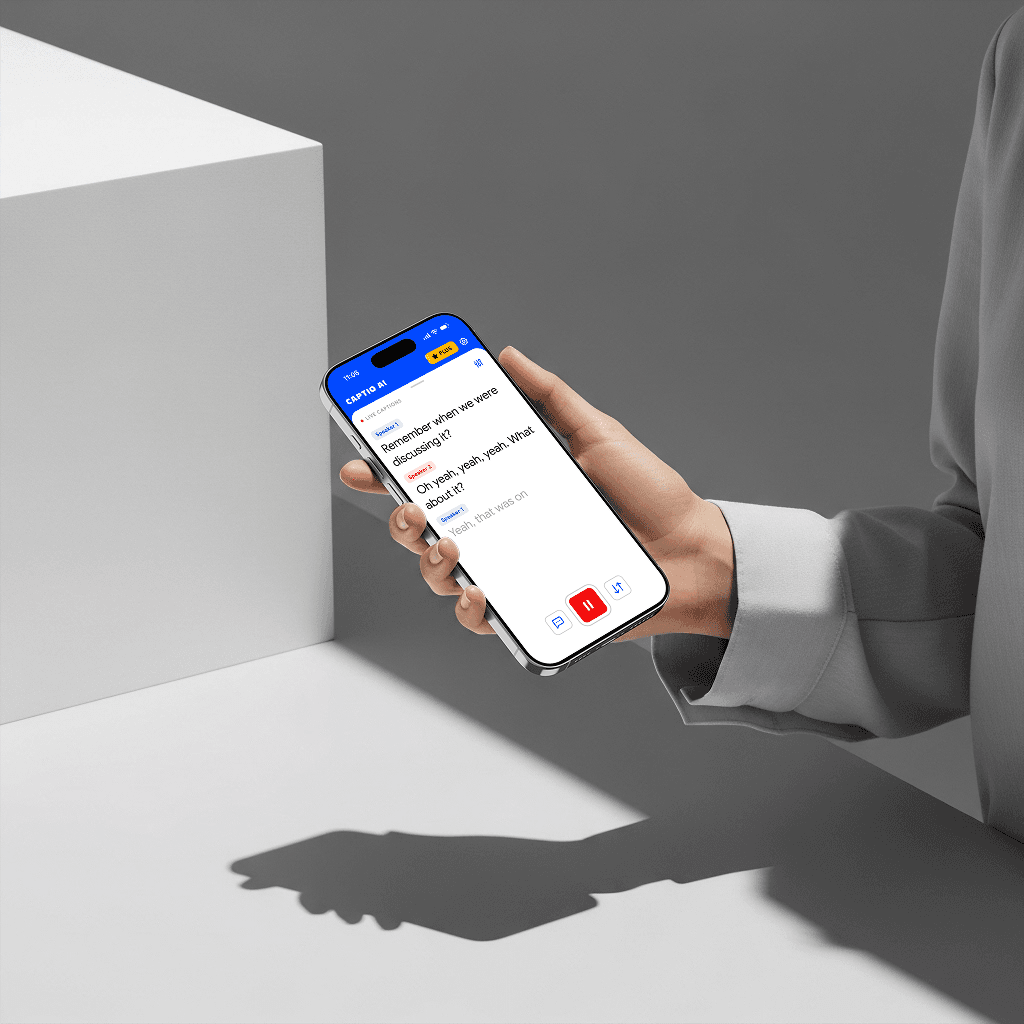
You talk. They follow. No adjustment needed.
You speak naturally
No slowing down, no special phrasing, no training required. Captio AI handles everything — you just talk the way you always do.
They read as you speak
Your words appear on their screen word by word while you are still talking. Not a summary after — the full sentence, in real time.
Works wherever you both are
Living rooms, offices, restaurants, social gatherings. No venue setup, no special conditions. Captio AI works anywhere you have a conversation.
No sign language from either side
You do not need to learn anything new. Neither do they. Captio AI bridges the gap without requiring any change to how either of you communicates.
Works with how you actually speak
Fast, accented, casual. Captio AI handles real speech — not just slow, clear dictation. You do not need to perform clarity for it to work.
Private by default
Your conversations are never recorded, stored, or shared. Audio is processed in real time and discarded immediately — nothing is kept.
Why Urdu is hard to understand
Aspirated and retroflex consonants
- Urdu's most phonologically active consonants are invisible on the lips
- Urdu has aspirated stop pairs (/pʰ/, /bʱ/, /tʰ/, /dʱ/, /kʰ/, /gʱ/) and retroflex consonants (ṭ, ḍ, ṛ, ṇ) that are acoustically distinct but visually identical to their counterparts. Aspiration is a puff of air; retroflexion is a tongue position inside the mouth. Neither is visible at the lips. Research on Urdu speech audiometry identifies these consonants as the most challenging for clinical assessment of deaf and hard of hearing speakers — they are challenging precisely because no visual information distinguishes them.
Uvular and pharyngeal sounds
- Arabic–Persian loanwords bring throat sounds that are entirely invisible
- Urdu has deep phonological ties to Arabic and Persian through its literary and religious tradition. Sounds like the uvular stop /q/ (as in qalam, pen), the uvular fricative /ġ/, and pharyngeal /ʕ/ appear throughout common Urdu vocabulary. All are produced deep in the throat, behind the visible mouth. A deaf person following a hearing family member or colleague will encounter these sounds in everyday Urdu — culturally significant vocabulary whose distinctive sounds produce no visible lip movement.
Murmured consonants
- Breathiness distinguishes words — and breathiness is acoustic
- Urdu has breathy-voiced (murmured) consonants — /bʱ/, /dʱ/, /gʱ/, /ɖʱ/ — where a layer of breathiness is superimposed on the articulation. The lip and jaw position does not change between /b/ and /bʱ/. This distinction is phonologically significant in Urdu vocabulary and is entirely absent from the visual signal. A deaf person lip-reading a hearing family member misses this entire phonological dimension.
Urdish switching
- Urban Urdu switches to English mid-sentence without any signal
- Urban Urdu in Lahore, Karachi, Islamabad, and diaspora communities switches freely between Urdu and English — sometimes mid-phrase. A hearing family member or colleague in any Pakistani urban setting naturally mixes both languages. For a deaf or hard of hearing person, each switch resets the phonological system they are trying to read, without any audible or visible cue that the switch has happened.
Register and dialect range
- Lahori, Karachi, and diaspora Urdu are each different lip-reading challenges
- Urdu spans a wide range: from Persianised formal Urdu to everyday colloquial speech, to Punjabi-inflected Lahori Urdu, to the Karachi variety with its Muhajir community features. A deaf person who has learned to lip-read one register or regional variety will find a hearing speaker from a different background near-impossible to follow without additional tools.
Download for free
Pakistan's deaf community navigates daily life without a single standardized clinical assessment tool in Urdu.
Pakistan's hearing loss prevalence is estimated at 7.4% of the population, with hearing impairment among children at 1.2 per 1,000 live births for moderate-to-severe bilateral loss. Late identification is common across the country — a 2023 WHO EMRO study on hearing impairment in Pakistan found that absence of neonatal hearing screening programmes means most cases are identified late, delaying intervention significantly. A 2025 ASHA study noted that no standardized speech audiometry materials exist for Urdu — a gap that constrains even the clinical measurement of hearing loss in the world's second most spoken Urdu-speaking country.
72% of Persons with Disabilities in Pakistan report inaccessibility as a major barrier to education, training, and employment. The formal disability support system is concentrated in urban areas; in rural Pakistan, which is where the majority of the population lives, specialized hearing services are effectively absent. Sign language interpretation in Pakistan is extremely limited, with Pakistani Sign Language (PSL) having no formal institutional presence in most settings outside schools for the deaf.
In 2024, UNICEF's TALEEM initiative aimed to fit 3,500 deaf children in Punjab with hearing aids as part of a five-year educational access programme. The scale of the initiative relative to the size of Pakistan's deaf population — estimated at millions — illustrates how large the unmet need is. For the vast majority of deaf and hard of hearing Urdu speakers, the most important communication environment is the family home, where hearing family members speak Urdu at a natural pace with no tool to make that speech readable. Captio AI captions any hearing speaker's Urdu in real time — across Pakistani and Indian varieties, registers, and Urdish switching — so a deaf or hard of hearing person reads every word wherever they are.
Download for free
What you hear stays with you.
Gone the moment it ends
Captio AI processes your audio in real time and discards it immediately. Nothing is recorded. Nothing is kept.
Not a product
Your conversations are not something Captio AI sells, shares, or monetizes — to anyone, for any reason.
Not used to train anything
What you say in a doctor's appointment or a job interview never ends up in a training dataset. Not ours. Not anyone else's.

Private by default
Captio AI supports 60+ languages
Download for free
Frequently asked questions
Make every conversation work — for both sides in Urdu.
Captio AI is free to start
Download for free