

Korean live captions and productivity tool for communicating with deaf & HoH
For deaf and hard of hearing people.
Download for free


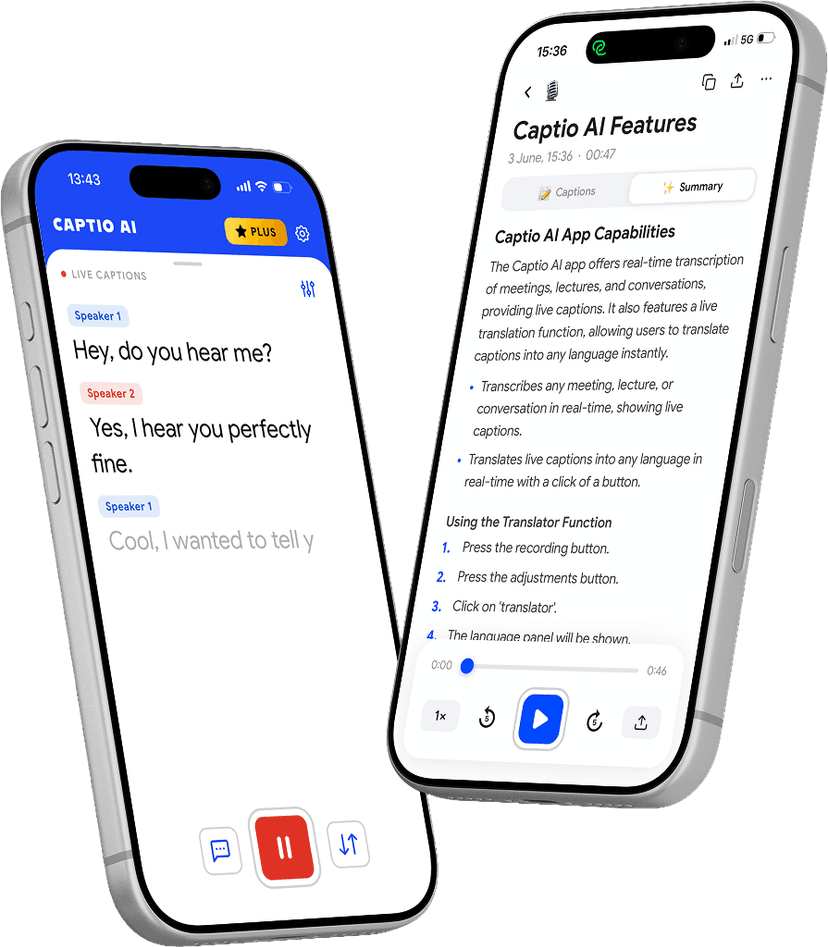
Everything you need to follow Korean communicating with deaf & HoH
Four tools built for deaf and hard of hearing Korean speakers.
You speak. They read.
- Your words appear on their screen word by word
- No sign language required from you
- Works at home, at work, anywhere
- Any accent, any pace
When language is also a barrier
- You speak your language, they read in theirs
- Translates in real time as you speak
- 60+ languages, no setup
- Handles mid-sentence switches
Save the conversation for them
- Record and transcribe any exchange
- They can review everything at their own pace
- Organised by speaker
- Any length, any format
Make sure nothing important was missed
- Key points extracted from any transcript
- Useful after appointments, meetings, or important conversations
- Organised into clear sections
- Works on any saved recording
Download for free
Every situation covered
Designed for the real moments that matter — not just quiet controlled environments.
Korean family meals — in Seoul, Busan, or a smaller family home — move fast, with hearing family members speaking in the casual register they use with each other. Captio AI captions what each person says in real time so a deaf or hard of hearing family member follows the full conversation without asking anyone to slow down or repeat.
Korean workplaces have clear hierarchical registers — formal speech for seniors, casual for close colleagues. A hearing colleague moves naturally between these levels. Captio AI captions everything in real time so a deaf or hard of hearing colleague follows desk conversations, quick instructions, and hallway exchanges without missing a word.
When your partner is deaf or hard of hearing and Korean is your home language. You speak naturally — the usual pace, the usual mix of formal and casual. Captio AI puts every word on their screen as you say it so nothing is lost between you.
Everyday home life in a Korean household — questions across the living room, talking over a drama on TV, quick exchanges over breakfast. Captio AI covers the continuous low-key conversation that connects a household day by day.
When a deaf or hard of hearing person meets a new hearing Korean speaker — at a family gathering, a hoesik dinner, or through a common friend. Set up Captio AI and the conversation starts naturally, without anyone needing to adjust how they speak.
Group settings — a chuseok gathering, a family meal, or a mixed social event — where some people are deaf or hard of hearing and some are not. Captio AI captions whoever is speaking so every person at the table is fully included in the conversation.
Most accurate and fastest models
character accuracy
independent benchmark, 2025
real-time captions
first word appears as you speak
Download for free
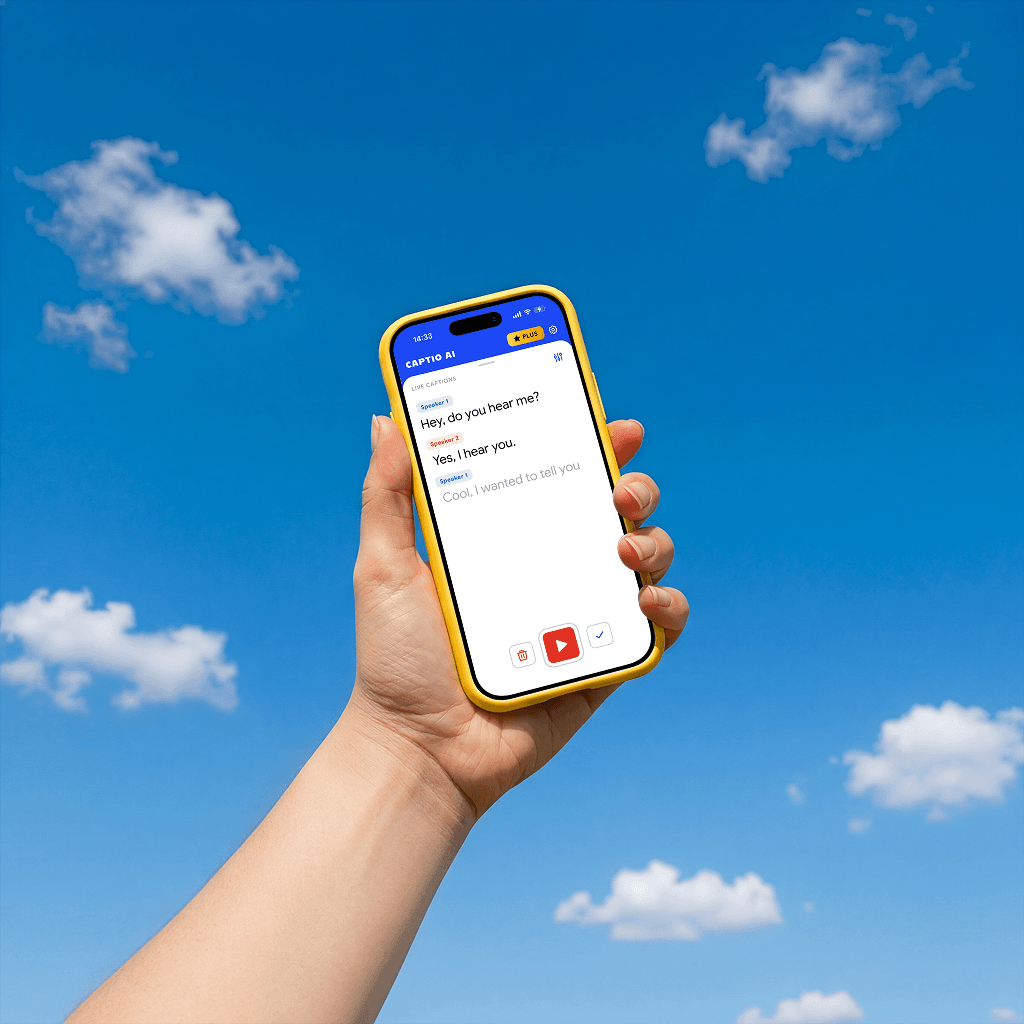
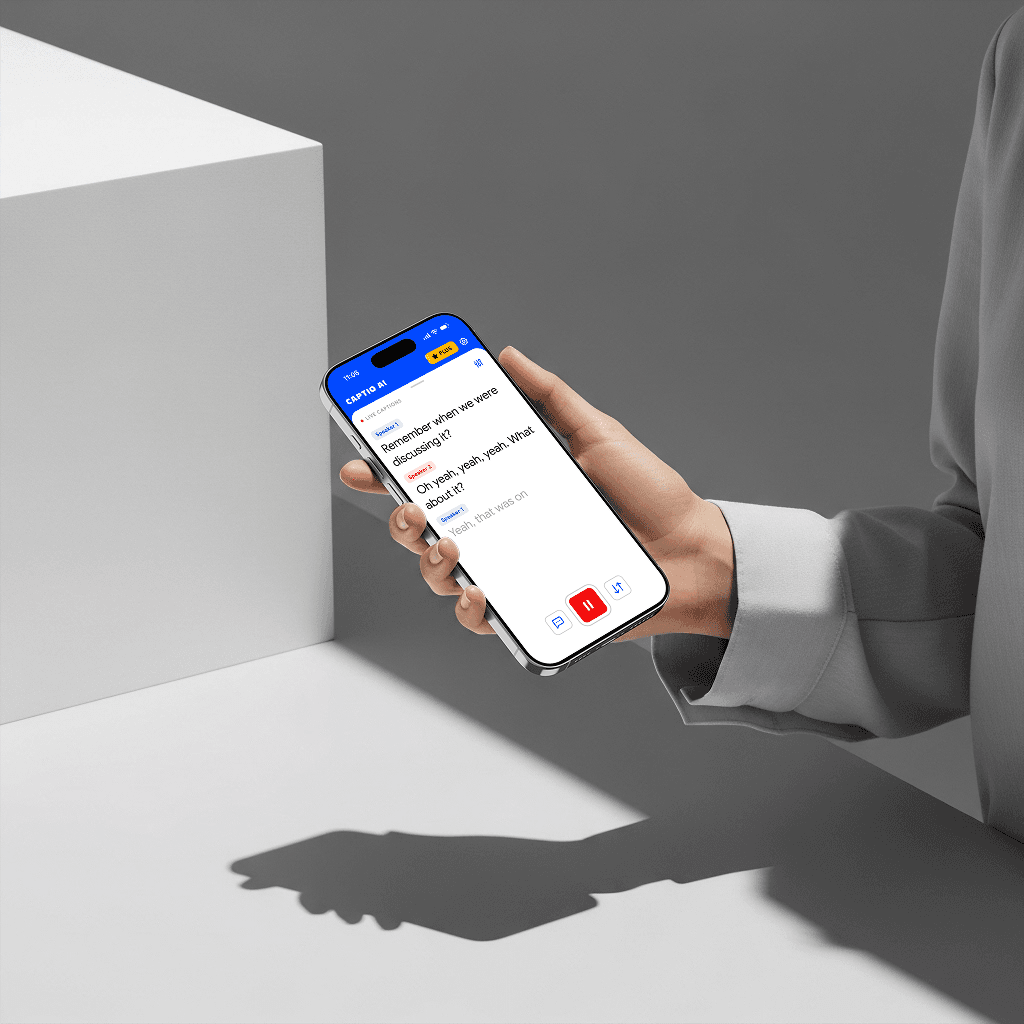
You talk. They follow. No adjustment needed.
You speak naturally
No slowing down, no special phrasing, no training required. Captio AI handles everything — you just talk the way you always do.
They read as you speak
Your words appear on their screen word by word while you are still talking. Not a summary after — the full sentence, in real time.
Works wherever you both are
Living rooms, offices, restaurants, social gatherings. No venue setup, no special conditions. Captio AI works anywhere you have a conversation.
No sign language from either side
You do not need to learn anything new. Neither do they. Captio AI bridges the gap without requiring any change to how either of you communicates.
Works with how you actually speak
Fast, accented, casual. Captio AI handles real speech — not just slow, clear dictation. You do not need to perform clarity for it to work.
Private by default
Your conversations are never recorded, stored, or shared. Audio is processed in real time and discarded immediately — nothing is kept.
Why Korean is hard to understand
Three-way stop contrast
- Plain, tense, and aspirated Korean stops all look the same at the lips
- Korean distinguishes plain, tense, and aspirated stops at the same place of articulation — /p/, /p'/, /pʰ/; /t/, /t'/, /tʰ/. The contrast is carried entirely by voice onset time and pitch — two acoustic cues that are invisible at the lips. 'Pa', 'ppa', and 'pha' look identical to a deaf lip-reader, yet they are different words.
Unreleased final consonants
- Korean word endings close the mouth but never open again
- Korean has seven permissible final consonants, but in natural speech, stop codas are unreleased before another consonant. The mouth closes, no burst follows, and the coda is phonetically invisible. A deaf lip-reader sees a closed mouth at word endings and cannot distinguish which final consonant was intended.
Gyeongsang tone-accent split
- Busan and Seoul Korean are different lip-reading tasks
- Standard Seoul Korean has relatively flat pitch; Gyeongsang Korean (Busan, Daegu) is a pitch-accent dialect where words change meaning with different pitch contours — a dimension that is entirely auditory. A deaf lip-reader familiar with Seoul-standard speech faces an added invisible layer when a hearing family member from the Gyeongsang region speaks.
Casual syllable compression
- Korean casual speech drops entire syllables that a lip-reader expects to see
- Korean casual speech drops syllables aggressively: '어디 가?' becomes '드가?', '뭐야?' becomes '먀?'. These contractions have no standard written form — a deaf lip-reader's learned visual patterns do not match what a hearing family member actually produces at a family dinner or at home.
Koreanized English loanword density
- English loanwords in Korean sound like neither English nor traditional Korean
- Modern Seoul Korean is dense with 외래어 (English loanwords) fully absorbed into Korean phonology — 'ice cream', 'computer', 'air conditioning' become '아이스크림', '컴퓨터', '에어컨'. The lip shapes don't match English pronunciation or traditional Korean — creating a third visual category a deaf lip-reader must navigate.
Download for free
Hearing loss in South Korea: a common condition, a persistent daily gap
A nationwide population-based study found that severe to profound hearing loss affected 0.46% of South Korea's population in 2015 — approximately 237,000 people (PMC6028585). But clinically significant hearing loss extends well beyond this threshold: a separate study found that 37.4% of South Koreans have minimal hearing loss, and the Frontiers in Public Health situational analysis (2023) identified significant gaps in rural-urban access to ear care. Hearing impairment is more prevalent in rural areas — 1.4 times higher than urban — and in men, reflecting occupational noise exposure across South Korea's industrial sectors.
South Korea's National Health Insurance has subsidised hearing aids for registered individuals with severe hearing loss since 1989, and subsidies increased to approximately US$1,000 in 2015. But the programme covers only the most severe end of the spectrum. People with moderate hearing loss — the majority of those with a clinically significant condition — receive no financial support for hearing aids and often go undiagnosed for years. Korean Sign Language (KSL) exists as a recognised language with a small community of users, but for the large majority of deaf and hard of hearing Koreans, daily communication with hearing family members depends on informal strategies rather than any structural support.
South Korea has one of the world's most rapidly ageing populations, and hearing loss rises steeply with age. As Korean households increasingly include elderly members with significant hearing impairment, the communication gap at family tables grows — while the technology to bridge it has remained limited to formal hearing aid provision. Captio AI captions natural Korean speech in real time, at a chuseok table in Seoul or a family dinner in Busan, so a deaf or hard of hearing family member reads exactly what their hearing relatives are saying — at natural pace, in their home dialect.
Download for free
What you hear stays with you.
Gone the moment it ends
Captio AI processes your audio in real time and discards it immediately. Nothing is recorded. Nothing is kept.
Not a product
Your conversations are not something Captio AI sells, shares, or monetizes — to anyone, for any reason.
Not used to train anything
What you say in a doctor's appointment or a job interview never ends up in a training dataset. Not ours. Not anyone else's.

Private by default
Captio AI supports 60+ languages
Download for free
Frequently asked questions
Make every conversation work — for both sides in Korean.
Captio AI is free to start
Download for free