

Malay live captions and productivity tool for communicating with deaf & HoH
For deaf and hard of hearing people.
Download for free


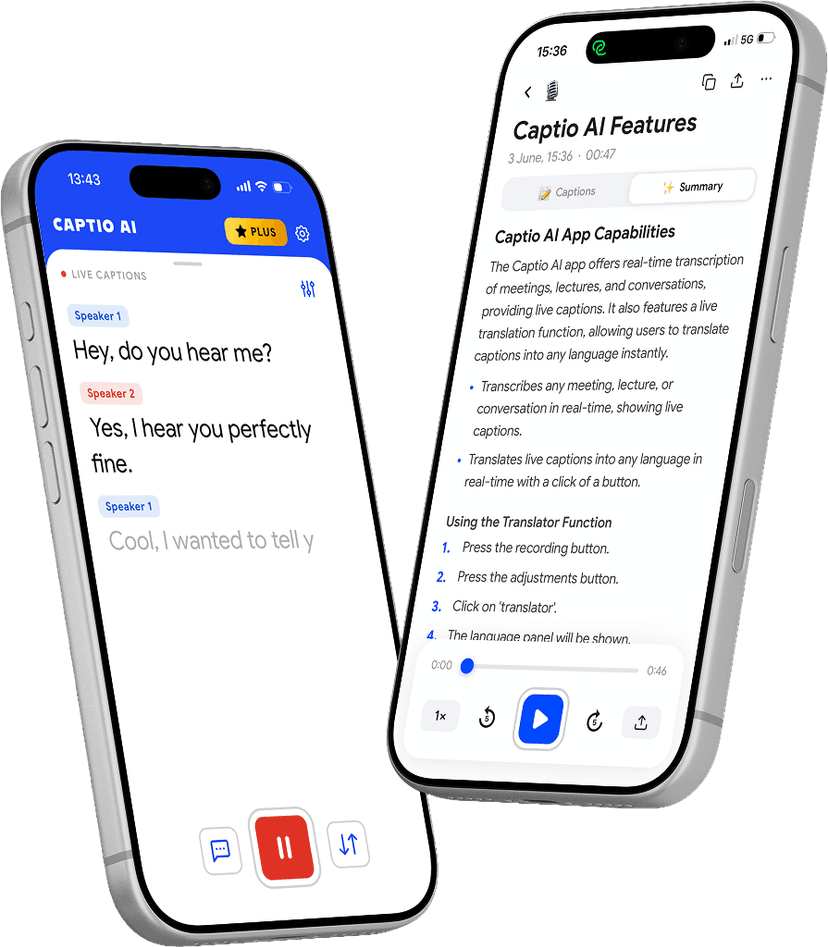
Everything you need to follow Malay communicating with deaf & HoH
Four tools built for deaf and hard of hearing Malay speakers.
You speak. They read.
- Your words appear on their screen word by word
- No sign language required from you
- Works at home, at work, anywhere
- Any accent, any pace
When language is also a barrier
- You speak your language, they read in theirs
- Translates in real time as you speak
- 60+ languages, no setup
- Handles mid-sentence switches
Save the conversation for them
- Record and transcribe any exchange
- They can review everything at their own pace
- Organised by speaker
- Any length, any format
Make sure nothing important was missed
- Key points extracted from any transcript
- Useful after appointments, meetings, or important conversations
- Organised into clear sections
- Works on any saved recording
Download for free
Every situation covered
Designed for the real moments that matter — not just quiet controlled environments.
Malay family meals — in Kuala Lumpur, Johor Bahru, Penang, or a family home in another state — are warm and multi-generational, with hearing family members speaking in whatever mix of standard Malay, regional dialect, and colloquial Rojak comes naturally. Captio AI captions what they say so a deaf or hard of hearing family member follows without asking anyone to repeat.
Malaysian workplaces run in Malay for official exchanges and in an informal mix of Malay, English, and Mandarin or Tamil for everyday corridor talk. A hearing colleague speaks in whichever blend fits the moment. Captio AI captions the Malay speech so a deaf or hard of hearing colleague follows desk conversations and team exchanges.
When your partner is deaf or hard of hearing and Malay is the language you speak at home. You talk naturally — at your normal pace, in the casual Malay of daily life. Captio AI puts every word on their screen as you say it so nothing is lost between you.
Everyday home life in a Malay-speaking household — calling from another room, talking over the evening news, quick exchanges before leaving the house. Captio AI covers the continuous thread of home conversation that a deaf or hard of hearing family member might otherwise guess at.
When a deaf or hard of hearing person meets a new hearing Malay speaker — at a family gathering, a community event, or a kenduri celebration. Set up Captio AI and the conversation begins naturally, without anyone needing to adjust how they speak.
Group settings — a Hari Raya family gathering, a large multi-generation meal, or a mixed community event — where some people are deaf or hard of hearing and some are not. Captio AI captions whoever is speaking so every person at the table is fully part of the conversation.
Most accurate and fastest models
word accuracy
independent benchmark, 2025
real-time captions
first word appears as you speak
Download for free
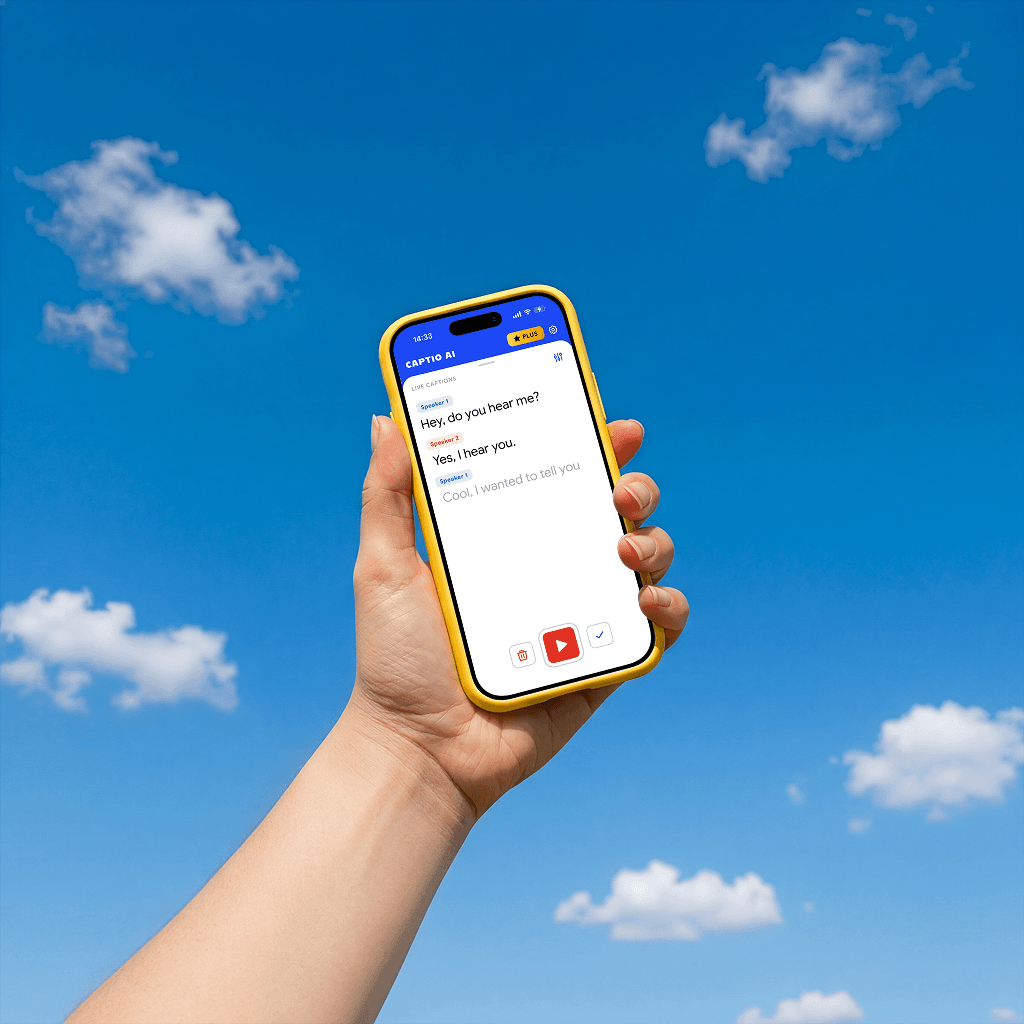
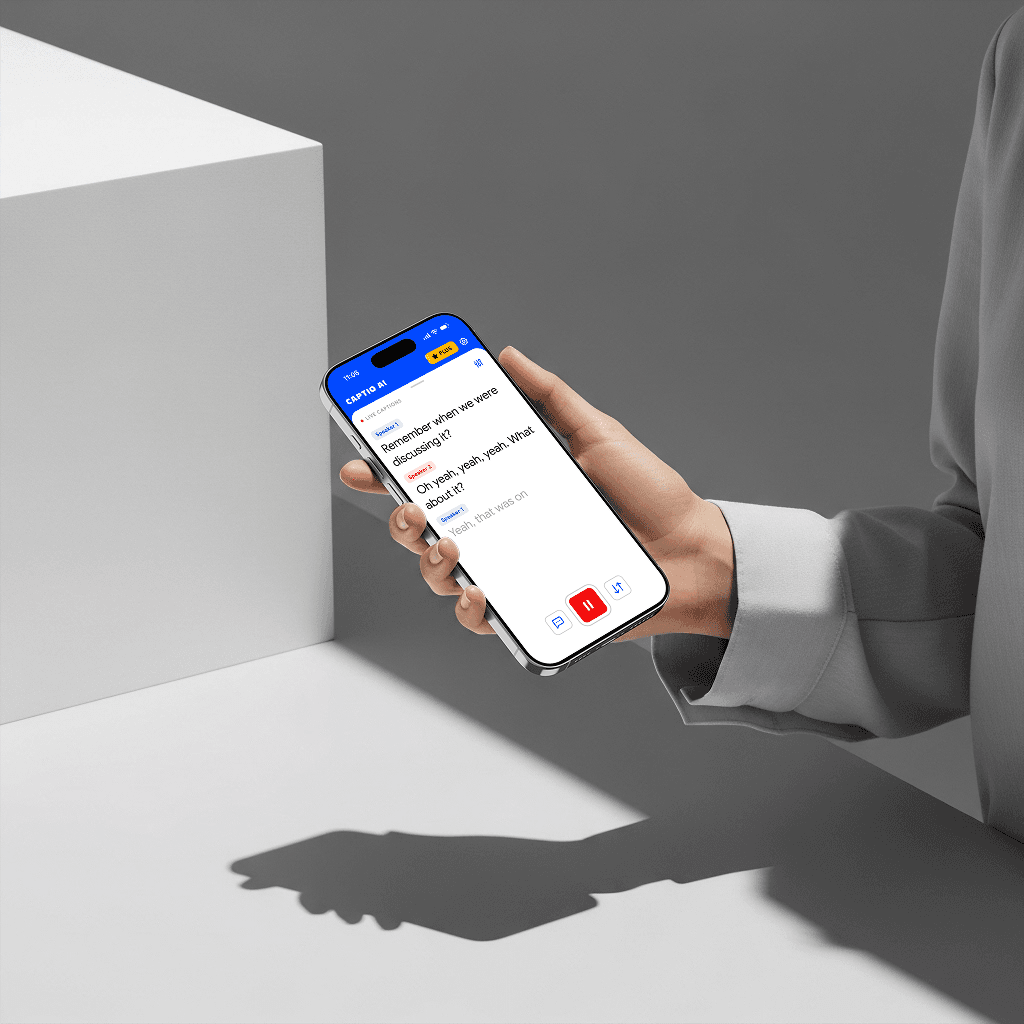
You talk. They follow. No adjustment needed.
You speak naturally
No slowing down, no special phrasing, no training required. Captio AI handles everything — you just talk the way you always do.
They read as you speak
Your words appear on their screen word by word while you are still talking. Not a summary after — the full sentence, in real time.
Works wherever you both are
Living rooms, offices, restaurants, social gatherings. No venue setup, no special conditions. Captio AI works anywhere you have a conversation.
No sign language from either side
You do not need to learn anything new. Neither do they. Captio AI bridges the gap without requiring any change to how either of you communicates.
Works with how you actually speak
Fast, accented, casual. Captio AI handles real speech — not just slow, clear dictation. You do not need to perform clarity for it to work.
Private by default
Your conversations are never recorded, stored, or shared. Audio is processed in real time and discarded immediately — nothing is kept.
Why Malay is hard to understand
Unreleased final stops
- Malay word endings close the mouth but give no visible signal
- Malay syllables commonly end in stops (/p/, /t/, /k/) and nasals. In natural speech, final stops are unreleased — the mouth closes without a burst. For a deaf lip-reader, word endings produce a closed mouth with no further information. It is impossible to distinguish which of the possible final consonants was spoken, collapsing distinctions that change meaning.
Standard Malay vs. Indonesian Malay
- Malaysian Baku and Indonesian produce vowels in different mouth positions
- Standard Malaysian Malay and Indonesian differ in vowel qualities for some common words — the 'o' vs. 'u' distinction in words like 'buku' is one prominent example. A deaf person familiar with one standard finds that a hearing speaker from the other community produces vowels at different mouth positions, requiring relearning the visual map.
Bahasa Rojak code-switching
- Colloquial Malaysian Malay mixes three languages without visual warning
- Colloquial Malay (Bahasa Pasar or Bahasa Rojak) blends Malay with English, Mandarin, and Tamil loanwords in informal settings. A hearing family member in Kuala Lumpur may produce a sentence where consecutive words come from different phonological systems. For a deaf lip-reader, the mouth shapes suddenly don't match any Malay word — with no auditory cue to signal why.
Kelantanese and regional dialect diversity
- Kelantanese and Sarawak Malay follow very different phonological patterns
- Regional Malaysian Malay dialects — Kelantanese, Terengganu, Sarawak Malay, Sabah Malay — have vowel systems and prosodic patterns that differ significantly from Standard Malaysian Malay. A deaf person who lip-reads standard Malay finds that a hearing family member from Kelantan or Sarawak uses mouth shapes for some phonemes that don't fit the standard Malay pattern at all.
Low lip movement per syllable
- Malay speech gives a deaf lip-reader less visual information per word than most European languages
- Malay has 6 vowels and 18 native consonants, with limited use of strongly lip-rounded vowels compared to European languages. The reduced lip movement in natural Malay speech means there are fewer visible articulatory cues per syllable for a deaf lip-reader to work with — making visual disambiguation harder than it would be for a language where the lips move more dramatically.
Download for free
Hearing loss in Malaysia: registered numbers, the real gap, and daily barriers
Malaysia's Department of Statistics (DOSM) recorded 42,652 persons with hearing impairment in 2023 — 6.69% of all registered persons with disabilities and 0.13% of the total population. Selangor, Johor, and Perak had the highest absolute numbers of registered hearing-impaired individuals. But this official count reflects only those formally registered — the National Health Morbidity Survey 2018 found that among older adults, 73.6% had at least mild hearing loss (≥25 dB HL) and 24.6% had at least moderate hearing loss (≥40 dB HL), pointing to a much larger unregistered burden.
A Taylor's University report (2025) documented the barriers faced by deaf Malaysians in detail: deaf students in Malaysia are frequently pushed toward oralism — lip-reading and spoken language — rather than being given access to Malaysian Sign Language (Bahasa Isyarat Malaysia, BIM). Many grow up in hearing families who don't know BIM, and in school settings teachers often cannot sign. The assimilation pressure places the entire communication burden on the deaf person — learning to lip-read a language that gives limited visual cues, rather than having the hearing environment meet them with accessible communication.
A 2024 scoping review of hearing care services in Malaysia found significant gaps in audiological service delivery, particularly outside major urban centres (Tandfonline 2023). Projections from a 2024 European Archives study suggest that mild and moderate hearing loss among adolescents and working-age adults in Malaysia will continue to increase through 2030. As Malaysia's population ages, age-related hearing loss will add further to the burden. Captio AI captions natural Malay speech in real time — in Standard Malay, in regional dialects, or in the Bahasa Rojak of a Kuala Lumpur household — so a deaf family member reads exactly what their hearing relatives are saying.
Download for free
What you hear stays with you.
Gone the moment it ends
Captio AI processes your audio in real time and discards it immediately. Nothing is recorded. Nothing is kept.
Not a product
Your conversations are not something Captio AI sells, shares, or monetizes — to anyone, for any reason.
Not used to train anything
What you say in a doctor's appointment or a job interview never ends up in a training dataset. Not ours. Not anyone else's.

Private by default
Captio AI supports 60+ languages
Download for free
Frequently asked questions
Make every conversation work — for both sides in Malay.
Captio AI is free to start
Download for free