

Tagalog live captions and productivity tool for group settings
For deaf and hard of hearing people.
Download for free


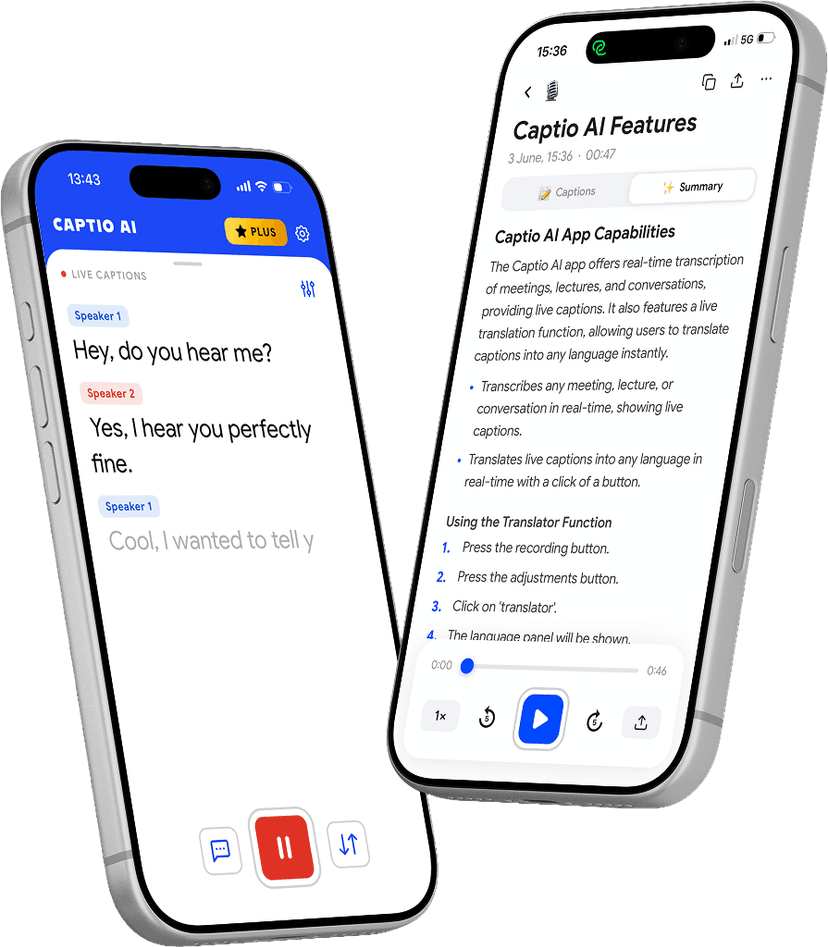
Everything you need to follow Tagalog group settings
Four tools built for deaf and hard of hearing Tagalog speakers.
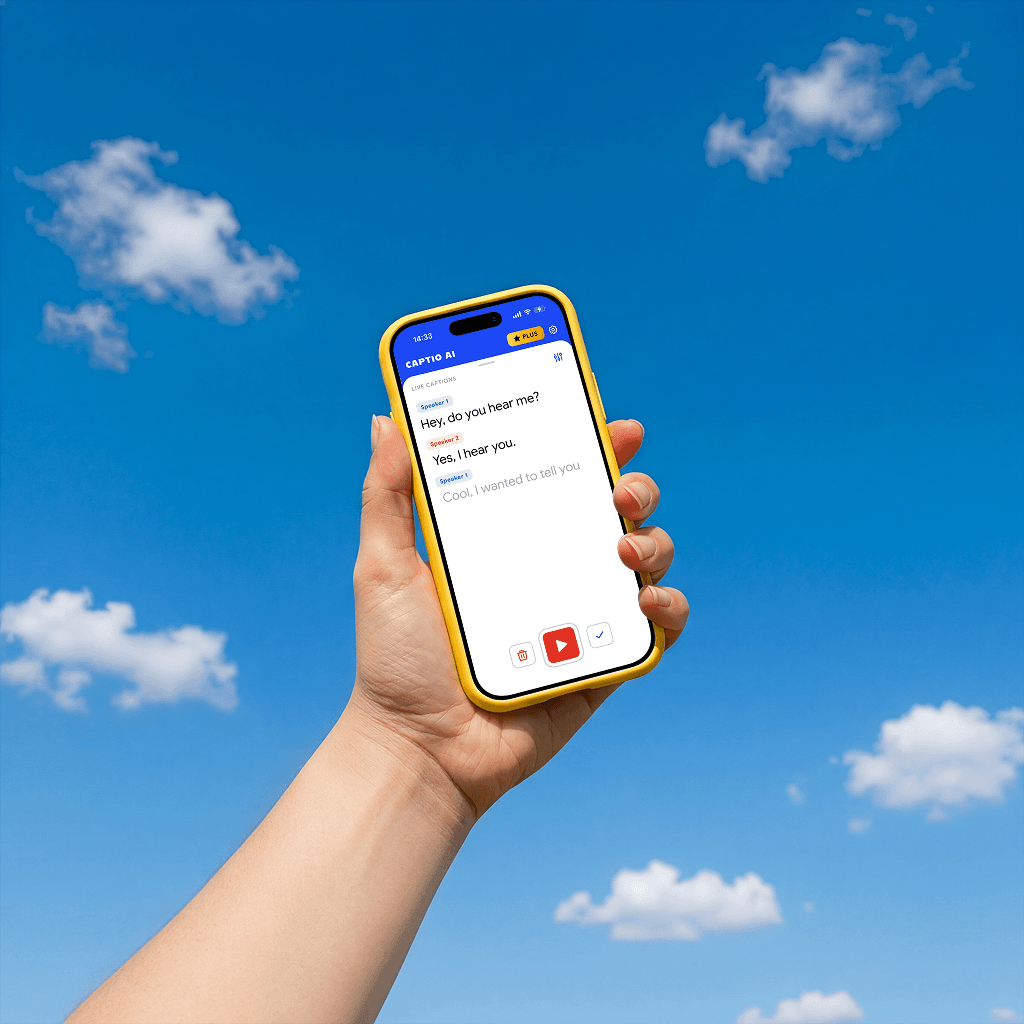
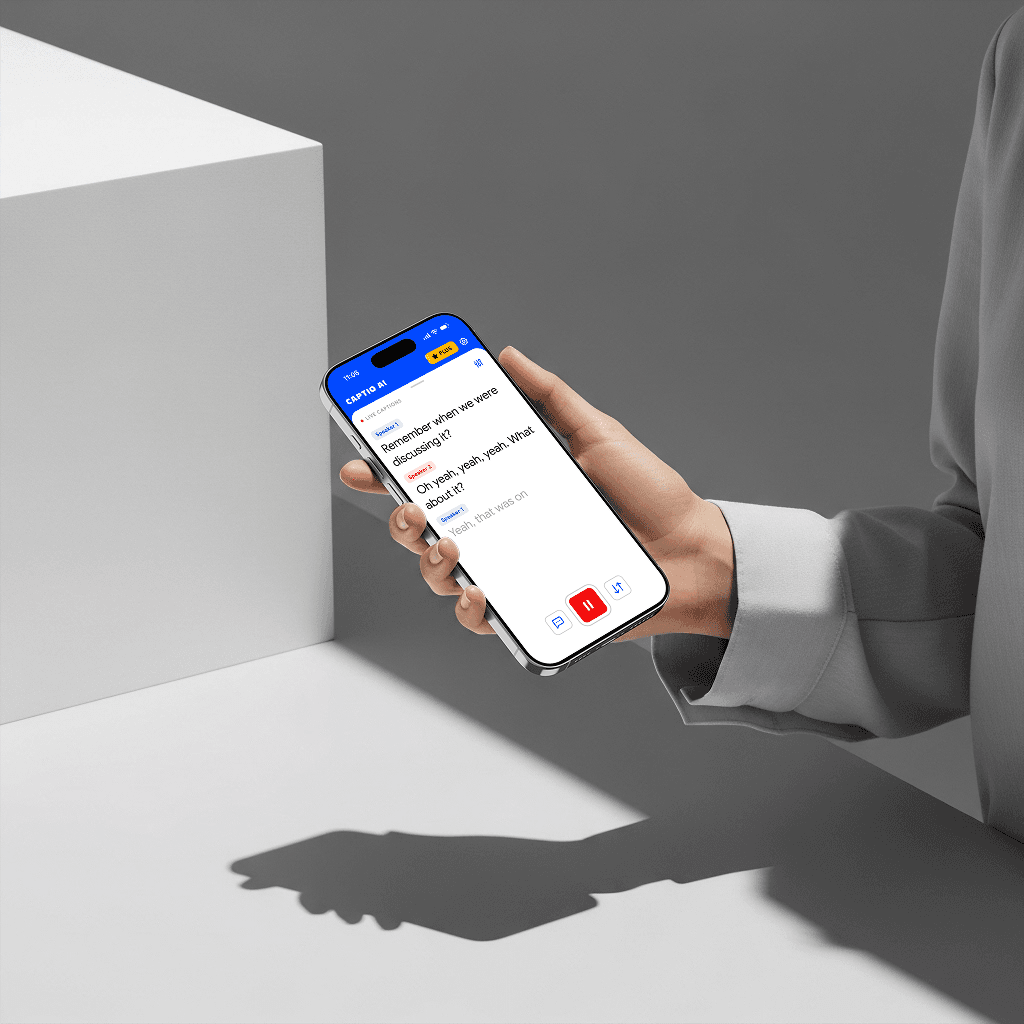
Follow whoever is speaking
- Captions the active voice at any moment
- Works at dinner tables, parties, and social gatherings
- Place the phone in the centre of the group
- Any accent, any pace
For multilingual groups
- Each person speaks their own language
- You read in yours, in real time
- 60+ languages, no switching
- For international families, mixed-language groups, travel
Transcribe any group conversation
- Record and get the full conversation in writing
- Organised by speaker
- Review who said what after the fact
- Any group size, any language
Key points from any group discussion
- Decisions and takeaways extracted automatically
- Useful for group meetings and community discussions
- Organised into clear sections
- Works on any saved recording
Download for free
Every situation covered
Designed for the real moments that matter — not just quiet controlled environments.
A Filipino family dinner — a Noche Buena, a birthday celebration, or a Sunday family lunch — with relatives arriving from different provinces and talking over each other.
A fiesta celebration or a barangay gathering where the yard fills with guests and multiple conversations run simultaneously over lechon and rice.
A catch-up with old friends over sinigang and soft drinks, with fast conversation jumping between personal news, work, and shared memories.
A barangay community meeting or a neighbourhood association gathering where announcements are made and everyone participates.
Three generations at a family table — grandparents in provincial Tagalog or Bisaya, parents in Manila Tagalog, children in Taglish.
A casual evening at a neighbour's home or a birthday gathering in the living room where small groups form and talk freely.
Most accurate and fastest models
word accuracy
independent benchmark, 2025
real-time captions
first word appears as you speak
Download for free
Built to keep you in the conversation, not just in the room
Captions whoever is speaking
Captio AI follows the dominant voice at any moment — whoever is loudest in the microphone's direction. In a group conversation, this tracks the active speaker naturally.
Works through background noise
Restaurants, living rooms, parties, outdoor gatherings. Moderate background noise does not prevent accurate captions — Captio AI is built for real environments, not quiet rooms.
Place it in the centre and forget it
Put the phone on the table or in the middle of the group, microphone facing the conversation. No positioning it after every speaker change, no adjusting between voices.
Less effort, less fatigue
The cognitive load of following a group conversation by lip-reading and reconstructing speech is exhausting. Captio AI handles the following so you can direct your energy toward actually being in the conversation.
60+ languages
For multilingual families, mixed-language social groups, or gatherings where people switch between languages mid-conversation. No setup required between language changes.
No setup between conversations
Open the app and place the phone. No configuration per setting, no briefing the group, nothing to manage between conversations. It works for any group, in any situation.
Why Tagalog is hard to understand
Stress-meaning pairs
- Word stress changes the word — same lip shape
- In Tagalog, stress position on the final or penultimate syllable changes a word's meaning: báta (child) versus batá (robe), or bilí (buy) versus bíli (price). This distinction is carried by vowel length rather than pitch, and at a family gathering both words produce the same brief lip pattern with no visible signal of which meaning was intended.
Glottal stop invisibility
- A phonemic sound that produces no lip movement
- Tagalog has a phonemic glottal stop that occurs within and between words. This sound is produced by a brief closure of the vocal folds, producing no visible change in lips, jaw, or tongue from the outside. At a dinner table, glottal-stop minimal pairs are completely visually identical.
Taglish code-switching
- Tagalog and English shift in every other sentence
- Filipino social conversation — particularly among younger and urban speakers — continuously mixes Tagalog and English (Taglish). The switch can happen mid-phrase without pause or signal. A deaf person applying Tagalog lip-reading patterns is suddenly reading English phonology, and vice versa, without warning.
Regional variation
- Batangas, Bulacan, and Manila Tagalog sound different
- Batangas Tagalog, Bulacan Tagalog, and Metro Manila Tagalog differ in vowel quality, intonation patterns, and word choice. Family gatherings that draw relatives from different provinces put a deaf person in front of several distinct sound inventories simultaneously.
Fast overlapping pace
- Filipino family gatherings are loud and simultaneous
- Filipino family social events are famously lively with multiple speakers talking simultaneously and loudly. At a family reunion or birthday celebration, the visual competition between overlapping speakers at close table distance makes lip-reading extremely difficult — even identifying which face to watch is a constant active decision.
Download for free
Hearing loss in the Philippines: the scale of daily exclusion
A national survey of hearing loss in the Philippines found that 8.8% of the population — an estimated 9 million people — have hearing loss requiring medical attention or rehabilitation. The prevalence varies sharply by age: 7.5% in those under 18, 14.7% in adults aged 18–65, and 49.1% in adults over 65. Despite this scale, the Philippines has one of the smallest ear and hearing specialist populations in Southeast Asia: only 862 ENT physicians, 84 audiologists, and 462 speech and language pathologists serve the entire country. Access to hearing care is especially challenging in geographically isolated and disadvantaged areas — including the island provinces where a significant portion of the population lives.
Deaf and hard-of-hearing Filipinos face compounding structural barriers. Every city and municipality is required by law to maintain a PWD Affairs Office, but disability ID registration remains significantly undercounted: official records show approximately 1.44 million registered persons with hearing impairment (1.57% of the population), far below the 9 million estimated to have hearing loss requiring support. Sign language interpretation is absent from most community social events, family gatherings, and neighbourhood occasions. Existing lip-reading technology has historically been developed for English and other major languages — researchers have documented that Tagalog-specific visual speech patterns are not captured by existing lip-reading systems, leaving Filipino deaf users without accessible tools in their own language.
Captio AI captions Tagalog conversation in real time on a phone screen — so a deaf family member at a Noche Buena gathering, a fiesta, or a barangay reunion in Manila, Cebu, or Pampanga can follow every story and toast as it is spoken, without sitting aside from the table.
Download for free
What you hear stays with you.
Gone the moment it ends
Captio AI processes your audio in real time and discards it immediately. Nothing is recorded. Nothing is kept.
Not a product
Your conversations are not something Captio AI sells, shares, or monetizes — to anyone, for any reason.
Not used to train anything
What you say in a doctor's appointment or a job interview never ends up in a training dataset. Not ours. Not anyone else's.

Private by default
Captio AI supports 60+ languages
Download for free
Frequently asked questions
Keep up with the group in Tagalog.
Captio AI is free to start
Download for free