

Arabic live captions and productivity tool for group settings
For deaf and hard of hearing people.
Download for free


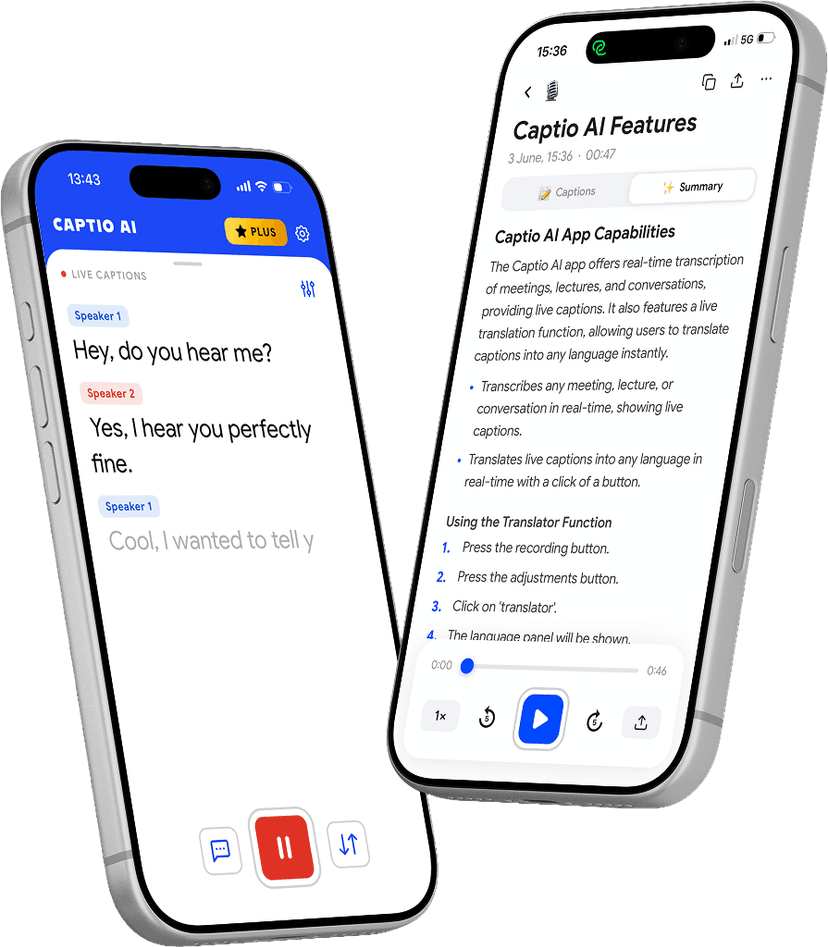
Everything you need to follow Arabic group settings
Four tools built for deaf and hard of hearing Arabic speakers.
Follow whoever is speaking
- Captions the active voice at any moment
- Works at dinner tables, parties, and social gatherings
- Place the phone in the centre of the group
- Any accent, any pace
For multilingual groups
- Each person speaks their own language
- You read in yours, in real time
- 60+ languages, no switching
- For international families, mixed-language groups, travel
Transcribe any group conversation
- Record and get the full conversation in writing
- Organised by speaker
- Review who said what after the fact
- Any group size, any language
Key points from any group discussion
- Decisions and takeaways extracted automatically
- Useful for group meetings and community discussions
- Organised into clear sections
- Works on any saved recording
Download for free
Every situation covered
Designed for the real moments that matter — not just quiet controlled environments.
A family iftar dinner during Ramadan where the whole extended family sits together and conversation runs fast in colloquial dialect. Captio AI captions each speaker so you follow the breaking of fast without missing any of it.
A weekend family visit where relatives from different Arab countries speak their home dialect and the conversation shifts registers constantly. Captio AI handles each colloquial variety without adjustment.
A social gathering at a café or tea house where friends talk fast in colloquial Arabic and occasionally switch into English or French. Captio AI captions the full conversation.
A community event at a mosque or cultural centre where formal and informal Arabic mix as the setting shifts from announcements to social mingling. Captio AI follows each register.
A multigenerational family gathering where older relatives speak a regional variety and younger ones mix in a European language. Captio AI captions each speaker across the generational divide.
A wedding celebration or family party where music, overlapping conversations, and people moving between groups make tracking any single conversation visually impossible. Captio AI gives you real-time captions of whoever is near your phone.
Most accurate and fastest models
word accuracy
independent benchmark, 2025
real-time captions
first word appears as you speak
Download for free
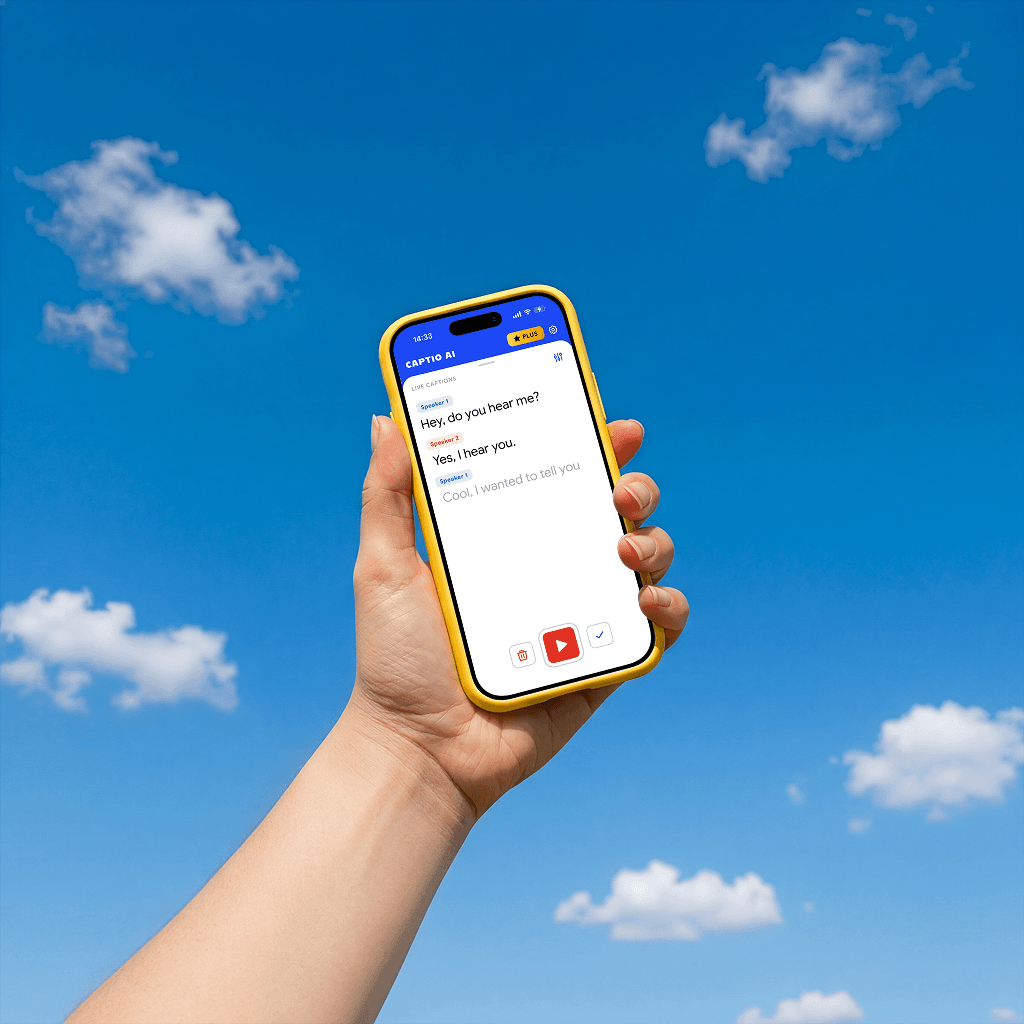
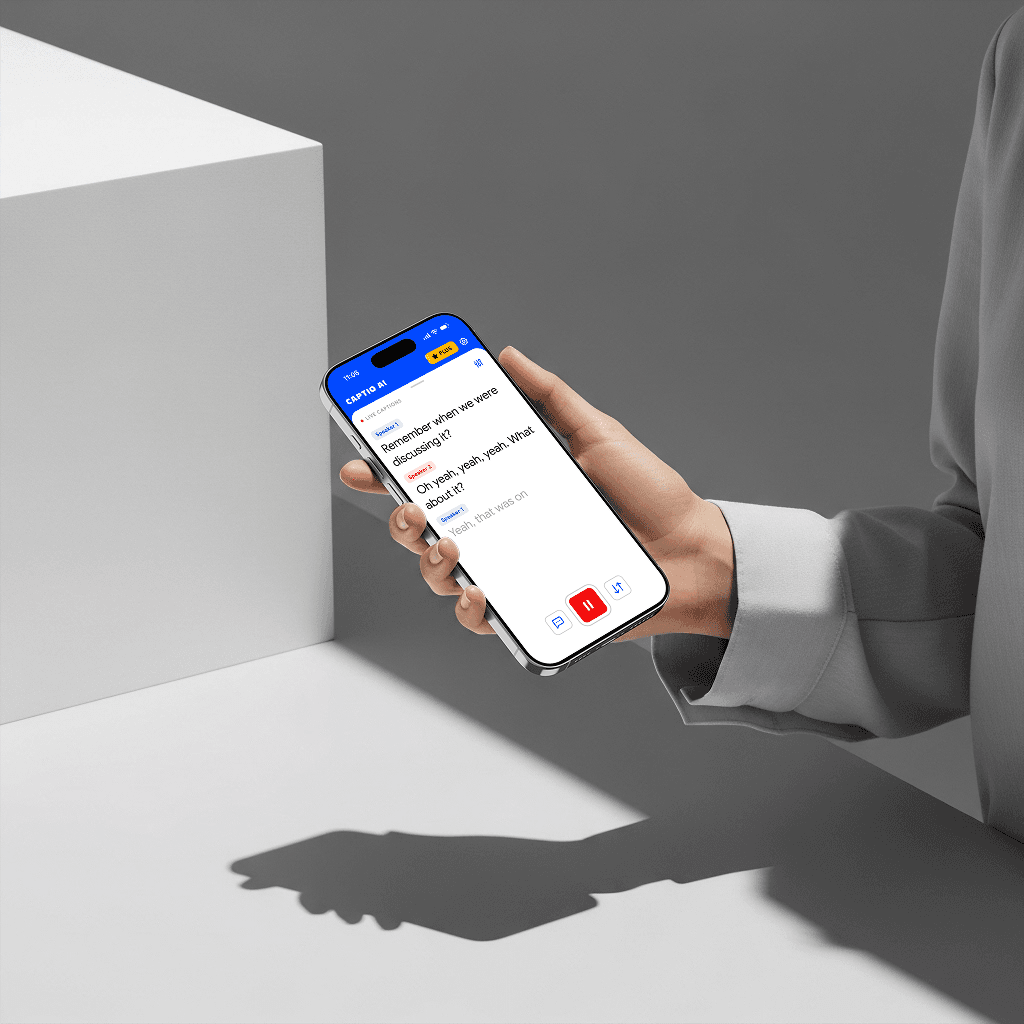
Built to keep you in the conversation, not just in the room
Captions whoever is speaking
Captio AI follows the dominant voice at any moment — whoever is loudest in the microphone's direction. In a group conversation, this tracks the active speaker naturally.
Works through background noise
Restaurants, living rooms, parties, outdoor gatherings. Moderate background noise does not prevent accurate captions — Captio AI is built for real environments, not quiet rooms.
Place it in the centre and forget it
Put the phone on the table or in the middle of the group, microphone facing the conversation. No positioning it after every speaker change, no adjusting between voices.
Less effort, less fatigue
The cognitive load of following a group conversation by lip-reading and reconstructing speech is exhausting. Captio AI handles the following so you can direct your energy toward actually being in the conversation.
60+ languages
For multilingual families, mixed-language social groups, or gatherings where people switch between languages mid-conversation. No setup required between language changes.
No setup between conversations
Open the app and place the phone. No configuration per setting, no briefing the group, nothing to manage between conversations. It works for any group, in any situation.
Why Arabic is hard to understand
Diglossia barrier
- The Arabic taught in school is not the Arabic spoken at family gatherings
- Arabic has two registers in constant tension: Modern Standard Arabic (fuṣḥā), used in formal writing and broadcasts, and colloquial dialects (ʿāmmiyya), used in everyday spoken life. Family gatherings use colloquial dialect exclusively — and colloquial differs substantially from MSA in vocabulary, grammar, and phonology. A deaf person trained in MSA lip-reading faces a completely different phonological landscape in a living room or at an iftar table.
Dialect gulf
- Egyptian, Moroccan, Gulf, and Levantine Arabic are phonologically distinct
- Colloquial Arabic dialects are distinct enough that native speakers from different regions sometimes struggle to follow each other. A social gathering in a European city bringing together Arabic-speaking families from Egypt, Syria, and Morocco features three different phonological systems in the same room — different vowel inventories, different consonant patterns, different prosody. A deaf person calibrated to one dialect loses comprehension whenever another appears.
Pharyngeal sounds
- A whole class of Arabic consonants is invisible on the lips
- Arabic has pharyngeal (ح ع) and uvular (خ غ) consonants produced deep in the pharynx or at the back of the mouth. The visible articulators — lips, teeth, tongue tip — do not move for these sounds. For a deaf person lip-reading Arabic, an entire consonant class is simply not visible, and these consonants appear in high-frequency, core vocabulary items throughout every conversation.
Code-switching registers
- Arabic gatherings shift between dialect, formal register, and a European language
- In Morocco, Algeria, and Tunisia, French appears mid-sentence in everyday colloquial speech. In Lebanon and the Gulf, English does the same. Educated urban Arabic speakers routinely move between dialect, a semi-formal register, and a European language within the same conversation. Each shift moves the phonological ground without announcement — and a deaf person tracking one variety loses comprehension when another appears.
Fast social speech
- Colloquial Arabic in informal group settings runs substantially faster than formal Arabic
- The Arabic of family iftars, neighbourhood gatherings, and social visits is the fast, vowel-elided, consonant-assimilated colloquial — not the measured Arabic of speeches or broadcasts. Vowels elide between words, syllables compress in fast casual registers, and the pace is substantially higher than anything a formal Arabic speech model prepares for. A deaf person trained on formal Arabic encounters a different language in a relaxed social setting.
Download for free
22 million across the Eastern Mediterranean. One interpreter for every 93,000 deaf people in Saudi Arabia.
The Eastern Mediterranean Region — which encompasses much of the Arab world — is home to an estimated 22 million people with hearing loss, a figure expected to more than double by 2050 according to WHO regional data. A genetic epidemiological review published in Otology & Neurotology (2020) examining hearing loss across all 22 Arab countries found that rates are significantly elevated by consanguineous marriage patterns, which are common across much of the Arab world and represent the primary genetic driver of non-syndromic deafness in the region. In some communities, profound bilateral deafness from recessive genetic causes begins at birth, creating deaf populations with no access to formal support from childhood through adulthood.
Support infrastructure is severely underdeveloped. A CSIS analysis of Arabic sign languages found that Saudi Arabia had one sign language interpreter for approximately every 93,000 deaf people — a ratio that renders professional communication support structurally unavailable in any everyday setting. Each Arab country has developed its own national sign language rather than a shared regional standard, further fragmenting deaf communities' access to education and interpreters. Arabic deaf communities in Jordan, Egypt, Morocco, and the Gulf navigate entirely different sign language systems, with no common standard that could enable cross-border support.
Captio AI captions colloquial Arabic in real time — Egyptian, Gulf, Levantine, and Moroccan Darija — so the Ramadan iftar gathering, the weekend family visit, and the community event at the local mosque are conversations a deaf or hard of hearing person can follow without reconstructing speech from invisible pharyngeal consonants and fast elided vowels.
Download for free
What you hear stays with you.
Gone the moment it ends
Captio AI processes your audio in real time and discards it immediately. Nothing is recorded. Nothing is kept.
Not a product
Your conversations are not something Captio AI sells, shares, or monetizes — to anyone, for any reason.
Not used to train anything
What you say in a doctor's appointment or a job interview never ends up in a training dataset. Not ours. Not anyone else's.

Private by default
Captio AI supports 60+ languages
Download for free
Frequently asked questions
Keep up with the group in Arabic.
Captio AI is free to start
Download for free