

Japanese live captions and productivity tool for group settings
For deaf and hard of hearing people.
Download for free


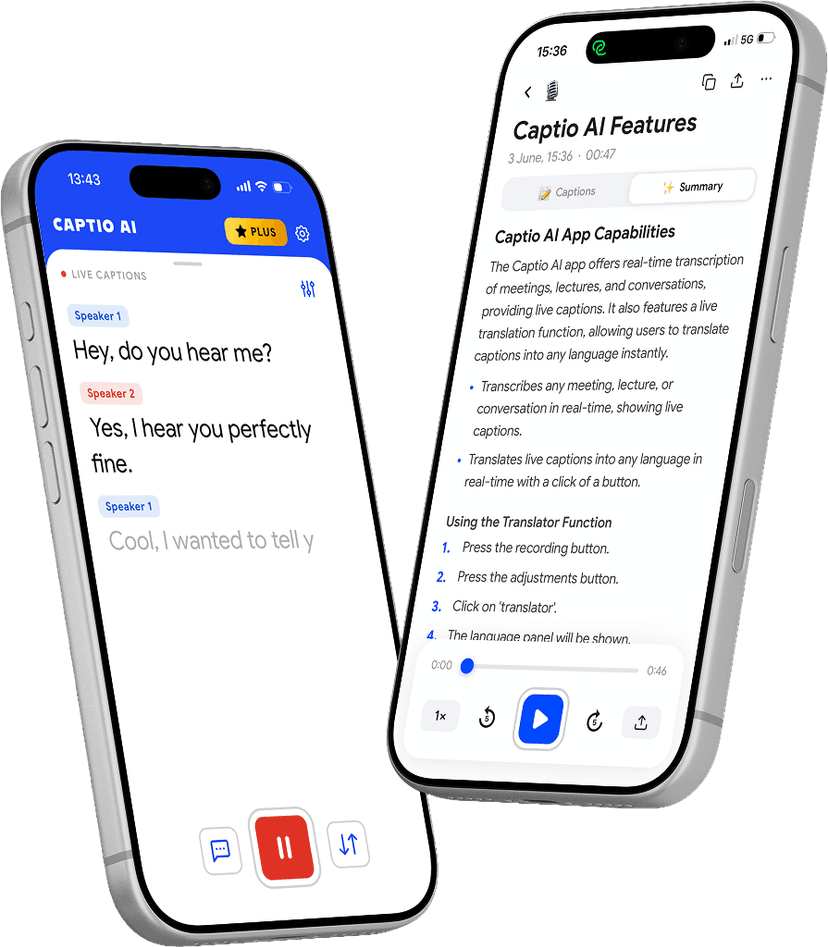
Everything you need to follow Japanese group settings
Four tools built for deaf and hard of hearing Japanese speakers.
Follow whoever is speaking
- Captions the active voice at any moment
- Works at dinner tables, parties, and social gatherings
- Place the phone in the centre of the group
- Any accent, any pace
For multilingual groups
- Each person speaks their own language
- You read in yours, in real time
- 60+ languages, no switching
- For international families, mixed-language groups, travel
Transcribe any group conversation
- Record and get the full conversation in writing
- Organised by speaker
- Review who said what after the fact
- Any group size, any language
Key points from any group discussion
- Decisions and takeaways extracted automatically
- Useful for group meetings and community discussions
- Organised into clear sections
- Works on any saved recording
Download for free
Every situation covered
Designed for the real moments that matter — not just quiet controlled environments.
A New Year (お正月) family gathering where relatives from different regions — Kansai grandparents, Tokyo-raised children, Tohoku cousins — all speak their regional dialect at full speed. Captio AI captions each voice so you follow the whole evening.
An obon family reunion where the extended family gathers at the family home, grandparents speak in dialect, and the fast informal Japanese of tameguchi fills every room. Captio AI follows each speaker.
A nomi-kai (飲み会) gathering with friends where the conversation is fast, informal, and nobody thinks to accommodate anyone who is not following. Captio AI captions whoever is speaking near your phone.
A neighbourhood association (自治会) meeting or apartment building event where multiple residents contribute quickly in Japanese with no formal captioning. Captio AI gives you real-time captions of every contribution.
A multigenerational family birthday or seasonal celebration where grandparents speak in regional dialect, parents in standard Japanese, and grandchildren in fast casual tameguchi with current slang. Captio AI follows all three.
A barbecue or outdoor hanami (cherry-blossom viewing) party with friends where the combination of background noise and fast social Japanese makes lip-reading nearly impossible. Captio AI captions the full conversation.
Most accurate and fastest models
character accuracy
independent benchmark, 2025
real-time captions
first word appears as you speak
Download for free
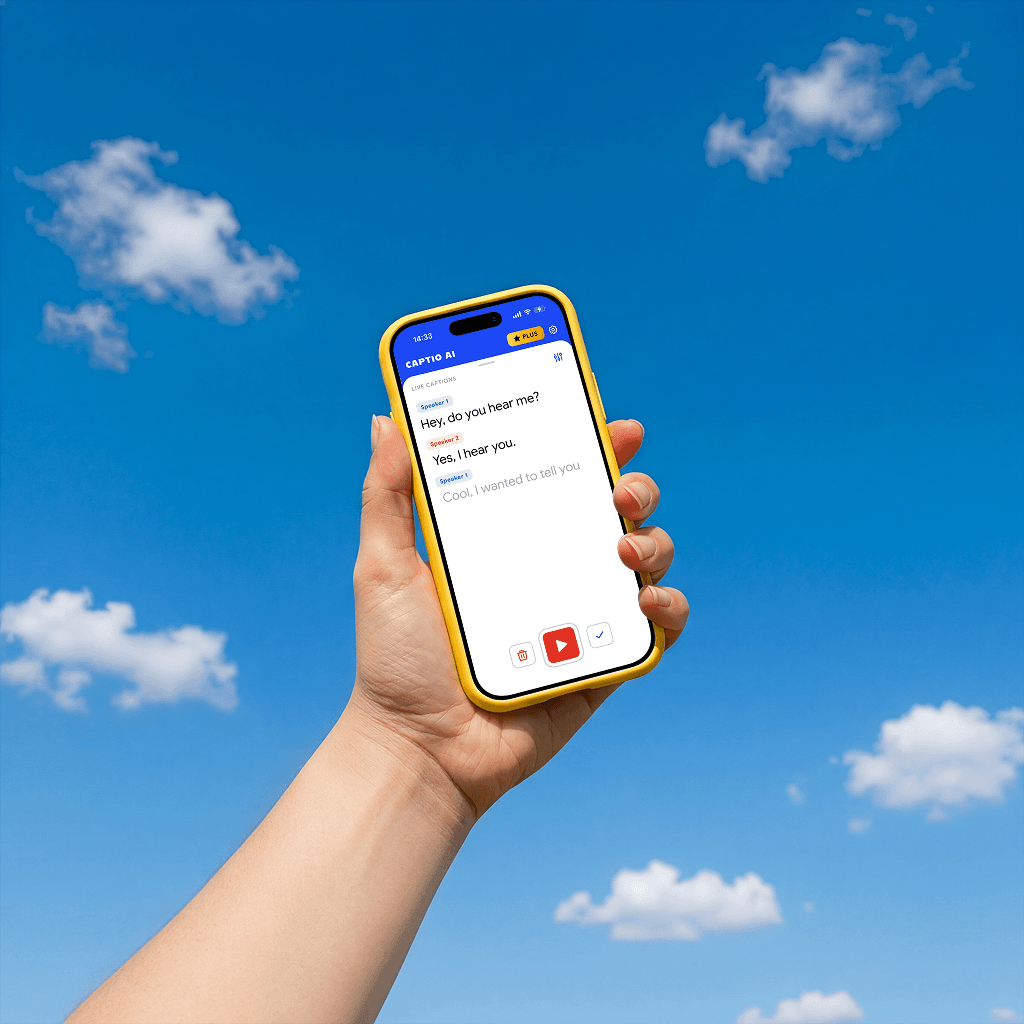
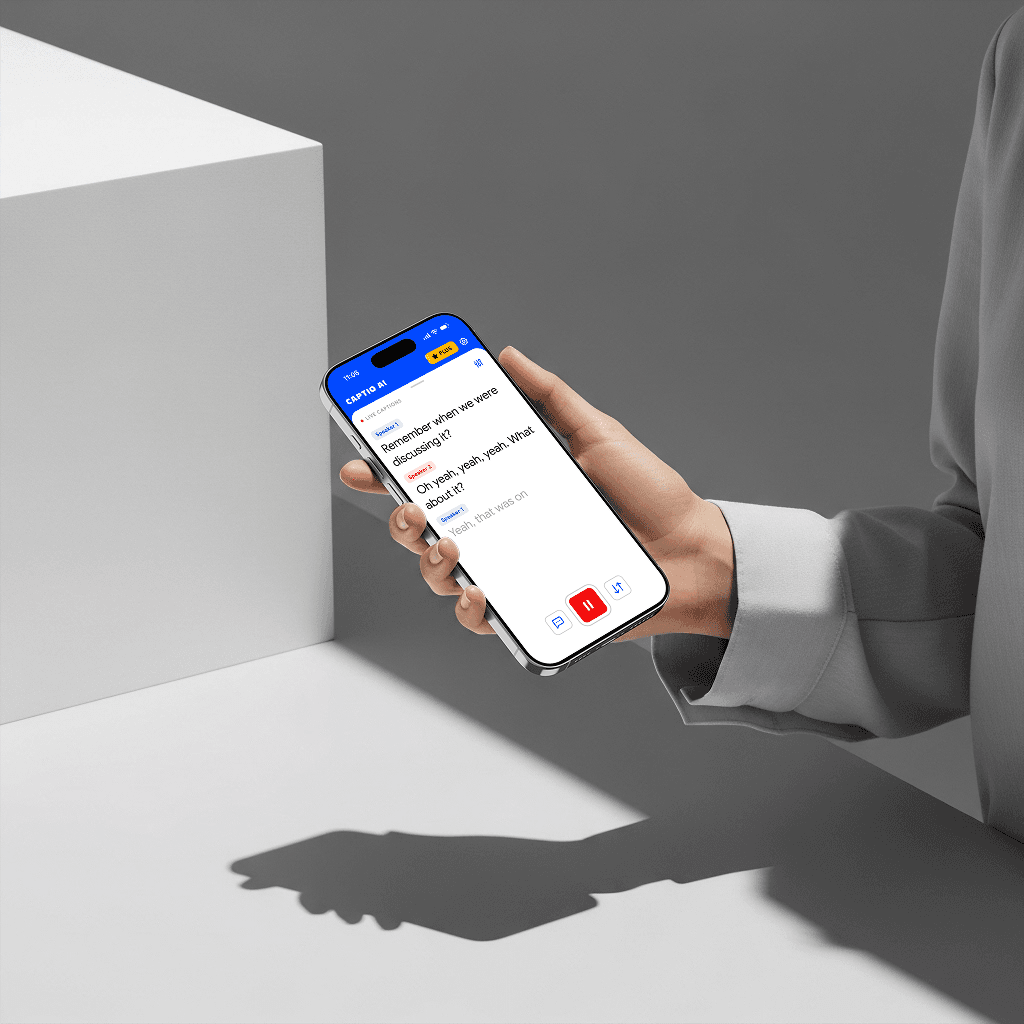
Built to keep you in the conversation, not just in the room
Captions whoever is speaking
Captio AI follows the dominant voice at any moment — whoever is loudest in the microphone's direction. In a group conversation, this tracks the active speaker naturally.
Works through background noise
Restaurants, living rooms, parties, outdoor gatherings. Moderate background noise does not prevent accurate captions — Captio AI is built for real environments, not quiet rooms.
Place it in the centre and forget it
Put the phone on the table or in the middle of the group, microphone facing the conversation. No positioning it after every speaker change, no adjusting between voices.
Less effort, less fatigue
The cognitive load of following a group conversation by lip-reading and reconstructing speech is exhausting. Captio AI handles the following so you can direct your energy toward actually being in the conversation.
60+ languages
For multilingual families, mixed-language social groups, or gatherings where people switch between languages mid-conversation. No setup required between language changes.
No setup between conversations
Open the app and place the phone. No configuration per setting, no briefing the group, nothing to manage between conversations. It works for any group, in any situation.
Why Japanese is hard to understand
Keigo vs tameguchi
- The Japanese spoken at family gatherings is phonologically different from what school and media teach
- Japanese has two sharply differentiated registers: keigo (polite/formal) and tameguchi or kudaketa (casual/intimate). At family dinners and friend gatherings, tameguchi is the exclusive register — rapid speech with dropped particles, contracted sentence endings, and implicit subjects. A deaf person who has calibrated lip-reading to keigo-based Japanese from school or media encounters a phonologically different language at the dinner table, where the careful enunciation of formal speech is entirely absent.
Pitch accent system
- Tokyo and Kansai pitch accent systems are completely different — and both are inaudible to a lip-reader
- Standard Tokyo Japanese uses a pitch accent system where the syllable at which pitch drops determines word meaning: 橋 (hashi, bridge) and 箸 (hashi, chopsticks) differ only in their pitch pattern. Kansai dialect (Osaka, Kyoto, Kobe) uses an entirely different pitch accent system — the same words carry different pitch patterns. For a deaf person, pitch accent distinctions are auditory, not visual, and invisible on the lips regardless of which regional system the speaker uses.
Regional dialect gulf
- Kansai-ben, Hakata-ben, and Tohoku dialects are phonologically distinct from Tokyo standard
- Japanese regional dialects differ substantially from standard Tokyo Japanese. Kansai dialect has different vocabulary (ya instead of da, hen instead of nai), different pitch accent, and distinctive prosody. Hakata dialect (Fukuoka) has different verb endings and phonological features. Tohoku dialect has heavy vowel devoicing. A family gathering with relatives from different prefectures brings multiple dialect systems into the same room — and for a deaf person, each regional shift is another calibration challenge.
Particle and subject omission
- Casual Japanese drops the grammatical information that makes sentences parseable
- Japanese casual speech drops subjects, objects, and particles constantly. '行く?' (iku?, going?) conveys what a formal sentence would express in fifteen syllables. The context-dependence of casual Japanese means that what appears on the lips is a minimal phonological fragment that relies on shared conversational context. For a deaf person following speech visually, the lip-read fragment is insufficient to reconstruct the full utterance without the prosodic and contextual information that carries the dropped elements.
Voiced/voiceless merging
- Japanese consonant pairs that differ in voicing are visually identical on the lips
- Japanese has voiced/voiceless consonant pairs (s/z, t/d, k/g, h/b/p) that are auditory distinctions invisible in lip movement. In fast casual speech at a family gathering or social event, these distinctions reduce further. For a lip-reader, さ (sa) and ざ (za) look identical — a distinction that changes meaning throughout the Japanese lexicon.
Download for free
6 million with hearing loss in Japan. And the family gathering is still the hardest setting of all.
Approximately 6 million people in Japan have moderate-to-severe hearing loss, with an estimated 350,000 identifying as Deaf. A PMC study published in 2025 on Japanese individuals undergoing comprehensive health checks found significant prevalence of high-frequency hearing loss across age groups, with rates rising steeply with age in a country where the population is among the oldest on earth. Japan's rapidly ageing society means the number of people navigating group social life with hearing loss is projected to grow substantially through the next two decades.
A study published in PMC on Japanese women with hearing loss found what researchers called 'triple difficulties' — lower rates of marriage, more frequent smoking, and poorer mental health outcomes compared to hearing women. These disparities are rooted in the social context of hearing loss in Japan: a disability that is often invisible, frequently underacknowledged, and that manifests most acutely in informal social settings — the family gathering, the dinner party, the community event — where no formal accommodation is available and the expectation of natural participation remains unchanged.
Captio AI captions Japanese in real time — across standard Tokyo Japanese, Kansai-ben, Hakata-ben, and other regional varieties — so the New Year family gathering, the obon reunion, and the nomi-kai with friends are conversations a deaf or hard of hearing person can follow without the exhaustion of lip-reading fast tameguchi from multiple regional speakers at the same time.
Download for free
What you hear stays with you.
Gone the moment it ends
Captio AI processes your audio in real time and discards it immediately. Nothing is recorded. Nothing is kept.
Not a product
Your conversations are not something Captio AI sells, shares, or monetizes — to anyone, for any reason.
Not used to train anything
What you say in a doctor's appointment or a job interview never ends up in a training dataset. Not ours. Not anyone else's.

Private by default
Captio AI supports 60+ languages
Download for free
Frequently asked questions
Keep up with the group in Japanese.
Captio AI is free to start
Download for free