

Korean live captions and productivity tool for group settings
For deaf and hard of hearing people.
Download for free


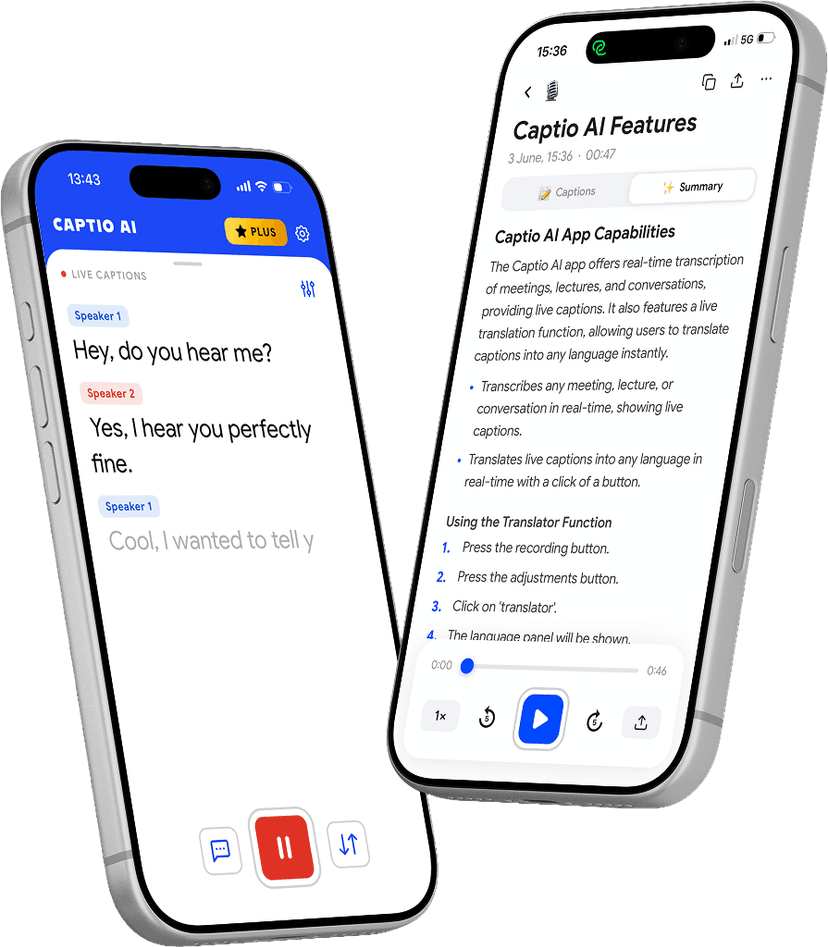
Everything you need to follow Korean group settings
Four tools built for deaf and hard of hearing Korean speakers.
Follow whoever is speaking
- Captions the active voice at any moment
- Works at dinner tables, parties, and social gatherings
- Place the phone in the centre of the group
- Any accent, any pace
For multilingual groups
- Each person speaks their own language
- You read in yours, in real time
- 60+ languages, no switching
- For international families, mixed-language groups, travel
Transcribe any group conversation
- Record and get the full conversation in writing
- Organised by speaker
- Review who said what after the fact
- Any group size, any language
Key points from any group discussion
- Decisions and takeaways extracted automatically
- Useful for group meetings and community discussions
- Organised into clear sections
- Works on any saved recording
Download for free
Every situation covered
Designed for the real moments that matter — not just quiet controlled environments.
A Chuseok (추석) or Seollal (설날) family gathering where the whole extended family comes together and fast Korean from multiple generations fills the house. Captio AI captions each voice so you follow the whole celebration.
A family Sunday lunch in Seoul or Busan where conversation moves between generations speaking different speech levels and regional accents. Captio AI handles both without adjustment.
A 회식 (after-work social gathering) at a Korean BBQ restaurant where the noise, the drinking, and the fast conversation make lip-reading very difficult. Captio AI captions whoever is speaking near your phone.
A neighbourhood or apartment complex community meeting where multiple residents contribute quickly in Korean with no formal captioning. Captio AI gives you real-time captions of every speaker.
A multigenerational family gathering where grandparents speak Gyeongsang or Jeolla dialect and younger family members speak Seoul Korean. Captio AI follows each variety.
A social gathering with friends where Korean and English mix freely and pop culture slang moves faster than any formal language training prepares for. Captio AI captions the full exchange.
Most accurate and fastest models
character accuracy
independent benchmark, 2025
real-time captions
first word appears as you speak
Download for free
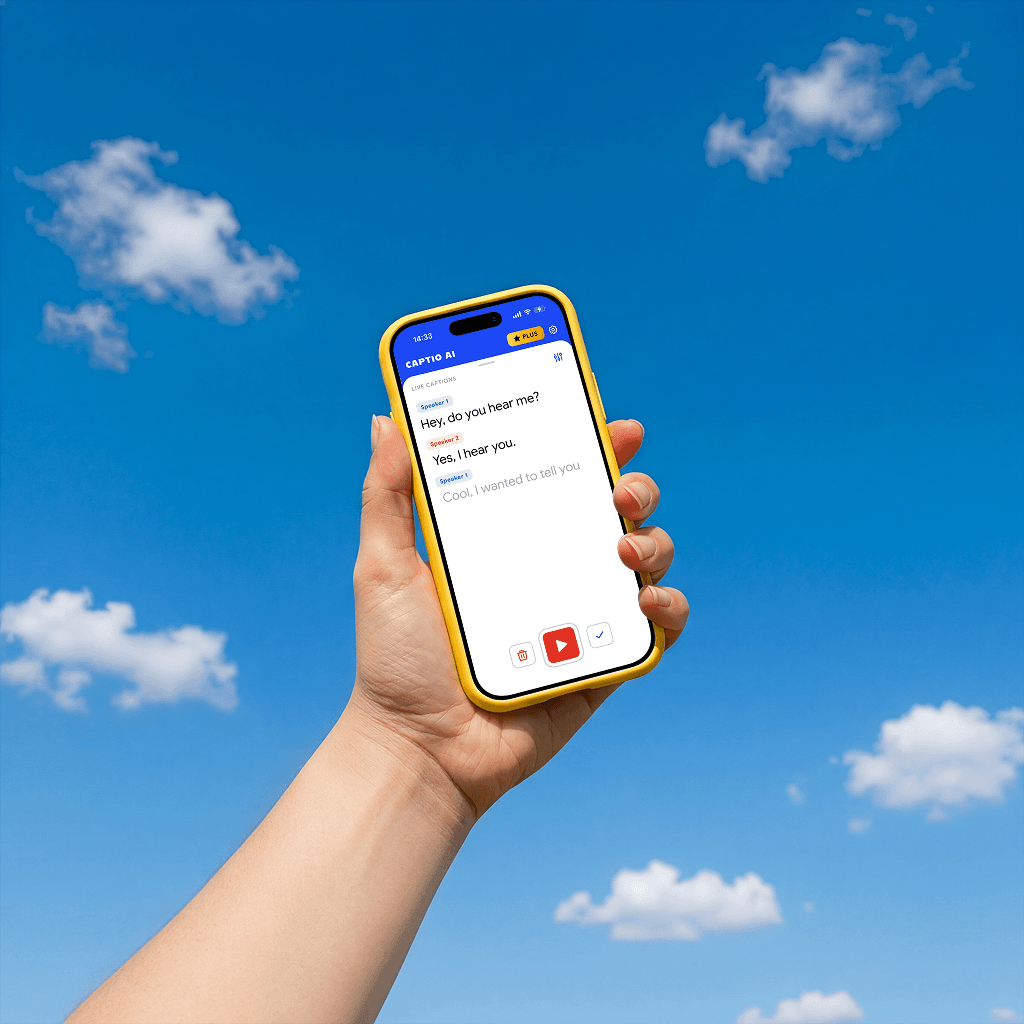
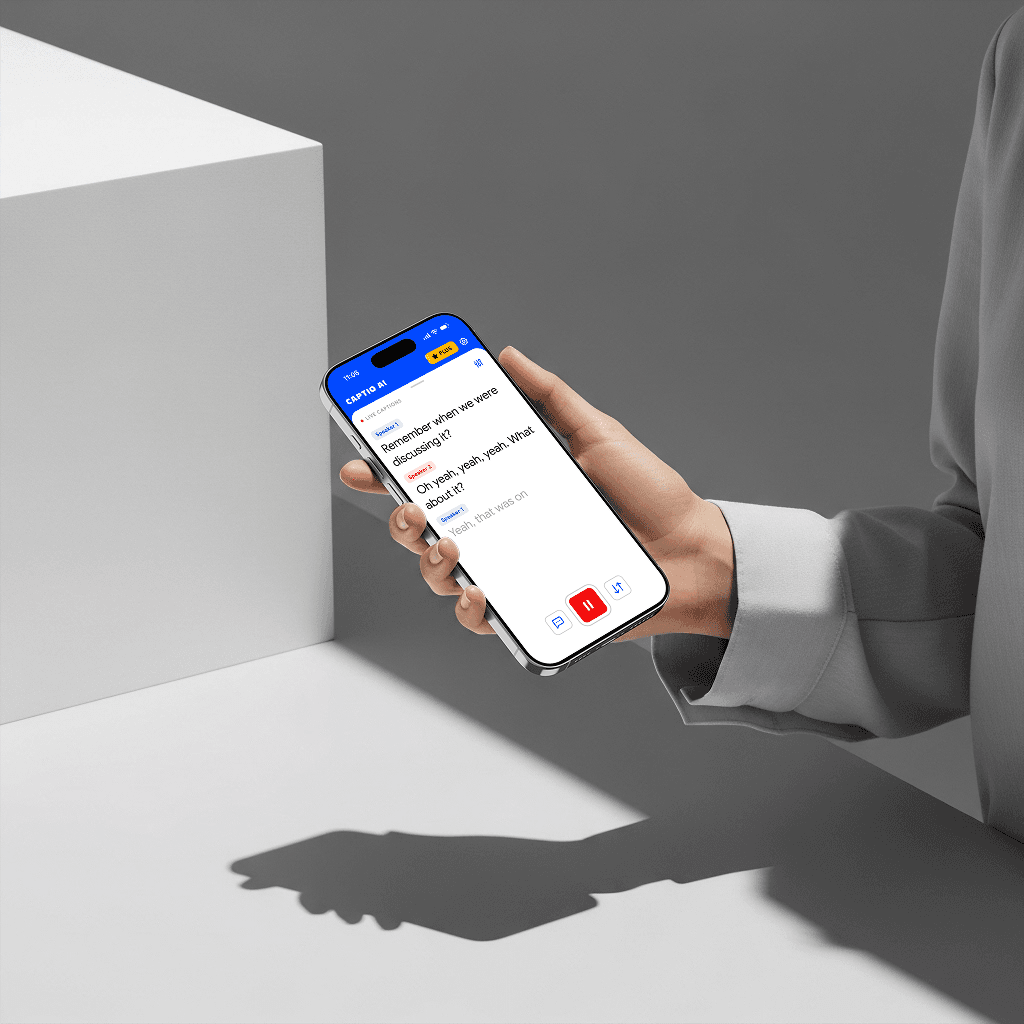
Built to keep you in the conversation, not just in the room
Captions whoever is speaking
Captio AI follows the dominant voice at any moment — whoever is loudest in the microphone's direction. In a group conversation, this tracks the active speaker naturally.
Works through background noise
Restaurants, living rooms, parties, outdoor gatherings. Moderate background noise does not prevent accurate captions — Captio AI is built for real environments, not quiet rooms.
Place it in the centre and forget it
Put the phone on the table or in the middle of the group, microphone facing the conversation. No positioning it after every speaker change, no adjusting between voices.
Less effort, less fatigue
The cognitive load of following a group conversation by lip-reading and reconstructing speech is exhausting. Captio AI handles the following so you can direct your energy toward actually being in the conversation.
60+ languages
For multilingual families, mixed-language social groups, or gatherings where people switch between languages mid-conversation. No setup required between language changes.
No setup between conversations
Open the app and place the phone. No configuration per setting, no briefing the group, nothing to manage between conversations. It works for any group, in any situation.
Why Korean is hard to understand
Seoul vs Gyeongsang pitch accent
- Gyeongsang dialect has a pitch accent system absent from Seoul Korean — two different phonological systems in the same family
- Standard Seoul Korean has no lexical pitch accent. Gyeongsang dialect (southeastern Korea — Busan, Daegu) uses a pitch accent system where high/low tonal distinctions change word meaning. A family gathering with Gyeongsang-dialect grandparents and Seoul-raised grandchildren presents two phonological systems at the same table. For a deaf person calibrated to Seoul Korean, the prosodic pattern of Gyeongsang speech is unfamiliar, and the added pitch layer — invisible on the lips — is not recoverable from visual information.
Speech level system
- Korean speech levels shift throughout a gathering as social relationships shift — and the endings that mark them are invisible
- Korean has multiple speech level endings (formal polite, informal polite, informal, intimate) that shift depending on the relationship between speakers. At a family gathering where elders and younger members speak in the same conversation, the speech level changes constantly — and in fast speech, the ending particles that carry the speech level are contracted or swallowed, making them invisible on the lips. A deaf person tracks not just the phonemes but also the social relationship encoded in the ending — an additional layer of meaning that fast speech obscures.
Consonant assimilation in connected speech
- Korean consonants change across syllable and word boundaries in natural speech
- Korean has extensive consonant assimilation rules that change the actual consonants produced across syllable and word boundaries in connected speech. '한국말' (Korean language) is pronounced 'hangungmal' with nasalisation, not the individual sounds of each syllable. These assimilations change what actually appears on the lips in natural speech — the written form is not what a deaf person sees in a fast conversation. The gap between spelling and pronunciation is particularly large in Korean connected speech.
Korean-English mixing
- South Korean social gatherings among younger speakers constantly blend Korean and English
- In South Korea, particularly among younger and educated speakers, English vocabulary appears throughout casual conversation: '오늘 meeting 있어서 바빠.' '이 coffee shop이 너무 good해.' English words are often given Korean inflection but carry a phonological shift that breaks the visual comprehension chain for a deaf person tracking Korean. In Korean social settings among people under 40, this mixing is frequent enough to constitute a distinct register.
Fast social pace with overlapping contributions
- Korean group conversation at family gatherings and social events runs at high speed
- Korean group conversation — at a family Chuseok gathering, a 회식 (work social), or a friend gathering — runs at high speed with rapid contributions, frequent overlapping, and minimal pause between speakers. The conversational pace leaves minimal visual processing time. At a family gathering during Seollal or Chuseok where multiple generations speak simultaneously and the background noise of a large family home compounds the challenge, even hearing people sometimes lose the thread.
Download for free
Hearing impairment: the most common newly registered disability in South Korea in 2024.
Hearing impairment was the most common newly registered disability type in South Korea in 2024, at 31.7% of new registrations. A KoreaTrak 2024 survey found that approximately 5.3% of the total Korean population reports having hearing loss, with 5.9% among adults 18 and older. Despite this prevalence, only 34.4% of people with self-reported hearing loss reported using hearing aids — a treatment gap that leaves the majority managing daily social life without assistive technology. A PMC study on severe-profound hearing loss found significant and stable prevalence across a ten-year nationwide dataset from 2006 to 2015.
The social consequences of hearing loss in Korea are well documented. A study on quality of life among Koreans with sensory impairments found that individuals with hearing loss are more likely to have limited physical and social functioning, resulting in lower life satisfaction. Research framed the impact explicitly as exclusion from social community and family — not just a communication impairment but a participation barrier. In the context of Korean family life — where Chuseok and Seollal family gatherings are central social occasions and where collective participation carries strong cultural expectations — this exclusion is particularly acute.
Captio AI captions Korean in real time — across Seoul standard, Gyeongsang dialect, Jeolla varieties, and Korean-English mixing — so the Chuseok family gathering, the Sunday lunch in Busan, and the 회식 with friends are conversations a deaf or hard of hearing person can follow without the effort of tracking speech levels and consonant assimilations across a fast-moving group conversation.
Download for free
What you hear stays with you.
Gone the moment it ends
Captio AI processes your audio in real time and discards it immediately. Nothing is recorded. Nothing is kept.
Not a product
Your conversations are not something Captio AI sells, shares, or monetizes — to anyone, for any reason.
Not used to train anything
What you say in a doctor's appointment or a job interview never ends up in a training dataset. Not ours. Not anyone else's.

Private by default
Captio AI supports 60+ languages
Download for free
Frequently asked questions
Keep up with the group in Korean.
Captio AI is free to start
Download for free