

Afrikaans live captions and productivity tool for group settings
For deaf and hard of hearing people.
Download for free


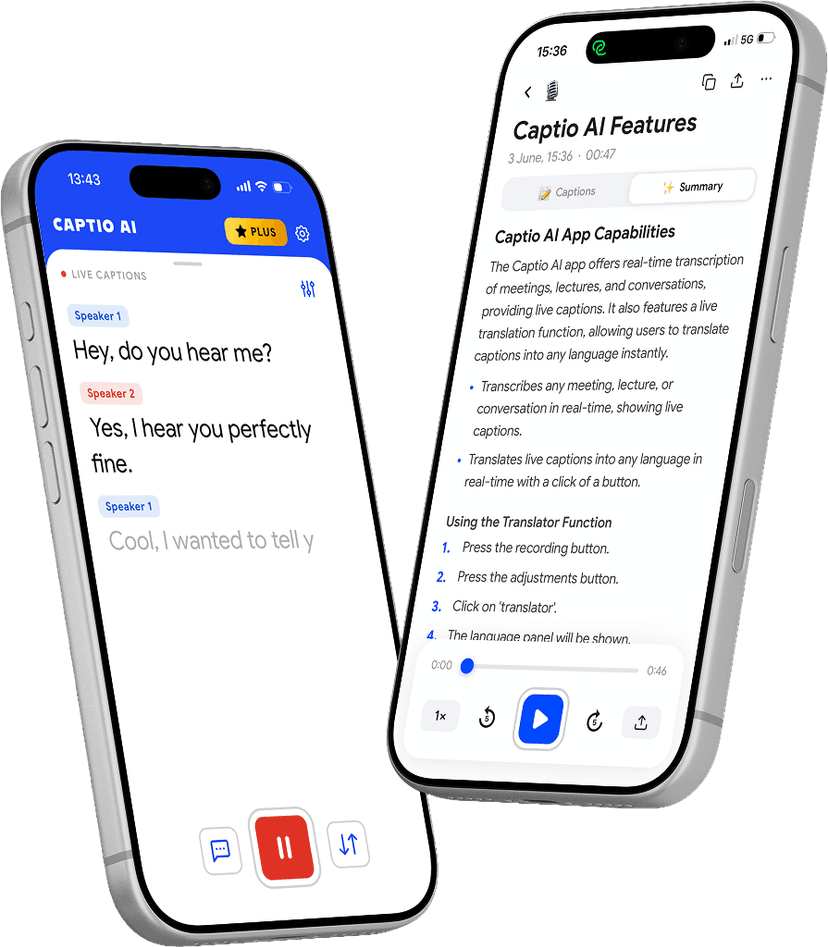
Everything you need to follow Afrikaans group settings
Four tools built for deaf and hard of hearing Afrikaans speakers.
Follow whoever is speaking
- Captions the active voice at any moment
- Works at dinner tables, parties, and social gatherings
- Place the phone in the centre of the group
- Any accent, any pace
For multilingual groups
- Each person speaks their own language
- You read in yours, in real time
- 60+ languages, no switching
- For international families, mixed-language groups, travel
Transcribe any group conversation
- Record and get the full conversation in writing
- Organised by speaker
- Review who said what after the fact
- Any group size, any language
Key points from any group discussion
- Decisions and takeaways extracted automatically
- Useful for group meetings and community discussions
- Organised into clear sections
- Works on any saved recording
Download for free
Every situation covered
Designed for the real moments that matter — not just quiet controlled environments.
Afrikaans family gatherings — a braai for a birthday or a Christmas lunch — are loud, joyful events with multiple family members talking across each other over food, music, and laughter.
A weekend gathering with friends around the braai fire where conversations run from late afternoon into the night across different clusters of people, some sitting, some standing.
Meeting old friends at a Cape Town coffee shop or at someone's home, catching up over coffee and rusks in a long, relaxed conversation about family, sport, and life.
A church committee or neighbourhood watch meeting (still common in Afrikaans-speaking communities) where several voices speak at once and discussion can get passionate.
A Sunday lunch (Sondagmiddagete) where three or four generations eat together — grandparents, parents, and children all talking at once in a warm, noisy home.
An impromptu afternoon gathering at a friend's stoep (veranda) — the quintessential Afrikaans social setting where conversations happen in the open air over food and drinks.
Most accurate and fastest models
word accuracy
independent benchmark, 2025
real-time captions
first word appears as you speak
Download for free
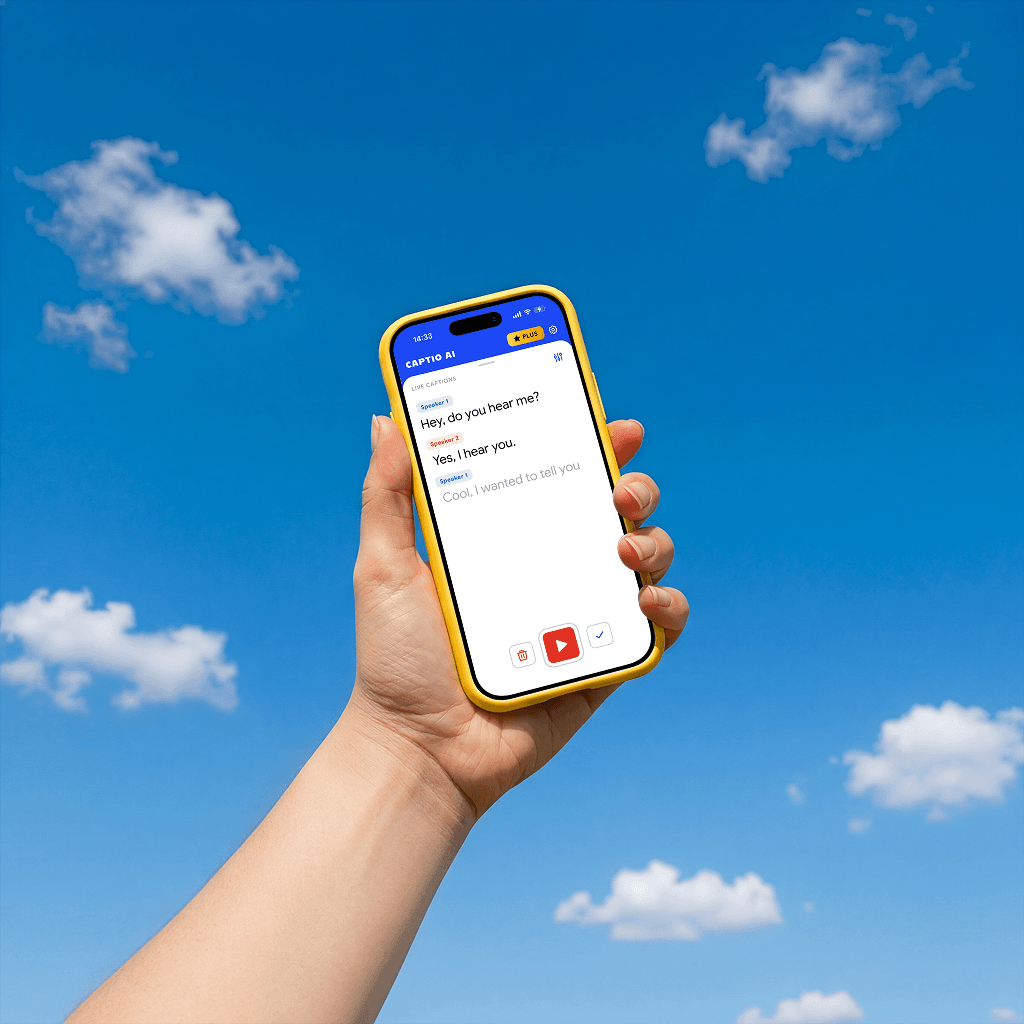
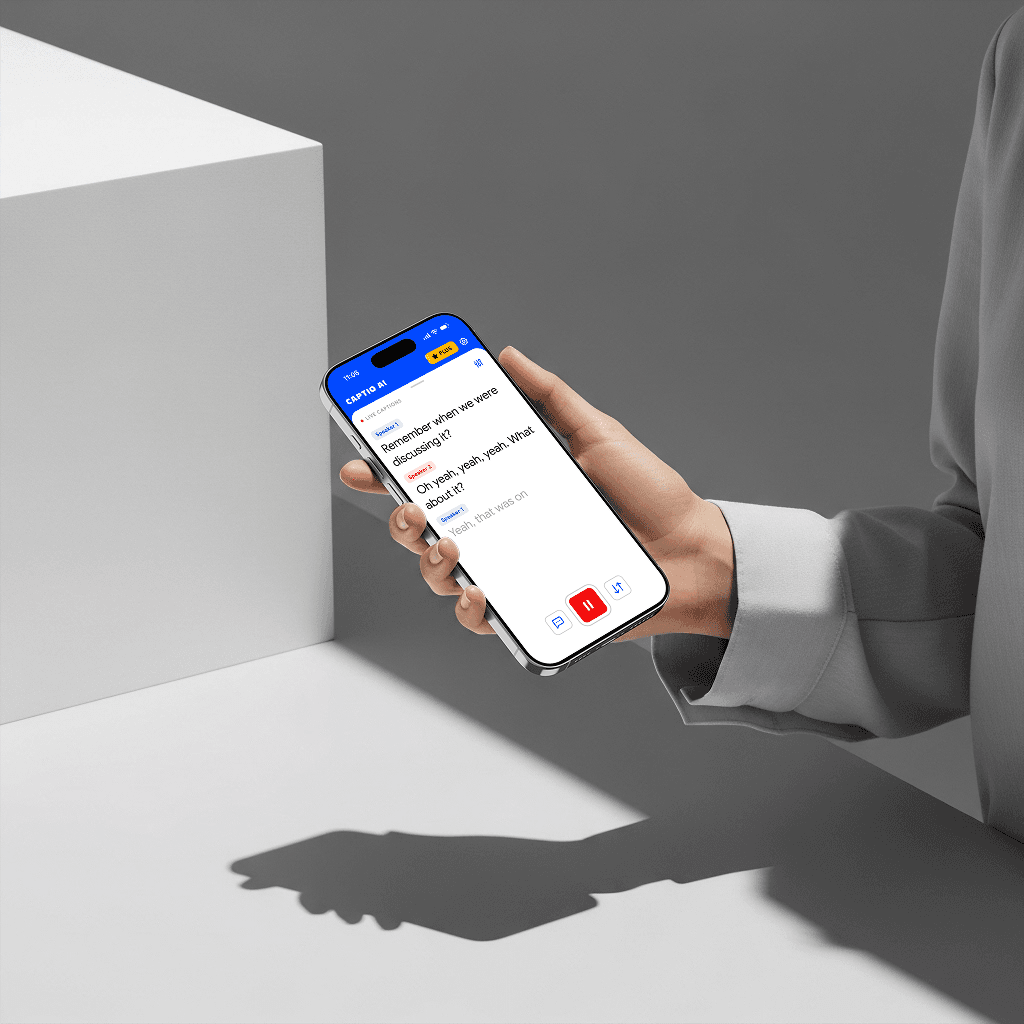
Built to keep you in the conversation, not just in the room
Captions whoever is speaking
Captio AI follows the dominant voice at any moment — whoever is loudest in the microphone's direction. In a group conversation, this tracks the active speaker naturally.
Works through background noise
Restaurants, living rooms, parties, outdoor gatherings. Moderate background noise does not prevent accurate captions — Captio AI is built for real environments, not quiet rooms.
Place it in the centre and forget it
Put the phone on the table or in the middle of the group, microphone facing the conversation. No positioning it after every speaker change, no adjusting between voices.
Less effort, less fatigue
The cognitive load of following a group conversation by lip-reading and reconstructing speech is exhausting. Captio AI handles the following so you can direct your energy toward actually being in the conversation.
60+ languages
For multilingual families, mixed-language social groups, or gatherings where people switch between languages mid-conversation. No setup required between language changes.
No setup between conversations
Open the app and place the phone. No configuration per setting, no briefing the group, nothing to manage between conversations. It works for any group, in any situation.
Why Afrikaans is hard to understand
Velar Fricative Invisibility
- The g-sound produces zero lip movement
- Afrikaans uses the voiceless velar fricative and its voiced counterpart as high-frequency phonemes — written as g. Both are produced deep in the throat with zero lip involvement. Any word beginning or containing g is entirely absent from the lip-reader's view.
Diminutive Sound Cascade
- Suffix changes that happen inside the mouth
- Afrikaans diminutives (-tjie, -jie, -pjie) trigger systematic consonant changes at the morpheme boundary — kat becomes katjie with palatalization. In group speech, diminutives are very frequent, and the sound changes they trigger are produced inside the mouth, invisible on lips.
Cape Afrikaans vs. Standard
- Vowel quality shifts across communities
- Cape Afrikaans (historically associated with Cape Malay and coloured communities in Cape Town) differs from Standard Afrikaans in vowel quality and prosody. At a gathering in the Cape Flats, the speech variety may differ substantially from what a deaf person's lip-reading experience was based on.
Afrikaans-English Code-Switching
- Language switches without a signal
- In urban South Africa, Afrikaans and English switch freely mid-sentence in casual conversation. A deaf person tracking Afrikaans lip patterns is frequently confronted with English phonology without warning — and vice versa.
Fast Casual Prosody
- Unstressed syllables vanish at braai speed
- Afrikaans in relaxed group settings runs at a fast, rhythmic pace with heavy stress on content words and very rapid function word reduction. Unstressed syllables virtually disappear, making the gap between formal and casual braai-table speech significant for lip-readers.
Download for free
Hearing loss in South Africa: the scale of daily exclusion
South Africa has an estimated 4 to 5 million people with a hearing impairment — roughly 8 to 9 percent of the population. Research at primary health care clinics found a 17.5 percent prevalence of hearing loss, while urban Cape Town studies identified disabling hearing impairment in 4.57 percent of the metropolitan population. These figures make hearing loss one of South Africa's most prevalent disability categories, yet the deaf and hard of hearing community's access to everyday social communication — including family gatherings conducted in Afrikaans — remains largely unsupported.
South African Sign Language was formally recognised as the 12th official language in the 2023 constitutional amendment — a landmark achievement. Yet practical infrastructure for daily communication access lags behind. Estimates of SASL users range between 500,000 and 1.5 million, but the number of certified interpreters is a fraction of what this population requires. For Afrikaans-speaking deaf and hard of hearing people, much of their social world — braais, family lunches, church services, community events — happens in speech-only environments where no interpretation is available.
Captio AI captions Afrikaans conversation in real time — whether the fast, elision-heavy speech of a Cape Town braai or the Standard Afrikaans of a multigenerational Sunday lunch — so deaf and hard of hearing South Africans can read every word at the table instead of watching the gathering happen around them.
Download for free
What you hear stays with you.
Gone the moment it ends
Captio AI processes your audio in real time and discards it immediately. Nothing is recorded. Nothing is kept.
Not a product
Your conversations are not something Captio AI sells, shares, or monetizes — to anyone, for any reason.
Not used to train anything
What you say in a doctor's appointment or a job interview never ends up in a training dataset. Not ours. Not anyone else's.

Private by default
Captio AI supports 60+ languages
Download for free
Frequently asked questions
Keep up with the group in Afrikaans.
Captio AI is free to start
Download for free