

Swahili live captions and productivity tool for group settings
For deaf and hard of hearing people.
Download for free


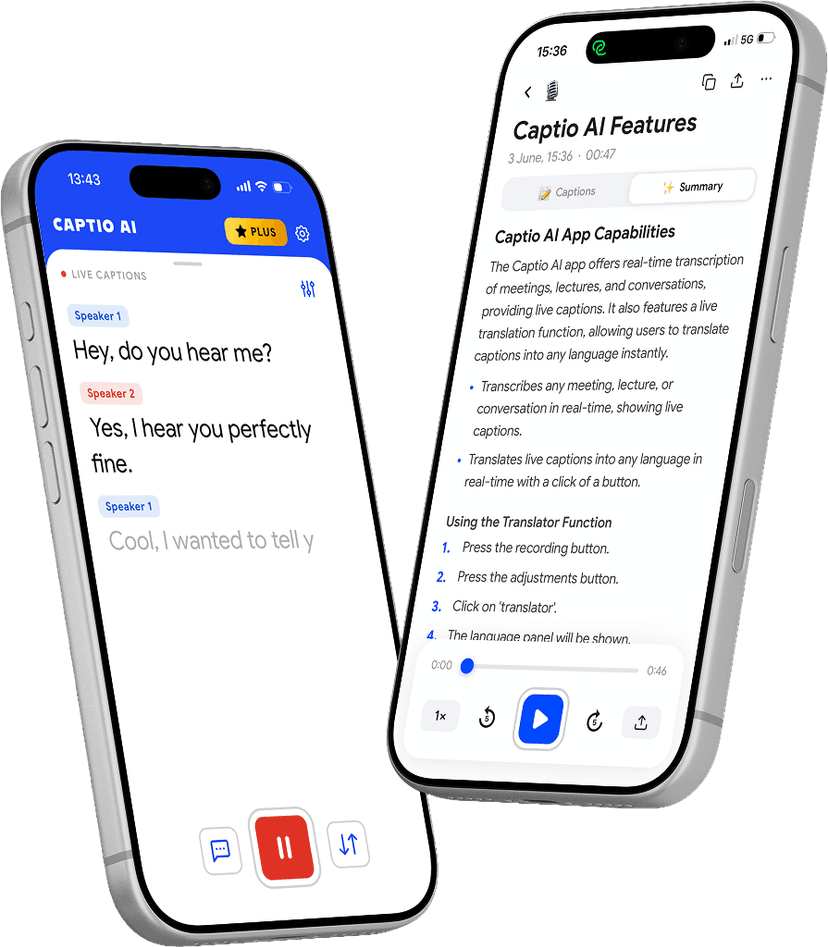
Everything you need to follow Swahili group settings
Four tools built for deaf and hard of hearing Swahili speakers.
Follow whoever is speaking
- Captions the active voice at any moment
- Works at dinner tables, parties, and social gatherings
- Place the phone in the centre of the group
- Any accent, any pace
For multilingual groups
- Each person speaks their own language
- You read in yours, in real time
- 60+ languages, no switching
- For international families, mixed-language groups, travel
Transcribe any group conversation
- Record and get the full conversation in writing
- Organised by speaker
- Review who said what after the fact
- Any group size, any language
Key points from any group discussion
- Decisions and takeaways extracted automatically
- Useful for group meetings and community discussions
- Organised into clear sections
- Works on any saved recording
Download for free
Every situation covered
Designed for the real moments that matter — not just quiet controlled environments.
A family gathering for Eid al-Fitr or Christmas in Nairobi, Mombasa, or Dar es Salaam where relatives from different regions of Kenya or Tanzania come together speaking their local variety of Swahili. Captio AI captions each voice so you follow the full celebration.
A neighbourhood harambee (community fundraising event) where multiple speakers contribute in Swahili with no formal captioning and topics shift quickly. Captio AI gives you real-time captions of every speaker.
A family Sunday lunch in Nairobi or Dar es Salaam where fast Swahili, Sheng, and occasional English mix in the same conversation. Captio AI follows the full exchange.
A community gathering at a mosque or church where formal Swahili in the address transitions to fast colloquial conversation during the social hour. Captio AI follows both registers.
A social gathering with friends at a local pub or chai kiosk where fast Sheng, Swahili slang, and the pace of close-knit group conversation make lip-reading nearly impossible. Captio AI captions whoever is speaking near your phone.
A multigenerational family event where grandparents speak coastal Mombasa Swahili and grandchildren speak Nairobi urban colloquial — Captio AI handles each variety without adjustment.
Most accurate and fastest models
word accuracy
independent benchmark, 2025
real-time captions
first word appears as you speak
Download for free
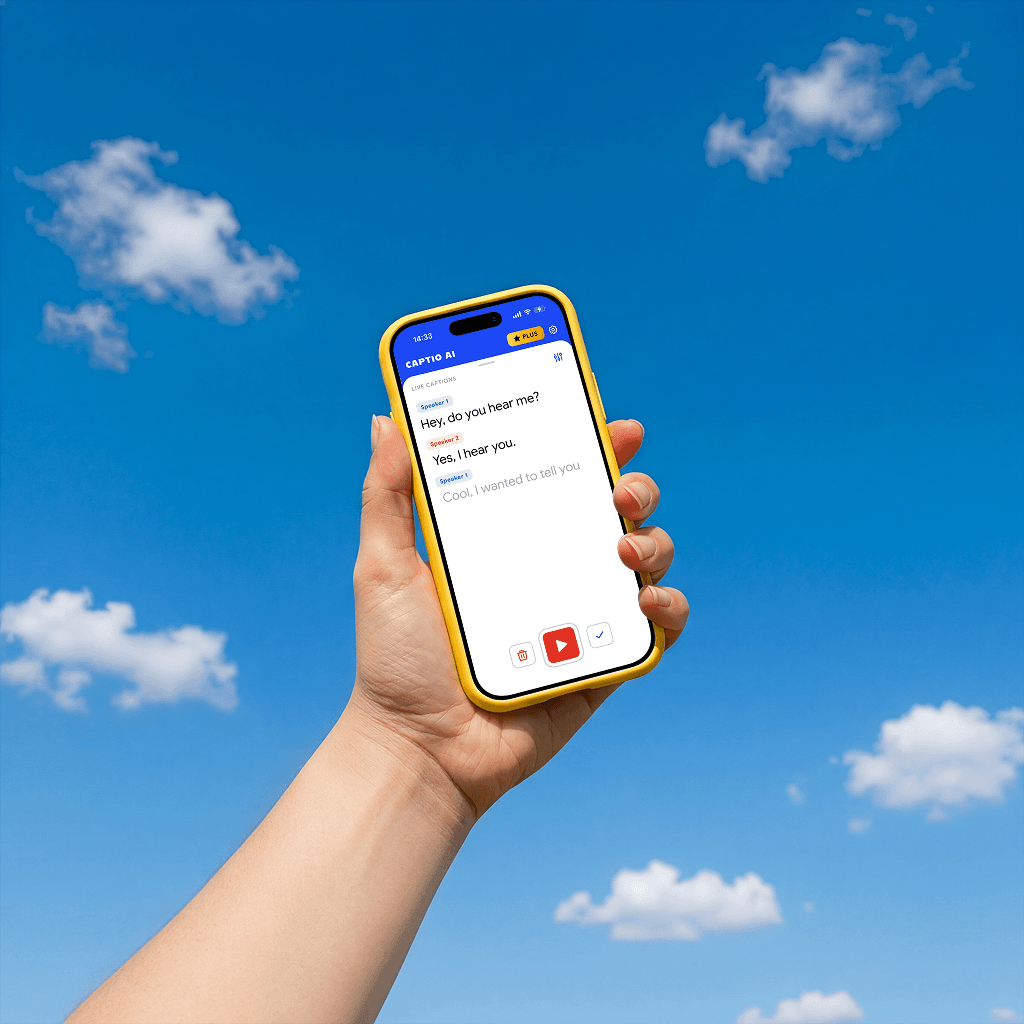
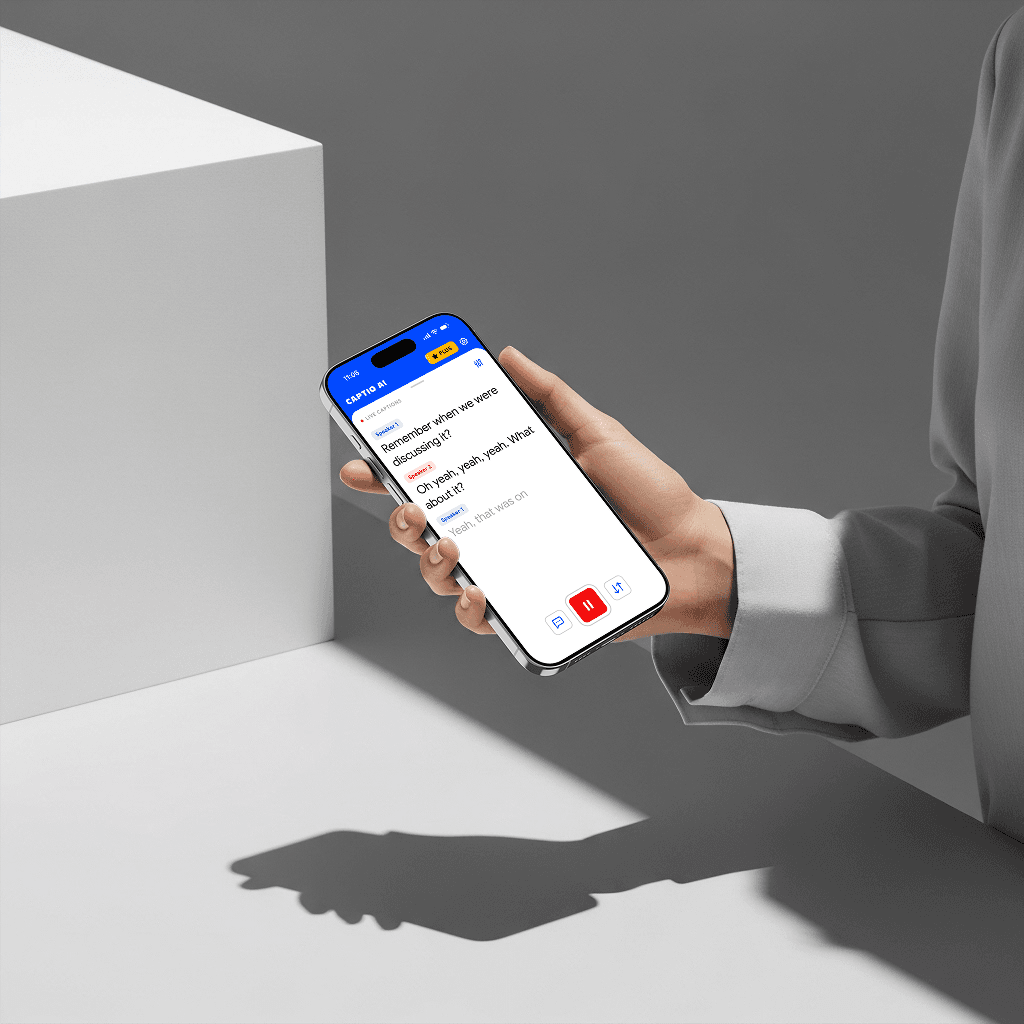
Built to keep you in the conversation, not just in the room
Captions whoever is speaking
Captio AI follows the dominant voice at any moment — whoever is loudest in the microphone's direction. In a group conversation, this tracks the active speaker naturally.
Works through background noise
Restaurants, living rooms, parties, outdoor gatherings. Moderate background noise does not prevent accurate captions — Captio AI is built for real environments, not quiet rooms.
Place it in the centre and forget it
Put the phone on the table or in the middle of the group, microphone facing the conversation. No positioning it after every speaker change, no adjusting between voices.
Less effort, less fatigue
The cognitive load of following a group conversation by lip-reading and reconstructing speech is exhausting. Captio AI handles the following so you can direct your energy toward actually being in the conversation.
60+ languages
For multilingual families, mixed-language social groups, or gatherings where people switch between languages mid-conversation. No setup required between language changes.
No setup between conversations
Open the app and place the phone. No configuration per setting, no briefing the group, nothing to manage between conversations. It works for any group, in any situation.
Why Swahili is hard to understand
14+ regional dialects
- Coastal Swahili, Nairobi colloquial, and regional varieties differ substantially at family gatherings
- Swahili has over 14 regional dialects — Kiamu, Kimvita (Mombasa), Kipemba, Kitumbatu, Kingwana (DRC), and others — with phonological and lexical differences from Standard Swahili. While most speakers understand each other, a family gathering where a grandparent speaks coastal Kipemba and grandchildren speak Nairobi colloquial presents distinct phonological systems at the same table. A deaf person calibrated to standard Kiunguja encounters unfamiliar vowel patterns and vocabulary in regional varieties.
Noun class prefix system
- Swahili's 8+ noun class agreement prefixes fire rapidly throughout every sentence
- Swahili requires agreement prefixes on verbs, adjectives, and pronouns that match the noun class of every noun — m-/wa- for people, ki-/vi- for objects, n-/n- for abstracts, etc. These prefixes are produced rapidly in natural speech and carry grammatical meaning critical to parsing sentences. In fast group conversation, these rapid prefix changes create a morphologically dense speech stream that is difficult to reconstruct from lip movement alone.
Swahili-English (Sheng) mixing
- Kenya and Tanzania's urban youth culture mixes Swahili and English in the same sentence
- Sheng — a Nairobi-origin Swahili-English pidgin that has spread across urban East Africa — appears regularly in social gatherings among younger speakers. 'Nilikwenda kukutana naye lakini he was totally busy, you know?' The English segments are unannounced and often carry the most specific content. A deaf person tracking Swahili loses the thread at each switch — and in Nairobi social gatherings, Sheng can constitute half the conversation.
Fast community social speech
- Swahili at community gatherings moves faster than any broadcast or formal setting
- Social gatherings in East Africa — family visits, community meetings, harambee (community fundraising events), neighbourhood gatherings — use fast conversational Swahili with spoken contractions, rapid topic switching, and the relaxed pace of familiar group interaction. The speed of informal social speech is substantially higher than the measured Swahili of radio or formal meetings, and visual processing cannot keep pace.
Multilingual community context
- East African gatherings can mix Swahili with local community languages without announcement
- In Kenya, Swahili coexists with 42+ local languages, many of which appear in family or community settings. Luo, Kikuyu, Luhya, or Kamba may appear in a Nairobi family gathering alongside Swahili. In Tanzania, local Bantu languages appear in community contexts. In the DRC, Lingala appears alongside Kingwana Swahili. A deaf person tracking Swahili cannot anticipate or follow switches to community languages that share no visual cues with the Swahili they are lip-reading.
Download for free
40 million across Africa with hearing loss. And fewer than 10% can access a hearing aid.
Africa currently has approximately 40 million people with hearing loss — a figure WHO reported in 2024 that is projected to rise to 54 million by 2030 and 97 million by 2050 without significant intervention. Kenya has an estimated 1 million deaf individuals, and across East Africa, hearing loss is driven by preventable causes including infections, noise exposure, and limited access to early intervention. A WHO report on ear and hearing care in the African region found that more than 56% of African countries have only a single ENT specialist per million people — a ratio that makes professional hearing care structurally inaccessible for most of the population.
Despite the scale of need, access to hearing aids across Africa remains severely limited. A WHO analysis found that while approximately 33 million Africans could benefit from a hearing aid, only around 10% have access — constrained by cost, availability, and the near-absence of audiological infrastructure in most countries. In Kenya and Tanzania, community-level support for deaf people in everyday social settings — family gatherings, neighbourhood events, community celebrations — is entirely absent, with no formal captioning, interpreter provision, or communication support in any informal social context.
Captio AI captions Swahili in real time — including Nairobi colloquial, coastal varieties, and Swahili-English code-switching — so the harambee, the family iftar gathering, and the Sunday lunch in Nairobi or Dar es Salaam are conversations a deaf or hard of hearing person can follow without watching faces and guessing at Sheng they cannot track on the lips.
Download for free
What you hear stays with you.
Gone the moment it ends
Captio AI processes your audio in real time and discards it immediately. Nothing is recorded. Nothing is kept.
Not a product
Your conversations are not something Captio AI sells, shares, or monetizes — to anyone, for any reason.
Not used to train anything
What you say in a doctor's appointment or a job interview never ends up in a training dataset. Not ours. Not anyone else's.

Private by default
Captio AI supports 60+ languages
Download for free
Frequently asked questions
Keep up with the group in Swahili.
Captio AI is free to start
Download for free