

Kazakh live captions and productivity tool for group settings
For deaf and hard of hearing people.
Download for free


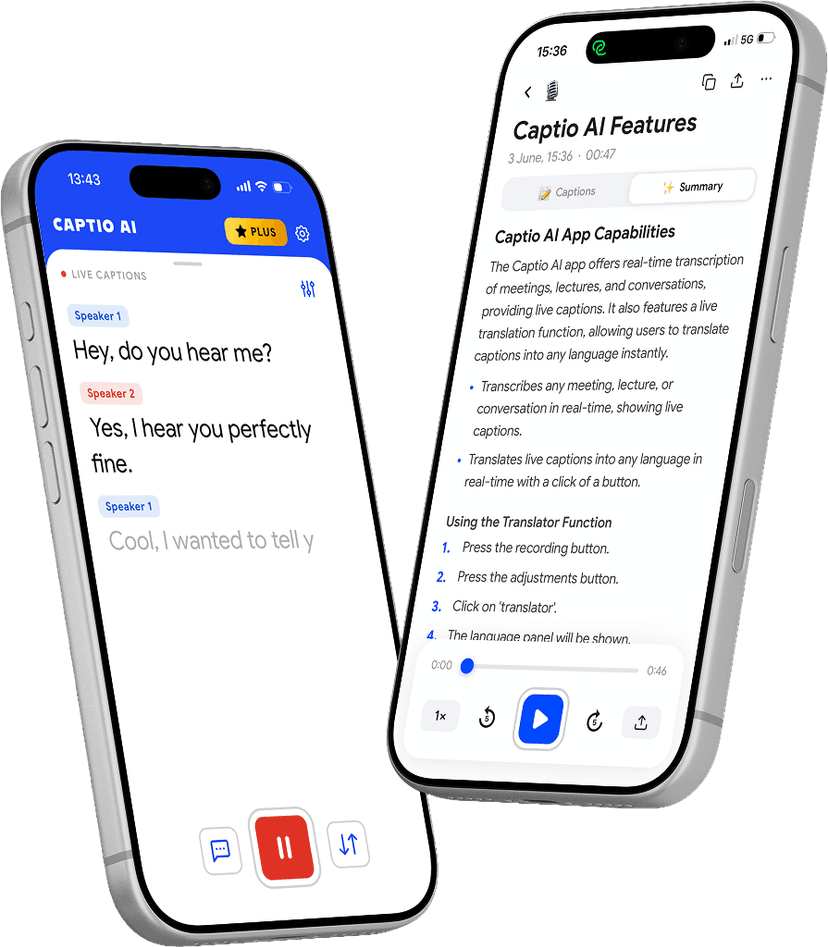
Everything you need to follow Kazakh group settings
Four tools built for deaf and hard of hearing Kazakh speakers.
Follow whoever is speaking
- Captions the active voice at any moment
- Works at dinner tables, parties, and social gatherings
- Place the phone in the centre of the group
- Any accent, any pace
For multilingual groups
- Each person speaks their own language
- You read in yours, in real time
- 60+ languages, no switching
- For international families, mixed-language groups, travel
Transcribe any group conversation
- Record and get the full conversation in writing
- Organised by speaker
- Review who said what after the fact
- Any group size, any language
Key points from any group discussion
- Decisions and takeaways extracted automatically
- Useful for group meetings and community discussions
- Organised into clear sections
- Works on any saved recording
Download for free
Every situation covered
Designed for the real moments that matter — not just quiet controlled environments.
A Kazakh family dinner — a Nauryz celebration, a toi (wedding feast), or a Sunday family meal — with relatives from multiple regions of Kazakhstan gathered at the dastarkhan.
A toi gathering or community feast where the yurt or hall fills with guests and overlapping conversation is the norm.
A catch-up with old friends over kumiss or tea and baursak, with rapid conversation switching between Kazakh and Russian.
A community gathering at a mosque, cultural association, or neighbourhood committee where everyone has something to say.
Three generations at a family table — grandparents in rural Kazakh, parents in urban Almaty Kazakh, grandchildren mixing in Russian or English.
A casual evening at a friend's home or a neighbourhood gathering where small groups form and the conversation flows.
Most accurate and fastest models
word accuracy
independent benchmark, 2025
real-time captions
first word appears as you speak
Download for free


Built to keep you in the conversation, not just in the room
Captions whoever is speaking
Captio AI follows the dominant voice at any moment — whoever is loudest in the microphone's direction. In a group conversation, this tracks the active speaker naturally.
Works through background noise
Restaurants, living rooms, parties, outdoor gatherings. Moderate background noise does not prevent accurate captions — Captio AI is built for real environments, not quiet rooms.
Place it in the centre and forget it
Put the phone on the table or in the middle of the group, microphone facing the conversation. No positioning it after every speaker change, no adjusting between voices.
Less effort, less fatigue
The cognitive load of following a group conversation by lip-reading and reconstructing speech is exhausting. Captio AI handles the following so you can direct your energy toward actually being in the conversation.
60+ languages
For multilingual families, mixed-language social groups, or gatherings where people switch between languages mid-conversation. No setup required between language changes.
No setup between conversations
Open the app and place the phone. No configuration per setting, no briefing the group, nothing to manage between conversations. It works for any group, in any situation.
Why Kazakh is hard to understand
Uvular consonants
- Back-of-throat sounds appear throughout native vocabulary
- Kazakh has uvular consonants /q/, /ɢ/, and the fricative /χ/ that are produced far back in the throat with essentially no lip or jaw movement. These sounds appear throughout core Kazakh vocabulary and are visually indistinguishable from their front-velar counterparts /k/ and /g/ at a dinner table.
Vowel harmony
- Nine vowels — front and back series look nearly identical
- Kazakh has a nine-vowel system with front-back vowel harmony. The distinction between harmonic pairs — /e/ vs /a/, /ø/ vs /o/, /y/ vs /u/ — is produced by tongue backness with very similar lip shapes. In fast social speech these distinctions compress further, making vowel contrasts that carry grammatical meaning visually ambiguous.
Kazakh-Russian switching
- Urban gatherings mix Kazakh and Russian mid-sentence
- In Kazakhstani urban centres — particularly Almaty and Nur-Sultan — Russian remains widely used alongside Kazakh. Social gatherings routinely alternate between the two languages, sometimes within the same sentence. A deaf person applying Kazakh lip-reading patterns is suddenly reading Russian phonology without any signal of the switch.
Agglutinative suffix stacking
- Long suffix chains accumulate at word ends at speed
- Kazakh is agglutinative: multiple grammatical suffixes stack onto word stems, each adding meaning. In fast social speech these suffix sequences appear at the end of long words where lip-reading is already harder — and where the suffix boundaries between case, plural, possessive, and tense markers are invisible on the lips.
Script transition
- Kazakhstan's move from Cyrillic to Latin disrupts visual anchors
- Kazakhstan is transitioning its Kazakh script from Cyrillic to Latin. Deaf speakers accustomed to one orthographic system are encountering new written forms of their language during a period of social and cultural change. The mental mapping between script and sounds is shifting, adding cognitive load to an already demanding lip-reading situation.
Download for free
Hearing loss in Kazakhstan: the scale of daily exclusion
Approximately 150,000 people in Kazakhstan are officially registered as having hearing impairments, but experts estimate the actual number may be as high as 250,000, reflecting significant underdiagnosis and limited population-level awareness. A cross-sectional study found that 20% of participants had audiometrically confirmed hearing loss, with prevalence rising sharply after age 60. The age-standardised prevalence of hearing loss in Kazakhstan in 2021 was estimated at 17,212 per 100,000 population, with mild hearing loss accounting for the majority of cases. Burden is unevenly distributed: rural communities, where access to screening and audiology services is minimal, carry a disproportionate share.
The gap between legal provision and lived access is significant. The government provides a statutory entitlement of 30 hours of sign language interpretation per year for deaf individuals — equivalent to two and a half hours per month — which experts in the field consistently describe as inadequate for participation in working and social life. Employment of deaf people is one of the primary challenges noted by disability advocates: deaf and hard-of-hearing Kazakhstanis face substantial barriers to labour market participation. Rehabilitation centres have been promised in all 12 regions, but capacity remains limited and community social events — family gatherings, toi feasts, community meetings — receive no accessible communication support.
Captio AI captions Kazakh conversation in real time on a phone screen — so a deaf family member at a Nauryz celebration or a multigenerational toi gathering in Almaty, Shymkent, or the Kazakh diaspora can follow every story and toast as it is spoken, in Kazakh, Russian, or whatever the table is speaking.
Download for free
What you hear stays with you.
Gone the moment it ends
Captio AI processes your audio in real time and discards it immediately. Nothing is recorded. Nothing is kept.
Not a product
Your conversations are not something Captio AI sells, shares, or monetizes — to anyone, for any reason.
Not used to train anything
What you say in a doctor's appointment or a job interview never ends up in a training dataset. Not ours. Not anyone else's.

Private by default
Captio AI supports 60+ languages
Download for free
Frequently asked questions
Keep up with the group in Kazakh.
Captio AI is free to start
Download for free