

Hebrew live captions and productivity tool for group settings
For deaf and hard of hearing people.
Download for free


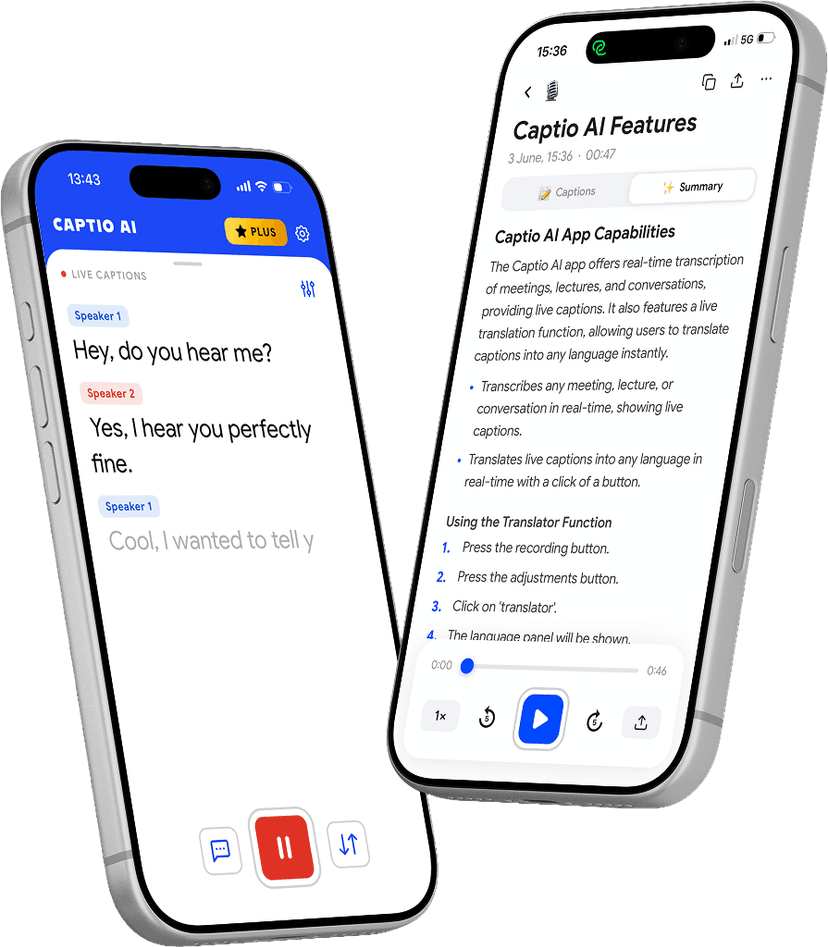
Everything you need to follow Hebrew group settings
Four tools built for deaf and hard of hearing Hebrew speakers.
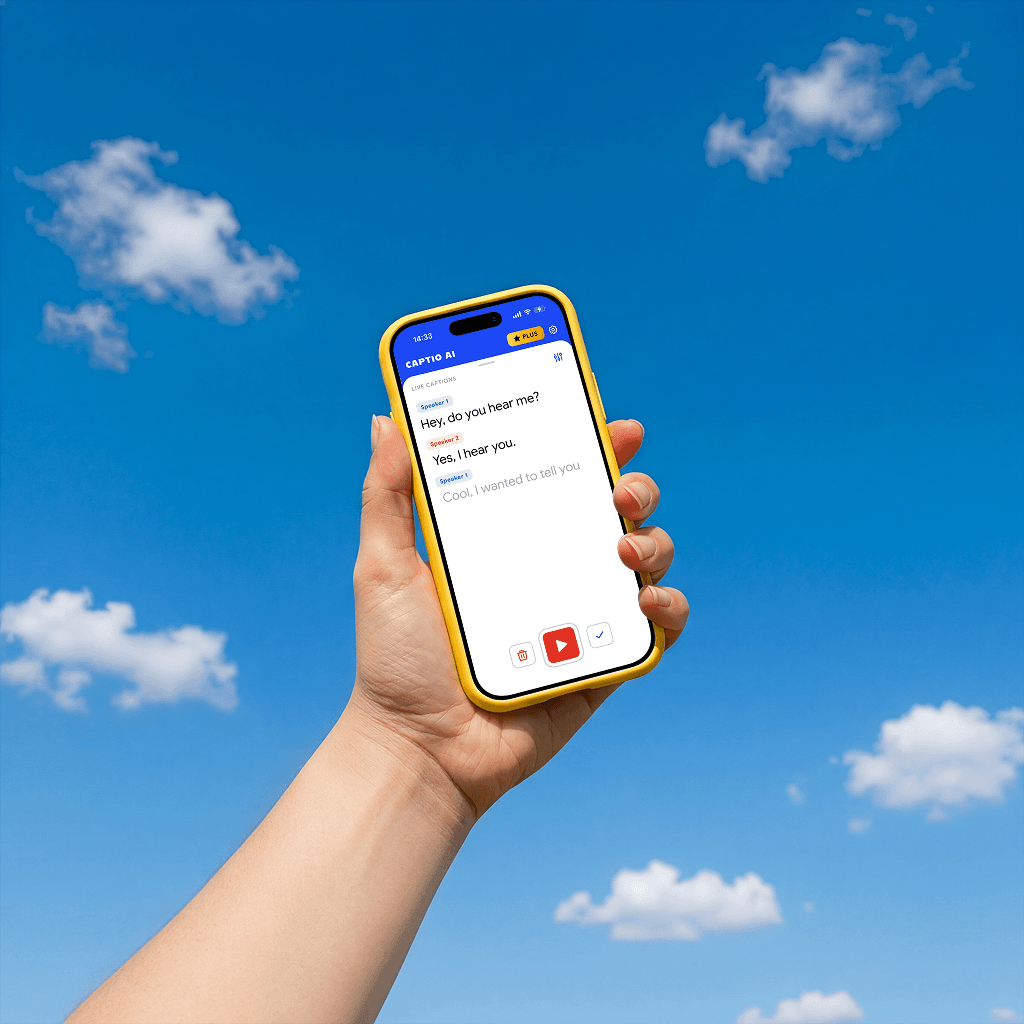
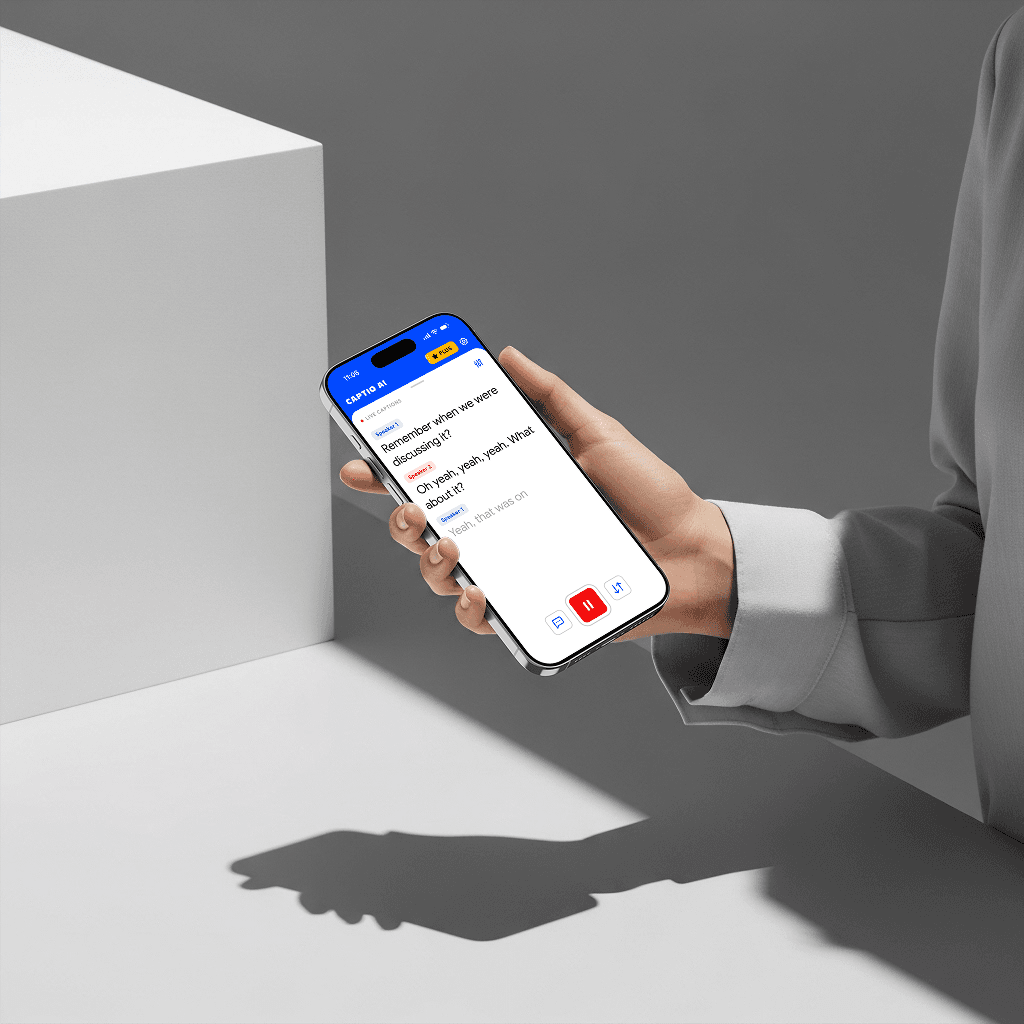
Follow whoever is speaking
- Captions the active voice at any moment
- Works at dinner tables, parties, and social gatherings
- Place the phone in the centre of the group
- Any accent, any pace
For multilingual groups
- Each person speaks their own language
- You read in yours, in real time
- 60+ languages, no switching
- For international families, mixed-language groups, travel
Transcribe any group conversation
- Record and get the full conversation in writing
- Organised by speaker
- Review who said what after the fact
- Any group size, any language
Key points from any group discussion
- Decisions and takeaways extracted automatically
- Useful for group meetings and community discussions
- Organised into clear sections
- Works on any saved recording
Download for free
Every situation covered
Designed for the real moments that matter — not just quiet controlled environments.
A Shabbat dinner or holiday meal — Rosh Hashanah, Passover Seder, or Hanukkah gathering — with family filling the table and multiple conversations running at once.
A birthday party or family celebration where the living room fills with guests and groups form and reform throughout the evening.
A catch-up with old friends over hummus and coffee, with rapid conversation moving between Hebrew and sometimes English or Arabic.
A community gathering at a synagogue, community centre, or neighbourhood association where announcements are made and the group responds.
Three generations at a Shabbat table — grandparents from an Ashkenazi or Mizrahi tradition speaking differently, parents in modern Israeli Hebrew, grandchildren mixing in English.
A casual Friday evening at a friend's home or a neighbourhood rooftop gathering where small groups form and conversations flow freely.
Most accurate and fastest models
word accuracy
independent benchmark, 2025
real-time captions
first word appears as you speak
Download for free
Built to keep you in the conversation, not just in the room
Captions whoever is speaking
Captio AI follows the dominant voice at any moment — whoever is loudest in the microphone's direction. In a group conversation, this tracks the active speaker naturally.
Works through background noise
Restaurants, living rooms, parties, outdoor gatherings. Moderate background noise does not prevent accurate captions — Captio AI is built for real environments, not quiet rooms.
Place it in the centre and forget it
Put the phone on the table or in the middle of the group, microphone facing the conversation. No positioning it after every speaker change, no adjusting between voices.
Less effort, less fatigue
The cognitive load of following a group conversation by lip-reading and reconstructing speech is exhausting. Captio AI handles the following so you can direct your energy toward actually being in the conversation.
60+ languages
For multilingual families, mixed-language social groups, or gatherings where people switch between languages mid-conversation. No setup required between language changes.
No setup between conversations
Open the app and place the phone. No configuration per setting, no briefing the group, nothing to manage between conversations. It works for any group, in any situation.
Why Hebrew is hard to understand
Pharyngeal consonants
- Het and ayin are produced in the throat with no lip movement
- Traditional Hebrew has the pharyngeal consonants het /ħ/ and ayin /ʕ/ — produced deep in the throat with essentially no lip, jaw, or tongue-tip movement visible from outside. In Mizrahi Hebrew communities, these sounds remain phonemically active. At a multigenerational gathering, a deaf person finds some speakers using sounds with zero visual signature that change the meaning of words.
Ashkenazi-Mizrahi phonological split
- Two major Hebrew speech traditions differ at the phoneme level
- Ashkenazi Hebrew (originating with Eastern European Jewish communities) and Mizrahi Hebrew (from North African and Middle Eastern communities) differ in consonant inventory, vowel quality, and stress placement. Israeli families that span these communities bring different phonological systems to the same Shabbat dinner table, and a deaf person training on one tradition faces a different visual landscape from relatives using the other.
Unvoweled script mismatch
- Deaf readers supply vowels from phonological knowledge — which varies by community
- Standard written Hebrew omits vowel diacritics (nikkud). A deaf person who has developed reading strategies for Hebrew must supply vowels from phonological knowledge — but different communities supply different vowels for the same written word. Research specifically on Hebrew deaf readers has documented this as a significant comprehension challenge at the word level.
Hebrew-Arabic bilingualism
- Mixed gatherings alternate between two phonologically distinct Semitic languages
- In Arab-Israeli social contexts and in Israeli-Arab families, Hebrew and Arabic alternate mid-conversation. A deaf person at a mixed gathering faces two Semitic languages — each with pharyngeal and guttural consonants, but with different phoneme inventories — switching without predictable signal.
Fast colloquial reduction
- Modern Israeli Hebrew reduces quickly in natural social speech
- Modern Israeli Hebrew has undergone significant sound reduction in connected speech: consonants assimilate across word boundaries, unstressed syllables compress, and informal social speech runs words together rapidly. The gap between careful classroom pronunciation and natural fast-paced family conversation is wide enough to produce different visual lip patterns for the same words.
Download for free
Hearing loss in Israel: the scale of daily exclusion
According to the Israel Deaf Association and the Central Bureau of Statistics, approximately 10,000 people in Israel are profoundly deaf, with an estimated 150,000 to 200,000 additional people living with significant hearing loss. One in 1,000 babies is born completely deaf and one in 200 with some form of hearing impairment. Israel has an active research tradition in the genetics of hearing loss: more than 20 genes have been identified as causing deafness in the Jewish-Israeli population, and rates of specific genetic variants vary by community background — Ashkenazi, Mizrahi, and other communities each carry different founder variants at different frequencies.
Israel's Equal Rights for People with Disabilities Law mandates accessibility in employment, public transportation, healthcare, and government services, and organizations like Bekol — a self-help association founded and directed by people with hearing loss — work to improve social integration and legislative access. Despite this framework, many deaf and hard-of-hearing Israelis still struggle to access services and opportunities. Family social events — Shabbat dinners, holiday gatherings, birthday celebrations — are not covered by any formal interpretation or accessibility service. At a Passover Seder or a Rosh Hashanah dinner where multiple Hebrew dialects and sometimes Arabic are spoken, a deaf person navigates one of the world's few languages with actively used pharyngeal consonants that are invisible on the lips.
Captio AI captions Hebrew conversation in real time on a phone screen — so a deaf family member at a Shabbat dinner or a Seder in Tel Aviv, Haifa, or Jerusalem can follow every story, blessing, and debate as it is spoken, whether in Ashkenazi or Mizrahi Hebrew.
Download for free
What you hear stays with you.
Gone the moment it ends
Captio AI processes your audio in real time and discards it immediately. Nothing is recorded. Nothing is kept.
Not a product
Your conversations are not something Captio AI sells, shares, or monetizes — to anyone, for any reason.
Not used to train anything
What you say in a doctor's appointment or a job interview never ends up in a training dataset. Not ours. Not anyone else's.

Private by default
Captio AI supports 60+ languages
Download for free
Frequently asked questions
Keep up with the group in Hebrew.
Captio AI is free to start
Download for free