

Belarusian live captions and productivity tool for group settings
For deaf and hard of hearing people.
Download for free


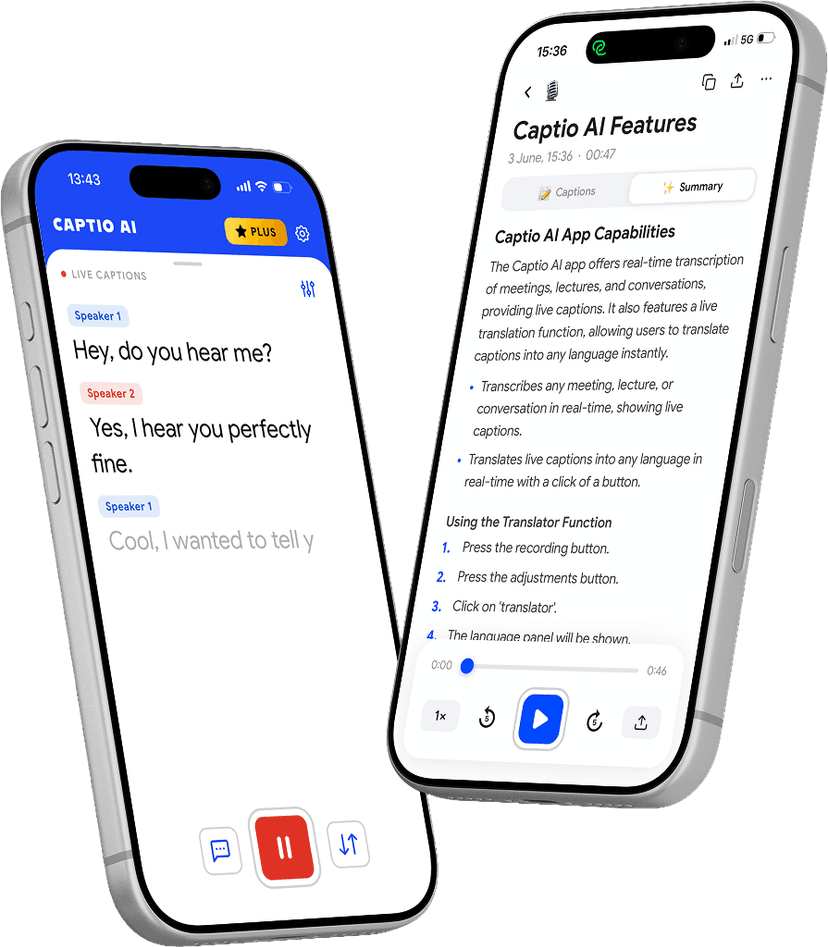
Everything you need to follow Belarusian group settings
Four tools built for deaf and hard of hearing Belarusian speakers.
Follow whoever is speaking
- Captions the active voice at any moment
- Works at dinner tables, parties, and social gatherings
- Place the phone in the centre of the group
- Any accent, any pace
For multilingual groups
- Each person speaks their own language
- You read in yours, in real time
- 60+ languages, no switching
- For international families, mixed-language groups, travel
Transcribe any group conversation
- Record and get the full conversation in writing
- Organised by speaker
- Review who said what after the fact
- Any group size, any language
Key points from any group discussion
- Decisions and takeaways extracted automatically
- Useful for group meetings and community discussions
- Organised into clear sections
- Works on any saved recording
Download for free
Every situation covered
Designed for the real moments that matter — not just quiet controlled environments.
Belarusian family celebrations — weddings, birthdays, or Orthodox holidays — bring multiple generations together for a long feast with toasts, songs, and continuous conversation.
A gathering with friends at a Belarusian home, typically centred around a table of home-cooked food where conversation runs freely for the whole evening.
Meeting friends in a cafe in Minsk or another city, catching up over tea or coffee in a long, relaxed conversation that covers family, work, and the world.
A neighbourhood or apartment building committee meeting — the kind of informal gathering where multiple residents speak at once and no one is running a formal agenda.
A summer visit to grandparents in the countryside — a setting where older generations speak older, more dialect-heavy Belarusian and younger generations respond in mixed speech.
An evening around a fire (vuohnishcha) with friends or family at a dacha — one of the most typical Belarusian social settings, where conversations are relaxed and unstructured.
Most accurate and fastest models
word accuracy
independent benchmark, 2025
real-time captions
first word appears as you speak
Download for free
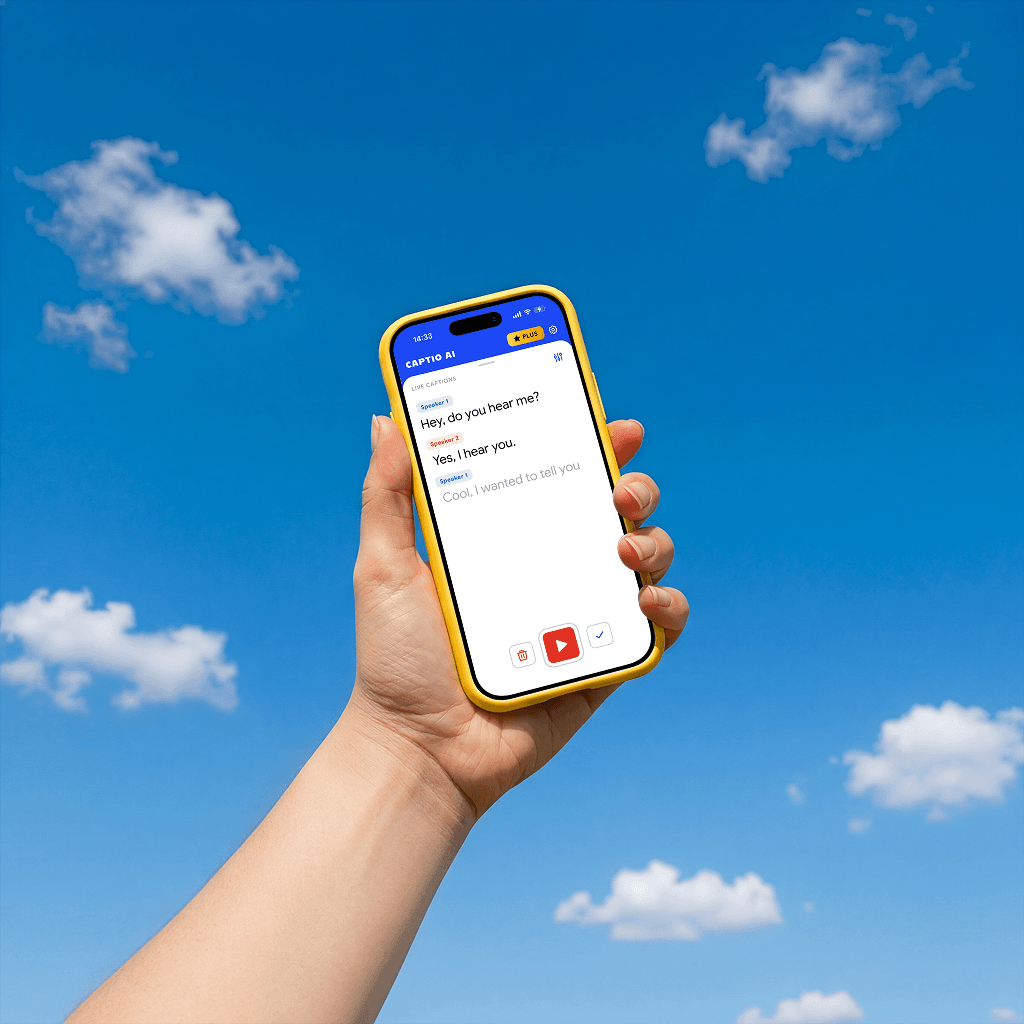
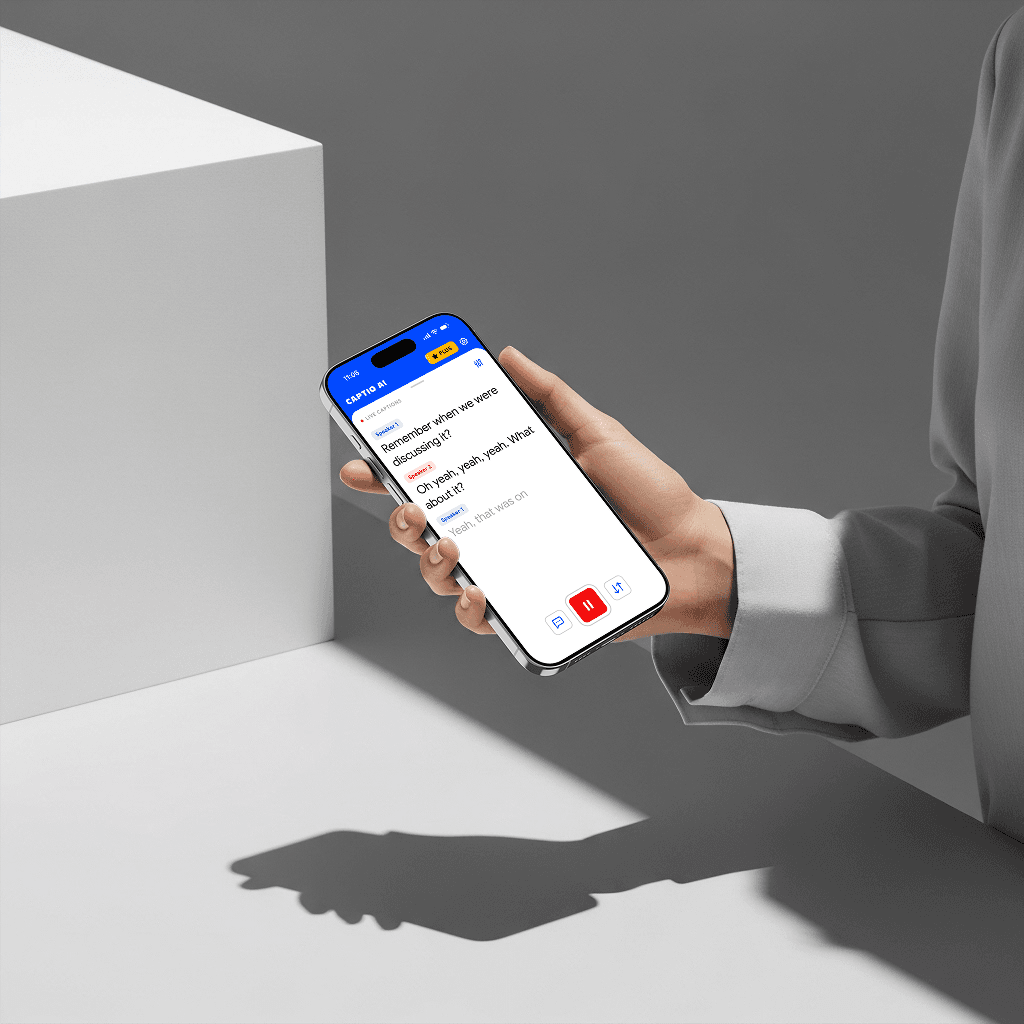
Built to keep you in the conversation, not just in the room
Captions whoever is speaking
Captio AI follows the dominant voice at any moment — whoever is loudest in the microphone's direction. In a group conversation, this tracks the active speaker naturally.
Works through background noise
Restaurants, living rooms, parties, outdoor gatherings. Moderate background noise does not prevent accurate captions — Captio AI is built for real environments, not quiet rooms.
Place it in the centre and forget it
Put the phone on the table or in the middle of the group, microphone facing the conversation. No positioning it after every speaker change, no adjusting between voices.
Less effort, less fatigue
The cognitive load of following a group conversation by lip-reading and reconstructing speech is exhausting. Captio AI handles the following so you can direct your energy toward actually being in the conversation.
60+ languages
For multilingual families, mixed-language social groups, or gatherings where people switch between languages mid-conversation. No setup required between language changes.
No setup between conversations
Open the app and place the phone. No configuration per setting, no briefing the group, nothing to manage between conversations. It works for any group, in any situation.
Why Belarusian is hard to understand
Palatalization Invisibility
- Soft and hard consonants look the same
- Belarusian has a deep soft/hard consonant contrast — nearly every consonant has a palatalized partner. Palatalization is produced at the palate, behind the teeth, and produces almost no visible change on the lips. Two words that differ only by softness sound different but look identical on a speaker's face.
Akanne and Yakanne
- Vowels that shift from their written form
- Belarusian phonology features akanne (unstressed o becomes a) and yakanne (unstressed e becomes ya after soft consonants). These systematic sound shifts mean that the written word and the spoken word carry different vowel shapes — making lip-reading based on text knowledge unreliable.
Trasianka
- Belarusian-Russian mid-sentence without warning
- The dominant everyday speech mode in Belarus is trasianka: a fluid blend of Belarusian and Russian that switches phonological system mid-word. At social gatherings, speakers shift between Belarusian-dominant and Russian-dominant trasianka without signalling — a deaf person following Belarusian lip patterns suddenly faces Russian phonology.
Dialect Divergence
- Northern and southwestern varieties at one table
- Belarusian has two major dialect zones — northern (transitional to Russian) and southwestern (transitional to Ukrainian). At a gathering with family from different regions, the same word may carry different vowel realisations, different prosody, and different consonant assimilation patterns.
Consonant Cluster Density
- Clusters that compress at conversation speed
- Belarusian allows complex consonant clusters. In fast casual speech these compress further and the already-limited lip information is reduced to near zero at group-conversation pace.
Download for free
Hearing loss in Belarus: the scale of daily exclusion
Belarus has a population of approximately 9.4 million people, and the GBD 2019 study's regional data suggests that around 1.5 to 1.9 million Belarusians experience some degree of hearing loss — with rates rising sharply among those over 60. This is a substantial population, but one with very limited infrastructure support. Belarus has no law specifically recognising Belarusian Sign Language as an official language, and the number of trained sign language interpreters serving the country is far below demand.
The human cost of this gap is felt most acutely in everyday social life. Deaf and hard of hearing Belarusians frequently report that family gatherings — weddings, baptisms, name-day celebrations, and dacha weekends — are among the most exhausting social environments they navigate, because there is no structured way to follow group conversation. Unlike in Western European countries where captioning technology and remote interpreter services have expanded access, Belarus has minimal public infrastructure for real-time communication support, and private alternatives are financially inaccessible to most families.
Captio AI captions Belarusian conversation in real time — including the trasianka of a Minsk apartment gathering or the soft-dialect speech of a rural family celebration — so deaf and hard of hearing Belarusians can follow every voice at the table, not just watch the gathering from the outside.
Download for free
What you hear stays with you.
Gone the moment it ends
Captio AI processes your audio in real time and discards it immediately. Nothing is recorded. Nothing is kept.
Not a product
Your conversations are not something Captio AI sells, shares, or monetizes — to anyone, for any reason.
Not used to train anything
What you say in a doctor's appointment or a job interview never ends up in a training dataset. Not ours. Not anyone else's.
Private by default
Captio AI supports 60+ languages
Download for free
Frequently asked questions
Keep up with the group in Belarusian.
Captio AI is free to start
Download for free