

Norwegian live captions and productivity tool for group settings
For deaf and hard of hearing people.
Download for free


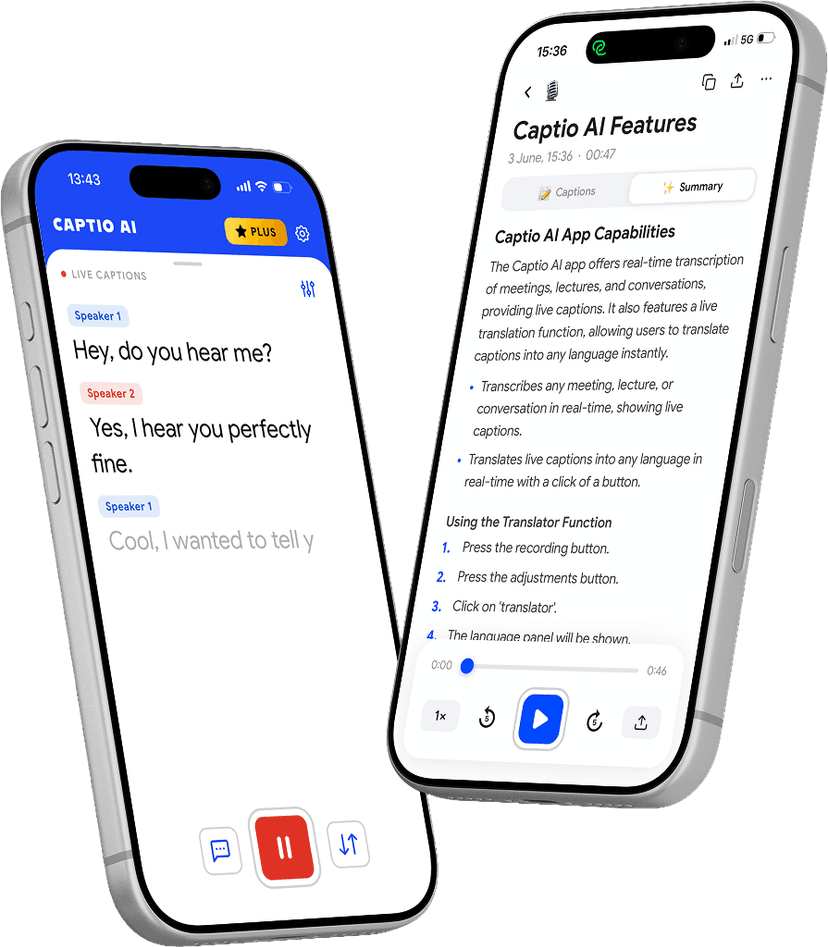
Everything you need to follow Norwegian group settings
Four tools built for deaf and hard of hearing Norwegian speakers.
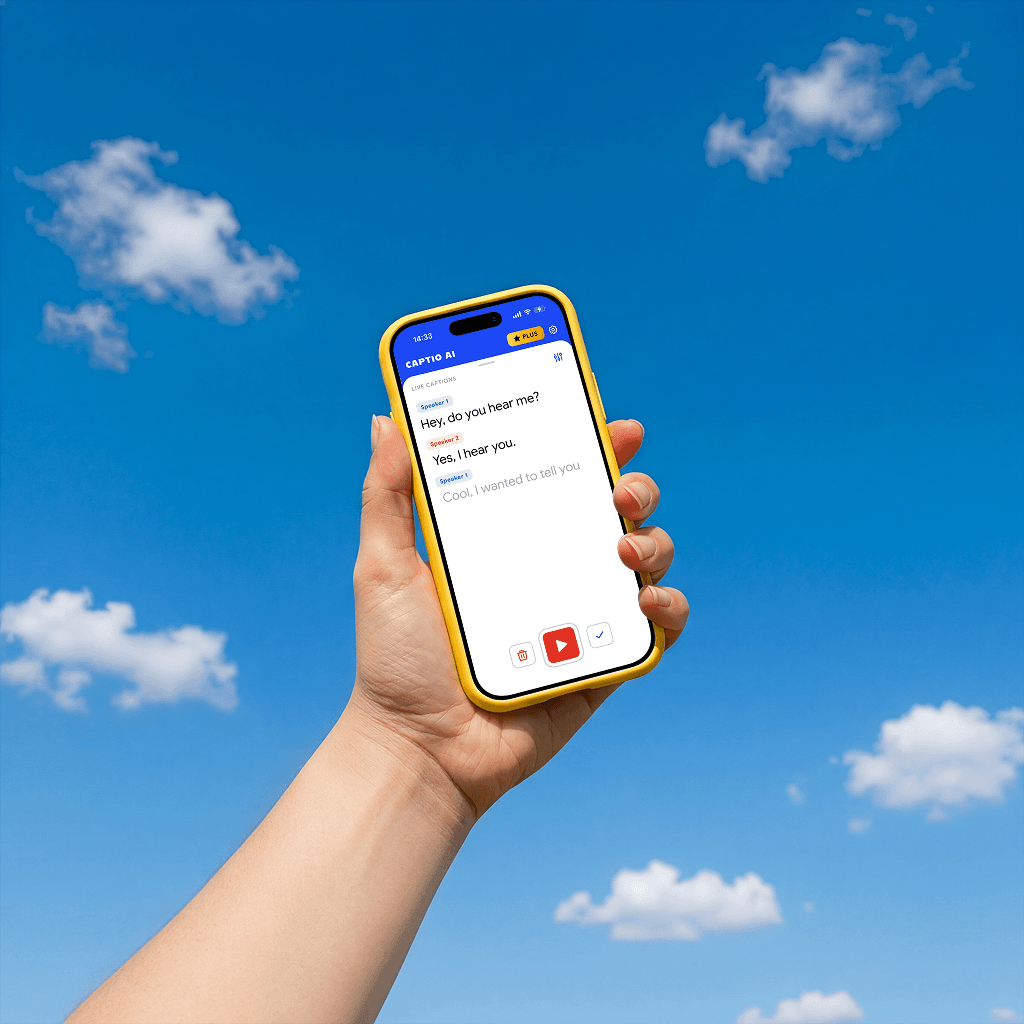
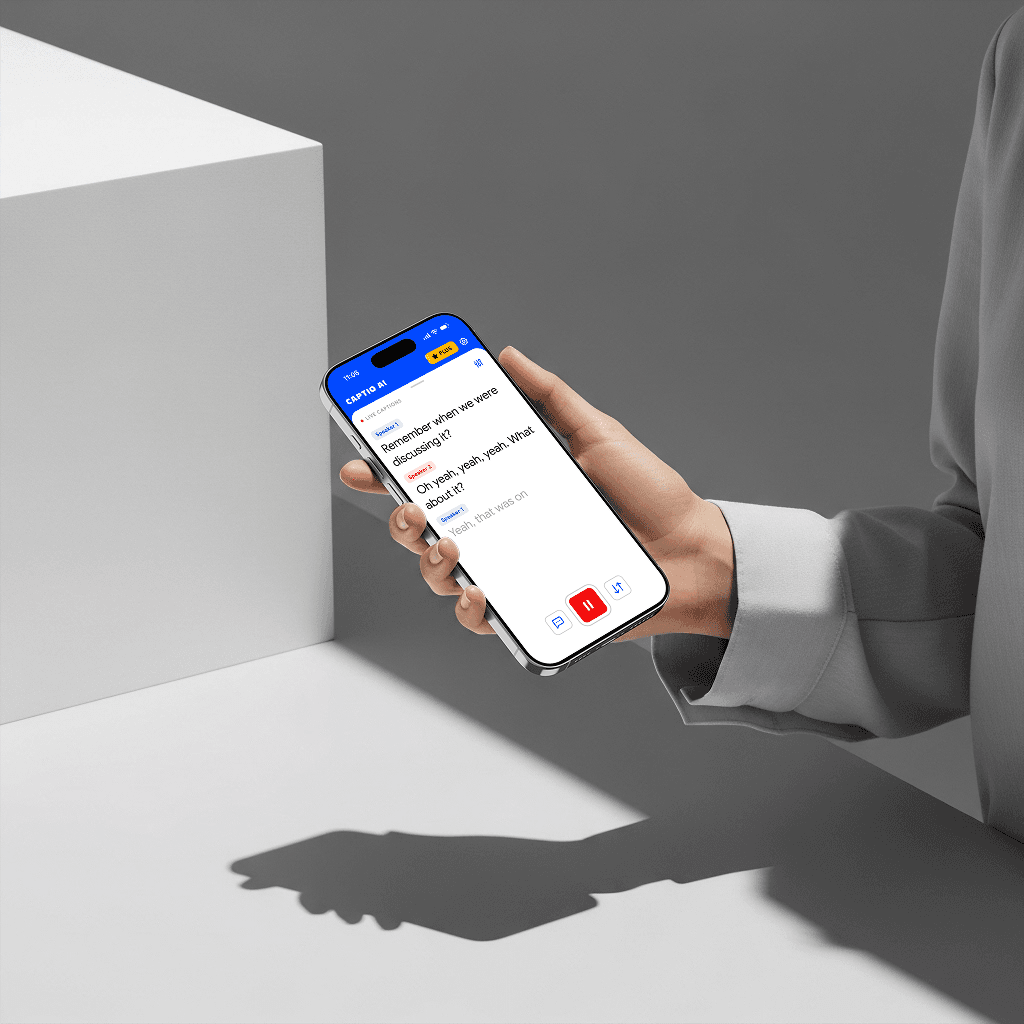
Follow whoever is speaking
- Captions the active voice at any moment
- Works at dinner tables, parties, and social gatherings
- Place the phone in the centre of the group
- Any accent, any pace
For multilingual groups
- Each person speaks their own language
- You read in yours, in real time
- 60+ languages, no switching
- For international families, mixed-language groups, travel
Transcribe any group conversation
- Record and get the full conversation in writing
- Organised by speaker
- Review who said what after the fact
- Any group size, any language
Key points from any group discussion
- Decisions and takeaways extracted automatically
- Useful for group meetings and community discussions
- Organised into clear sections
- Works on any saved recording
Download for free
Every situation covered
Designed for the real moments that matter — not just quiet controlled environments.
A Norwegian family gathering — a Christmas Eve dinner (julekveld) or a summer birthday party — brings multiple generations around a long table, with everyone talking in their own regional dialect.
An evening with Norwegian friends at someone's home, with food, wine, and the kind of long, warm conversation that runs comfortably from early evening into the night.
Meeting old friends over kaffe og kake in a Norwegian kitchen or cafe, the familiar ritual of a long unhurried catch-up about family, work, and the world.
A neighbourhood meeting or dugnad planning session where several people speak at once in their local dialect and decisions are made informally.
A Sunday meal where grandparents, parents, and children eat together — each generation speaking its own regional variety of Norwegian at the same table.
A cabin weekend (hyttetur) with friends — one of Norway's most typical group social settings, where long conversations happen around a wood stove or on the cabin terrace.
Most accurate and fastest models
word accuracy
independent benchmark, 2025
real-time captions
first word appears as you speak
Download for free
Built to keep you in the conversation, not just in the room
Captions whoever is speaking
Captio AI follows the dominant voice at any moment — whoever is loudest in the microphone's direction. In a group conversation, this tracks the active speaker naturally.
Works through background noise
Restaurants, living rooms, parties, outdoor gatherings. Moderate background noise does not prevent accurate captions — Captio AI is built for real environments, not quiet rooms.
Place it in the centre and forget it
Put the phone on the table or in the middle of the group, microphone facing the conversation. No positioning it after every speaker change, no adjusting between voices.
Less effort, less fatigue
The cognitive load of following a group conversation by lip-reading and reconstructing speech is exhausting. Captio AI handles the following so you can direct your energy toward actually being in the conversation.
60+ languages
For multilingual families, mixed-language social groups, or gatherings where people switch between languages mid-conversation. No setup required between language changes.
No setup between conversations
Open the app and place the phone. No configuration per setting, no briefing the group, nothing to manage between conversations. It works for any group, in any situation.
Why Norwegian is hard to understand
Radical Dialect Diversity
- No standard spoken Norwegian — eight ways to say I
- Norwegian has no standard spoken form. Every speaker uses their regional dialect, and these dialects differ substantially in phonology, vocabulary, and prosody. The pronoun for I (jeg) has eight or more distinct regional pronunciations. A deaf person lip-reading across a table with guests from Bergen, Tromsø, and Stavanger is, in effect, lip-reading in different languages.
Pitch Accent
- Two tones, completely invisible on lips
- Norwegian uses two pitch accents (tone 1 and tone 2) on lexical words, distinguishing minimal pairs. These tonal distinctions are auditory-only — they leave no mark on the lips — and are lost entirely to lip-readers, who cannot distinguish the word pairs that hearing people separate automatically.
Uvular vs. Alveolar R
- Two R-sounds, same lip shape
- In South and West Norway, r is realised as a uvular fricative produced deep in the throat. In North and East Norway, r is alveolar. The two sound nothing alike — but both produce ambiguous lip information. A deaf person encountering both variants at the same table is tracking two different sounds that look the same.
Retroflexion at Consonant Boundaries
- Hidden consonant changes in alveolar dialects
- In dialects with alveolar r, sequences of r followed by a dental consonant produce retroflex sounds — the tongue blade curls back. These retroflexes are produced behind the teeth, invisible on lips, and cause unexpected consonant shapes where a dental was expected.
Rapid Elision in Casual Speech
- Norwegian contractions at social pace
- Norwegian informal speech contracts heavily. Particles, determiners, and negators merge with adjacent words at pace. In a lively group gathering, the rate of contraction and reduction makes word identification from lip patterns alone nearly impossible.
Download for free
Hearing loss in Norway: the scale of daily exclusion
In Norway, an estimated 15 percent of the adult population — approximately 650,000 people out of 5.4 million — experience permanent hearing loss, a figure the Norwegian Institute of Public Health has noted is expected to rise as the population ages. Research from the HUNT Study, one of the largest population health surveys in Europe, found that hearing loss in Norway is socioeconomically patterned: people in manual occupations and with lower educational attainment are significantly more likely to develop hearing loss and significantly less likely to use hearing aids.
Hearing aid use in Norway increased from 4.2 percent in 1997 to 5.8 percent in 2018 among the general adult population — but even among those with disabling hearing loss (at or above 35 dB), more than a third do not use a hearing aid. Research consistently shows that hearing aids alone do not resolve the difficulty of following group conversations in noisy, multi-speaker environments like family gatherings, parties, and community meetings. Norwegian Sign Language is recognised as an official minority language, but relatively few deaf and hard of hearing people who acquired their hearing loss in adulthood use sign language — leaving a large population underserved in daily social settings.
Captio AI captions Norwegian conversation in real time — including the radical dialect variation from a table where guests come from Bergen, Tromso, and Stavanger — so deaf and hard of hearing Norwegians can read every voice at the gathering, without relying on the one speaker who happens to face them.
Download for free
What you hear stays with you.
Gone the moment it ends
Captio AI processes your audio in real time and discards it immediately. Nothing is recorded. Nothing is kept.
Not a product
Your conversations are not something Captio AI sells, shares, or monetizes — to anyone, for any reason.
Not used to train anything
What you say in a doctor's appointment or a job interview never ends up in a training dataset. Not ours. Not anyone else's.

Private by default
Captio AI supports 60+ languages
Download for free
Frequently asked questions
Keep up with the group in Norwegian.
Captio AI is free to start
Download for free