

Dutch live captions and productivity tool for group settings
For deaf and hard of hearing people.
Download for free


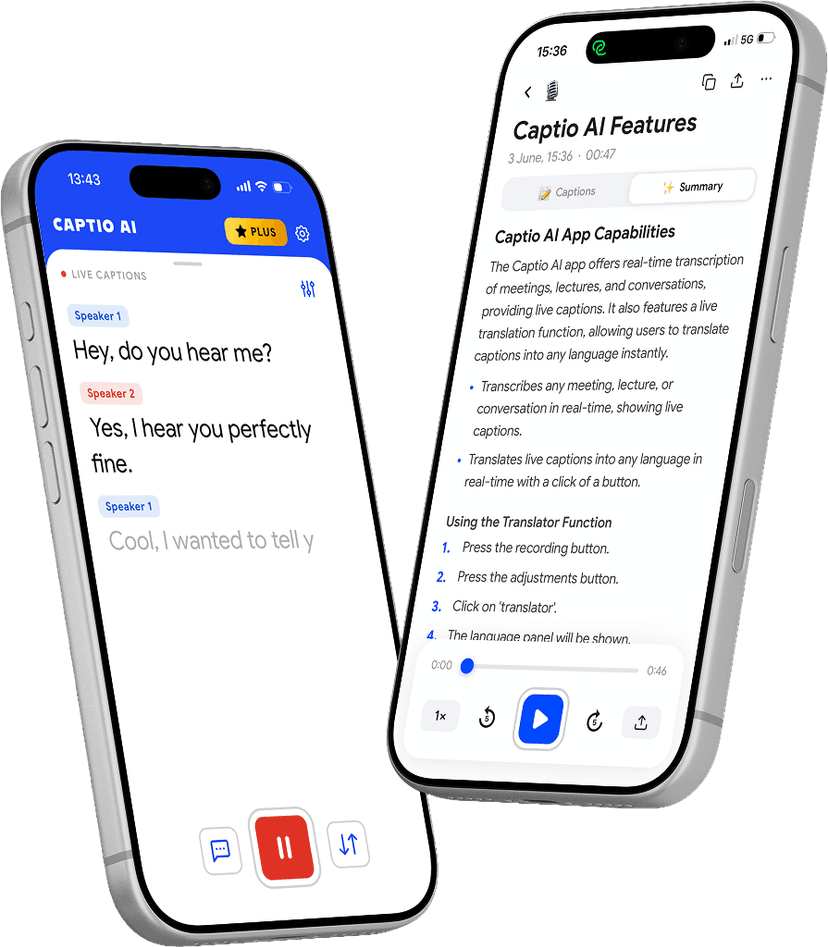
Everything you need to follow Dutch group settings
Four tools built for deaf and hard of hearing Dutch speakers.
Follow whoever is speaking
- Captions the active voice at any moment
- Works at dinner tables, parties, and social gatherings
- Place the phone in the centre of the group
- Any accent, any pace
For multilingual groups
- Each person speaks their own language
- You read in yours, in real time
- 60+ languages, no switching
- For international families, mixed-language groups, travel
Transcribe any group conversation
- Record and get the full conversation in writing
- Organised by speaker
- Review who said what after the fact
- Any group size, any language
Key points from any group discussion
- Decisions and takeaways extracted automatically
- Useful for group meetings and community discussions
- Organised into clear sections
- Works on any saved recording
Download for free
Every situation covered
Designed for the real moments that matter — not just quiet controlled environments.
A Dutch family dinner — Sinterklaas evening, a birthday, or a Sunday family lunch — with relatives talking freely across the table.
A birthday party or neighbourhood gathering where the living room fills with guests and small groups form and talk simultaneously.
A catch-up with old friends over coffee and vlaai or bitterballen, with fast conversation moving across topics.
A community meeting at a neighbourhood association, church, or local club where everyone wants to say something.
Three generations at a family table — grandparents in regional dialect, parents in standard Dutch, grandchildren mixing in English.
A casual evening at a Dutch pub or a friend's home where small groups form and conversations flow freely.
Most accurate and fastest models
word accuracy
independent benchmark, 2025
real-time captions
first word appears as you speak
Download for free
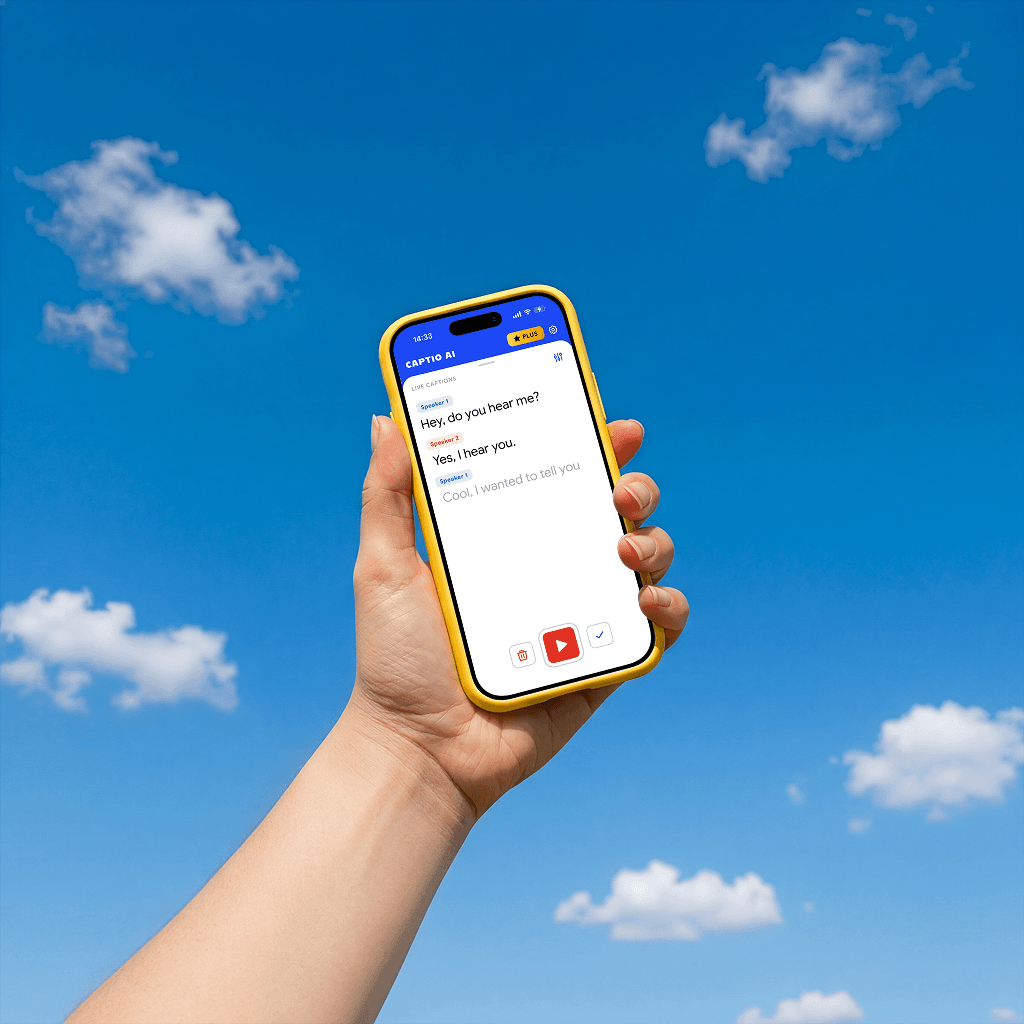
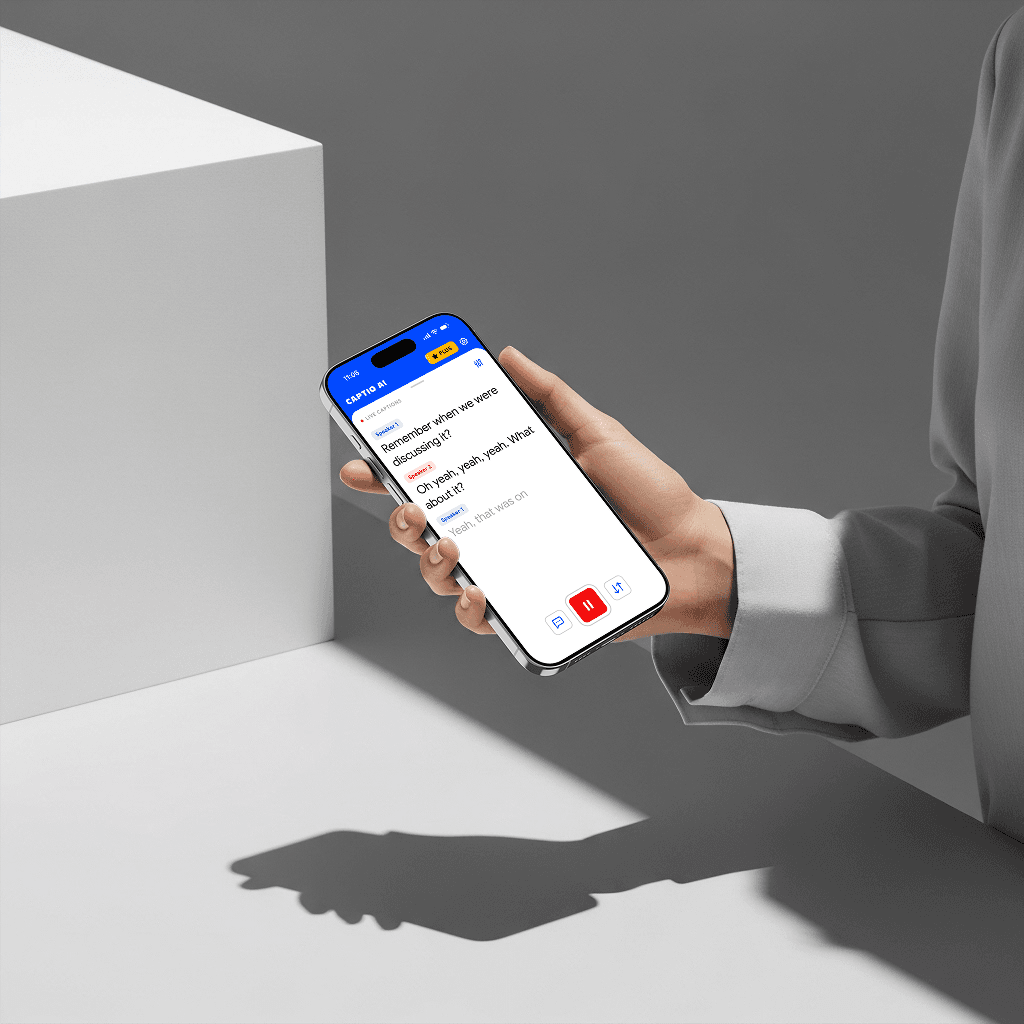
Built to keep you in the conversation, not just in the room
Captions whoever is speaking
Captio AI follows the dominant voice at any moment — whoever is loudest in the microphone's direction. In a group conversation, this tracks the active speaker naturally.
Works through background noise
Restaurants, living rooms, parties, outdoor gatherings. Moderate background noise does not prevent accurate captions — Captio AI is built for real environments, not quiet rooms.
Place it in the centre and forget it
Put the phone on the table or in the middle of the group, microphone facing the conversation. No positioning it after every speaker change, no adjusting between voices.
Less effort, less fatigue
The cognitive load of following a group conversation by lip-reading and reconstructing speech is exhausting. Captio AI handles the following so you can direct your energy toward actually being in the conversation.
60+ languages
For multilingual families, mixed-language social groups, or gatherings where people switch between languages mid-conversation. No setup required between language changes.
No setup between conversations
Open the app and place the phone. No configuration per setting, no briefing the group, nothing to manage between conversations. It works for any group, in any situation.
Why Dutch is hard to understand
Final devoicing
- Word-final consonant pairs become identical on lips
- Dutch devoices all obstruents in word-final position: b→p, d→t, g→k, v→f, z→s. The minimal pair *bad* (bath) versus *bat* (bat) sounds — and looks — identical in isolation. At a family gathering, dozens of word pairs that differ only word-finally become visually indistinguishable.
The Dutch G
- The most prominent Dutch sound produces zero lip movement
- The Dutch /g/ and /ch/ are voiced and voiceless velar or uvular fricatives produced far back in the throat — the characteristic guttural sound that defines the Dutch acoustic profile. For a deaf person lip-reading at a family table, this sound, which appears in many of the most common Dutch words, leaves the lips completely still.
Northern-Southern divide
- Netherlandic and Flemish Dutch sound different
- Standard Dutch in the Netherlands (Amsterdam, Rotterdam) and Belgian Dutch (Ghent, Antwerp) differ substantially in vowel quality, /g/ realization, and intonation. A deaf person trained on Amsterdam Dutch finds Flemish speakers at the same gathering using a different sound system — including a softer /g/ that is even less visible.
Tense-lax vowel pairs
- Dutch's many vowel contrasts look the same from across a table
- Dutch has a complex vowel inventory with tense-lax distinctions and multiple diphthongs. Pairs like tense /eː/ and lax /ɛ/, or the diphthong /ɛi/ and /œy/, involve subtle jaw and tongue differences that produce very similar lip shapes. In natural social conversation, these distinctions are compressed further.
Oralist education legacy
- Decades of lip-reading training still leaves 50-70% comprehension gaps
- The Netherlands had one of Europe's strongest oralist traditions in deaf education: deaf children were trained for decades to lip-read and speak rather than sign. Many deaf Dutch adults have extensive lip-reading experience — yet research consistently shows comprehension rates of 30-70% in real conversation, dropping further in group settings where multiple faces and overlapping speech are present.
Download for free
Hearing loss in the Netherlands: the scale of daily exclusion
Approximately 1.3 million people in the Netherlands have some degree of hearing loss — around 7-8% of the population — making it one of the most prevalent sensory disabilities in the country. A population-based study estimated 11,400 deaf and severely hard-of-hearing people in the Netherlands, with 9% having post-lingual onset, and noted that children with non-Western origin were less likely to receive ambulatory support and more likely to attend schools for the deaf than their Dutch peers. The Netherlands has historically had one of Europe's strongest oralist traditions in deaf education — training deaf children to lip-read and speak rather than use sign language for much of the 20th century.
Research on employment outcomes of deaf and hard-of-hearing people in the Netherlands — drawing on non-public microdata from 5,609 claimants — found that deaf and hard-of-hearing adults are significantly more likely than the general Dutch population to receive income from disability pension, sick leave, or other social benefits, and earn lower hourly wages while working fewer hours per week. Despite the Netherlands' strong welfare state, gaps in workplace and social accessibility persist: interpretation services are available for formal settings but are virtually absent from family social events, community gatherings, and informal group occasions where natural Dutch conversation is fastest and hardest to lip-read.
Captio AI captions Dutch conversation in real time on a phone screen — so a deaf family member at a Sinterklaas evening or a birthday gathering in Amsterdam, Rotterdam, or Ghent can follow every story and joke as it is spoken, without needing an interpreter or missing the moment.
Download for free
What you hear stays with you.
Gone the moment it ends
Captio AI processes your audio in real time and discards it immediately. Nothing is recorded. Nothing is kept.
Not a product
Your conversations are not something Captio AI sells, shares, or monetizes — to anyone, for any reason.
Not used to train anything
What you say in a doctor's appointment or a job interview never ends up in a training dataset. Not ours. Not anyone else's.

Private by default
Captio AI supports 60+ languages
Download for free
Frequently asked questions
Keep up with the group in Dutch.
Captio AI is free to start
Download for free