

Bengali live captions and productivity tool for group settings
For deaf and hard of hearing people.
Download for free


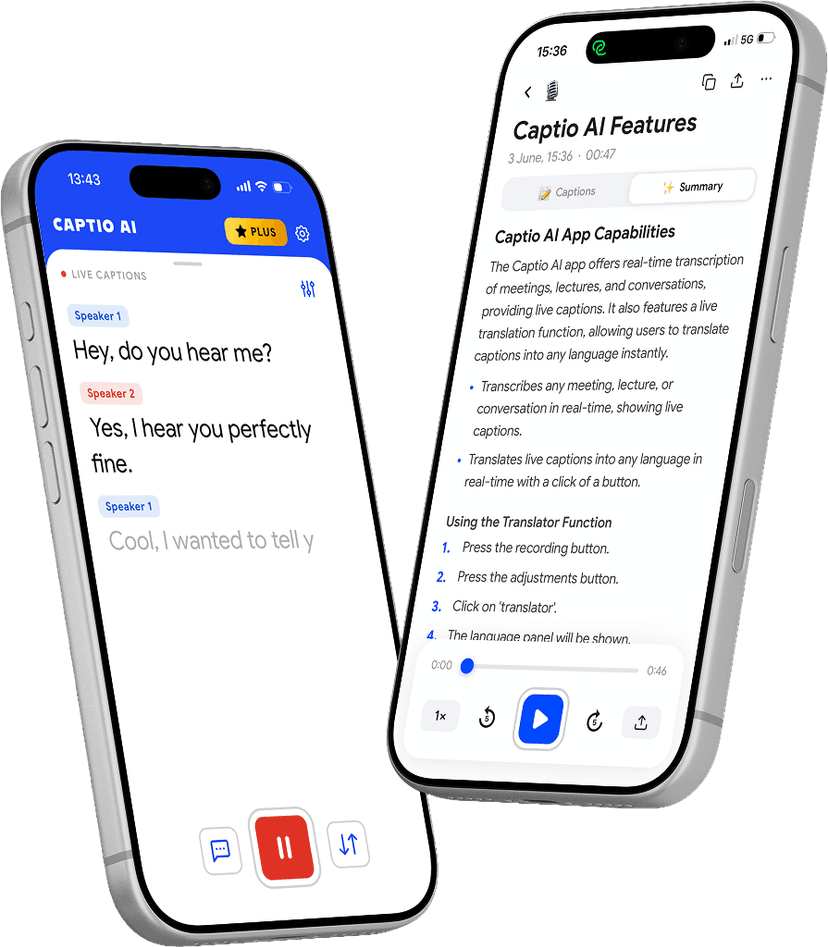
Everything you need to follow Bengali group settings
Four tools built for deaf and hard of hearing Bengali speakers.
Follow whoever is speaking
- Captions the active voice at any moment
- Works at dinner tables, parties, and social gatherings
- Place the phone in the centre of the group
- Any accent, any pace
For multilingual groups
- Each person speaks their own language
- You read in yours, in real time
- 60+ languages, no switching
- For international families, mixed-language groups, travel
Transcribe any group conversation
- Record and get the full conversation in writing
- Organised by speaker
- Review who said what after the fact
- Any group size, any language
Key points from any group discussion
- Decisions and takeaways extracted automatically
- Useful for group meetings and community discussions
- Organised into clear sections
- Works on any saved recording
Download for free
Every situation covered
Designed for the real moments that matter — not just quiet controlled environments.
An Eid-ul-Fitr gathering where the extended family comes together from different cities and districts, each speaking a slightly different regional variety of Bengali. Captio AI captions each voice so you follow the celebration without gaps.
A Sunday adda — the beloved Bengali tradition of informal gathering with tea and conversation — where friends sit for hours and the talk moves fast. Captio AI lets you follow without being the one who always asks for a repeat.
A multigenerational family meal in Dhaka or Kolkata where grandparents' regional dialect, parents' standard Bengali, and children's code-switched Benglish all appear at the same table. Captio AI captions each speaker.
A community gathering in Tower Hamlets, Birmingham, or Sylhet where Sylheti-accented Bengali and English mix in the same conversation. Captio AI follows the full exchange without adjustment.
A cultural event — Durga Puja, Eid mela, or community meeting — where multiple speakers contribute quickly in Bengali with no formal captioning. Captio AI covers each contributor in real time.
A gathering with friends at a chaayer dokan or local restaurant where fast casual Bengali with urban slang makes lip-reading nearly impossible. Captio AI gives you the full text of every exchange.
Most accurate and fastest models
word accuracy
independent benchmark, 2025
real-time captions
first word appears as you speak
Download for free
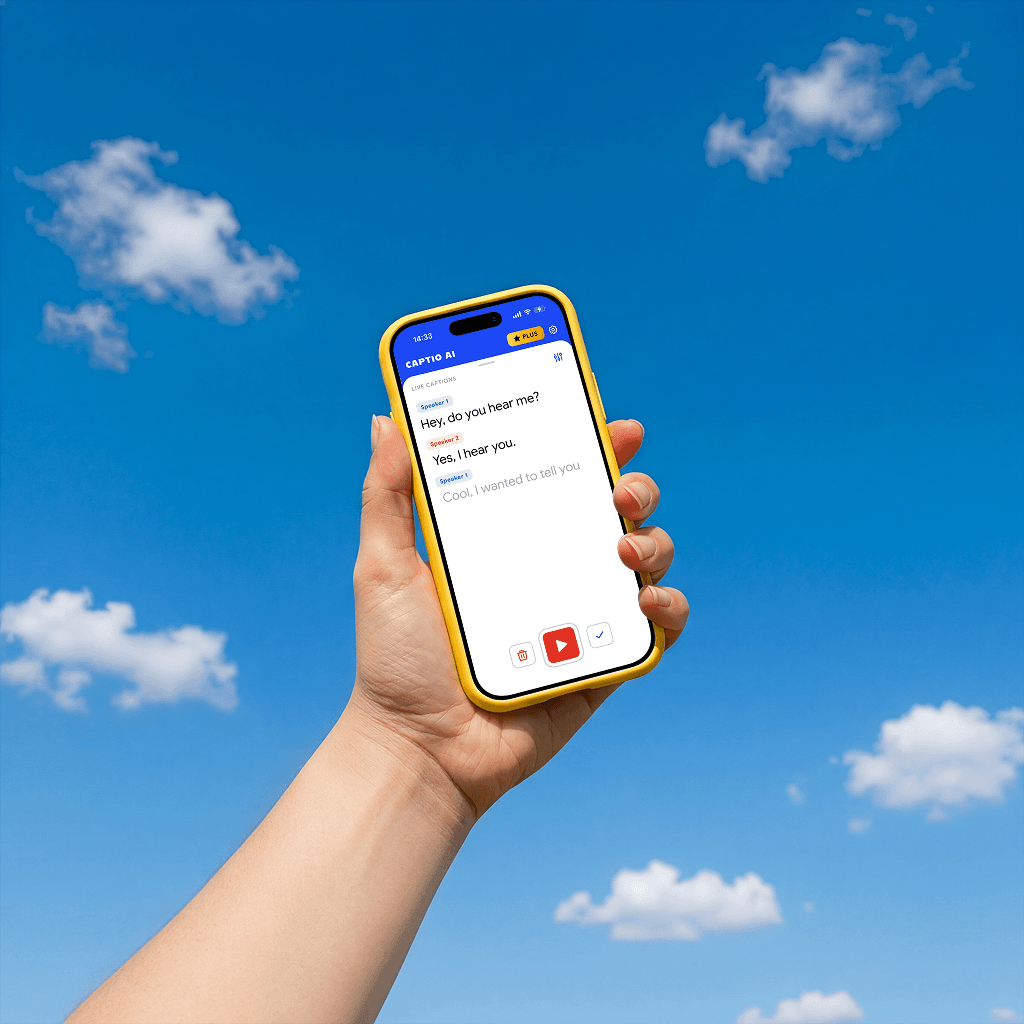
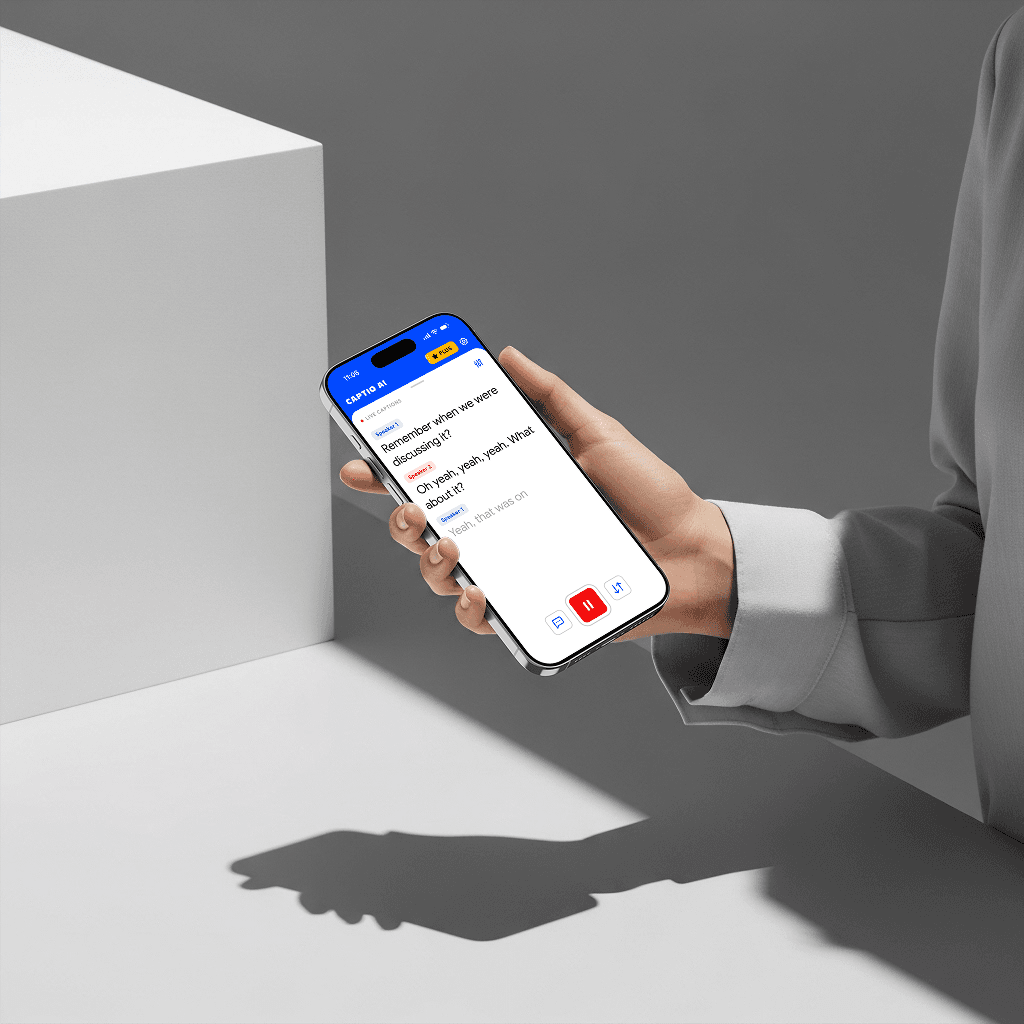
Built to keep you in the conversation, not just in the room
Captions whoever is speaking
Captio AI follows the dominant voice at any moment — whoever is loudest in the microphone's direction. In a group conversation, this tracks the active speaker naturally.
Works through background noise
Restaurants, living rooms, parties, outdoor gatherings. Moderate background noise does not prevent accurate captions — Captio AI is built for real environments, not quiet rooms.
Place it in the centre and forget it
Put the phone on the table or in the middle of the group, microphone facing the conversation. No positioning it after every speaker change, no adjusting between voices.
Less effort, less fatigue
The cognitive load of following a group conversation by lip-reading and reconstructing speech is exhausting. Captio AI handles the following so you can direct your energy toward actually being in the conversation.
60+ languages
For multilingual families, mixed-language social groups, or gatherings where people switch between languages mid-conversation. No setup required between language changes.
No setup between conversations
Open the app and place the phone. No configuration per setting, no briefing the group, nothing to manage between conversations. It works for any group, in any situation.
Why Bengali is hard to understand
55 dialect zones
- A family gathering in London or Dhaka can contain three phonologically distinct Bengali varieties
- Bengali has an estimated 55 distinct dialects with substantial differences in phonology, vocabulary, and prosody. Chittagonian, spoken in Chittagong and across the UK Bangladeshi diaspora, is phonologically distant enough from standard Dhaka Bengali that comprehension is significantly reduced even for hearing speakers. A gathering with Sylheti-speaking grandparents, Dhaka-raised parents, and Kolkata Bengali aunts presents three different phonological systems at the same table.
Nasal vowel elision
- Bengali's nasalized vowels are invisible on the lips and drop in fast speech
- Bengali has nasalized vowels marked with chandrabindu (ঁ) that carry lexical and grammatical distinctions. In fast informal speech, nasalization is frequently dropped or inconsistently produced. The nasal/oral vowel distinction is in any case invisible on the lips — meaning minimal pairs that differ only in nasality cannot be resolved from visual information alone, regardless of how clearly a speaker produces them.
Sandhi compression
- Words run together at Bengali word boundaries in fast group conversation
- Bengali applies sandhi — vowel and consonant merging — at word boundaries in connected speech, compressing what appears on paper as distinct words into fused phonological units. In fast casual Bengali at a social gathering, the word boundaries a lip-reader uses as markers for parsing speech disappear, and the speech stream becomes a continuous sequence without the gaps that aid visual comprehension.
Sylheti-Dhaka accent gap
- Sylheti, spoken by most UK Bangladeshis, has a different phonological inventory from Dhaka Bengali
- Sylheti is spoken by the majority of the UK Bangladeshi diaspora and has distinct vowel qualities, a different consonant inventory, and different vocabulary from standard Dhaka Bengali. A deaf person raised in Dhaka who moves to Tower Hamlets or Birmingham encounters a phonologically distinct variety of Bengali in their own community — and vice versa for a Sylheti speaker encountering Dhaka-accented family members.
Bengali-English mixing
- Urban gatherings in Dhaka, Kolkata, and the UK shift between Bengali and English without announcement
- Urban Bangladeshi and West Bengali gatherings — especially among younger generations — mix Bengali and English freely: 'Oi, tui ki already submit korli tomar assignment?' The English segment carries specific content and appears without warning. A deaf person tracking Bengali loses the thread the moment the switch happens, and the phonological systems of Bengali and English share few visual cues.
Download for free
13 million in Bangladesh alone — and recognition in law has not reached the family table.
Bangladesh has one of the highest rates of disabling hearing impairment in Asia. A population study published in PMC found that approximately 9.6% of the Bangladeshi population — around 13 million people — are deaf or hard of hearing, with profound hearing loss (≥90 dB) present in 1.2% of the population. These figures represent a population navigating daily social life, including family gatherings and community events, without adequate communication support and in many cases without any diagnosis or audiological care.
The social consequences are well documented. Research on deaf communities in Bangladesh found that deaf people frequently lack access to education, face discrimination in employment, and suffer from poor or absent communication with family members — leading to social exclusion and loneliness even within their own homes. In 2019, Prime Minister Sheikh Hasina officially recognised Bangla Sign Language (BDSL) as an official language, establishing February 7th as national sign language day. But recognition in law has not translated to meaningful change in daily life: interpreter provision remains minimal and deaf people's participation in everyday family and community settings remains structurally unsupported.
Captio AI captions Bengali in real time — across Dhaka colloquial, Sylheti-accented speech, and Bengali-English code-switching — so the Eid family gathering, the Sunday adda, and the neighbourhood community event are conversations a deaf or hard of hearing person can follow without asking to be repeated.
Download for free
What you hear stays with you.
Gone the moment it ends
Captio AI processes your audio in real time and discards it immediately. Nothing is recorded. Nothing is kept.
Not a product
Your conversations are not something Captio AI sells, shares, or monetizes — to anyone, for any reason.
Not used to train anything
What you say in a doctor's appointment or a job interview never ends up in a training dataset. Not ours. Not anyone else's.

Private by default
Captio AI supports 60+ languages
Download for free
Frequently asked questions
Keep up with the group in Bengali.
Captio AI is free to start
Download for free