

Urdu live captions and productivity tool for everyday conversations
For deaf and hard of hearing people.
Download for free


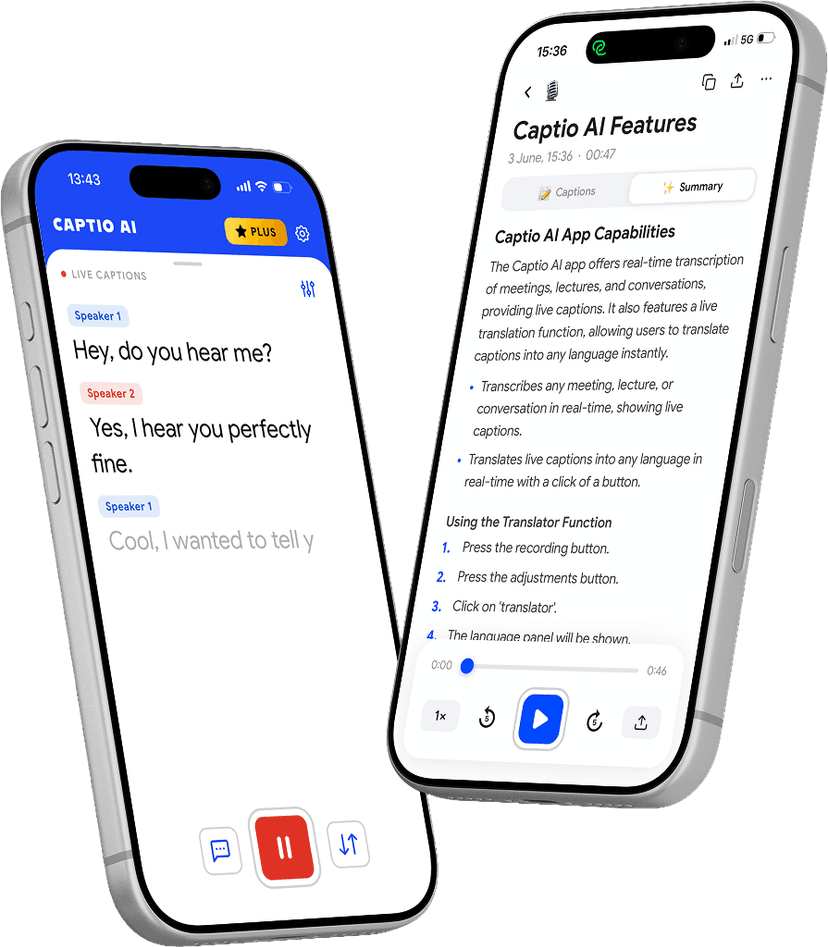
Everything you need to follow Urdu everyday conversations
Four tools built for deaf and hard of hearing Urdu speakers.
Captions any conversation in real time
- Word by word, as the person speaks
- Works in noisy places — counters, streets, busy rooms
- Any accent, any pace
- No lip reading needed
Everyday conversations in any language
- Translates as they speak, not after
- Each person speaks their own language
- Handles mid-sentence switches
- 60+ languages, no setup
Save any conversation for later
- Record and get the full transcript
- Organized by speaker
- Read, copy, search, share
- Any language, any audio
Key points from any exchange
- Important points extracted automatically
- Works on any saved transcript
- Organized into clear sections
- Nothing gets missed
Download for free
Every situation covered
Designed for the real moments that matter — not just quiet controlled environments.
Local chemist, utility company window, bank branch teller, NADRA office. Staff speak fast in colloquial Urdu and move on quickly. Captio AI shows what they said before the exchange ends.
Family dinner, Eid gathering, wedding mehndi or reception. Multiple generations, Urdu mixing with Punjabi or English, overlapping voices. Captio AI captions whoever is speaking.
Asking a rickshaw driver where they're going, getting a price at the market, chatting with a neighbour. People who speak at full pace without adjustment. Captio AI captions anyone near you.
Tea break conversation in the office, a quick question across the floor, banter in the canteen. The moments Pakistani workplaces run on. Captio AI keeps you in those conversations.
Government office window, hospital reception, bank branch, BISP centre. Fast Urdu, sometimes formal vocabulary, no repeat expected. Captio AI transcribes everything said.
Bus conductor calling routes, Careem driver conversation, asking at a railway station. Situations where you need to understand fast. Captio AI covers you anywhere on the move.
Most accurate and fastest models
word accuracy
independent benchmark, 2025
real-time captions
first word appears as you speak
Download for free
Built for conversations that don't wait
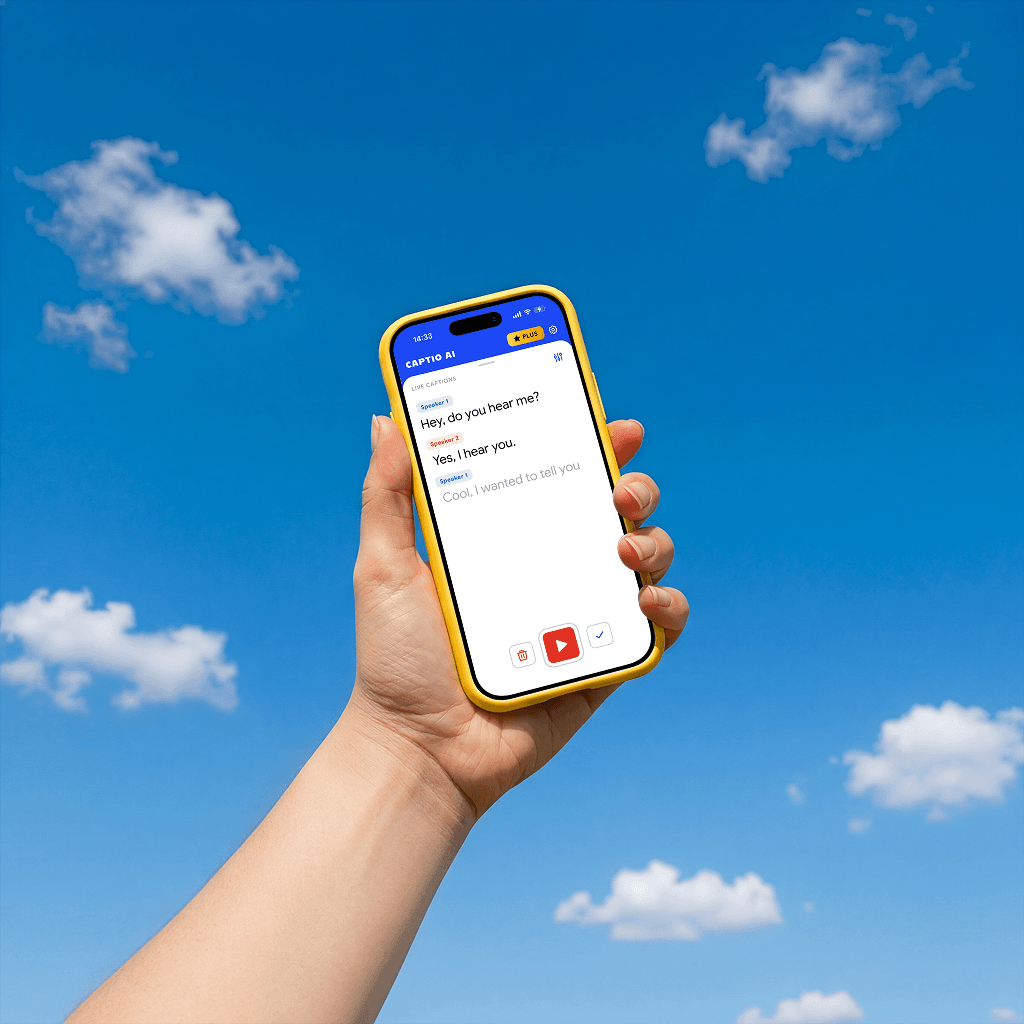
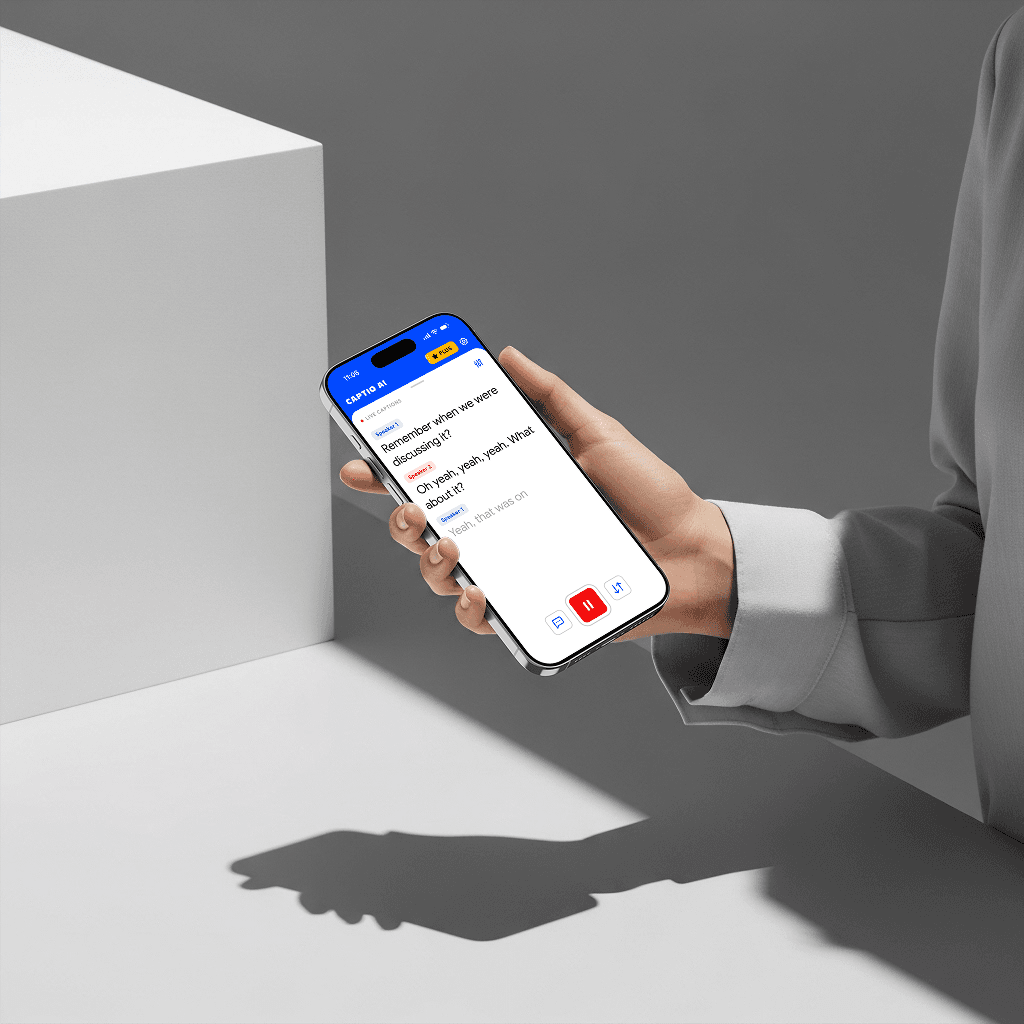
Captions as they speak, not after
Captio AI shows each word as it is spoken. You read what the person is saying while they are still saying it — not after they have finished and moved on.
No lip reading needed
You do not need to face the speaker or position yourself to see their mouth. Captio AI picks up speech from any direction — across a counter, at a table, in a busy street.
Works through background noise
Restaurants, pharmacies, busy streets, crowded waiting rooms. Captio AI separates speech from background noise so captions stay accurate where everyday conversations actually happen.
Follows any conversation
One person or six. Captio AI captions whoever is speaking at any moment — so you follow the thread at a dinner table or keep up with a counter exchange without losing track.
Any accent, any pace
People do not slow down or enunciate for you. Captio AI handles fast talkers, regional accents, and casual speech — the way people actually talk in real life.
Any language, no setup
When someone speaks a language you do not know, switch to Live Translator. They speak their language — you read in yours. No configuration needed. Works in 60+ languages.
Why Urdu is hard to understand
Nastaliq script, oral culture
- Pakistan's daily life is primarily oral, not written
- Urdu is written in Nastaliq script — right-to-left, beautiful, but rarely present in informal public settings. Literacy rates are uneven, and daily Pakistani life relies heavily on oral communication. For a deaf person, the absence of reliable written backup in markets, transport, and public spaces makes captioning the only real option.
Formal vs everyday Urdu
- High Urdu and street Urdu are genuinely different registers
- Formal Urdu — the literary and broadcast standard — draws heavily from Arabic and Persian vocabulary. Everyday Pakistani Urdu is far simpler, faster, and mixes extensively with Punjabi and English. A deaf person who learned formal Urdu faces a completely different spoken reality at the bazaar or the family kitchen.
Multilingual mixing
- Urban Pakistan mixes Urdu, Punjabi, English, and regional languages mid-sentence
- Lahore conversations mix Urdu and Punjabi constantly. Karachi speech mixes Urdu with Sindhi. Educated urban registers everywhere insert English. A single conversation at a Lahore bazaar can involve all three languages without any speaker switching consciously.
Fast bazaar pace
- Bazaar and market transactions have no patience for repetition
- Lahore's Anarkali, Karachi's Saddar, the neighbourhood kiryana shop — transactions happen fast in colloquial Urdu and Punjabi with minimal patience for repetition. This is where deaf and hard of hearing people face daily exclusion: not in formal settings, but in the ordinary commercial fabric of Pakistani daily life.
Pharyngeal consonants
- Urdu's Arabic and Persian loanwords carry throat sounds invisible on the lips
- Educated everyday Urdu — in homes, offices, and any formal exchange — draws heavily from Arabic and Persian, bringing in pharyngeal and uvular consonants: ع (ain), غ (ghain), ق (qaf), خ (khe). These are produced deep in the throat with zero visible lip or jaw movement. They appear in common everyday words — عزیز (dear), غلط (wrong), قریب (near) — and are completely absent from the lip reader's visual field.
Download for free
10 million people. Pakistan's deaf community with almost no daily-life infrastructure.
Pakistan has approximately 10 million deaf and hard of hearing people — 4.8% of the national population — according to government health data. For deaf Urdu speakers, exclusion from daily life begins immediately: the kiryana shop where the shopkeeper doesn't have time to repeat, the joint family household where multiple conversations happen in multiple languages at once, the bazaar where transactions are entirely verbal and entirely fast. These are not formal or institutional settings. They are the ordinary commercial and social fabric of Pakistani daily life.
Less than 5% of deaf children in Pakistan attend school, according to the Borgen Project's research on the Pakistani deaf community. Pakistani Sign Language has not been normalised in public life. Government offices, transport, markets, pharmacies, and public hospitals operate entirely without interpreter provision or captioning standards. The 2023 WHO Eastern Mediterranean Regional Office study on hearing impairment in Pakistan documented the profound impact of communication barriers on families from early childhood through adulthood — barriers that the absence of any systematic support structure means are never resolved.
Pakistan's population is young and growing, but hearing loss rates are elevated by high prevalence of chronic suppurative otitis media (CSOM) — the leading cause of childhood deafness — and limited preventative healthcare reach in rural areas. The deaf and hard of hearing population is substantial and almost entirely unsupported in the settings of daily life. Captio AI captions Urdu speech in real time — including fast colloquial registers, Punjabi-Urdu mixing, and the urban Hinglish of Pakistani cities — so the bazaar, the family kitchen, and the transport ride are no longer settings you have to navigate alone.
Download for free
What you hear stays with you.
Gone the moment it ends
Captio AI processes your audio in real time and discards it immediately. Nothing is recorded. Nothing is kept.
Not a product
Your conversations are not something Captio AI sells, shares, or monetizes — to anyone, for any reason.
Not used to train anything
What you say in a doctor's appointment or a job interview never ends up in a training dataset. Not ours. Not anyone else's.

Private by default
Captio AI supports 60+ languages
Download for free
Frequently asked questions
Follow any conversation in Urdu.
Captio AI is free to start
Download for free