

Japanese live captions and productivity tool for everyday conversations
For deaf and hard of hearing people.
Download for free


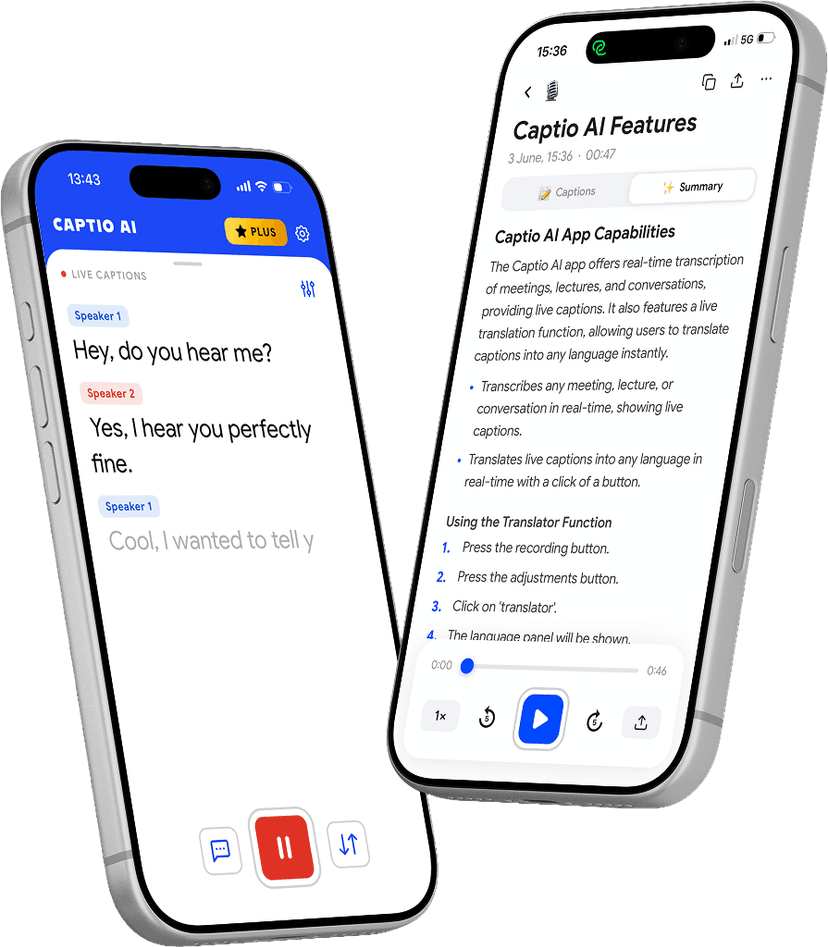
Everything you need to follow Japanese everyday conversations
Four tools built for deaf and hard of hearing Japanese speakers.
Captions any conversation in real time
- Word by word, as the person speaks
- Works in noisy places — counters, streets, busy rooms
- Any accent, any pace
- No lip reading needed
Everyday conversations in any language
- Translates as they speak, not after
- Each person speaks their own language
- Handles mid-sentence switches
- 60+ languages, no setup
Save any conversation for later
- Record and get the full transcript
- Organized by speaker
- Read, copy, search, share
- Any language, any audio
Key points from any exchange
- Important points extracted automatically
- Works on any saved transcript
- Organized into clear sections
- Nothing gets missed
Download for free
Every situation covered
Designed for the real moments that matter — not just quiet controlled environments.
Convenience store counter, pharmacy cashier, post office window, city hall service desk. Staff speak formally and quickly. Captio AI shows what they said before the moment passes.
Family dinner, izakaya evening with friends, hanami gathering. Multiple people, fast casual Japanese, keigo mixing with informal speech. Captio AI captions whoever is speaking.
Asking a shopkeeper for help, getting directions from a passerby, chatting with a neighbour. People who speak politely but quickly. Captio AI captions anyone near you.
Office break room conversation, a quick question between desks, chat before the morning meeting. The moments Japanese workplaces run on. Captio AI keeps you in those conversations.
Clinic reception, ward office counter, bank branch, Japan Post window. Polite but fast speech, sometimes formal keigo, no repeat expected. Captio AI transcribes everything said.
Train and subway announcements, asking at a station, taxi driver, asking for help at a bus stop. Japan's transport runs almost entirely on audio. Captio AI covers you anywhere on the move.
Most accurate and fastest models
character accuracy
independent benchmark, 2025
real-time captions
first word appears as you speak
Download for free
Built for conversations that don't wait
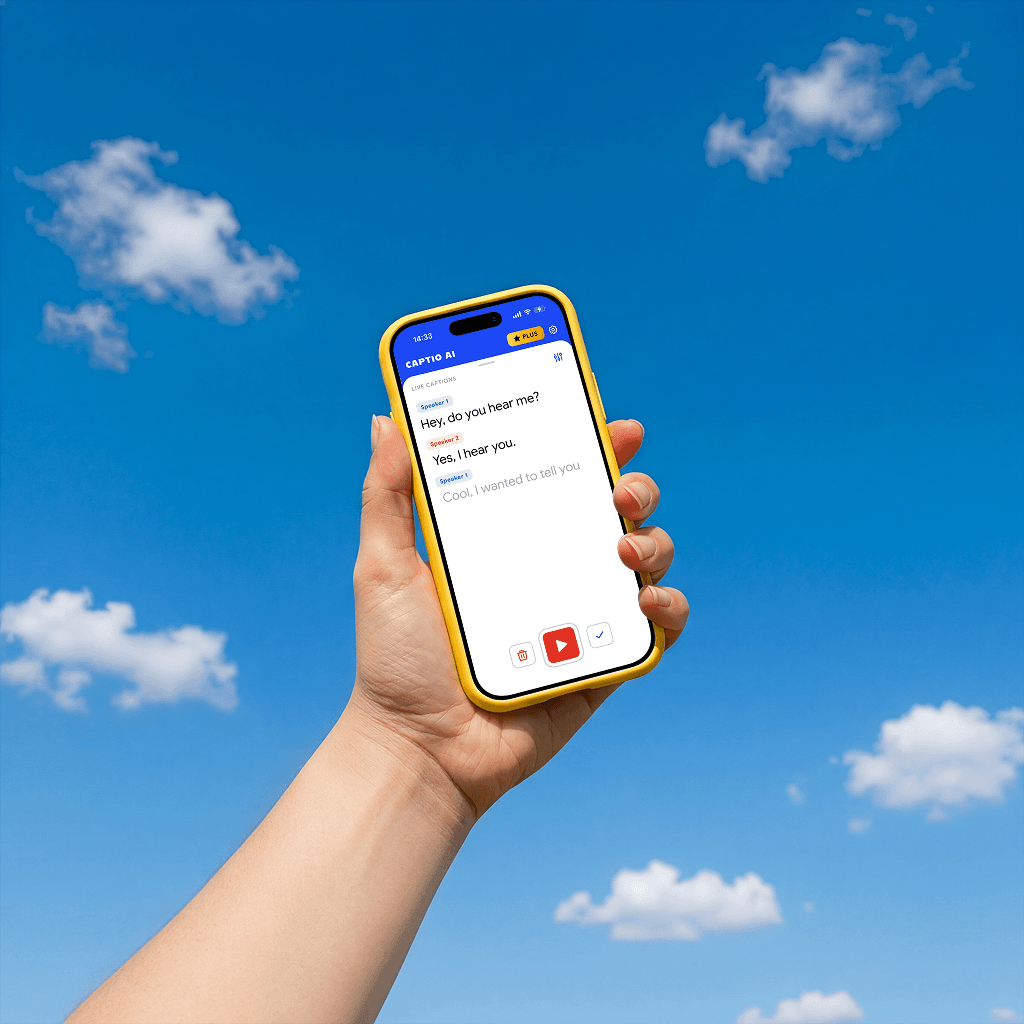
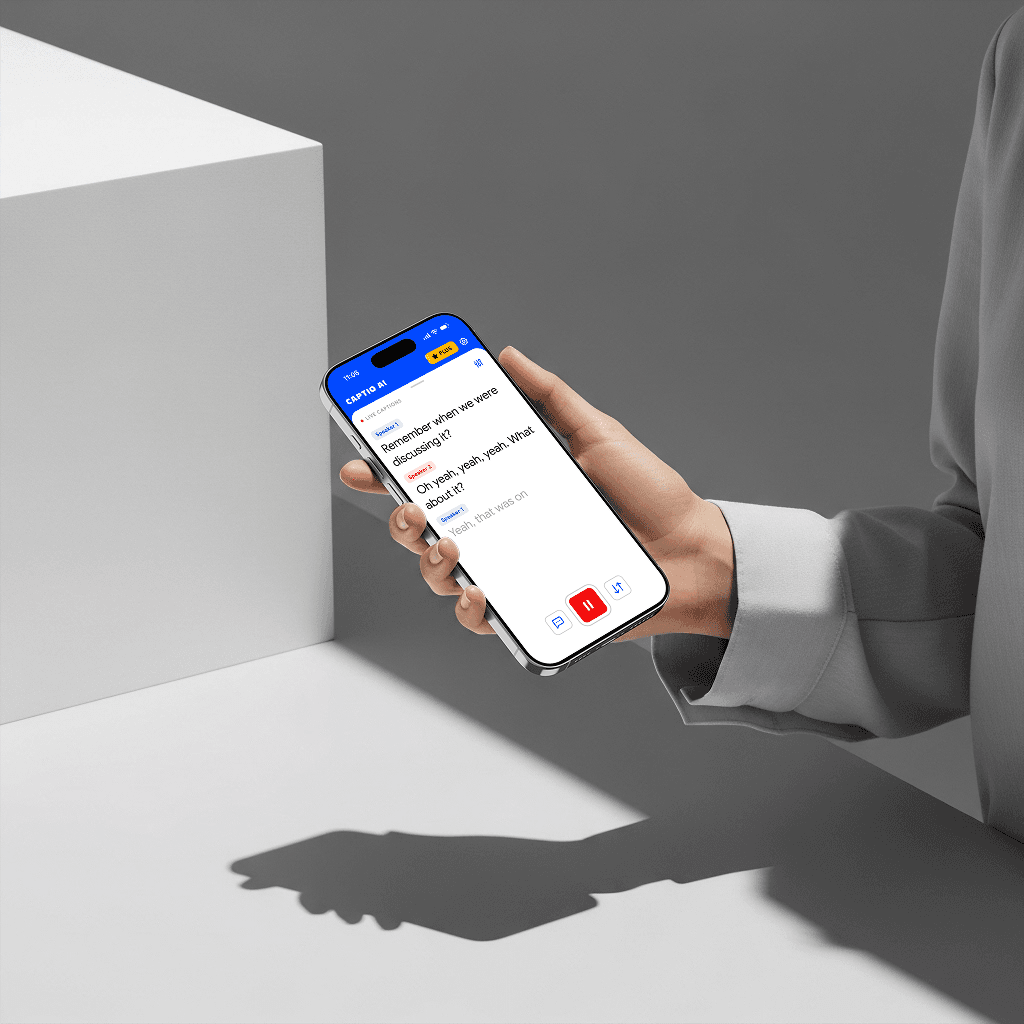
Captions as they speak, not after
Captio AI shows each word as it is spoken. You read what the person is saying while they are still saying it — not after they have finished and moved on.
No lip reading needed
You do not need to face the speaker or position yourself to see their mouth. Captio AI picks up speech from any direction — across a counter, at a table, in a busy street.
Works through background noise
Restaurants, pharmacies, busy streets, crowded waiting rooms. Captio AI separates speech from background noise so captions stay accurate where everyday conversations actually happen.
Follows any conversation
One person or six. Captio AI captions whoever is speaking at any moment — so you follow the thread at a dinner table or keep up with a counter exchange without losing track.
Any accent, any pace
People do not slow down or enunciate for you. Captio AI handles fast talkers, regional accents, and casual speech — the way people actually talk in real life.
Any language, no setup
When someone speaks a language you do not know, switch to Live Translator. They speak their language — you read in yours. No configuration needed. Works in 60+ languages.
Why Japanese is hard to understand
Minimal lip movement
- Japanese speakers articulate with far less visible mouth movement than European languages
- Research has confirmed that Japanese speakers are significantly less reliant on lip movement than English or German speakers. The phonology of Japanese — shorter vowels, minimal lip protrusion, and a syllabic rhythm — produces almost no visible information for a lip reader. Even skilled lip readers get very little from Japanese at conversational speed.
Keigo registers
- Formal and casual Japanese are effectively different languages
- Japanese has multiple speech registers: casual (だ/である), polite (です/ます), and honorific keigo, which uses entirely different vocabulary and verb forms. The word for 'to eat' is 食べる in casual speech and 召し上がる in formal keigo. In everyday conversations — meeting a neighbour, speaking to a shop owner, talking to a senior at work — the register shifts constantly, and following which register is being used is itself a communication challenge.
Pitch accent
- Tokyo and Osaka Japanese have different pitch accents — both are invisible on the lips
- Japanese uses pitch accent to distinguish words — 橋 (hashi, bridge) and 箸 (hashi, chopsticks) are phonetically identical on the lips but differ in pitch. Tokyo Japanese and Kansai Japanese have different accent systems. For a deaf or hard of hearing person, these distinctions are inaccessible without captions.
Social silence pressure
- Japanese social culture makes asking for accommodation extremely difficult
- Japanese social norms prioritise not causing disruption or burdening others. Asking someone to repeat themselves, slow down, or write something down carries social cost — especially when addressing a senior, a customer, or a stranger. Deaf and hard of hearing people in Japan regularly absorb social situations without understanding them rather than ask for accommodation.
Izakaya and group settings
- Japanese group socialising happens in loud, fast, multi-speaker settings
- Izakaya evenings, hanami gatherings, office nomikai — Japanese social life centres on group settings where overlapping speech, fast casual registers, and background noise make comprehension almost impossible for deaf or hard of hearing people without support.
Download for free
14 million people. A culture of accommodation that never reaches the izakaya or the convenience store.
Japan has approximately 14.2 million people with any degree of hearing disability, according to the Japan Hearing Aid Industry Association — a figure driven in large part by Japan having one of the world's oldest populations, with nearly 30% of citizens aged 65 or older. Around 360,000 people are Deaf or severely hard of hearing. For deaf people navigating Japanese daily life, exclusion happens not through overt hostility but through the structure of the language and society itself: the izakaya where the group conversation happens too fast to follow, the convenience store where the staff speak in scripted fast Japanese, the family dinner where register shifts signal social meaning that disappears without sound.
Japanese social norms create a particular barrier: asking someone to repeat, slow down, or write something is socially costly in a way that does not apply in Western cultures. Deaf people in Japan routinely absorb social situations without understanding them rather than create disruption by asking for accommodation. Japanese Sign Language (JSL) is used by approximately 70,000 people but is not widely understood outside the deaf community. For everyday informal settings — the konbini, the nomikai, the neighbourhood shop — there is no interpreter and no cultural expectation that one will be provided.
Japan's ageing population means the number of people navigating daily Japanese life with hearing loss is growing faster than in almost any other country. The Ministry of Health, Labour and Welfare projects continued increase in age-related hearing loss through 2050, while accessibility infrastructure for everyday informal settings remains minimal. Captio AI captions Japanese speech in real time — including casual registers, keigo shifts, and the pitch-accent varieties of Tokyo and Kansai — so the izakaya, the convenience store counter, and the family dinner are no longer settings you have to navigate alone.
Download for free
What you hear stays with you.
Gone the moment it ends
Captio AI processes your audio in real time and discards it immediately. Nothing is recorded. Nothing is kept.
Not a product
Your conversations are not something Captio AI sells, shares, or monetizes — to anyone, for any reason.
Not used to train anything
What you say in a doctor's appointment or a job interview never ends up in a training dataset. Not ours. Not anyone else's.

Private by default
Captio AI supports 60+ languages
Download for free
Frequently asked questions
Follow any conversation in Japanese.
Captio AI is free to start
Download for free