

Korean live captions and productivity tool for everyday conversations
For deaf and hard of hearing people.
Download for free


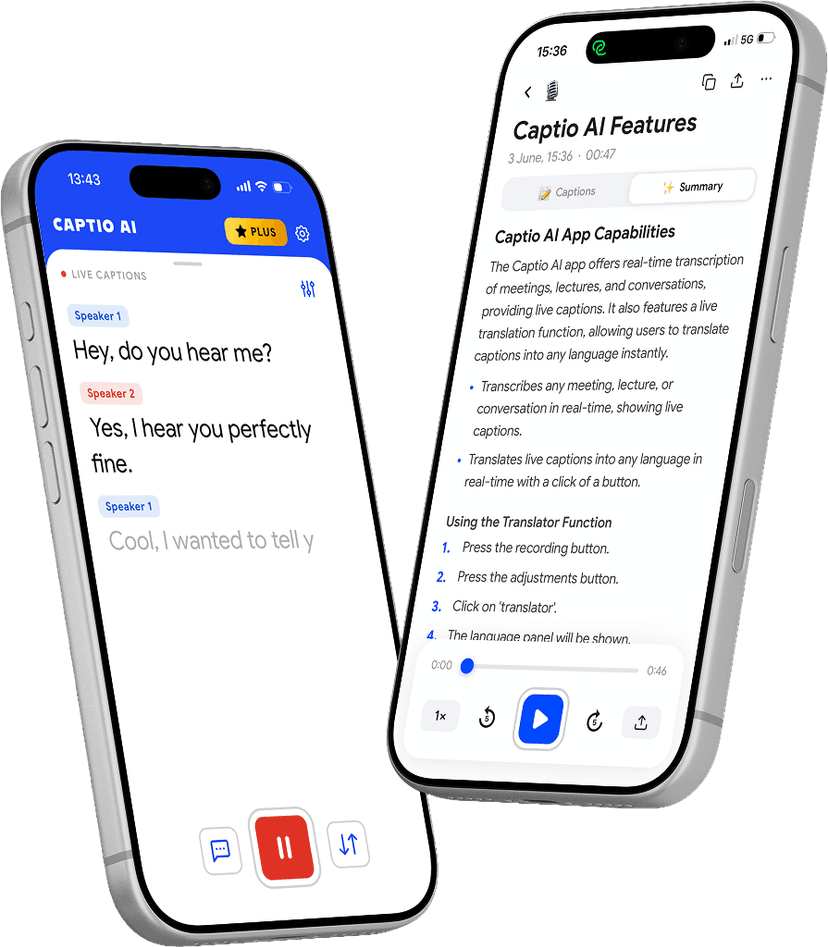
Everything you need to follow Korean everyday conversations
Four tools built for deaf and hard of hearing Korean speakers.
Captions any conversation in real time
- Word by word, as the person speaks
- Works in noisy places — counters, streets, busy rooms
- Any accent, any pace
- No lip reading needed
Everyday conversations in any language
- Translates as they speak, not after
- Each person speaks their own language
- Handles mid-sentence switches
- 60+ languages, no setup
Save any conversation for later
- Record and get the full transcript
- Organized by speaker
- Read, copy, search, share
- Any language, any audio
Key points from any exchange
- Important points extracted automatically
- Works on any saved transcript
- Organized into clear sections
- Nothing gets missed
Download for free
Every situation covered
Designed for the real moments that matter — not just quiet controlled environments.
Pharmacy counter, convenience store checkout, bank teller, community centre service desk. Staff speak fast in Korean and move on. Captio AI shows what they said before the moment passes.
Family dinner, Chuseok gathering, after-work hoesik meal. Multiple people, fast Korean, honorifics shifting between generations. Captio AI captions whoever is speaking.
Asking a shopkeeper for help, getting directions in a new neighbourhood, chatting with a neighbour. People who speak at full pace. Captio AI captions anyone near you.
Coffee break conversation, a quick question across the office, chat before the meeting starts. The moments Korean workplaces run on. Captio AI keeps you in those conversations.
Clinic reception, gu office counter, bank branch, post office. Polite but fast speech, formal honorifics, no repeat expected. Captio AI transcribes everything said.
Subway announcements, bus driver, asking at a station, taxi conversation. South Korea's transport runs on sound. Captio AI covers you anywhere on the move.
Most accurate and fastest models
character accuracy
independent benchmark, 2025
real-time captions
first word appears as you speak
Download for free
Built for conversations that don't wait
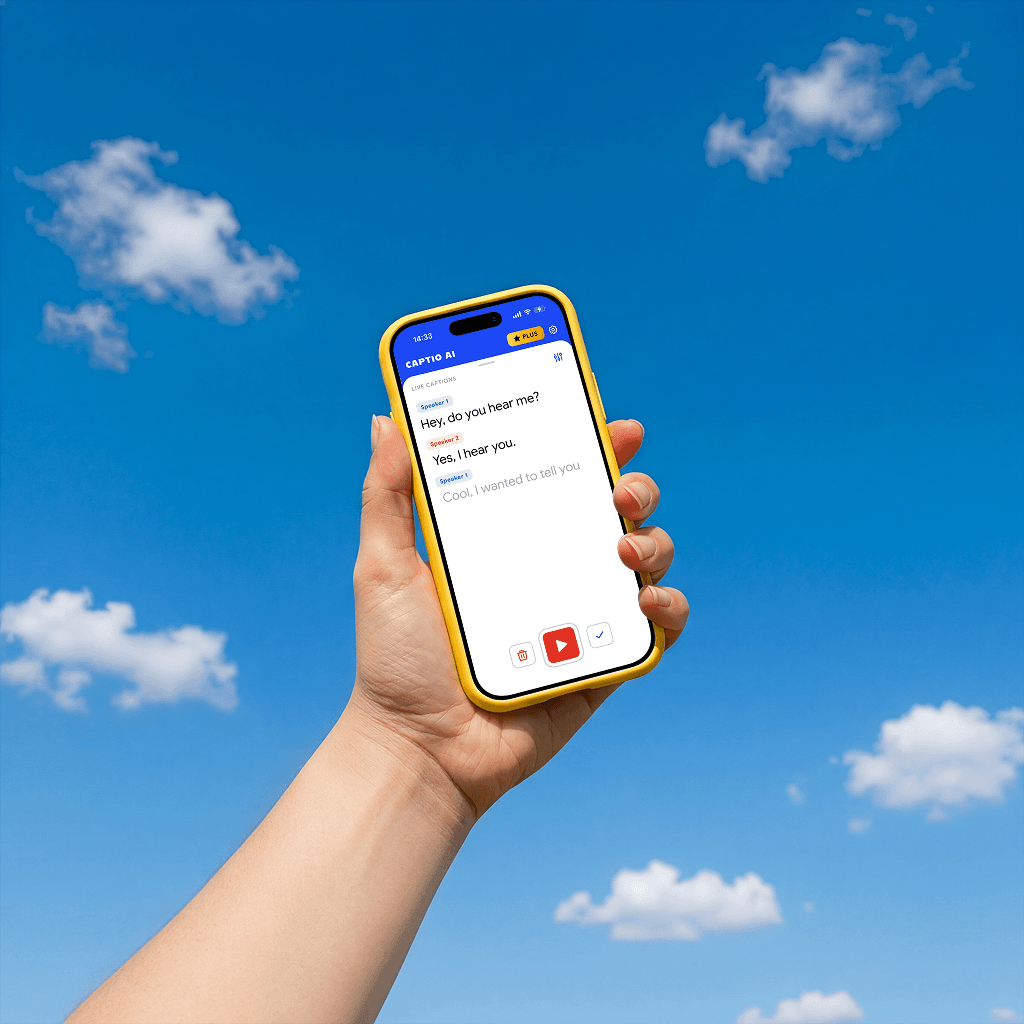
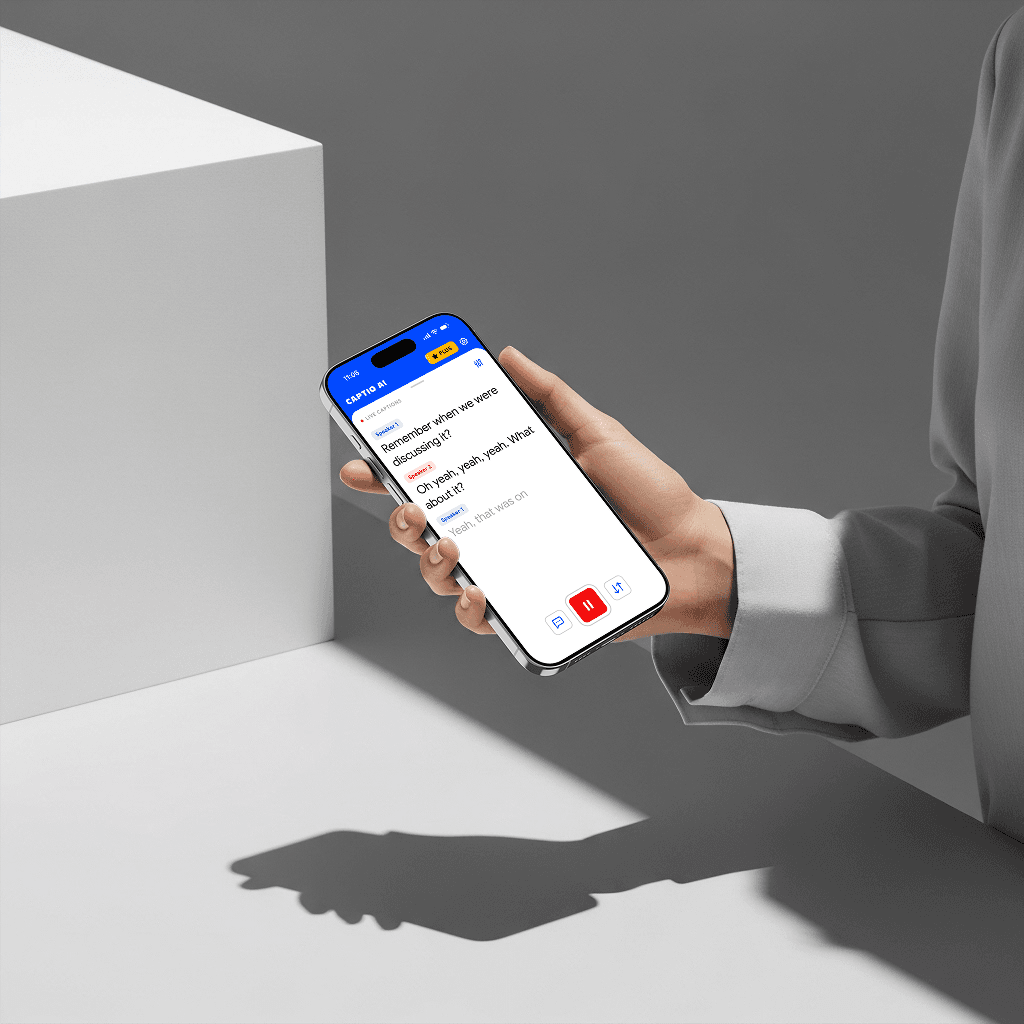
Captions as they speak, not after
Captio AI shows each word as it is spoken. You read what the person is saying while they are still saying it — not after they have finished and moved on.
No lip reading needed
You do not need to face the speaker or position yourself to see their mouth. Captio AI picks up speech from any direction — across a counter, at a table, in a busy street.
Works through background noise
Restaurants, pharmacies, busy streets, crowded waiting rooms. Captio AI separates speech from background noise so captions stay accurate where everyday conversations actually happen.
Follows any conversation
One person or six. Captio AI captions whoever is speaking at any moment — so you follow the thread at a dinner table or keep up with a counter exchange without losing track.
Any accent, any pace
People do not slow down or enunciate for you. Captio AI handles fast talkers, regional accents, and casual speech — the way people actually talk in real life.
Any language, no setup
When someone speaks a language you do not know, switch to Live Translator. They speak their language — you read in yours. No configuration needed. Works in 60+ languages.
Why Korean is hard to understand
Speech level system
- Korean has seven speech levels — and formal and informal use different words, not just different endings
- Korean grammar encodes the social relationship between speakers in the verb ending. But more than grammar, many Korean vocabulary items have entirely different formal and informal equivalents. A deaf person who learned formal Korean (used in education and media) encounters different vocabulary in casual family and friend settings. Each new social context brings new words.
Agglutination
- Korean adds suffixes to verbs that change meaning entirely
- Korean is agglutinative: verb stems take multiple attached endings that encode tense, aspect, modality, politeness, and negation simultaneously. At natural conversational speed, these extended verb forms are delivered quickly with minimal pause. For a lip reader, Korean verbs produce long indistinct visual streams.
Hierarchical social pressure
- Asking for repetition or accommodation carries significant social cost
- Korean social culture is hierarchical, and asking someone to slow down, repeat, or write something carries social cost — especially when that person is older, a customer, or a senior. Deaf and hard of hearing Koreans regularly absorb conversations they did not understand rather than create social awkwardness by asking for help.
Fast everyday registers
- Everyday informal Korean is fast and full of contractions and dropped sounds
- Formal Korean (broadcast, news, education) is deliberate and clear. Everyday street Korean contracts, drops final consonants, and runs syllables together at high speed. The spoken form of common phrases bears little resemblance to their written form. Lip reading casual Korean provides very limited information.
Café and convenience store culture
- Korean daily social life happens in fast, noisy, verbal settings
- Korean daily life is centred on cafés, convenience stores, and pojangmacha (street food tents). These settings involve fast speech, background music, and overlapping conversation. For deaf and hard of hearing people, these are the settings where exclusion from social life is most acutely felt.
Download for free
432,000 registered. Millions more with partial hearing loss. KSL is official — but daily life never got the memo.
South Korea had 432,900 people registered with a hearing disability in 2023, according to the Ministry of Health and Welfare. Broader population surveys, including the 2010–2012 Korea National Health and Nutrition Examination Survey (KNHANES), found that 9.2% of Korean adults have moderate-to-profound hearing impairment — a figure that extrapolates to millions. For deaf Koreans, exclusion from daily life happens not through legal failure but through cultural and structural reality: the café where conversation happens at high speed in fast informal Korean, the family gathering where speech levels shift constantly, the convenience store where staff speak scripted fast polite Korean with no expectation of needing to repeat.
Korean Sign Language (KSL) was designated an official language under the Korean Sign Language Act in 2016 — one of the more progressive legal recognitions in Asia. But legal recognition has not translated into daily-life accessibility. Outside formal institutions, KSL interpreters are absent from the settings that make up most of Korean daily existence. The cultural pressure not to ask for accommodation — rooted in Korean hierarchical social norms — means that many deaf and hard of hearing Koreans mask their hearing loss rather than disclose it and request support.
South Korea's rapidly ageing population is driving an increase in hearing loss prevalence. A nationwide 10-year trend study published in Scientific Reports found a consistent increase in severe-profound hearing loss in South Korea between 2006 and 2015. The gap between the scale of the deaf and hard of hearing population and the daily-life infrastructure to support them is widening. Captio AI captions Korean speech in real time — across all speech levels, from formal to casual — so the café, the family gathering, and the convenience store are no longer settings you have to navigate alone.
Download for free
What you hear stays with you.
Gone the moment it ends
Captio AI processes your audio in real time and discards it immediately. Nothing is recorded. Nothing is kept.
Not a product
Your conversations are not something Captio AI sells, shares, or monetizes — to anyone, for any reason.
Not used to train anything
What you say in a doctor's appointment or a job interview never ends up in a training dataset. Not ours. Not anyone else's.

Private by default
Captio AI supports 60+ languages
Download for free
Frequently asked questions
Follow any conversation in Korean.
Captio AI is free to start
Download for free