

Serbian live captions and productivity tool for everyday conversations
For deaf and hard of hearing people.
Download for free


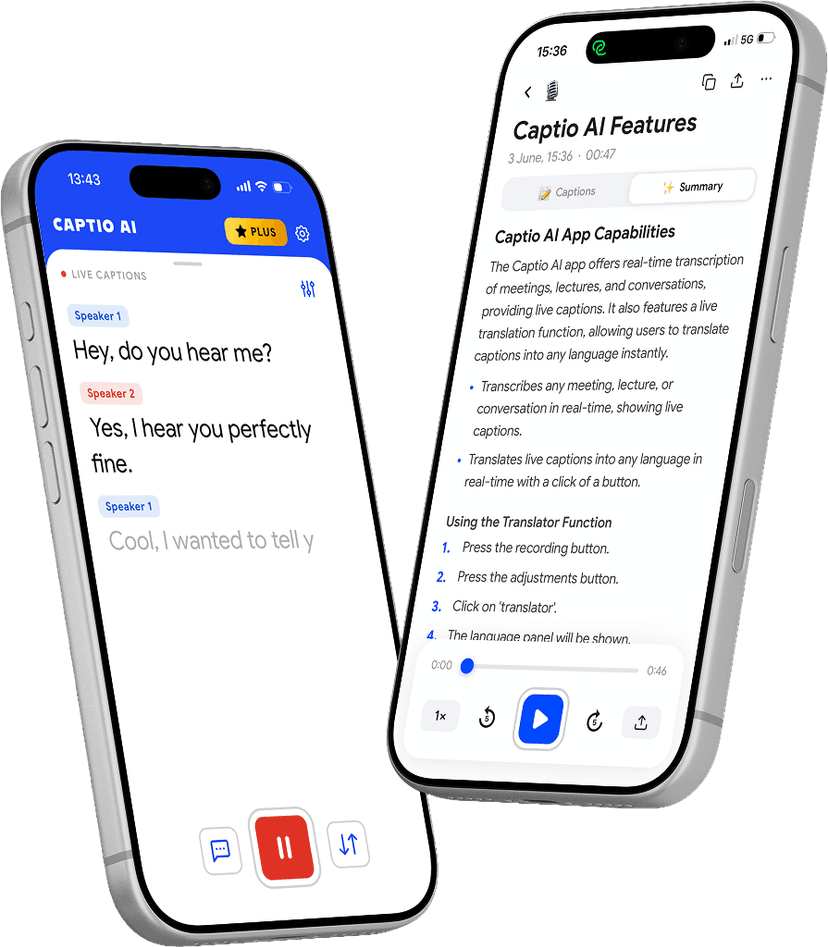
Everything you need to follow Serbian everyday conversations
Four tools built for deaf and hard of hearing Serbian speakers.
Captions any conversation in real time
- Word by word, as the person speaks
- Works in noisy places — counters, streets, busy rooms
- Any accent, any pace
- No lip reading needed
Everyday conversations in any language
- Translates as they speak, not after
- Each person speaks their own language
- Handles mid-sentence switches
- 60+ languages, no setup
Save any conversation for later
- Record and get the full transcript
- Organized by speaker
- Read, copy, search, share
- Any language, any audio
Key points from any exchange
- Important points extracted automatically
- Works on any saved transcript
- Organized into clear sections
- Nothing gets missed
Download for free
Every situation covered
Designed for the real moments that matter — not just quiet controlled environments.
Apoteka counter, pošta window, supermarket checkout, opštinska služba desk. Staff speak fast in Serbian and move on. Captio AI shows what they said before the moment passes.
Sunday family ručak, slava gathering, birthday dinner with extended family. Multiple generations, fast overlapping Serbian, Ekavian and Ijekavian mixing. Captio AI captions whoever is speaking.
Asking for directions in the city, chatting with a neighbour in the zgradi, meeting someone at the pijaca. People who speak at full conversational pace. Captio AI captions anyone near you.
Coffee break in the office, a quick question in the hodniku, catch-up before a meeting. The moments Serbian workplaces run on. Captio AI keeps you in those conversations.
Dom zdravlja reception, opštinska šalter, bank branch, PIO fond office. Formal vocabulary, fast delivery, no repeat expected. Captio AI transcribes everything said.
Tram and bus announcements, asking at a železnička stanica, taxi driver conversation. Situations where you need to understand the first time. Captio AI covers you anywhere.
Most accurate and fastest models
word accuracy
independent benchmark, 2025
real-time captions
first word appears as you speak
Download for free
Built for conversations that don't wait
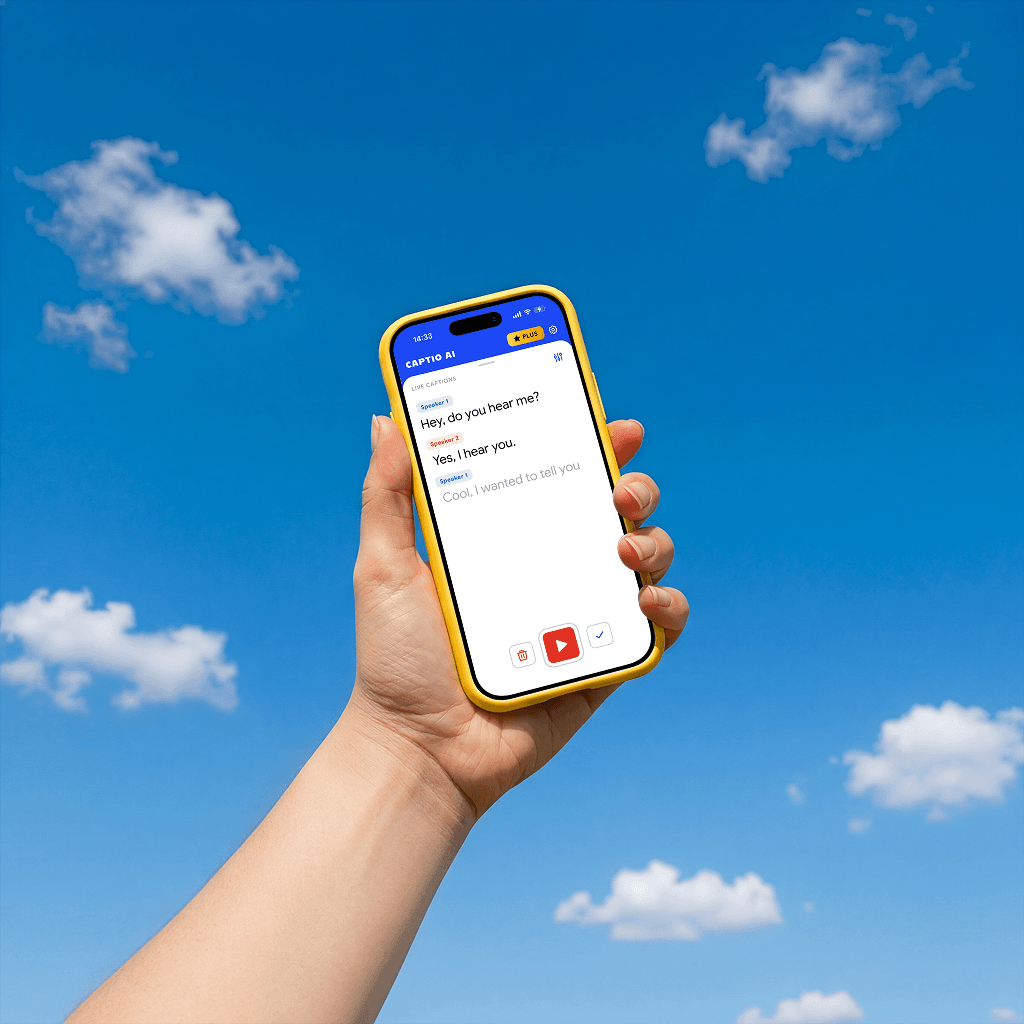
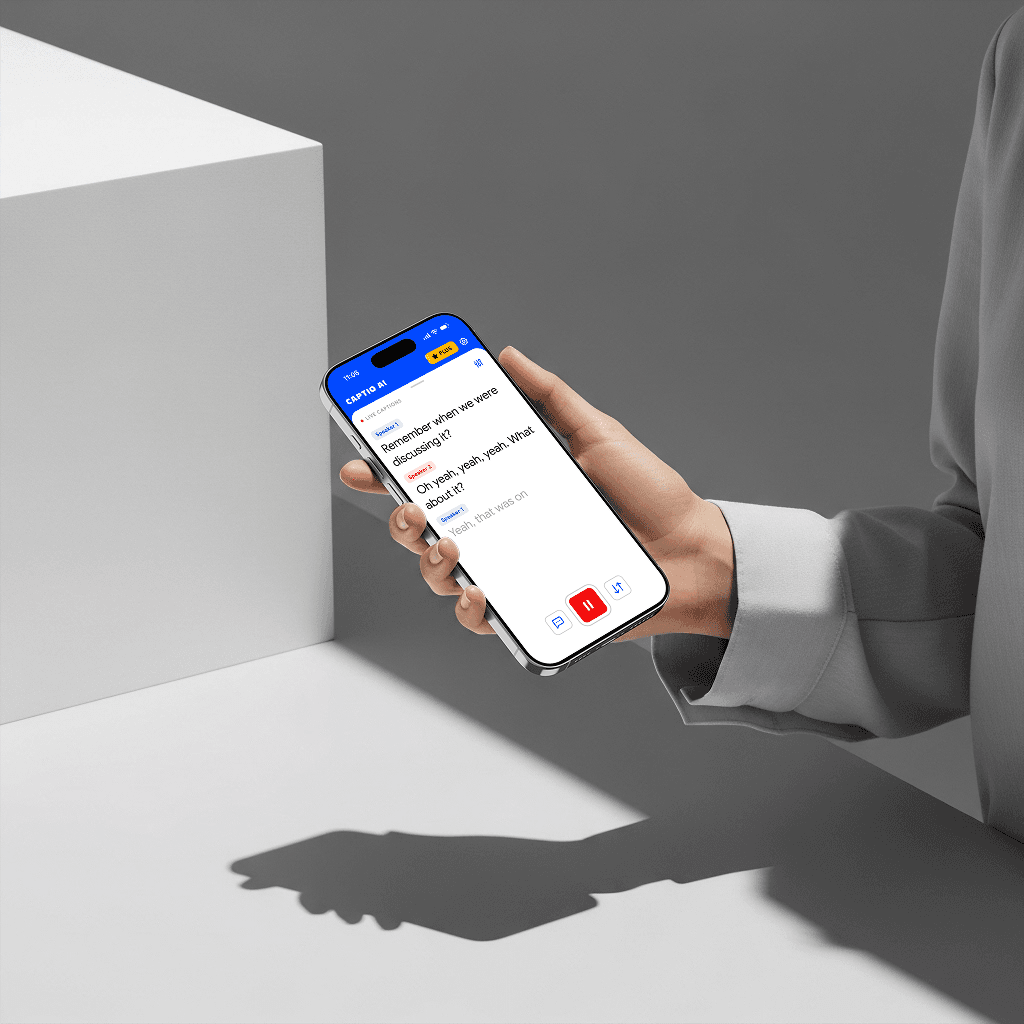
Captions as they speak, not after
Captio AI shows each word as it is spoken. You read what the person is saying while they are still saying it — not after they have finished and moved on.
No lip reading needed
You do not need to face the speaker or position yourself to see their mouth. Captio AI picks up speech from any direction — across a counter, at a table, in a busy street.
Works through background noise
Restaurants, pharmacies, busy streets, crowded waiting rooms. Captio AI separates speech from background noise so captions stay accurate where everyday conversations actually happen.
Follows any conversation
One person or six. Captio AI captions whoever is speaking at any moment — so you follow the thread at a dinner table or keep up with a counter exchange without losing track.
Any accent, any pace
People do not slow down or enunciate for you. Captio AI handles fast talkers, regional accents, and casual speech — the way people actually talk in real life.
Any language, no setup
When someone speaks a language you do not know, switch to Live Translator. They speak their language — you read in yours. No configuration needed. Works in 60+ languages.
Why Serbian is hard to understand
Ekavian vs. Ijekavian split
- Serbian spoken in Serbia and Serbian spoken in Bosnia or Montenegro sound meaningfully different
- Serbian has two major dialect variants in everyday use: Ekavian (spoken in Serbia proper) and Ijekavian (spoken in Bosnia-Herzegovina and Montenegro). The vowel 'e' and 'ije/je' replacements change the sound of dozens of common words. A deaf person who has calibrated lip-reading to Belgrade Ekavian Serbian will lose accuracy when family or colleagues come from Bosnia or Montenegro.
Fast colloquial speed
- Everyday Belgrade street Serbian is spoken fast with heavy slang and vowel reduction
- Colloquial Serbian as spoken in Belgrade and other cities runs at a high pace, drops syllables, and uses a heavy informal register that sounds very different from the formal Serbian of news broadcasts or written text. The gap between written and spoken Serbian is large enough that a lip-reader who has learned formal Serbian finds daily conversation essentially a separate challenge.
Kafana culture
- The kafana is Serbia's most important social space — and it is built for loud, overlapping conversation
- The Serbian kafana (traditional tavern) is not simply a restaurant. It is where political opinion forms, where friendships deepen, where community gathers — often with live music (sevdalinka, folk) playing throughout. The combination of live music, hard surfaces, and simultaneous conversation creates one of the most acoustically inaccessible environments in European social life for anyone with hearing loss.
Two scripts
- Serbian is written in both Cyrillic and Latin — written communication as a fallback is ambiguous
- Serbian uses both Cyrillic and Latin script in everyday life. For a deaf person who relies on written communication as a backup strategy, the ambiguity of which script the other person will use — or whether they will switch mid-message — adds friction to every written exchange.
Limited interpreter access
- Serbian Sign Language is recognised but interpreter availability outside Belgrade is very thin
- Serbian Sign Language was legally recognised in 2005, but certified interpreters are concentrated in Belgrade. A deaf person in Novi Sad, Niš, Kragujevac, or any smaller city navigating a government counter, a market, or a family gathering has minimal access to formal interpretation support. Everyday informal settings carry no provision at all.
Download for free
Over 400,000 Serbians with hearing loss. Sign language recognised in 2005 but interpreters concentrated in Belgrade. No captions at the kafana, the pijaca, or the slava table.
WHO estimates place Serbia's hearing-impaired population at over 400,000 people — roughly 6% of a population of 7 million — consistent with European regional averages. For deaf and hard of hearing Serbians, daily life revolves around settings built entirely on oral exchange: the kafana, the pijaca, the neighbourhood courtyard, the family slava. These are not marginal settings — they are the central institutions of Serbian social life. To be excluded from them by hearing loss is to be excluded from the structure of how Serbian community works.
Serbian Sign Language was legally recognised in 2005, making Serbia one of the earlier Balkan states to take this step. However, certified interpreters remain heavily concentrated in Belgrade, leaving deaf Serbians outside the capital without practical access to formal interpretation in any everyday setting. The kafana — which combines live music with loud conversation — represents a particular barrier: the single most socially important setting in Serbian culture is also one of the most acoustically impenetrable environments for anyone with hearing loss.
Research from the European Union of the Deaf and national disability organisations consistently documents that the formal recognition of sign language in the Western Balkans has not translated to everyday accessibility infrastructure. Informal daily settings — the market, the café, the neighbourhood conversation — carry no legal obligation for captioning or signing and are therefore entirely inaccessible to deaf Serbians without a hearing companion. The slava — Serbia's most culturally specific annual family gathering — remains a noise-filled event that deaf family members observe rather than participate in. Captio AI captions Serbian speech in real time — including fast Belgrade colloquial Serbian and Ijekavian varieties — so the kafana, the market, and the family table are no longer conversations you have to sit outside of.
Download for free
What you hear stays with you.
Gone the moment it ends
Captio AI processes your audio in real time and discards it immediately. Nothing is recorded. Nothing is kept.
Not a product
Your conversations are not something Captio AI sells, shares, or monetizes — to anyone, for any reason.
Not used to train anything
What you say in a doctor's appointment or a job interview never ends up in a training dataset. Not ours. Not anyone else's.

Private by default
Captio AI supports 60+ languages
Download for free
Frequently asked questions
Follow any conversation in Serbian.
Captio AI is free to start
Download for free