

Swahili live captions and productivity tool for everyday conversations
For deaf and hard of hearing people.
Download for free


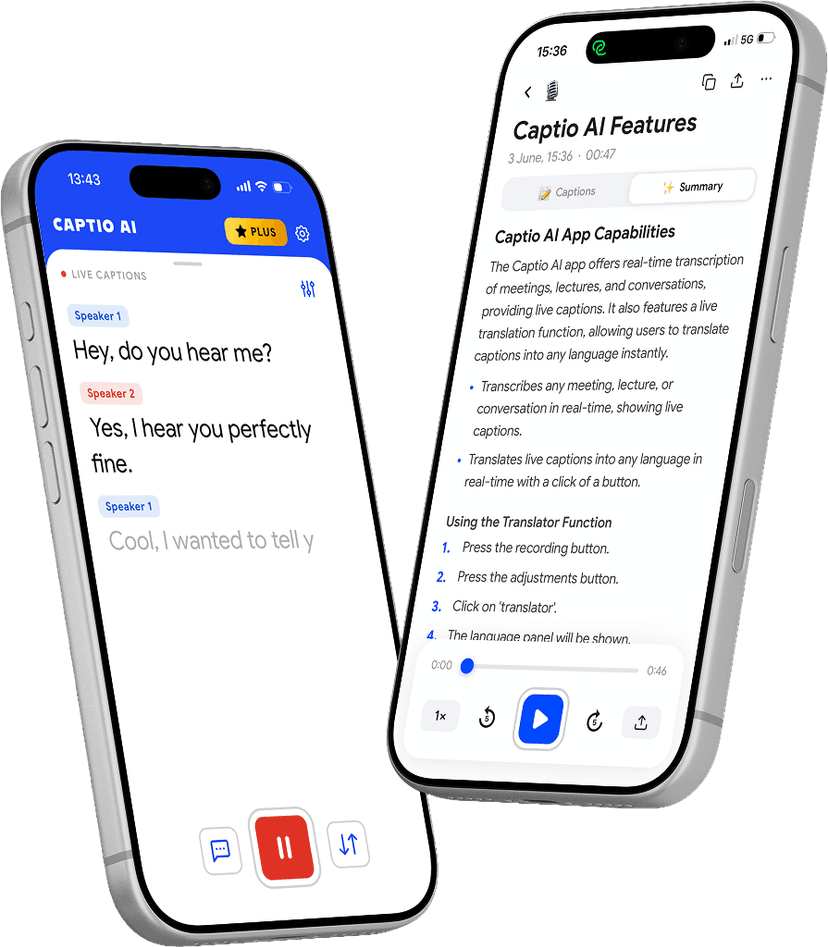
Everything you need to follow Swahili everyday conversations
Four tools built for deaf and hard of hearing Swahili speakers.
Captions any conversation in real time
- Word by word, as the person speaks
- Works in noisy places — counters, streets, busy rooms
- Any accent, any pace
- No lip reading needed
Everyday conversations in any language
- Translates as they speak, not after
- Each person speaks their own language
- Handles mid-sentence switches
- 60+ languages, no setup
Save any conversation for later
- Record and get the full transcript
- Organized by speaker
- Read, copy, search, share
- Any language, any audio
Key points from any exchange
- Important points extracted automatically
- Works on any saved transcript
- Organized into clear sections
- Nothing gets missed
Download for free
Every situation covered
Designed for the real moments that matter — not just quiet controlled environments.
Pharmacy counter, supermarket checkout, government office window, bank teller. Staff speak fast in Swahili and move on quickly. Captio AI shows what they said before the moment passes.
Family dinner, harambee gathering, Sunday meal with extended family. Multiple generations, fast overlapping conversation, occasional English mixing in. Captio AI captions whoever is speaking.
Getting a price from a market vendor, asking for directions, chatting with a neighbour. People who speak at full conversational pace. Captio AI captions anyone near you.
Tea break chat in the office, a quick question across the floor, catch-up in the corridor. The moments East African workplaces run on. Captio AI keeps you in those conversations.
Government office window, hospital outpatient counter, bank branch, NHIF clinic. Fast Swahili, sometimes bureaucratic phrasing, no repeat expected. Captio AI transcribes everything said.
Matatu conductor calling routes, asking at a bus stage, boda boda driver conversation. Situations where you need to understand fast. Captio AI covers you anywhere on the move.
Most accurate and fastest models
word accuracy
independent benchmark, 2025
real-time captions
first word appears as you speak
Download for free
Built for conversations that don't wait
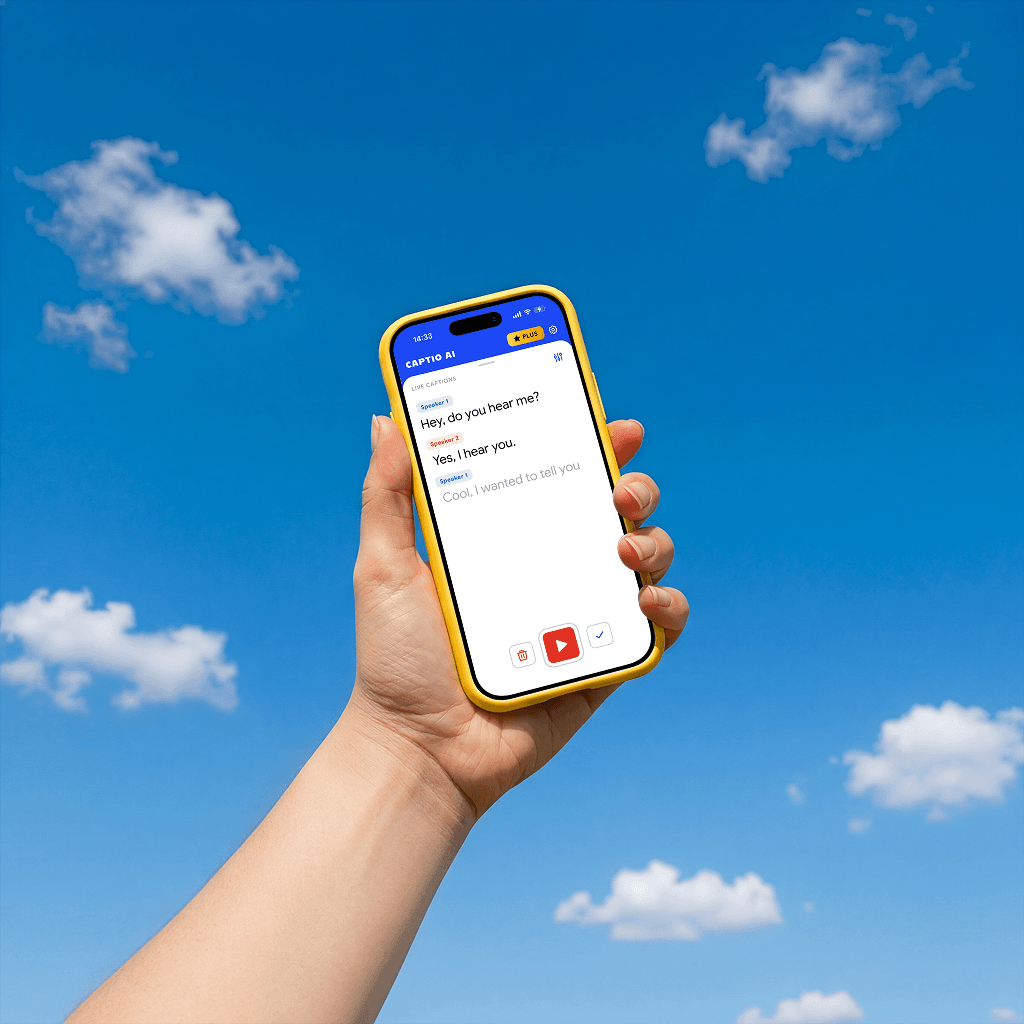
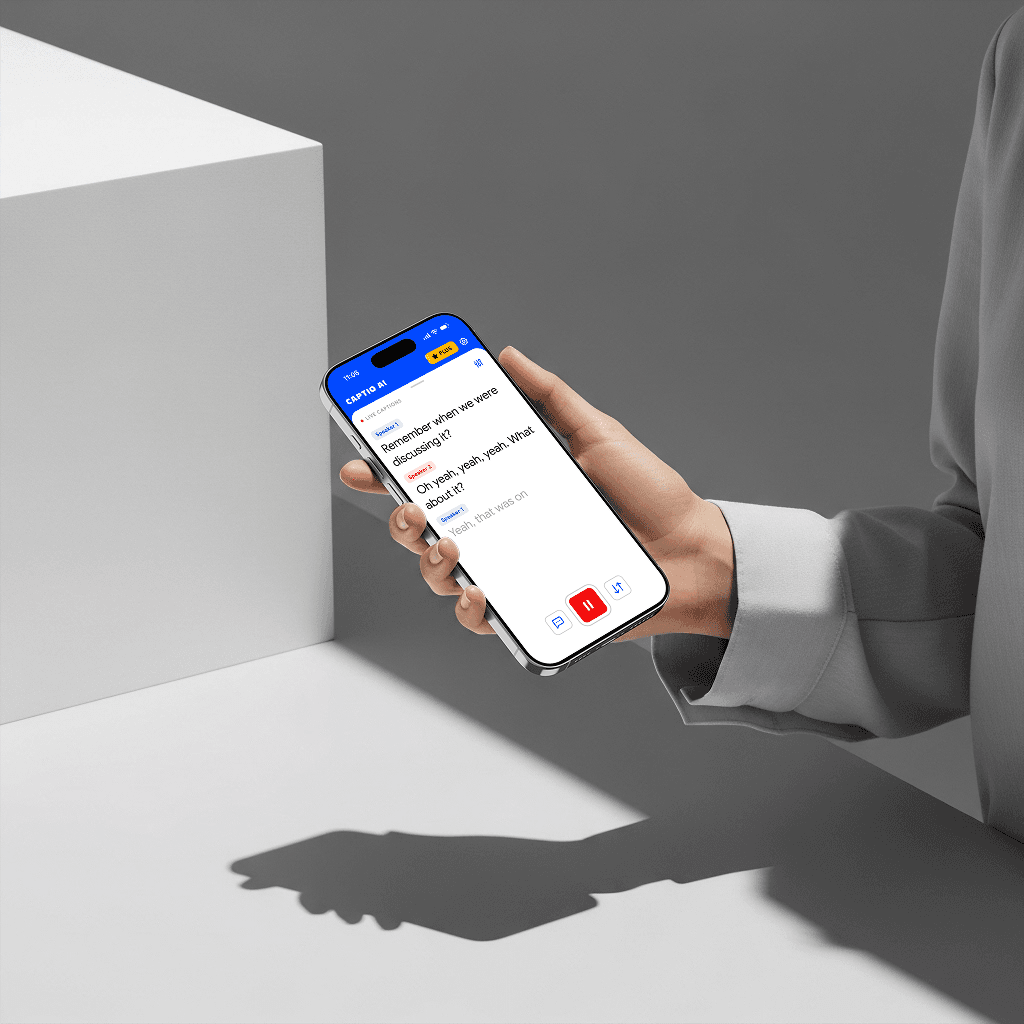
Captions as they speak, not after
Captio AI shows each word as it is spoken. You read what the person is saying while they are still saying it — not after they have finished and moved on.
No lip reading needed
You do not need to face the speaker or position yourself to see their mouth. Captio AI picks up speech from any direction — across a counter, at a table, in a busy street.
Works through background noise
Restaurants, pharmacies, busy streets, crowded waiting rooms. Captio AI separates speech from background noise so captions stay accurate where everyday conversations actually happen.
Follows any conversation
One person or six. Captio AI captions whoever is speaking at any moment — so you follow the thread at a dinner table or keep up with a counter exchange without losing track.
Any accent, any pace
People do not slow down or enunciate for you. Captio AI handles fast talkers, regional accents, and casual speech — the way people actually talk in real life.
Any language, no setup
When someone speaks a language you do not know, switch to Live Translator. They speak their language — you read in yours. No configuration needed. Works in 60+ languages.
Why Swahili is hard to understand
Code-switching
- Real Swahili conversations mix Kiswahili with Kikuyu, Luo, Luhya, and other local languages
- Swahili is the lingua franca of East Africa, but daily conversations in Kenya, Tanzania, and Uganda mix Kiswahili with local ethnic languages constantly. A family meal in Nairobi can shift between Swahili and Kikuyu. A market exchange in Kisumu moves between Swahili and Luo. Following the meaning requires all languages at once.
Sheng and urban slang
- Urban Nairobi Swahili is Sheng — a creole mixing Swahili, English, and local languages
- Sheng, spoken by younger people in Nairobi, is a hybrid street language that combines Swahili, English, and Kikuyu into a constantly evolving slang register. Standard Swahili and Sheng are not the same language. A deaf person who learned standard Swahili will miss large portions of a Nairobi youth conversation.
Loud market settings
- East African markets and matatus are among the loudest daily environments anywhere
- The matatu (shared minibus), the open-air market, the street food stall — these are the primary settings of East African daily social life. They are loud, fast, and entirely acoustic. For deaf and hard of hearing people, these settings present daily barriers with no visual alternative.
Limited interpreter access
- Kenyan Sign Language exists but is absent from most everyday settings
- Kenyan Sign Language (KSL) is a recognised language in Kenya, but interpreters are concentrated in formal institutions — schools, churches, hospitals. For markets, transport, neighbourhood interactions, and family gatherings, there is no interpreter and no captioning infrastructure.
Tanzania vs Kenya varieties
- Tanzanian Swahili and Kenyan Swahili are different spoken varieties
- Tanzania's Swahili (often considered the standard variety, as it originates near Zanzibar) differs in vocabulary and pronunciation from the Kenyan Nairobi variety. A deaf person calibrated to one will miss portions of the other — and both differ from the Swahili used as a second language in Uganda and the Democratic Republic of Congo.
Download for free
40 million people with hearing loss across Africa. No interpreter for the market, the matatu, or the family meal.
Africa has approximately 40 million people living with hearing loss, a figure the WHO projects will rise to 54 million by 2030 — one of the fastest-growing hearing loss burdens globally, driven by high rates of preventable ear disease, limited healthcare access, and an urbanising population with growing noise exposure. In Kenya alone, an estimated 2.5 million people are deaf, with the 2019 national census recording 153,381 registered deaf individuals. For deaf Swahili speakers in Kenya, Tanzania, and Uganda, exclusion from daily life is not abstract: it is the market stall where the vendor mixes Swahili and Kikuyu at full speed, the matatu where the conductor shouts route information, the family gathering where multiple languages overlap without pause.
Kenyan Sign Language is legally recognised, but interpreter provision in everyday informal settings is essentially absent. Public hospitals, government offices, and schools sometimes have KSL access; markets, transport, neighbourhood shops, and family gatherings never do. Hearing loss costs Africa an estimated $27.1 billion annually in lost productivity and healthcare costs, according to the WHO Africa Regional Office — yet investment in everyday-life accessibility for deaf and hard of hearing people remains minimal across the region.
The burden of hearing loss in Sub-Saharan Africa is set to continue rising through 2050, driven by population growth, urban noise exposure, and persistent gaps in preventative healthcare. The infrastructure gap between the scale of the deaf and hard of hearing population in East Africa and the support available in daily Swahili-speaking life is one of the largest in the world. Captio AI captions Swahili speech in real time — including fast colloquial registers and Sheng — so the market, the matatu, and the family gathering are no longer settings you have to navigate alone.
Download for free
What you hear stays with you.
Gone the moment it ends
Captio AI processes your audio in real time and discards it immediately. Nothing is recorded. Nothing is kept.
Not a product
Your conversations are not something Captio AI sells, shares, or monetizes — to anyone, for any reason.
Not used to train anything
What you say in a doctor's appointment or a job interview never ends up in a training dataset. Not ours. Not anyone else's.

Private by default
Captio AI supports 60+ languages
Download for free
Frequently asked questions
Follow any conversation in Swahili.
Captio AI is free to start
Download for free