

Thai live captions and productivity tool for everyday conversations
For deaf and hard of hearing people.
Download for free


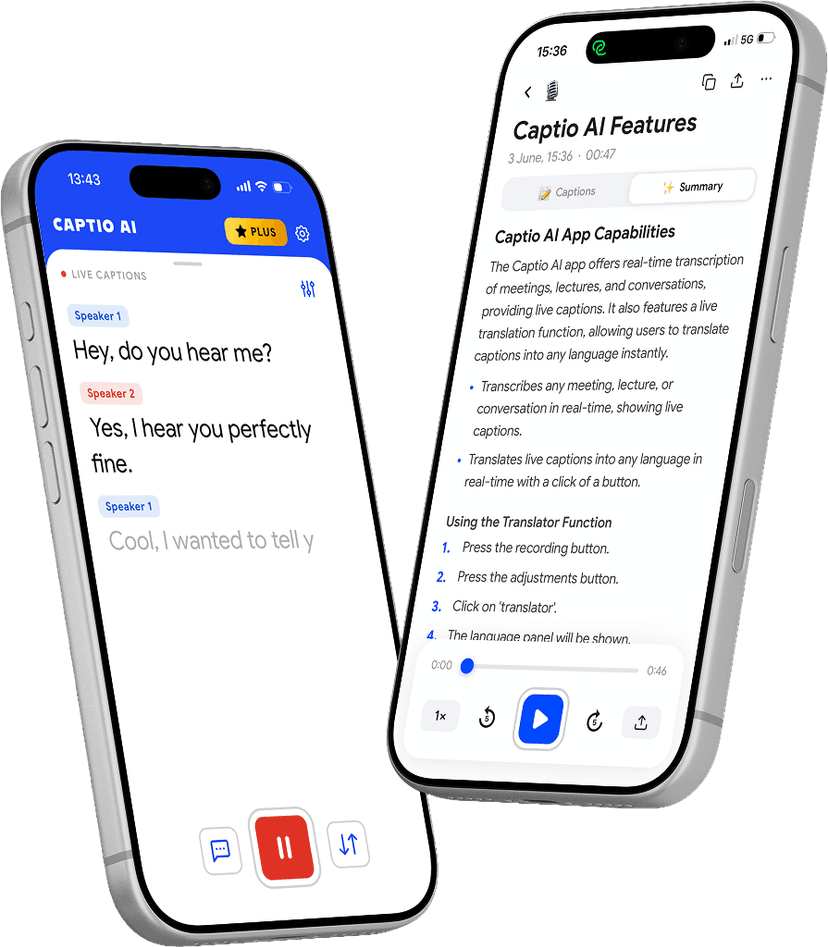
Everything you need to follow Thai everyday conversations
Four tools built for deaf and hard of hearing Thai speakers.
Captions any conversation in real time
- Word by word, as the person speaks
- Works in noisy places — counters, streets, busy rooms
- Any accent, any pace
- No lip reading needed
Everyday conversations in any language
- Translates as they speak, not after
- Each person speaks their own language
- Handles mid-sentence switches
- 60+ languages, no setup
Save any conversation for later
- Record and get the full transcript
- Organized by speaker
- Read, copy, search, share
- Any language, any audio
Key points from any exchange
- Important points extracted automatically
- Works on any saved transcript
- Organized into clear sections
- Nothing gets missed
Download for free
Every situation covered
Designed for the real moments that matter — not just quiet controlled environments.
Pharmacy counter, convenience store checkout, government service window, bank teller. Staff speak fast in Thai and move on quickly. Captio AI shows what they said before the moment passes.
Family dinner, Songkran gathering, birthday meal with extended family. Multiple generations, fast overlapping conversation, central and regional tones in the same room. Captio AI captions whoever is speaking.
Getting a price from a street food vendor, asking for directions, chatting with a neighbour. People who speak at full tonal pace. Captio AI captions anyone near you.
Coffee break in the office, a quick question across the floor, chat before the morning meeting. The moments Thai workplaces run on. Captio AI keeps you in those conversations.
Hospital reception, amphoe office counter, bank branch, post office. Fast Thai, sometimes formal vocabulary, no repeat expected. Captio AI transcribes everything said.
BTS and MRT announcements, songthaew or tuk-tuk driver conversation, asking at a bus terminal. Situations where you need to understand fast. Captio AI covers you anywhere.
Most accurate and fastest models
character accuracy
independent benchmark, 2025
real-time captions
first word appears as you speak
Download for free
Built for conversations that don't wait
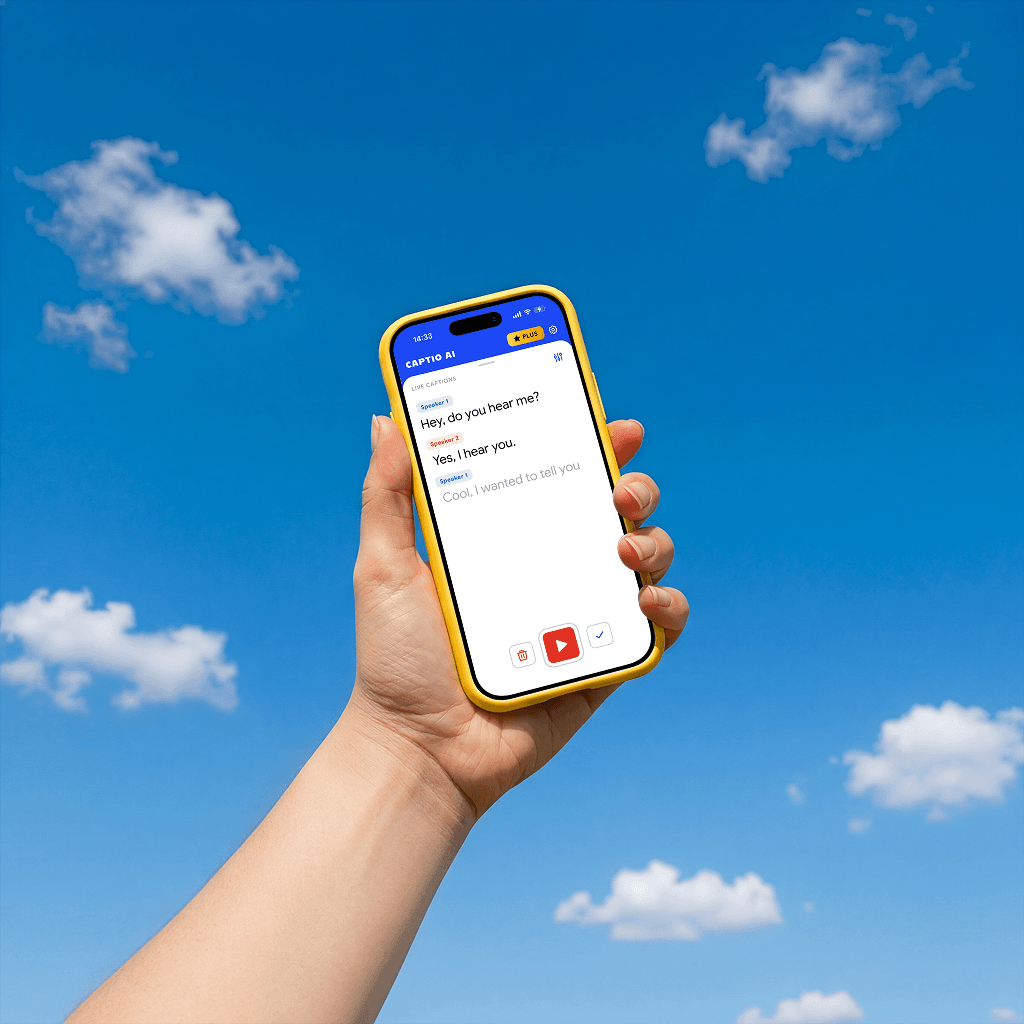
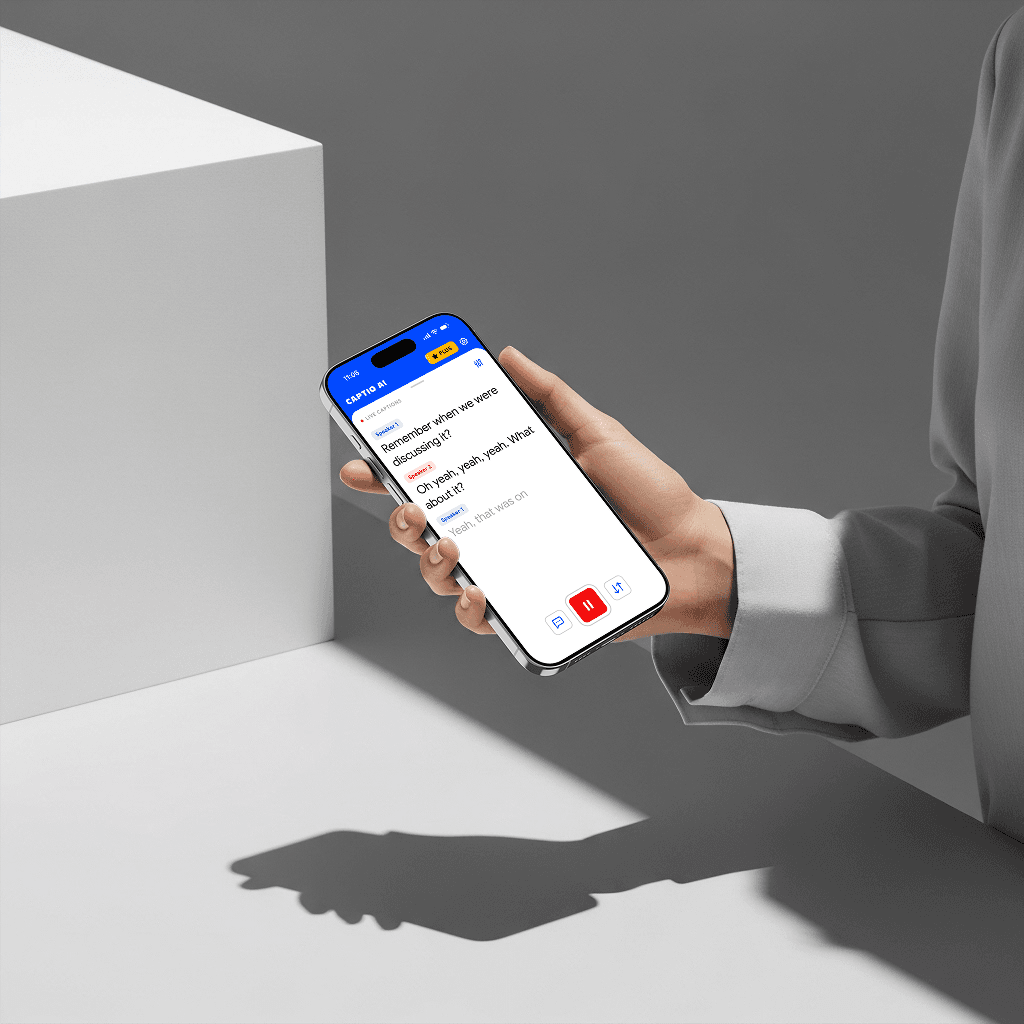
Captions as they speak, not after
Captio AI shows each word as it is spoken. You read what the person is saying while they are still saying it — not after they have finished and moved on.
No lip reading needed
You do not need to face the speaker or position yourself to see their mouth. Captio AI picks up speech from any direction — across a counter, at a table, in a busy street.
Works through background noise
Restaurants, pharmacies, busy streets, crowded waiting rooms. Captio AI separates speech from background noise so captions stay accurate where everyday conversations actually happen.
Follows any conversation
One person or six. Captio AI captions whoever is speaking at any moment — so you follow the thread at a dinner table or keep up with a counter exchange without losing track.
Any accent, any pace
People do not slow down or enunciate for you. Captio AI handles fast talkers, regional accents, and casual speech — the way people actually talk in real life.
Any language, no setup
When someone speaks a language you do not know, switch to Live Translator. They speak their language — you read in yours. No configuration needed. Works in 60+ languages.
Why Thai is hard to understand
Five tones, no lip signal
- Thai meaning lives in pitch — which a deaf person cannot access by sight
- Thai has five tones: mid, low, falling, high, and rising. The same syllable — 'ma', for example — can mean 'horse', 'dog', 'come', 'mother', or 'wood' depending entirely on pitch. These distinctions are carried acoustically and are invisible on the lips. Lip reading Thai provides only consonant-vowel shapes — the entire tonal meaning is missing.
Bangkok vs regional
- Central Thai and regional varieties are different spoken languages
- Standard Bangkok Thai differs significantly from Northern Thai (Kham Mueang), Northeastern Thai (Isan), and Southern Thai. Each has different tones, phonology, and vocabulary. A deaf person calibrated to standard Thai will miss large portions of a conversation in Chiang Mai, Khon Kaen, or Phuket.
Formal vs informal gap
- Formal Thai and street Thai are genuinely different registers
- Polite formal Thai is used in media, government, and formal occasions. Street Thai — especially among younger speakers in Bangkok — uses informal vocabulary, particle-heavy speech, and fast delivery. Family conversations and market exchanges happen entirely in the informal register.
Social pressure
- Thai social norms make asking for accommodation uncomfortable
- Thai culture places high value on maintaining social harmony ('kreng jai' — reluctance to impose on others). Asking someone to slow down, repeat, or write for you carries social cost, especially with older people or service providers. Deaf and hard of hearing Thais regularly absorb situations they did not understand rather than create social awkwardness.
No interpreter for daily life
- Thai Sign Language is official but absent from everyday informal settings
- Thai Sign Language (TSL) was designated the national language of deaf people in 1999. But TSL interpreters are concentrated in formal contexts — schools, hospitals, courts. For the market, the tuk-tuk, the street food stall, and the family meal, there is no interpreter and no expectation of one.
Download for free
300,000 deaf people. Five tones. No support for the street stall, the tuk-tuk, or the family meal.
Thailand's deaf and hard of hearing population is estimated at between 300,000 and 719,000, with a 2024 Bangkok hearing health survey finding that 2.8% of the Bangkok population has moderate or greater hearing impairment. For deaf people navigating Thai daily life, the core challenge is structural: Thai is a tonal language with five tones, all of which are carried acoustically. The same syllable means different things depending entirely on pitch — a dimension that is completely inaccessible without sound. Lip reading provides only the consonant-vowel skeleton of a Thai word; the meaning is carried by a channel that is closed to deaf listeners.
Thai Sign Language was recognised as the national language of the deaf community in 1999 — an early recognition by regional standards — but interpreter provision for everyday informal settings remains essentially absent. The market stall, the street food vendor, the family meal, and the tuk-tuk have no interpreter and no accessibility provision. A 2021 report on Thailand's deaf community documented that communication is 'a slow and painstaking process' for deaf Thais, and that the inability to access phone communication leaves them dependent on hearing intermediaries for even basic daily interactions.
Thailand's ageing population and growing urban noise exposure are increasing hearing loss prevalence. The 2024 Bangkok hearing survey documents a 53% prevalence of any hearing loss in Bangkok's population. The gap between the scale of the challenge and the daily-life support available is significant. Captio AI captions Thai speech in real time — including fast colloquial registers and regional varieties — so the street stall, the market, and the family gathering are no longer settings you have to navigate alone.
Download for free
What you hear stays with you.
Gone the moment it ends
Captio AI processes your audio in real time and discards it immediately. Nothing is recorded. Nothing is kept.
Not a product
Your conversations are not something Captio AI sells, shares, or monetizes — to anyone, for any reason.
Not used to train anything
What you say in a doctor's appointment or a job interview never ends up in a training dataset. Not ours. Not anyone else's.

Private by default
Captio AI supports 60+ languages
Download for free
Frequently asked questions
Follow any conversation in Thai.
Captio AI is free to start
Download for free