

Portuguese live captions and productivity tool for everyday conversations
For deaf and hard of hearing people.
Download for free


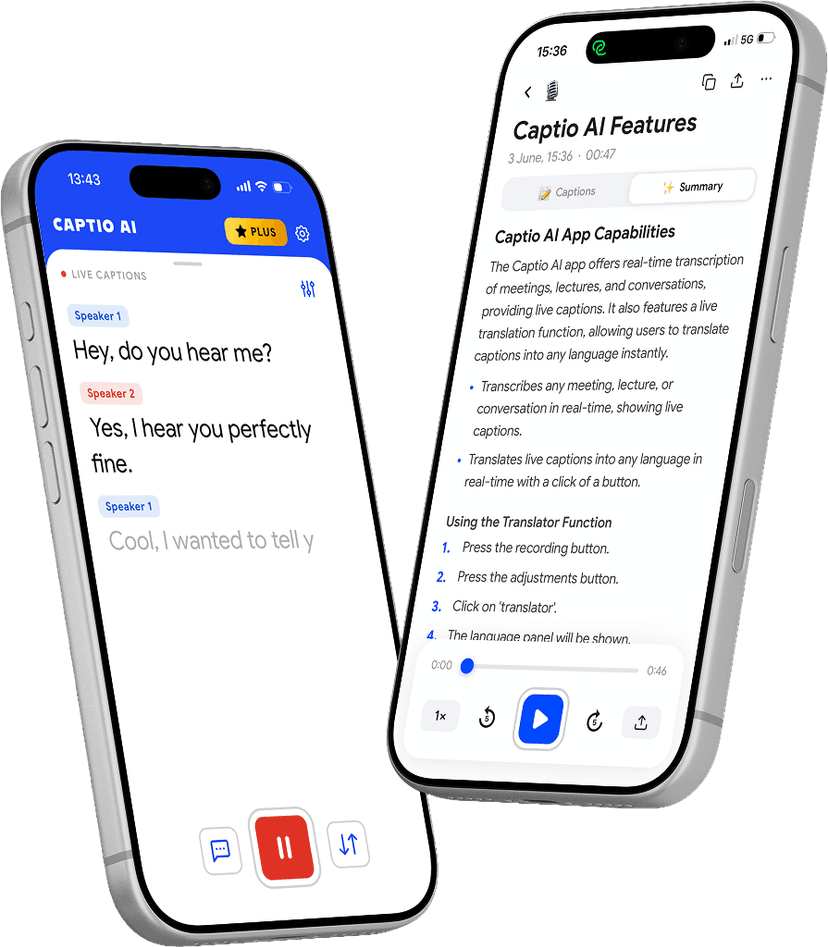
Everything you need to follow Portuguese everyday conversations
Four tools built for deaf and hard of hearing Portuguese speakers.
Captions any conversation in real time
- Word by word, as the person speaks
- Works in noisy places — counters, streets, busy rooms
- Any accent, any pace
- No lip reading needed
Everyday conversations in any language
- Translates as they speak, not after
- Each person speaks their own language
- Handles mid-sentence switches
- 60+ languages, no setup
Save any conversation for later
- Record and get the full transcript
- Organized by speaker
- Read, copy, search, share
- Any language, any audio
Key points from any exchange
- Important points extracted automatically
- Works on any saved transcript
- Organized into clear sections
- Nothing gets missed
Download for free
Every situation covered
Designed for the real moments that matter — not just quiet controlled environments.
Farmácia, lotérica, Correios, supermarket checkout, bank teller. Staff speak at full Brazilian pace and move on quickly. Captio AI shows what they said before the moment passes.
Family churrasco, birthday party, friends at a boteco. Multiple people, fast overlapping banter, accents varying by state. Captio AI captions whoever is speaking so you stay in it.
Asking for directions in the city, chatting with a neighbour in the condomínio, meeting someone at a feira. People who speak at full speed. Captio AI captions anyone near you.
Café da manhã chat, quick question at the coffee machine, corridor conversation between meetings. The moments Brazilian workplaces run on. Captio AI keeps you in those conversations.
UBS appointment, cartório, Poupatempo counter, bank branch. Fast speech, sometimes bureaucratic Portuguese, no repeat expected. Captio AI transcribes everything said.
Ônibus driver, metro announcement, mototaxi conversation, asking at a rodoviária. Situations where you need to understand the first time. Captio AI covers you anywhere.
Most accurate and fastest models
word accuracy
independent benchmark, 2025
real-time captions
first word appears as you speak
Download for free
Built for conversations that don't wait
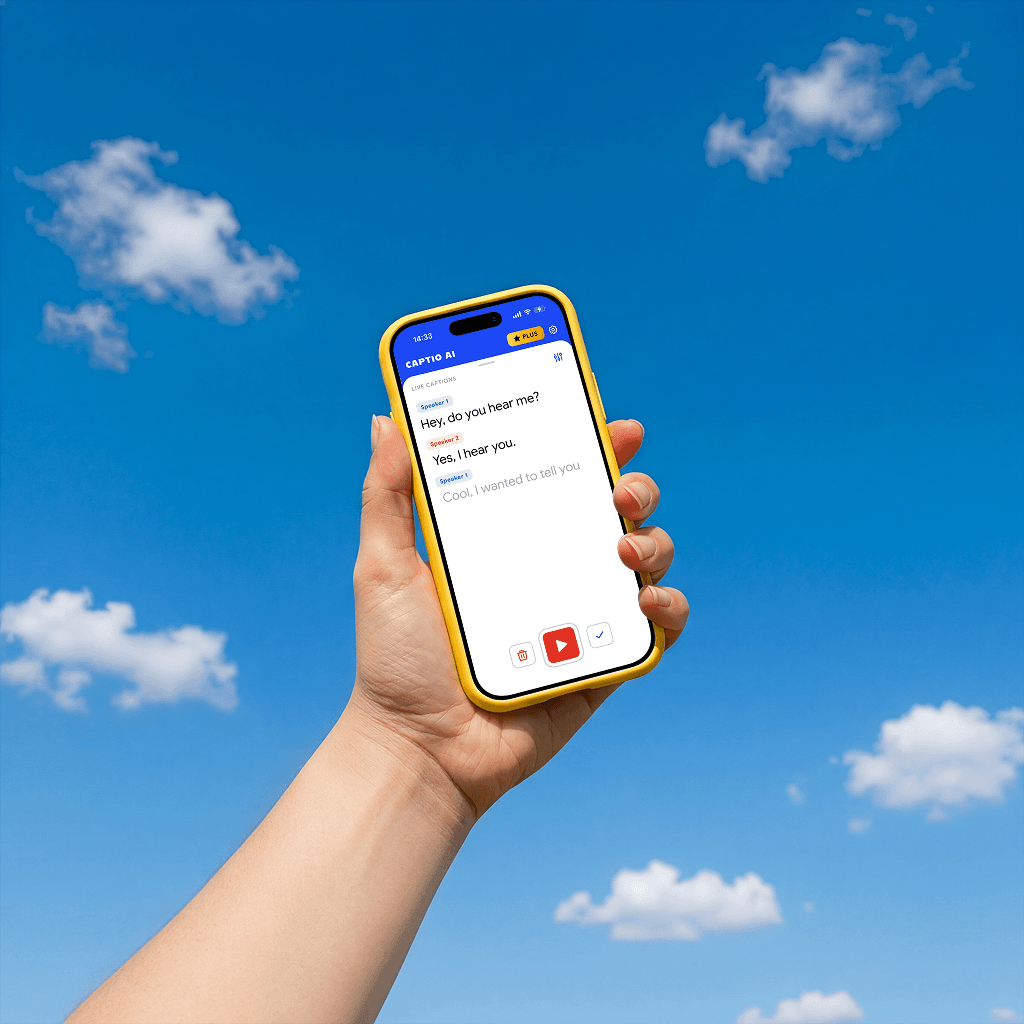
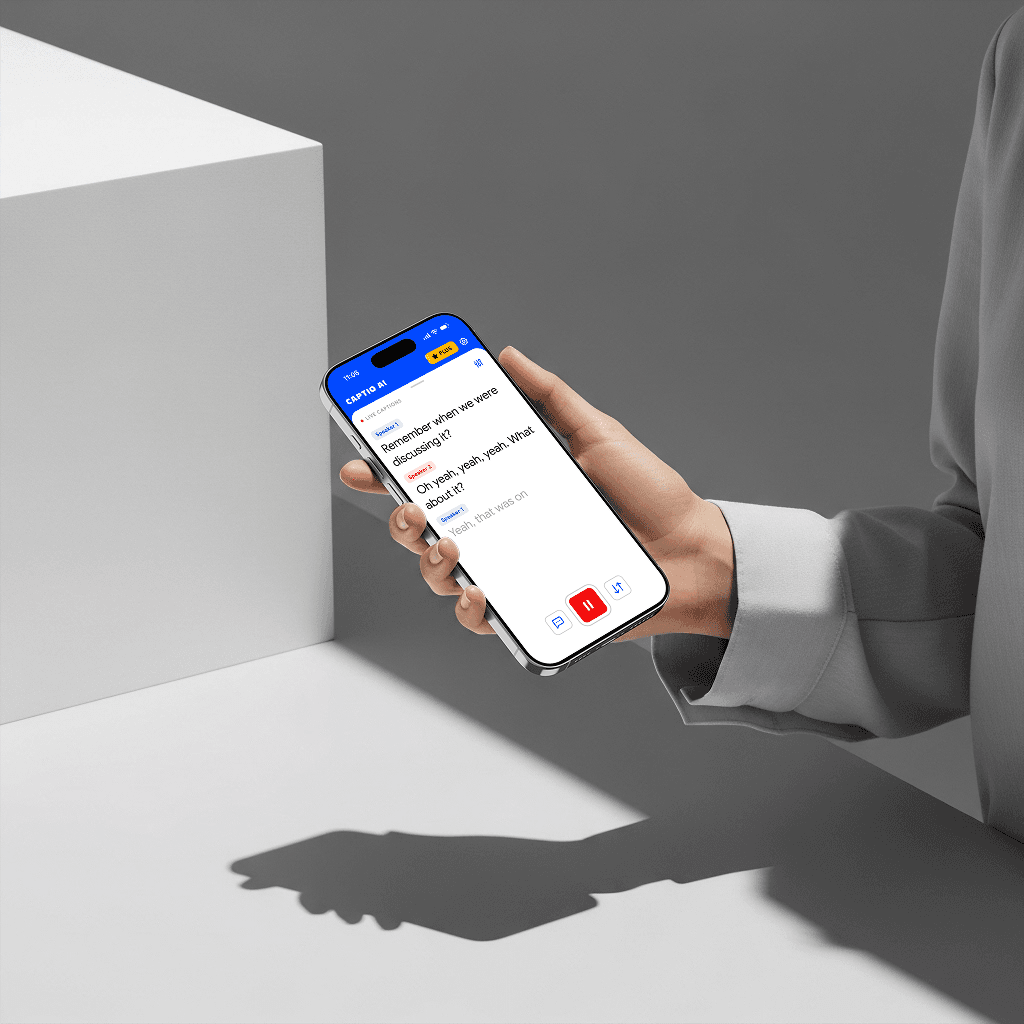
Captions as they speak, not after
Captio AI shows each word as it is spoken. You read what the person is saying while they are still saying it — not after they have finished and moved on.
No lip reading needed
You do not need to face the speaker or position yourself to see their mouth. Captio AI picks up speech from any direction — across a counter, at a table, in a busy street.
Works through background noise
Restaurants, pharmacies, busy streets, crowded waiting rooms. Captio AI separates speech from background noise so captions stay accurate where everyday conversations actually happen.
Follows any conversation
One person or six. Captio AI captions whoever is speaking at any moment — so you follow the thread at a dinner table or keep up with a counter exchange without losing track.
Any accent, any pace
People do not slow down or enunciate for you. Captio AI handles fast talkers, regional accents, and casual speech — the way people actually talk in real life.
Any language, no setup
When someone speaks a language you do not know, switch to Live Translator. They speak their language — you read in yours. No configuration needed. Works in 60+ languages.
Why Portuguese is hard to understand
Nasal vowels
- Brazilian Portuguese nasality reduces visible mouth movement
- Nasal vowels — ã, ẽ, õ — are a defining feature of Brazilian Portuguese and produce very little visible lip movement. At casual speech rates, word boundaries merge and the nasal articulation makes most phonemes visually indistinguishable. Lip reading Brazilian Portuguese is structurally difficult even for skilled readers.
Brazil vs Portugal
- European Portuguese swallows unstressed vowels entirely
- European Portuguese reduces unstressed vowels so dramatically that Brazilians often struggle to understand it by ear. For a deaf person, the difference between Brazilian and European Portuguese is even more acute — what is already difficult to lip-read in Brazil becomes near-opaque in Lisbon. A deaf person accustomed to one variety will miss large portions of the other.
Informal registers
- Street Brazilian Portuguese is a completely different register from formal speech
- Rio and São Paulo street Brazilian — with gíria (slang), dropped final vowels, and heavy elision — bears little resemblance to formal or broadcast Portuguese. The gap between formal and casual is enormous, and daily life happens entirely in the informal register.
Urban code-switching
- São Paulo mixes Portuguese with English and immigrant languages
- São Paulo is one of the world's most linguistically diverse cities. Daily conversations in many neighbourhoods mix Portuguese with English, Spanish (near southern borders), and expressions from the Italian, Japanese, and African communities that shaped Brazilian Portuguese. Following a full conversation often means following multiple languages.
Interrogative intonation
- Portuguese questions look identical to statements on the lips
- Brazilian Portuguese forms questions almost entirely through rising intonation — not through changed word order or visual particles. 'Você foi.' (You went.) and 'Você foi?' (Did you go?) are the same words in the same order, distinguished only by pitch — something entirely invisible on the lips. In fast casual padaria or family churrasco conversation, the intonation cue is brief and often further swallowed. Getting the wrong interpretation changes the entire meaning of the exchange.
Download for free
2.3 million Brazilians with profound hearing difficulty. No support outside institutions.
Brazil has 2.3 million people with extreme hearing difficulty — unable to hear at all or able to hear only loud sounds — according to IBGE's 2019 National Health Survey (PNS). A further significant portion of the population lives with partial hearing loss, with self-reported prevalence of hearing loss estimated at 5.2% of adults overall and 30.4% among older adults. For deaf Brazilians, exclusion from daily life is not hypothetical: it is the padaria counter where the attendant doesn't slow down, the family churrasco where everyone talks at once, the bus ride where the driver's instructions cannot be followed.
Brazil recognised Libras in 2002 (Law 10.436), but everyday implementation outside institutional settings remains minimal. Street vendors, family kitchens, bakery counters, and bus conversations have no Libras accommodation and no legal obligation to provide one. Research on access to health services among deaf Brazilians consistently shows that communication barriers persist even in formal healthcare settings — in informal daily settings, the barriers are total.
Brazil's ageing population and high rates of noise-induced hearing loss — driven by dense urban environments and industrial noise — mean the deaf and hard of hearing population is growing. The gap between the scale of the problem and the daily-life infrastructure to support it is widening every year. Captio AI captions Brazilian Portuguese in real time — including fast gíria-heavy speech, nasal vowel-dense casual registers, and the regional varieties of São Paulo, Rio, and the Northeast — so the padaria, the churrasco, and the bus are no longer settings you have to navigate alone.
Download for free
What you hear stays with you.
Gone the moment it ends
Captio AI processes your audio in real time and discards it immediately. Nothing is recorded. Nothing is kept.
Not a product
Your conversations are not something Captio AI sells, shares, or monetizes — to anyone, for any reason.
Not used to train anything
What you say in a doctor's appointment or a job interview never ends up in a training dataset. Not ours. Not anyone else's.

Private by default
Captio AI supports 60+ languages
Download for free
Frequently asked questions
Follow any conversation in Portuguese.
Captio AI is free to start
Download for free