

Dutch live captions and productivity tool for everyday conversations
For deaf and hard of hearing people.
Download for free


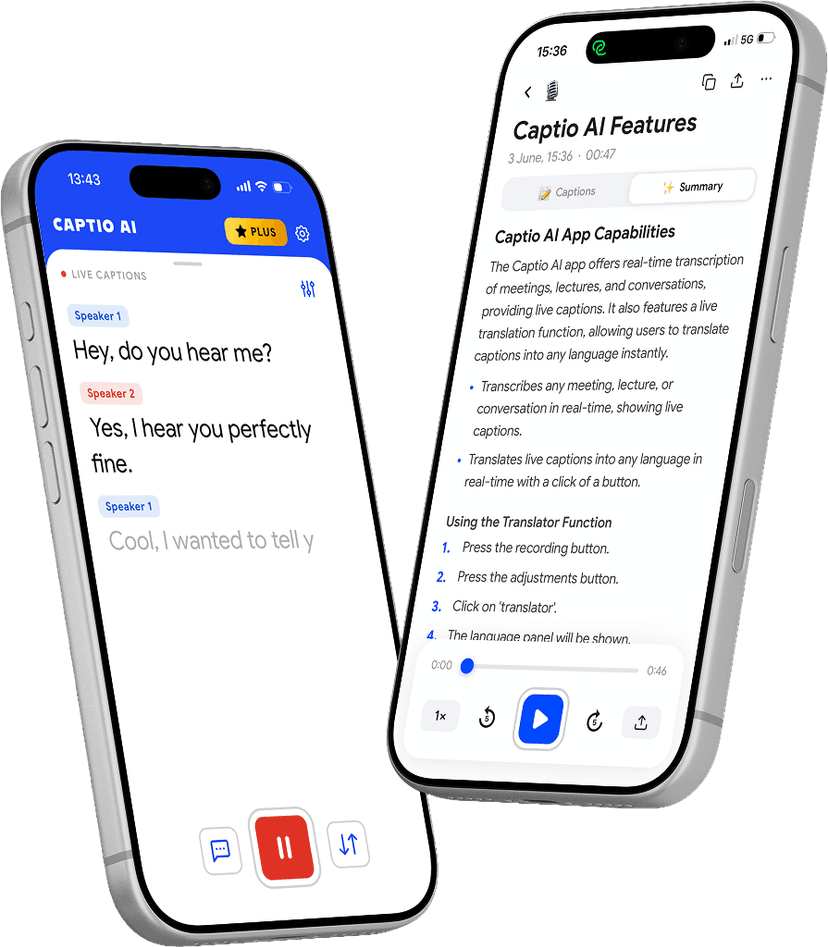
Everything you need to follow Dutch everyday conversations
Four tools built for deaf and hard of hearing Dutch speakers.
Captions any conversation in real time
- Word by word, as the person speaks
- Works in noisy places — counters, streets, busy rooms
- Any accent, any pace
- No lip reading needed
Everyday conversations in any language
- Translates as they speak, not after
- Each person speaks their own language
- Handles mid-sentence switches
- 60+ languages, no setup
Save any conversation for later
- Record and get the full transcript
- Organized by speaker
- Read, copy, search, share
- Any language, any audio
Key points from any exchange
- Important points extracted automatically
- Works on any saved transcript
- Organized into clear sections
- Nothing gets missed
Download for free
Every situation covered
Designed for the real moments that matter — not just quiet controlled environments.
Apotheek counter, supermarket checkout, postkantoor window, gemeentehuis desk. Staff speak fast in Dutch and move on. Captio AI shows what they said before the moment passes.
Sunday family dinner, birthday borrel, Friday drinks with colleagues. Fast overlapping Dutch, regional accents varying by province. Captio AI captions whoever is speaking.
Asking for directions in the city, chatting with a neighbour in the portiek, meeting someone at the wekelijkse markt. People who speak at full pace. Captio AI captions anyone near you.
Koffiepauze conversation, a quick question in the gang, catch-up before the vergadering. The moments Dutch workplaces run on. Captio AI keeps you in those conversations.
Huisarts reception, gemeentehuis counter, bank branch, DUO office. Formal vocabulary, fast delivery, no repeat expected. Captio AI transcribes everything said.
Tram and metro announcements, bus driver, asking at a station, taxi conversation. Situations where you need to understand the first time. Captio AI covers you anywhere.
Most accurate and fastest models
word accuracy
independent benchmark, 2025
real-time captions
first word appears as you speak
Download for free
Built for conversations that don't wait
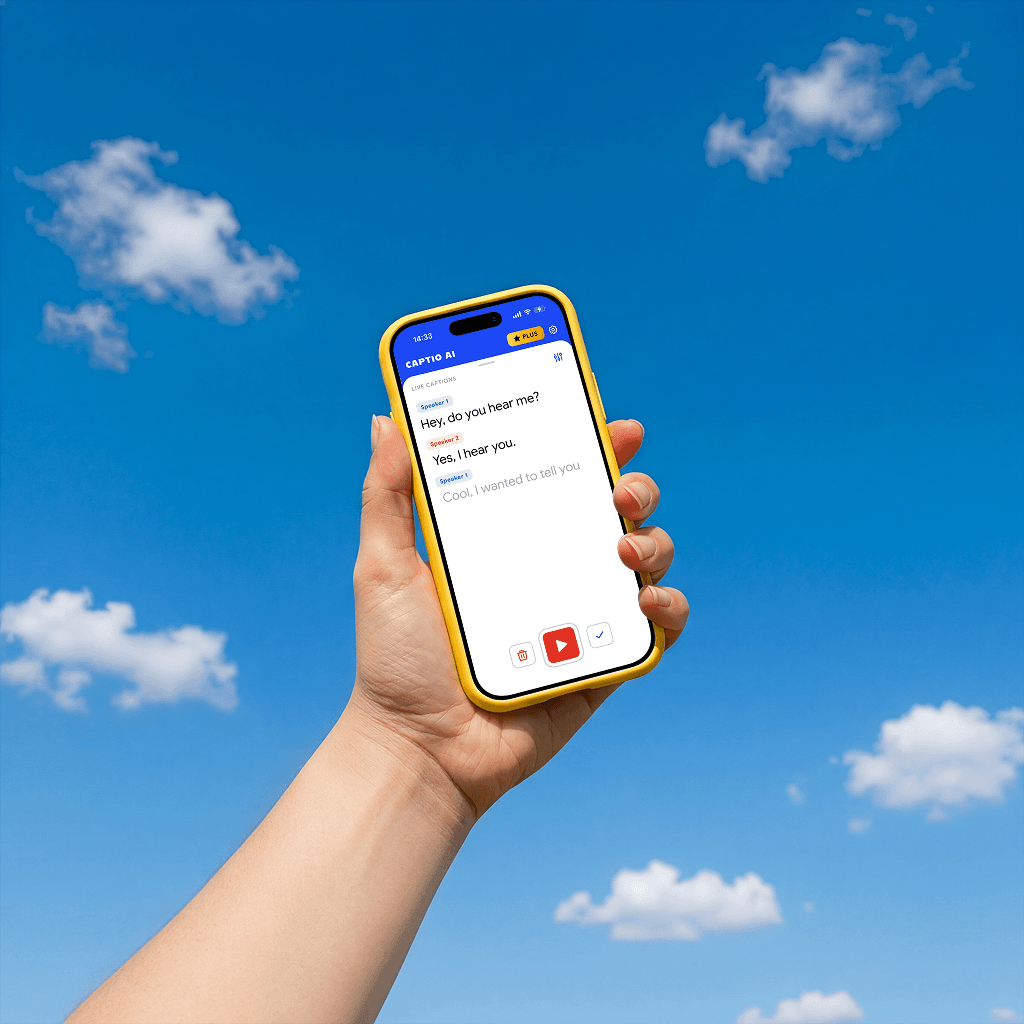
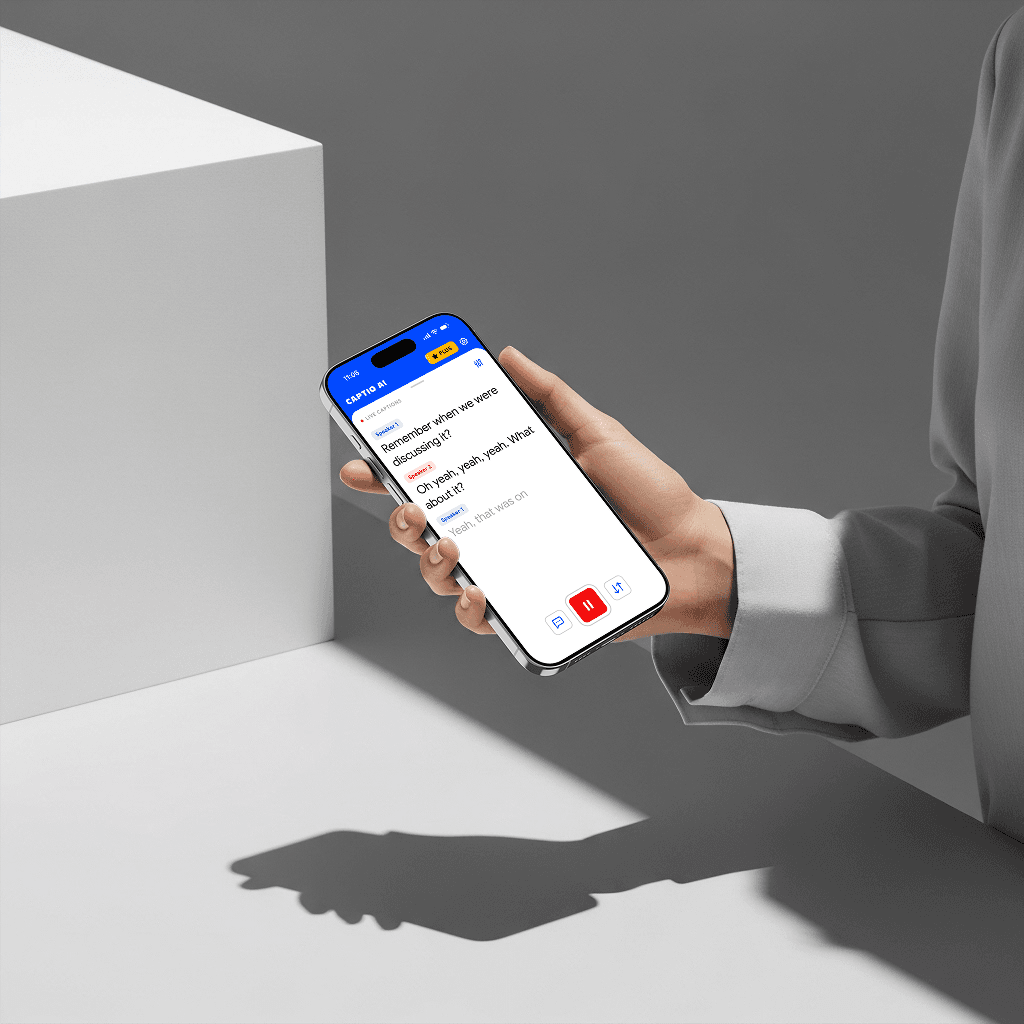
Captions as they speak, not after
Captio AI shows each word as it is spoken. You read what the person is saying while they are still saying it — not after they have finished and moved on.
No lip reading needed
You do not need to face the speaker or position yourself to see their mouth. Captio AI picks up speech from any direction — across a counter, at a table, in a busy street.
Works through background noise
Restaurants, pharmacies, busy streets, crowded waiting rooms. Captio AI separates speech from background noise so captions stay accurate where everyday conversations actually happen.
Follows any conversation
One person or six. Captio AI captions whoever is speaking at any moment — so you follow the thread at a dinner table or keep up with a counter exchange without losing track.
Any accent, any pace
People do not slow down or enunciate for you. Captio AI handles fast talkers, regional accents, and casual speech — the way people actually talk in real life.
Any language, no setup
When someone speaks a language you do not know, switch to Live Translator. They speak their language — you read in yours. No configuration needed. Works in 60+ languages.
Why Dutch is hard to understand
Guttural consonants
- Dutch g and ch sounds are produced in the throat with no visible lip movement
- The Dutch g and ch sounds — among the most distinctive features of Dutch — are produced as fricatives deep in the throat or at the back of the palate. They leave absolutely no trace on the lips. These are not rare sounds; they appear in extremely common words and at the beginning of sentences. A lip-reader loses them every single time.
Fast natural pace
- Conversational Dutch is spoken significantly faster than the formal Dutch taught in courses
- Dutch speakers in casual borrel (drinks) and gezelligheid settings speak at a noticeably higher pace than formal speech. Vowels reduce, word endings blur together, and informal vocabulary diverges sharply from written Dutch. A deaf person who has learned to lip-read textbook Dutch encounters something acoustically and visually different in everyday Amsterdam or Rotterdam conversation.
Dialect patchwork
- Dutch spoken in Amsterdam, Rotterdam, Limburg, and Flanders sound like different languages
- The Netherlands and Belgium have marked regional speech variation. Amsterdam Dutch, Rotterdam's distinct accent, Limburg's tonal dialect, and Flemish Belgian Dutch all differ significantly. A deaf person who has calibrated their lip-reading to one region loses that calibration when they travel or when visitors come from another region.
Café and kroeg noise
- Dutch café culture produces the worst possible acoustic environment for anyone with hearing loss
- The Dutch bruin café (brown pub) and kroeg are central social institutions — the places where Dutch people relax, bond, and talk. Hard wooden surfaces, background music, and dozens of simultaneous conversations create a constant noise floor. Even hearing people raise their voices. For a deaf or hard of hearing person, the café is the space most fully closed off from social participation.
Directness and nuance
- Dutch directness means a single word can pivot the meaning of an entire sentence
- Dutch culture prizes direct speech — a single deadpan word or ironic inversion can reverse the meaning of everything said before it. Missing one word while lip-reading means missing the register shift. A hard of hearing person who hears most of a sentence but misses the final pivot arrives at the completely wrong meaning.
Download for free
1.3 million Dutch people with hearing loss. Sign language only legally recognised in 2020. No captions at the borrel, the kroeg, or the weekly markt.
Approximately 1.3 million people in the Netherlands — about 13% of the population — live with some degree of hearing loss, according to data from the Netherlands Longitudinal Study on Hearing (NL-SH), which has tracked thousands of participants over decades. A 2022 EuroTrak Netherlands survey found 10.3% of all Dutch adults self-report hearing loss; among adults aged 18 and older, the figure rises to nearly 12%. For deaf and hard of hearing Dutch people, daily life plays out at the Albert Heijn checkout, the weekly outdoor markt, the tram stop, and the borrel — none of which carry any formal captioning or sign language infrastructure.
Dutch Sign Language (NGT — Nederlands Gebarentaal) was legally recognised only in 2020 — remarkably late for a country with one of Europe's strongest disability rights frameworks. Even with legal recognition, deaf Dutch people attending social events and borrels must arrange their own interpreters, explain what interpretation is to organisers, and ensure hearing people address them rather than the interpreter. For the everyday informal settings that Dutch social life depends on — the café, the neighbourhood conversation, the market — no such provision exists at all.
The NL-SH longitudinal study consistently shows that hearing loss progresses with age and noise exposure, and that fewer than half of those with hearing loss in the Netherlands use hearing aids or sound processors. As the Dutch population ages, the number of people navigating daily Dutch social life with hearing difficulties will grow substantially. Captio AI captions Dutch speech in real time — including guttural consonants and fast informal pace — so the borrel, the market, and the neighbourhood conversation are no longer settings you have to navigate alone.
Download for free
What you hear stays with you.
Gone the moment it ends
Captio AI processes your audio in real time and discards it immediately. Nothing is recorded. Nothing is kept.
Not a product
Your conversations are not something Captio AI sells, shares, or monetizes — to anyone, for any reason.
Not used to train anything
What you say in a doctor's appointment or a job interview never ends up in a training dataset. Not ours. Not anyone else's.

Private by default
Captio AI supports 60+ languages
Download for free
Frequently asked questions
Follow any conversation in Dutch.
Captio AI is free to start
Download for free