

Persian live captions and productivity tool for everyday conversations
For deaf and hard of hearing people.
Download for free
Everything you need to follow Persian everyday conversations
Four tools built for deaf and hard of hearing Persian speakers.
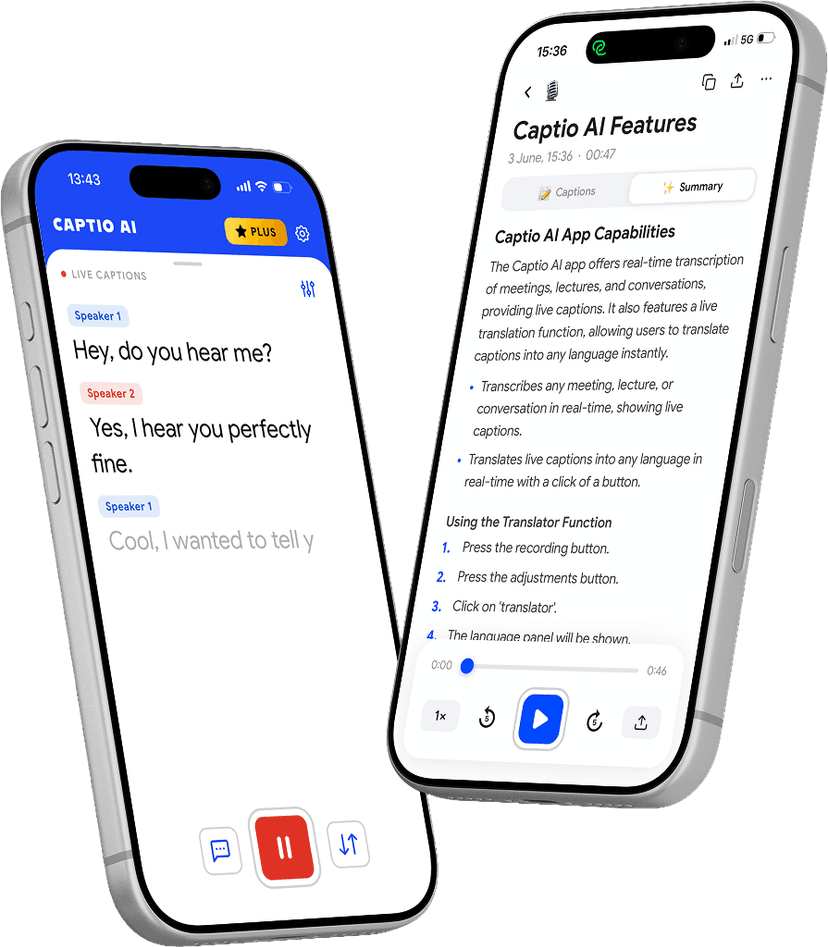
Captions any conversation in real time
- Word by word, as the person speaks
- Works in noisy places — counters, streets, busy rooms
- Any accent, any pace
- No lip reading needed
Everyday conversations in any language
- Translates as they speak, not after
- Each person speaks their own language
- Handles mid-sentence switches
- 60+ languages, no setup
Save any conversation for later
- Record and get the full transcript
- Organized by speaker
- Read, copy, search, share
- Any language, any audio
Key points from any exchange
- Important points extracted automatically
- Works on any saved transcript
- Organized into clear sections
- Nothing gets missed
Download for free
Every situation covered
Designed for the real moments that matter — not just quiet controlled environments.
Pharmacy counter, supermarket checkout, bank branch window, post office. Staff speak fast in Persian and move on. Captio AI shows what they said before the moment passes.
Family dinner, Nowruz gathering, birthday celebration with extended family. Multiple generations, fast overlapping conversation, regional accents mixing. Captio AI captions whoever is speaking.
Getting a price at the bazaar, asking for directions in a new neighbourhood, chatting with a neighbour. People who speak at full conversational pace. Captio AI captions anyone near you.
Tea break in the office, a quick question across the floor, chat before the meeting starts. The moments Iranian workplaces run on. Captio AI keeps you in those conversations.
Clinic reception, shahrdari service window, bank branch, post office. Fast Persian, sometimes formal vocabulary, no repeat expected. Captio AI transcribes everything said.
Metro announcements, bus driver, asking at a terminal, taxi conversation. Situations where you need to understand the first time. Captio AI covers you anywhere on the move.
Most accurate and fastest models
word accuracy
independent benchmark, 2025
real-time captions
first word appears as you speak
Download for free
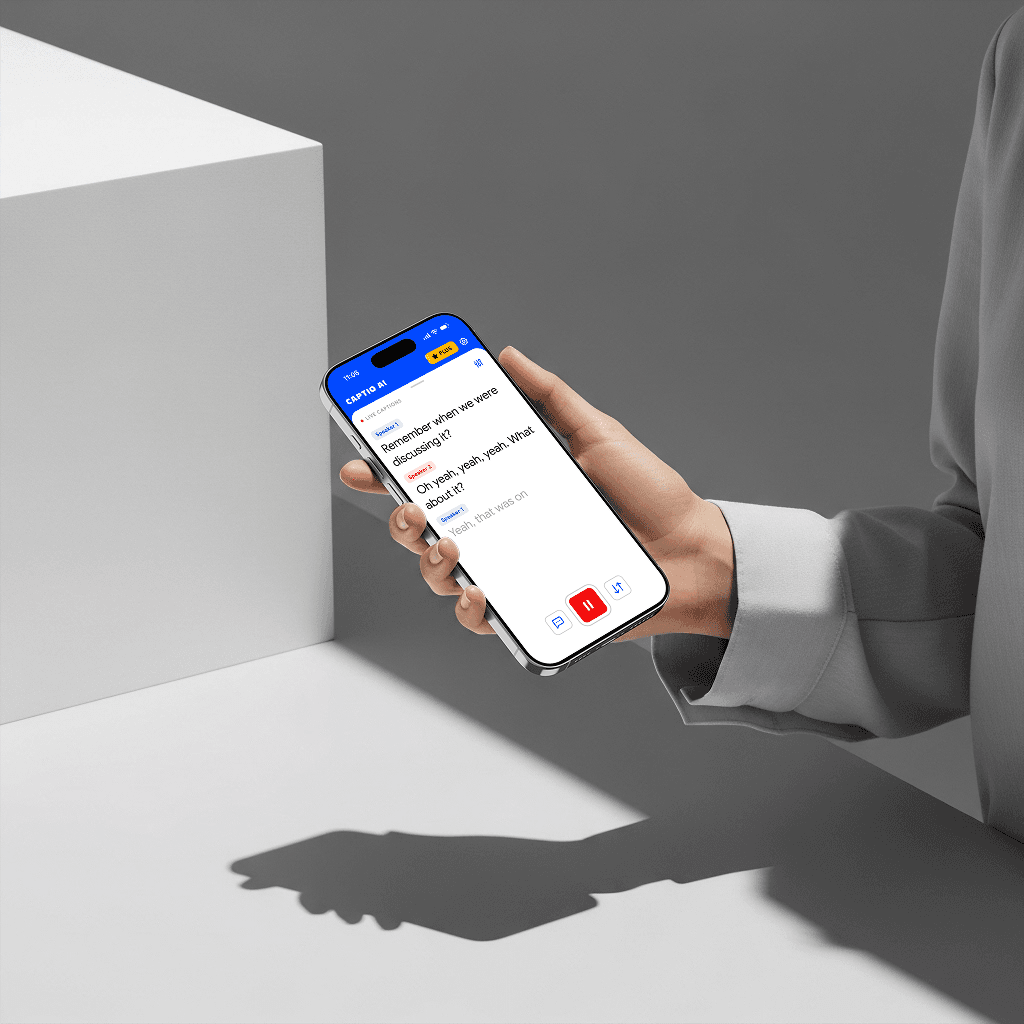
Built for conversations that don't wait
Captions as they speak, not after
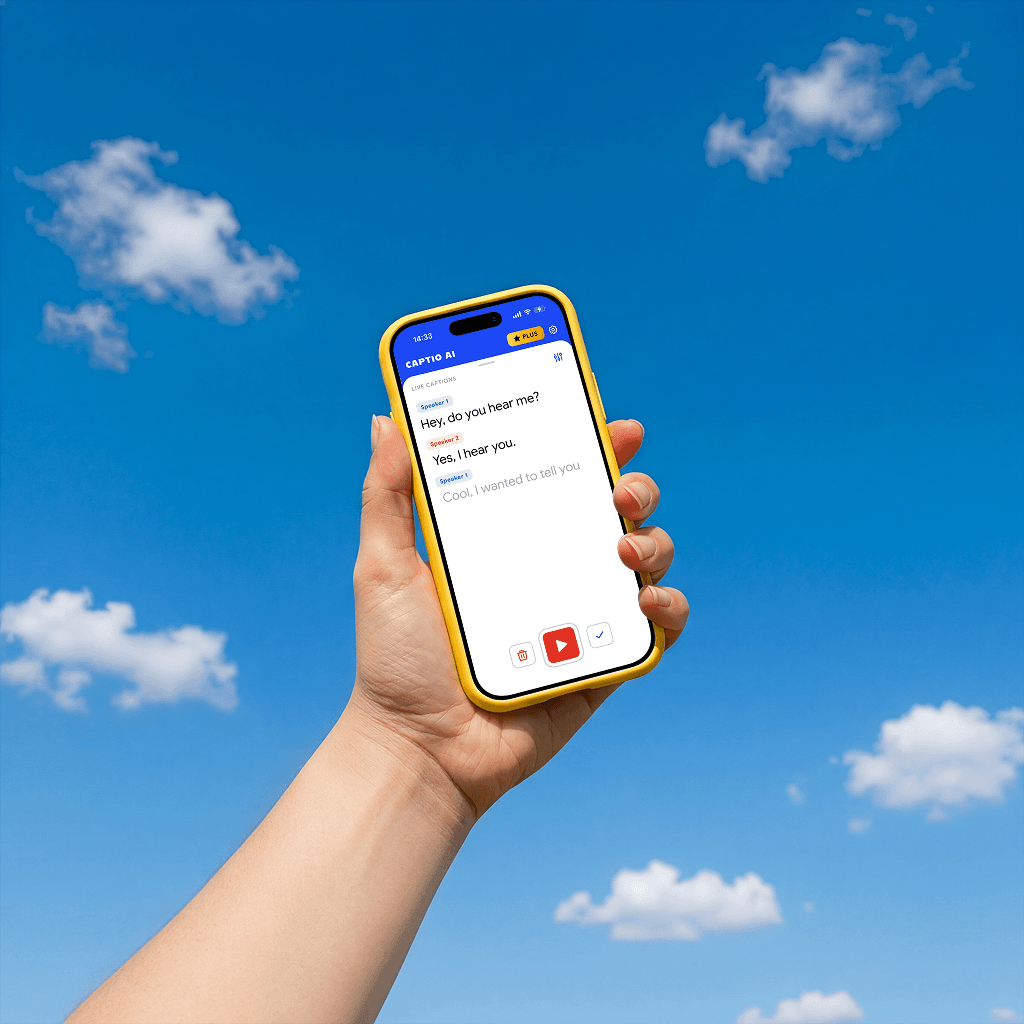
Captio AI shows each word as it is spoken. You read what the person is saying while they are still saying it — not after they have finished and moved on.
No lip reading needed
You do not need to face the speaker or position yourself to see their mouth. Captio AI picks up speech from any direction — across a counter, at a table, in a busy street.
Works through background noise
Restaurants, pharmacies, busy streets, crowded waiting rooms. Captio AI separates speech from background noise so captions stay accurate where everyday conversations actually happen.
Follows any conversation
One person or six. Captio AI captions whoever is speaking at any moment — so you follow the thread at a dinner table or keep up with a counter exchange without losing track.
Any accent, any pace
People do not slow down or enunciate for you. Captio AI handles fast talkers, regional accents, and casual speech — the way people actually talk in real life.
Any language, no setup
When someone speaks a language you do not know, switch to Live Translator. They speak their language — you read in yours. No configuration needed. Works in 60+ languages.
Why Persian is hard to understand
Two sign languages, neither official
- The state imposed Signed Persian; the deaf community uses Iranian Sign Language — they are not the same
- Iran has two competing sign languages: Iranian Sign Language (ISL), used naturally by the deaf community, and Signed Persian, a system created by the state that follows Persian grammar. The government requires Signed Persian in official contexts, but the deaf community finds it artificial and hard to learn. Neither has official legal status. For deaf people navigating daily life, the language they use is contested, not supported.
Fast informal Persian
- Spoken Persian drops and contracts at conversational speed
- Formal Persian is deliberate and close to written form. Everyday colloquial Persian — especially in Tehran — contracts words, drops vowels, and uses shortened forms that bear little resemblance to written Farsi. 'میخواهم' (I want) becomes 'میخوام' in speech. For a deaf person following captions, the mismatch between what is written and what is heard is compounded by this gap.
No legal recognition
- Iran has not officially recognised sign language despite endorsing the CRPD in 2009
- Iran endorsed the UN Convention on the Rights of Persons with Disabilities in 2009, yet has not officially recognised sign language. Human Rights Watch documented in 2018 that people with disabilities in Iran face discrimination and abuse, including from state officials who are supposed to support them. The legal framework that should support deaf daily life does not exist.
Government office barriers
- Deaf Iranians face discrimination in the formal settings that matter most
- Everyday barriers for deaf Iranians include going to government offices, healthcare centres, and using public transport. Discrimination and stigma from social workers and healthcare workers is documented. The formal settings where most people expect some accommodation are frequently where deaf people face the most explicit barriers.
Double exclusion for deaf women
- Deaf women in Iran face exclusion on two fronts simultaneously
- Research on deaf women in Iran documents a dual exclusion — the barriers of deafness compounded by gender restrictions in Iranian society. Deaf women face limitations in public life, employment, and social participation that go beyond what male deaf Iranians encounter. In daily life settings, this means a smaller social world with fewer accessible spaces.
Download for free
Up to 3 million people. A government that won't recognise their language.
Estimates of Iran's deaf and hard of hearing population range from 1.5 to 3 million people, though only around 200,000 are formally registered with social welfare services — a gap that reflects both the stigma around disability in Iranian society and the limited reach of formal registration systems. For deaf people navigating Persian-speaking daily life, exclusion operates at multiple levels simultaneously: the language they use naturally (Iranian Sign Language) is not legally recognised; the alternative the state provides (Signed Persian) is documented as difficult to learn and not used naturally; and the everyday settings of Iranian life — bazaars, tea houses, transport, government offices — have no interpreter and no accessibility provision.
Iran endorsed the UN Convention on the Rights of Persons with Disabilities in 2009 but has not officially recognised sign language. A 2018 Human Rights Watch report documented systematic discrimination and abuse against people with disabilities in Iran, including from social workers and healthcare staff who are meant to support them. For deaf Iranians navigating daily life, this means that the formal settings where accommodation is most expected are often where barriers are most explicit. Everyday informal settings — the bazaar, the tea house, the neighbourhood corner shop — have no accessibility infrastructure at all.
Iran's population is growing and urbanising, with rising noise exposure in dense cities like Tehran, Mashhad, and Isfahan contributing to hearing loss prevalence. The gap between the scale of the deaf and hard of hearing population and the daily-life infrastructure to support them is one of the largest in the region. Captio AI captions Persian speech in real time — including fast colloquial Tehran Farsi and the regional varieties of Iran — so the bazaar, the tea house, and the family gathering are no longer settings you have to navigate alone.
Download for free
What you hear stays with you.
Gone the moment it ends
Captio AI processes your audio in real time and discards it immediately. Nothing is recorded. Nothing is kept.
Not a product
Your conversations are not something Captio AI sells, shares, or monetizes — to anyone, for any reason.
Not used to train anything
What you say in a doctor's appointment or a job interview never ends up in a training dataset. Not ours. Not anyone else's.

Private by default
Captio AI supports 60+ languages
Download for free
Frequently asked questions
Follow any conversation in Persian.
Captio AI is free to start
Download for free