

Tagalog live captions and productivity tool for everyday conversations
For deaf and hard of hearing people.
Download for free


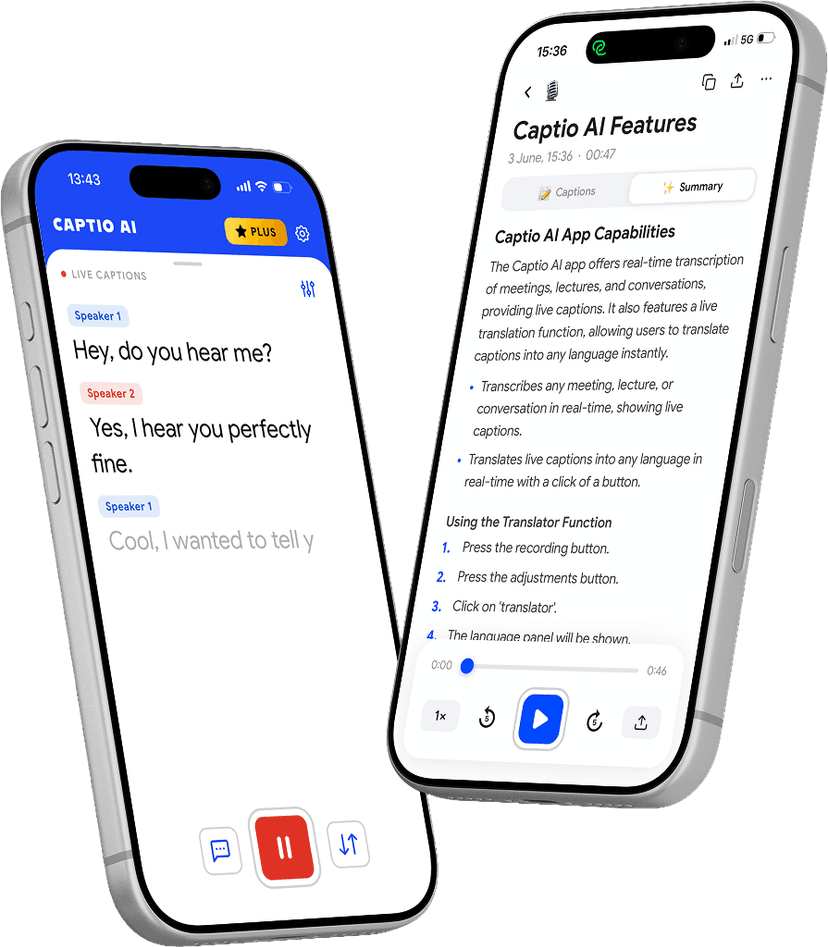
Everything you need to follow Tagalog everyday conversations
Four tools built for deaf and hard of hearing Tagalog speakers.
Captions any conversation in real time
- Word by word, as the person speaks
- Works in noisy places — counters, streets, busy rooms
- Any accent, any pace
- No lip reading needed
Everyday conversations in any language
- Translates as they speak, not after
- Each person speaks their own language
- Handles mid-sentence switches
- 60+ languages, no setup
Save any conversation for later
- Record and get the full transcript
- Organized by speaker
- Read, copy, search, share
- Any language, any audio
Key points from any exchange
- Important points extracted automatically
- Works on any saved transcript
- Organized into clear sections
- Nothing gets missed
Download for free
Every situation covered
Designed for the real moments that matter — not just quiet controlled environments.
Pharmacy counter, sari-sari store, post office window, bank teller. Staff speak fast in Filipino and move on. Captio AI shows what they said before the moment passes.
Family handaan, fiesta gathering, birthday celebration with extended family. Multiple generations, fast Tagalog mixing with English in Metro Manila. Captio AI captions whoever is speaking.
Getting a price from a palengke vendor, asking for directions, chatting with a neighbour. People who speak at full conversational pace. Captio AI captions anyone near you.
Meryenda break in the office, a quick question across the floor, chat in the pantry. The moments Filipino workplaces run on. Captio AI keeps you in those conversations.
Barangay hall window, hospital OPD counter, PhilHealth office, bank branch. Fast Filipino, sometimes formal phrasing, no repeat expected. Captio AI transcribes everything said.
Jeepney driver calling routes, MRT and LRT announcements, asking at a terminal. Situations where you need to understand fast. Captio AI covers you anywhere on the move.
Most accurate and fastest models
word accuracy
independent benchmark, 2025
real-time captions
first word appears as you speak
Download for free
Built for conversations that don't wait
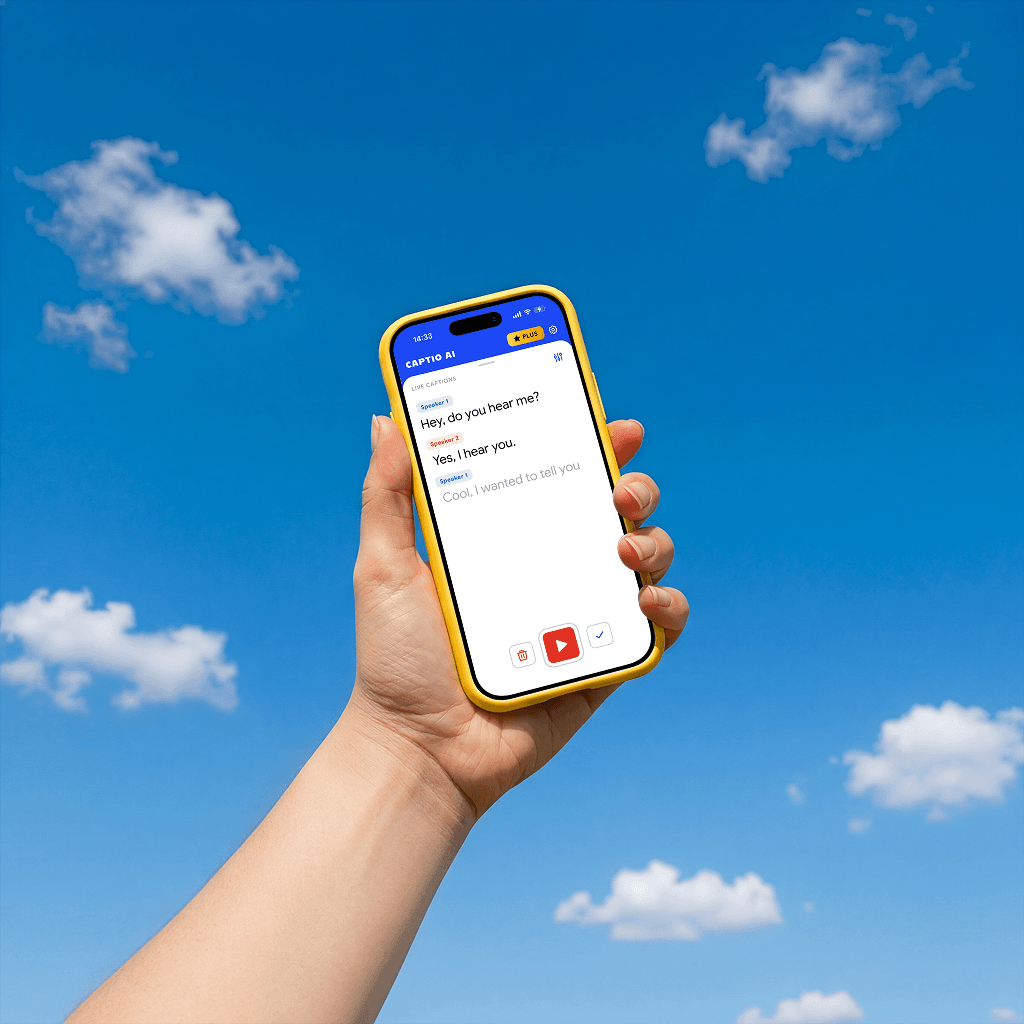
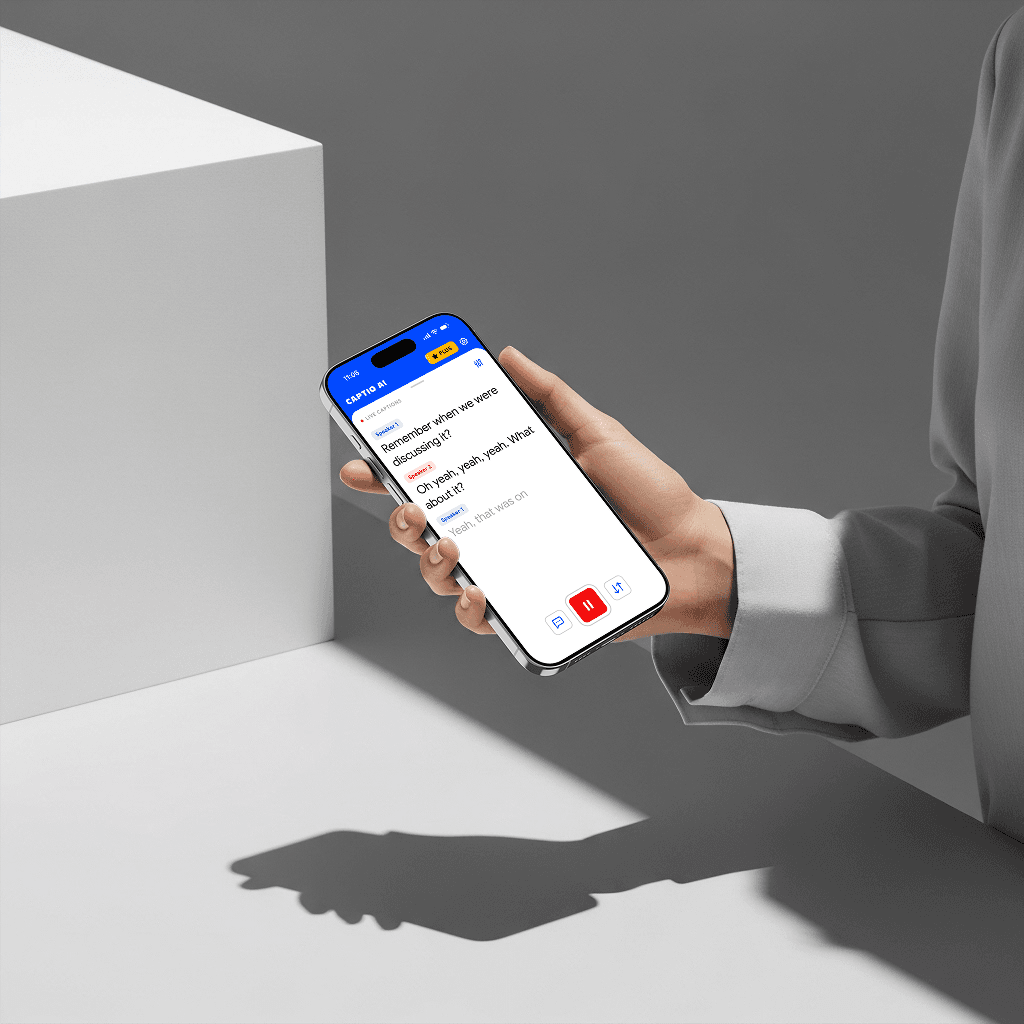
Captions as they speak, not after
Captio AI shows each word as it is spoken. You read what the person is saying while they are still saying it — not after they have finished and moved on.
No lip reading needed
You do not need to face the speaker or position yourself to see their mouth. Captio AI picks up speech from any direction — across a counter, at a table, in a busy street.
Works through background noise
Restaurants, pharmacies, busy streets, crowded waiting rooms. Captio AI separates speech from background noise so captions stay accurate where everyday conversations actually happen.
Follows any conversation
One person or six. Captio AI captions whoever is speaking at any moment — so you follow the thread at a dinner table or keep up with a counter exchange without losing track.
Any accent, any pace
People do not slow down or enunciate for you. Captio AI handles fast talkers, regional accents, and casual speech — the way people actually talk in real life.
Any language, no setup
When someone speaks a language you do not know, switch to Live Translator. They speak their language — you read in yours. No configuration needed. Works in 60+ languages.
Why Tagalog is hard to understand
Taglish code-switching
- Conversations flip between Tagalog and English mid-sentence without warning
- Filipino everyday speech constantly mixes Tagalog and English — often mid-sentence — in a pattern called Taglish. For a deaf or hard of hearing person lip-reading, tracking two different phoneme sets at once is nearly impossible. The switch happens without any visual signal, so even one missed word breaks comprehension entirely.
Fast casual speech
- Everyday spoken Tagalog at sari-sari stores and jeepneys is rapid and compressed
- Tagalog spoken at markets, on jeepneys, and at tindahan counters moves at high pace with syllables reduced and word endings swallowed. What sounds clear to a hearing native speaker is visually almost featureless on the lips — too fast to segment, with no clear word boundaries.
Regional accent variation
- Cebuano, Ilocano, and Kapampangan speakers all produce distinctly different Filipino
- The Philippines has over 180 languages. When speakers of Cebuano, Ilocano, Kapampangan, or Bisaya speak Filipino/Tagalog, they bring phoneme shifts from their first language. A deaf Filipino who lip-reads Metro Manila Tagalog cannot reliably transfer that skill to a Visayan or Ilocano speaker's version.
Noisy group settings
- Family handaan and outdoor gatherings involve constant overlapping voices
- Filipino celebrations — handaan, fiestas, barangay gatherings — involve large multigenerational groups talking simultaneously. For a deaf person, the fiesta table is not an event you participate in; it is an event you watch others participate in.
Palengke and market pace
- Wet market and palengke transactions run on speed — vendors expect rapid exchanges
- In Philippine wet markets, vendors expect brief, fast exchanges. A deaf shopper who cannot follow what is said quickly enough, or who asks for repetition, faces visible impatience from vendors and other customers. The market is one of the most important daily errands and one of the least accessible.
Download for free
1.78 million Filipinos with hearing difficulty. No captions at the tindahan, the palengke, or the handaan table.
The 2020 Philippine Census of Population and Housing identified approximately 1.78 million people aged five and older with difficulty hearing — and a National Survey of Hearing Loss published in SAGE Journals in 2020 found that moderate-or-worse hearing loss affects an estimated 15% of the total Philippine population, with 49% of those over 65 affected. Filipino deaf and hard of hearing people navigate a daily life built on oral community: the sari-sari store, the wet market palengke, the jeepney, the barangay health center. None of these settings have captioning, sign language support, or any formal accessibility infrastructure.
Filipino Sign Language (FSL) was formally recognized under Republic Act 11106 in 2018 — a landmark legal step. But recognition in law has not translated to interpreters in everyday settings. The corner store, the fiesta, the family meal, the public market: these are the spaces where daily Filipino social life happens, and they remain entirely inaccessible to deaf Filipinos without a hearing companion. Employment discrimination compounds the exclusion — deaf Filipinos are consistently underrepresented in the workforce despite equal cognitive ability.
The elevated hearing loss prevalence found in the 2020 national survey — substantially higher than in high-income countries — is driven by limited preventive care, untreated middle ear infections in childhood (present in 14.2% of cases surveyed), and environmental noise. WHO projections show the Philippines' hearing loss burden will continue to grow as urbanization and noise pollution in Metro Manila and secondary cities increase. Captio AI captions Tagalog speech in real time — including Taglish code-switching and fast colloquial Filipino — so the sari-sari store, the palengke, and the family handaan are no longer conversations you miss.
Download for free
What you hear stays with you.
Gone the moment it ends
Captio AI processes your audio in real time and discards it immediately. Nothing is recorded. Nothing is kept.
Not a product
Your conversations are not something Captio AI sells, shares, or monetizes — to anyone, for any reason.
Not used to train anything
What you say in a doctor's appointment or a job interview never ends up in a training dataset. Not ours. Not anyone else's.

Private by default
Captio AI supports 60+ languages
Download for free
Frequently asked questions
Follow any conversation in Tagalog.
Captio AI is free to start
Download for free