

Swahili live captions and productivity tool for conferences & events
For deaf and hard of hearing people.
Download for free


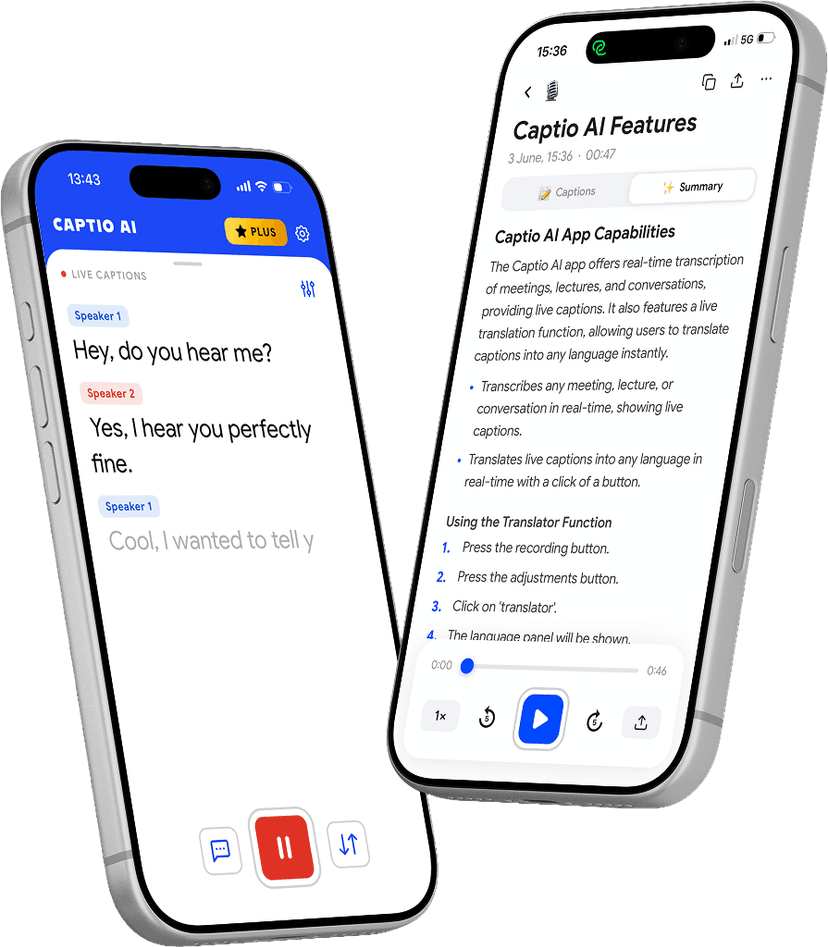
Everything you need to follow Swahili conferences & events
Four tools built for deaf and hard of hearing Swahili speakers.
Follow every speaker from any seat
- Point toward the PA or nearest speaker output
- Handles keynotes, panels, and Q&A sessions
- Works in large halls, seminar rooms, and outdoor venues
- No hearing loop or venue infrastructure required
International and multilingual conferences
- Speakers present in any language — you read in yours
- 60+ languages, no switching between sessions
- For global conferences, international panels, and foreign keynotes
- Translates in real time as each speaker talks
Full transcript of any session
- Record any talk or session and get the complete written transcript
- Review content you missed or want to study after the event
- Organised by speaker
- Searchable, copyable, shareable
Key takeaways from any session
- Main points and insights extracted from any session transcript
- Useful for dense technical talks and keynotes
- Organised into clear sections
- Works on any saved conference recording
Download for free
Every situation covered
Designed for the real moments that matter — not just quiet controlled environments.
From a far seat in a keynote hall at the Kenyatta International Convention Centre in Nairobi or a venue in Dar es Salaam, the speaker is distant and the room is loud. Point Captio AI toward the nearest PA speaker and read every word of the Swahili keynote from any seat.
At an academic conference — a research congress at the University of Nairobi or a scientific meeting in Dar es Salaam — presenters speak fast and mix in terminology. Captio AI captions in real time and transcribes for later review.
Industry events and development summits across East Africa carry content that affects your work. Captio AI captions every speaker and panellist so you follow the whole session.
In a workshop or breakout, several voices contribute in a Swahili–English mix from around the table. Place Captio AI on the table and follow every contribution, including from the back.
The most useful conversations often happen over chai breaks and at the conference dinner. Captio AI works in these noisy, informal settings the same way it does in the main hall.
At a pan-African or international conference, sessions switch between Swahili, English, and French. Live Translator captions foreign-language talks in real time so you follow the full programme.
Most accurate and fastest models
word accuracy
independent benchmark, 2025
real-time captions
first word appears as you speak
Download for free
Built for the room where you cannot ask anyone to repeat
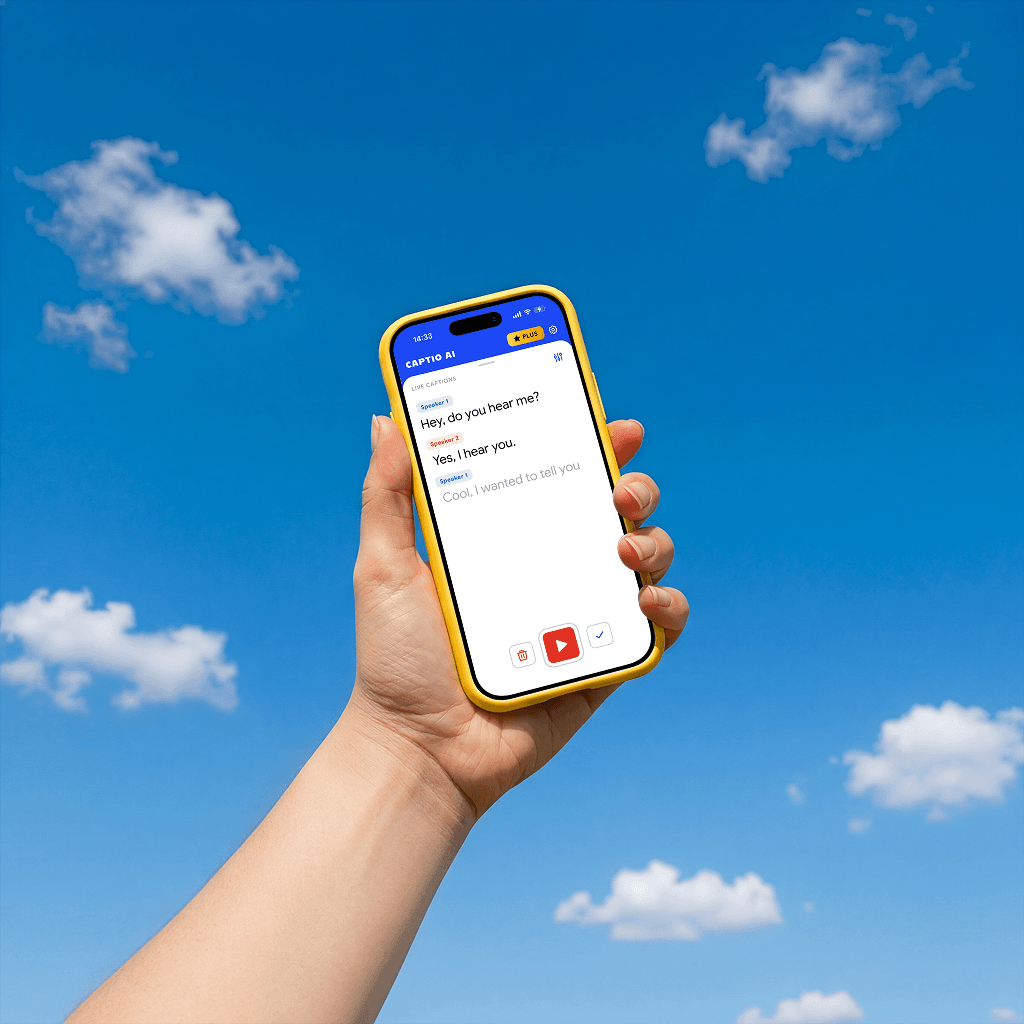
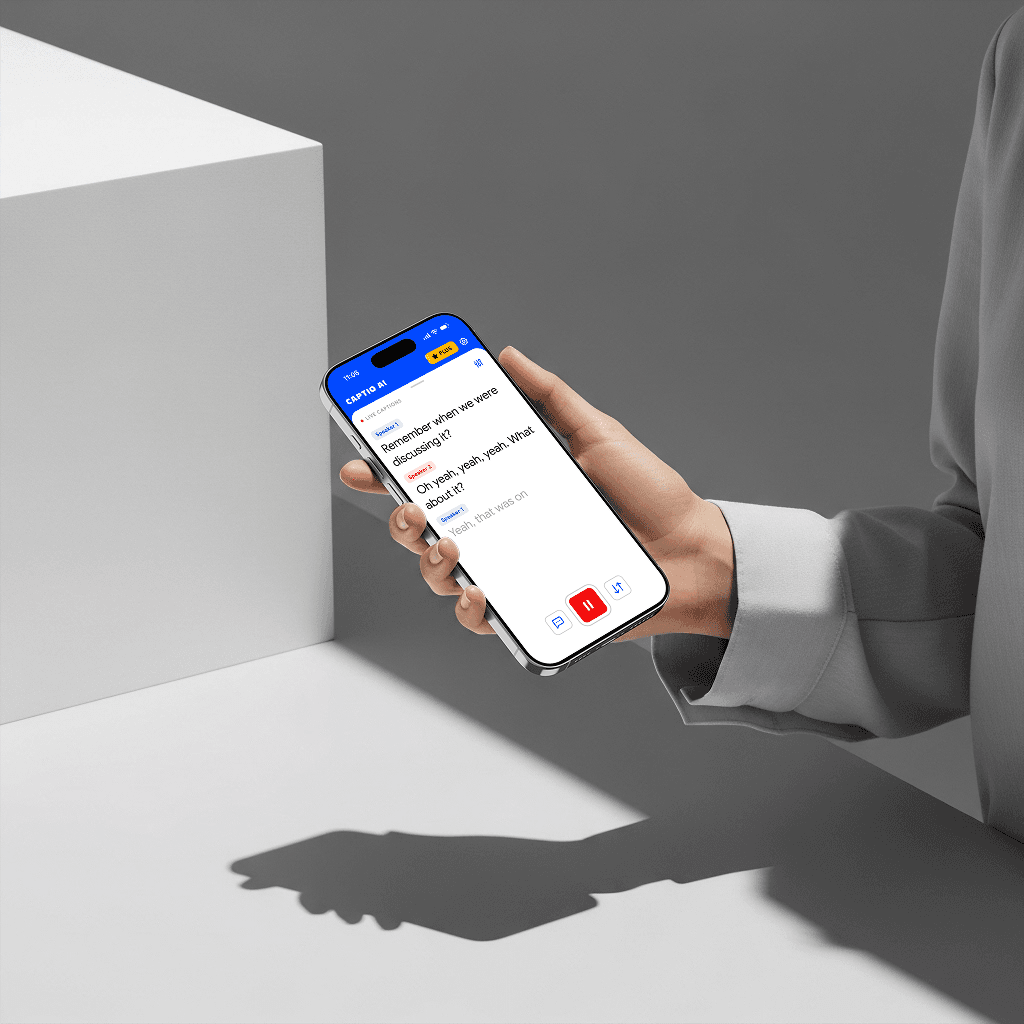
Live captions from any seat
Point the phone toward the nearest PA output or speaker. Captio AI captions whoever is presenting in real time — from the front row or the back of a large conference hall.
Works without venue infrastructure
No hearing loop, no captioning service, no advance booking required. Captio AI works independently via microphone — whether or not the venue has provided any accessibility infrastructure.
Covers what official captioning does not
Official captioning, where it exists, typically covers the main stage only. Q&A sessions, workshops, breakouts, and networking are usually left uncaptioned. Captio AI covers all of it.
Record and review after
Record any session and upload it to Audio Transcription for a full written record. Use AI Summary to extract key takeaways — useful for dense technical content you want to process at your own pace.
60+ languages
For international conferences, foreign-language keynotes, or multilingual panels. Live Translator captions and translates in real time across 60+ languages with no manual switching between speakers.
Works for networking too
The conversations in hallways and at lunch matter as much as the sessions. Captio AI works in any setting — informal, noisy, unstructured — the same way it works in the main hall.
Why Swahili is hard to understand
Prenasalized consonants
- Nasal-plus-stop sounds with almost no lip signal
- Swahili uses prenasalized consonants — clusters written mb, nd, ng, nj where a nasal glides straight into a stop. The nasal onset happens with little visible lip movement, so at a distance a deaf attendee sees the stop but not the nasal that changes the word in a keynote.
Dialect range
- Coastal, up-country, and East African varieties differ
- A regional conference in Nairobi or Dar es Salaam draws speakers of coastal Kiswahili (Kiunguja, Kimvita), Tanzanian standard, and the up-country Swahili of Kenya and Uganda. These varieties differ in rhythm and vocabulary, so a deaf attendee re-calibrates for each speaker who takes the stage.
Noun-class agreement
- Grammar riding on prefixes at the front of every word
- Swahili marks its many noun classes with prefixes that ripple agreement across a whole sentence. This grammatical information sits on unstressed syllables at the start of words, and when a presenter speaks quickly from a distant podium those prefixes clip and blur on the lips.
Arabic-origin sounds
- Borrowed consonants in formal vocabulary
- Formal and technical Swahili draws heavily on Arabic loanwords carrying sounds like 'gh' and 'kh' made far back in the mouth. These appear in exactly the elevated vocabulary a keynote reaches for, and they give a lip-reader little to nothing to work with.
Swahili–English code-switching
- Technical English inside Swahili sentences
- East African academic and professional speech mixes Swahili and English constantly — a term of art in English inside a Swahili sentence, then back again. A deaf attendee lip-reading Swahili must switch to English phonology on the technical vocabulary with no visual signal of the change.
Download for free
Hearing loss and professional access in East Africa
Hearing loss is a large and rising burden in East Africa. The Kenya 2019 census recorded 153,381 deaf people aged over five, and disabling hearing loss across Sub-Saharan Africa is estimated at around 4.55% of the population — with the WHO projecting that the number of people with hearing loss in Africa could reach 54 million by 2030. School surveys in Kenya and the Kilimanjaro region of Tanzania have found hearing impairment in 7% or more of children, much of it preventable and untreated for lack of services.
East Africa's conference and events sector is growing fast — the academic congresses of Nairobi and Dar es Salaam, the development and technology summits hosted at venues like the Kenyatta International Convention Centre — and these run on spoken Swahili and English delivered over PA systems. Real-time Swahili captioning of keynotes, panels, and Q&A is essentially never provided, and where any accessibility exists it does not reach the breakout sessions and networking where professional value is built.
Captio AI closes that gap. Point the phone toward the PA and read every Swahili keynote and Q&A answer from any seat, record a dense session for the full transcript, and follow the conversations over the chai break — so a deaf professional in Nairobi or Dar es Salaam gets the same value from the same conference as everyone in the hall.
Download for free
What you hear stays with you.
Gone the moment it ends
Captio AI processes your audio in real time and discards it immediately. Nothing is recorded. Nothing is kept.
Not a product
Your conversations are not something Captio AI sells, shares, or monetizes — to anyone, for any reason.
Not used to train anything
What you say in a doctor's appointment or a job interview never ends up in a training dataset. Not ours. Not anyone else's.

Private by default
Captio AI supports 60+ languages
Download for free
Frequently asked questions
Follow every speaker in Swahili.
Captio AI is free to start
Download for free