

Japanese live captions and productivity tool for conferences & events
For deaf and hard of hearing people.
Download for free


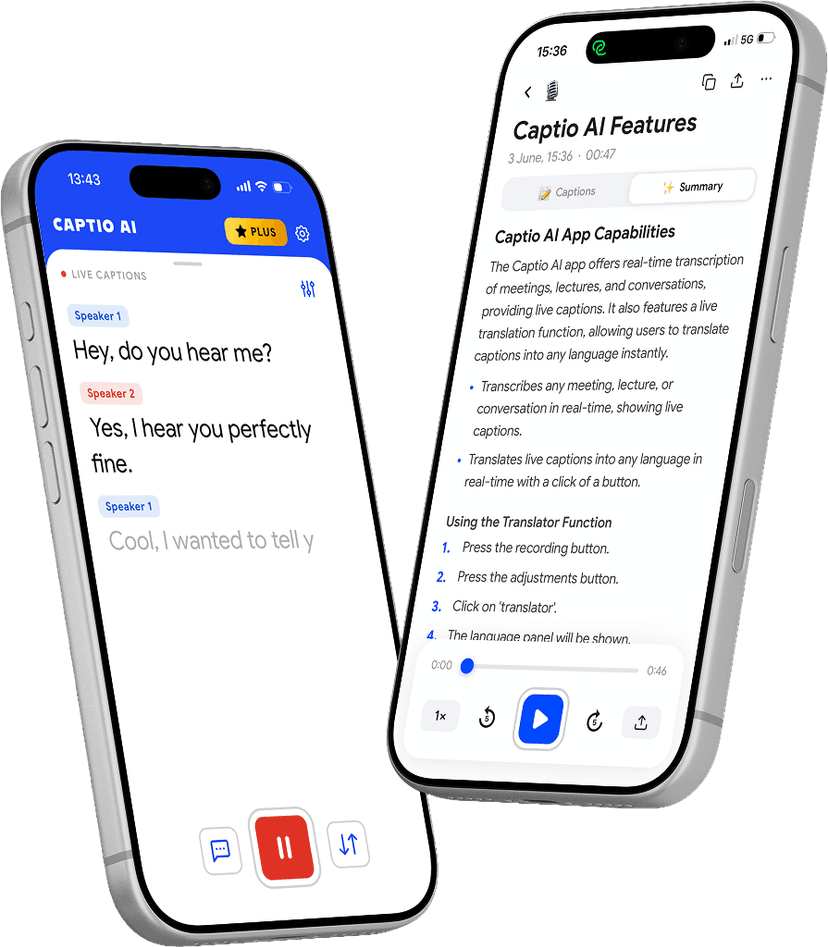
Everything you need to follow Japanese conferences & events
Four tools built for deaf and hard of hearing Japanese speakers.
Follow every speaker from any seat
- Point toward the PA or nearest speaker output
- Handles keynotes, panels, and Q&A sessions
- Works in large halls, seminar rooms, and outdoor venues
- No hearing loop or venue infrastructure required
International and multilingual conferences
- Speakers present in any language — you read in yours
- 60+ languages, no switching between sessions
- For global conferences, international panels, and foreign keynotes
- Translates in real time as each speaker talks
Full transcript of any session
- Record any talk or session and get the complete written transcript
- Review content you missed or want to study after the event
- Organised by speaker
- Searchable, copyable, shareable
Key takeaways from any session
- Main points and insights extracted from any session transcript
- Useful for dense technical talks and keynotes
- Organised into clear sections
- Works on any saved conference recording
Download for free
Every situation covered
Designed for the real moments that matter — not just quiet controlled environments.
From a far seat in a keynote hall at Tokyo Big Sight or a hall in Osaka, the speaker is distant and the Japanese is formal. Point Captio AI toward the nearest PA speaker and read every word of the keynote from any seat.
At an academic conference — a research congress at a Tokyo university or a scientific meeting in Kyoto — presenters speak fast and pack talks with Sino-Japanese terminology. Captio AI captions in real time and transcribes for later review.
Industry events and product launches in Tokyo or Yokohama carry content that affects your work. Captio AI captions every speaker so you follow the panel and miss nothing professionally relevant.
In a workshop or breakout, several voices contribute in Japanese from around the table. Place Captio AI on the table and follow every contribution, including from the back of the room.
The most useful exchanges often happen over coffee and at the conference reception. Captio AI works in these noisy, informal settings the same way it does in the main hall.
At an international conference in Japan, sessions switch between Japanese and English. Live Translator captions foreign-language talks in real time so you follow the full programme.
Most accurate and fastest models
character accuracy
independent benchmark, 2025
real-time captions
first word appears as you speak
Download for free
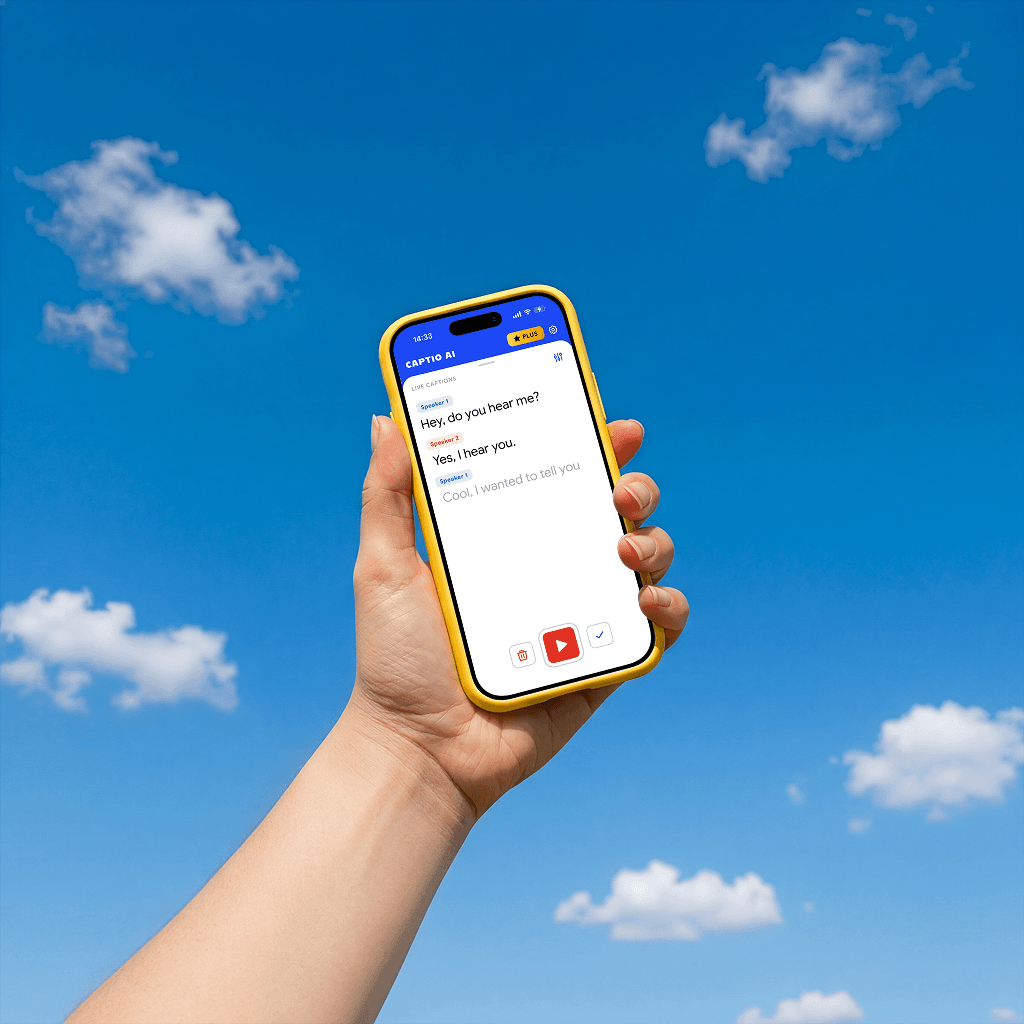
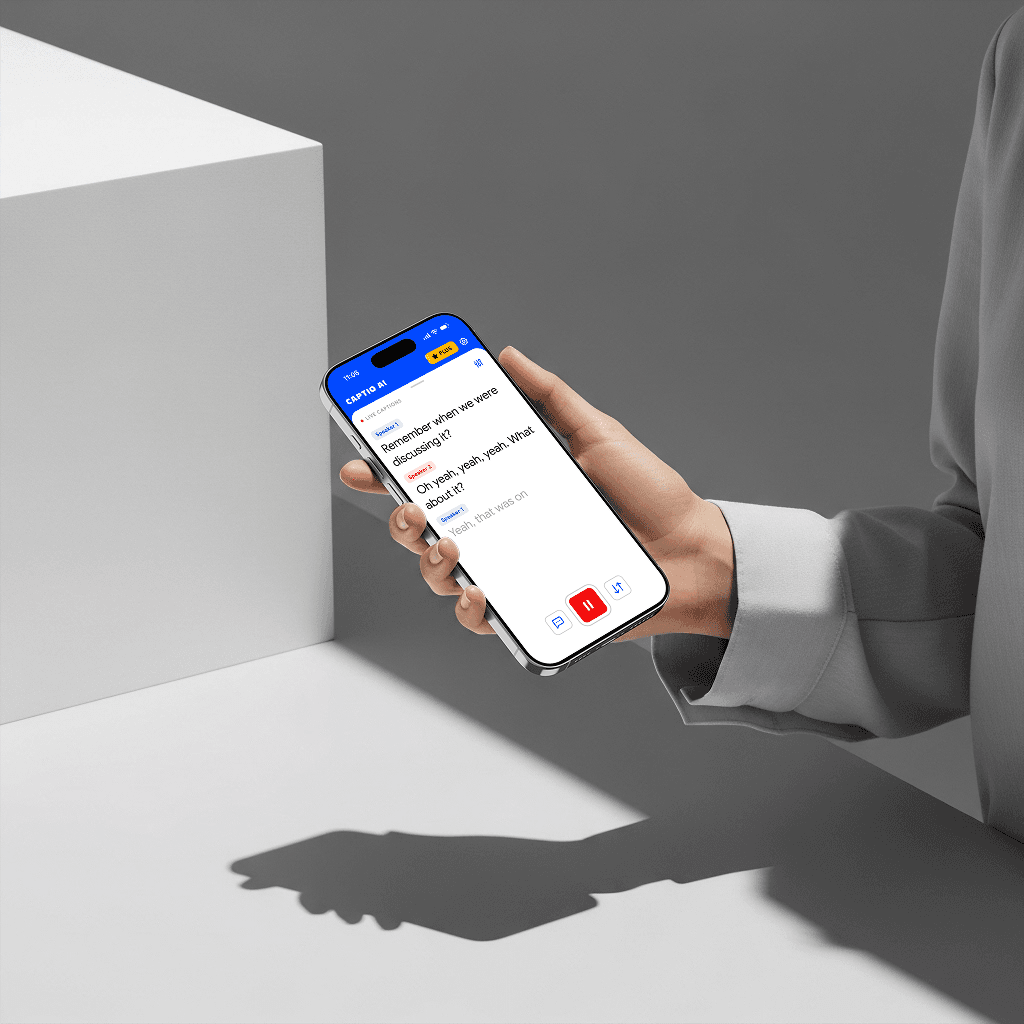
Built for the room where you cannot ask anyone to repeat
Live captions from any seat
Point the phone toward the nearest PA output or speaker. Captio AI captions whoever is presenting in real time — from the front row or the back of a large conference hall.
Works without venue infrastructure
No hearing loop, no captioning service, no advance booking required. Captio AI works independently via microphone — whether or not the venue has provided any accessibility infrastructure.
Covers what official captioning does not
Official captioning, where it exists, typically covers the main stage only. Q&A sessions, workshops, breakouts, and networking are usually left uncaptioned. Captio AI covers all of it.
Record and review after
Record any session and upload it to Audio Transcription for a full written record. Use AI Summary to extract key takeaways — useful for dense technical content you want to process at your own pace.
60+ languages
For international conferences, foreign-language keynotes, or multilingual panels. Live Translator captions and translates in real time across 60+ languages with no manual switching between speakers.
Works for networking too
The conversations in hallways and at lunch matter as much as the sessions. Captio AI works in any setting — informal, noisy, unstructured — the same way it works in the main hall.
Why Japanese is hard to understand
Pitch accent
- Words told apart by pitch, not by the lips
- Japanese distinguishes many words only by pitch accent — the same sequence of sounds means different things depending on where the pitch falls. Pitch is carried in the voice, not on the mouth, so a deaf attendee watching a distant keynote speaker gets no visual cue for the accent that fixes the meaning.
Homophone density
- So many same-sounding words that context decides
- Japanese has a small sound inventory and vast numbers of homophones, resolved by context and by the kanji in the mind of the speaker. In a dense technical talk full of Sino-Japanese compounds, a deaf attendee who misses the surrounding context cannot recover which of many identical-sounding terms was meant.
Mora timing
- Length and mora-timed rhythm carry meaning
- Japanese is mora-timed, and vowel and consonant length are contrastive — a long vowel or a doubled consonant makes a different word. These are timing distinctions, not lip shapes, so at the pace of a keynote they are invisible to a lip-reader from the audience.
Keigo register
- Formal honorific speech reshapes whole phrases
- Conference Japanese uses keigo — layered honorific and humble forms — that lengthen and restructure verbs and phrases far beyond casual speech. A deaf attendee who lip-reads everyday Japanese meets a formal register on the podium in which familiar words take unfamiliar, extended shapes.
Japanese–English terms
- Katakana English embedded in Japanese sentences
- Japanese technical talks are full of English loanwords rendered in Japanese sound patterns, plus raw English terms and acronyms dropped into Japanese sentences. A deaf attendee must track a term that is neither fully Japanese nor recognisably English on the lips, switching between systems with no visual warning.
Download for free
Hearing loss and professional access in Japan
Japan has one of the world's oldest populations, and hearing loss rises sharply with age — among people in their 70s, prevalence of high-frequency hearing loss reaches roughly 46% in men. The number of people with moderate or greater hearing loss is estimated at around 6 million and projected to reach 10 million by 2025 as the baby-boomer generation ages. A large and growing professional population lives and works with hearing loss, and hearing-aid coverage is limited — many with under-70 dB loss cannot obtain a disability certificate at all.
Japan's conference and events culture is vast — the academic congresses of Tokyo and Kyoto, the technology and industry events at Tokyo Big Sight and across the country — and it runs on spoken Japanese in a formal keigo register delivered over PA systems, with English terms woven in. Real-time Japanese captioning of keynotes, panels, and Q&A is rarely provided, and where any accessibility exists it does not reach the breakouts and networking where careers and collaborations form.
Captio AI closes that gap. Point the phone toward the PA and read every Japanese keynote and panel answer from any seat, record a dense technical session for the full transcript, and follow the conversations over coffee — so a deaf professional in Tokyo or Osaka gets the same value from the same conference as everyone in the hall.
Download for free
What you hear stays with you.
Gone the moment it ends
Captio AI processes your audio in real time and discards it immediately. Nothing is recorded. Nothing is kept.
Not a product
Your conversations are not something Captio AI sells, shares, or monetizes — to anyone, for any reason.
Not used to train anything
What you say in a doctor's appointment or a job interview never ends up in a training dataset. Not ours. Not anyone else's.

Private by default
Captio AI supports 60+ languages
Download for free
Frequently asked questions
Follow every speaker in Japanese.
Captio AI is free to start
Download for free