

Portuguese live captions and productivity tool for conferences & events
For deaf and hard of hearing people.
Download for free


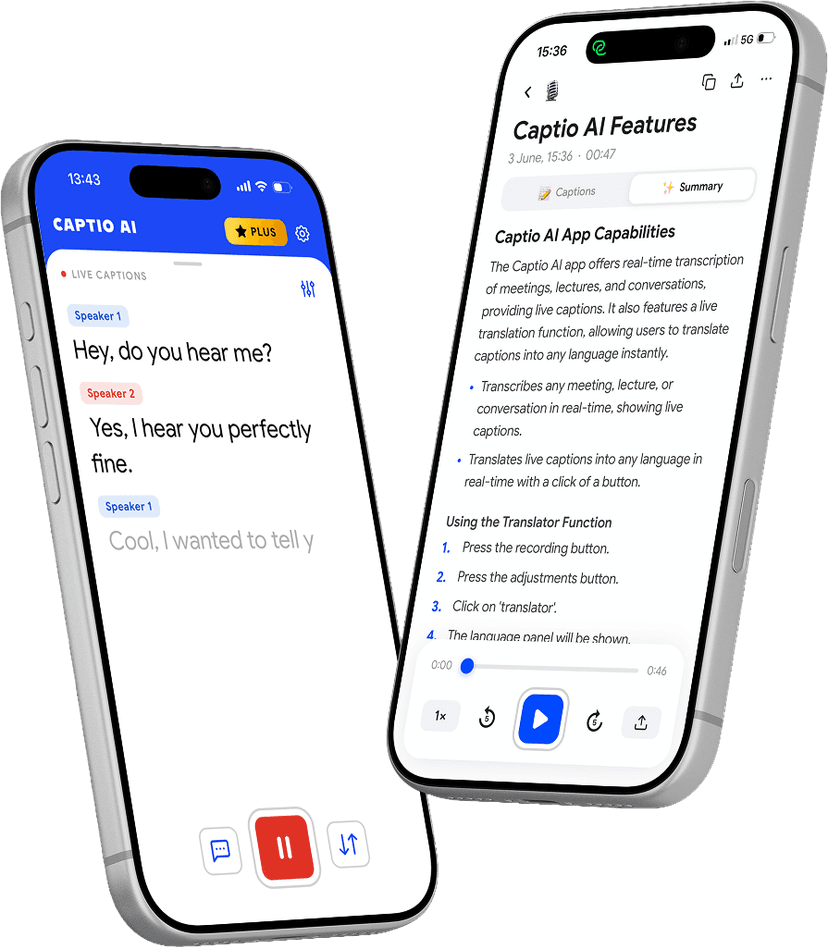
Everything you need to follow Portuguese conferences & events
Four tools built for deaf and hard of hearing Portuguese speakers.
Follow every speaker from any seat
- Point toward the PA or nearest speaker output
- Handles keynotes, panels, and Q&A sessions
- Works in large halls, seminar rooms, and outdoor venues
- No hearing loop or venue infrastructure required
International and multilingual conferences
- Speakers present in any language — you read in yours
- 60+ languages, no switching between sessions
- For global conferences, international panels, and foreign keynotes
- Translates in real time as each speaker talks
Full transcript of any session
- Record any talk or session and get the complete written transcript
- Review content you missed or want to study after the event
- Organised by speaker
- Searchable, copyable, shareable
Key takeaways from any session
- Main points and insights extracted from any session transcript
- Useful for dense technical talks and keynotes
- Organised into clear sections
- Works on any saved conference recording
Download for free
Every situation covered
Designed for the real moments that matter — not just quiet controlled environments.
From a far seat in a keynote hall in São Paulo, Rio, or Lisbon, the speaker is distant and the Portuguese is fast. Point Captio AI toward the nearest PA speaker and read every word of the keynote from any seat.
At an academic conference — a research congress at a Brazilian university or a scientific meeting in Porto — presenters speak quickly and pack talks with terminology. Captio AI captions in real time and transcribes for later review.
Industry events, startup summits, and product launches in São Paulo or Lisbon carry content that affects your work. Captio AI captions every speaker so you follow the panel and miss nothing.
In a workshop or breakout, several voices contribute in Portuguese from around the table. Place Captio AI on the table and follow every contribution, including from the back of the room.
The most useful conversations often happen over a cafezinho and at the conference dinner. Captio AI works in these noisy, informal settings the same way it does in the main hall.
At an international conference, sessions switch between Portuguese, English, and Spanish. Live Translator captions foreign-language talks in real time so you follow the full programme.
Most accurate and fastest models
word accuracy
independent benchmark, 2025
real-time captions
first word appears as you speak
Download for free
Built for the room where you cannot ask anyone to repeat
Live captions from any seat
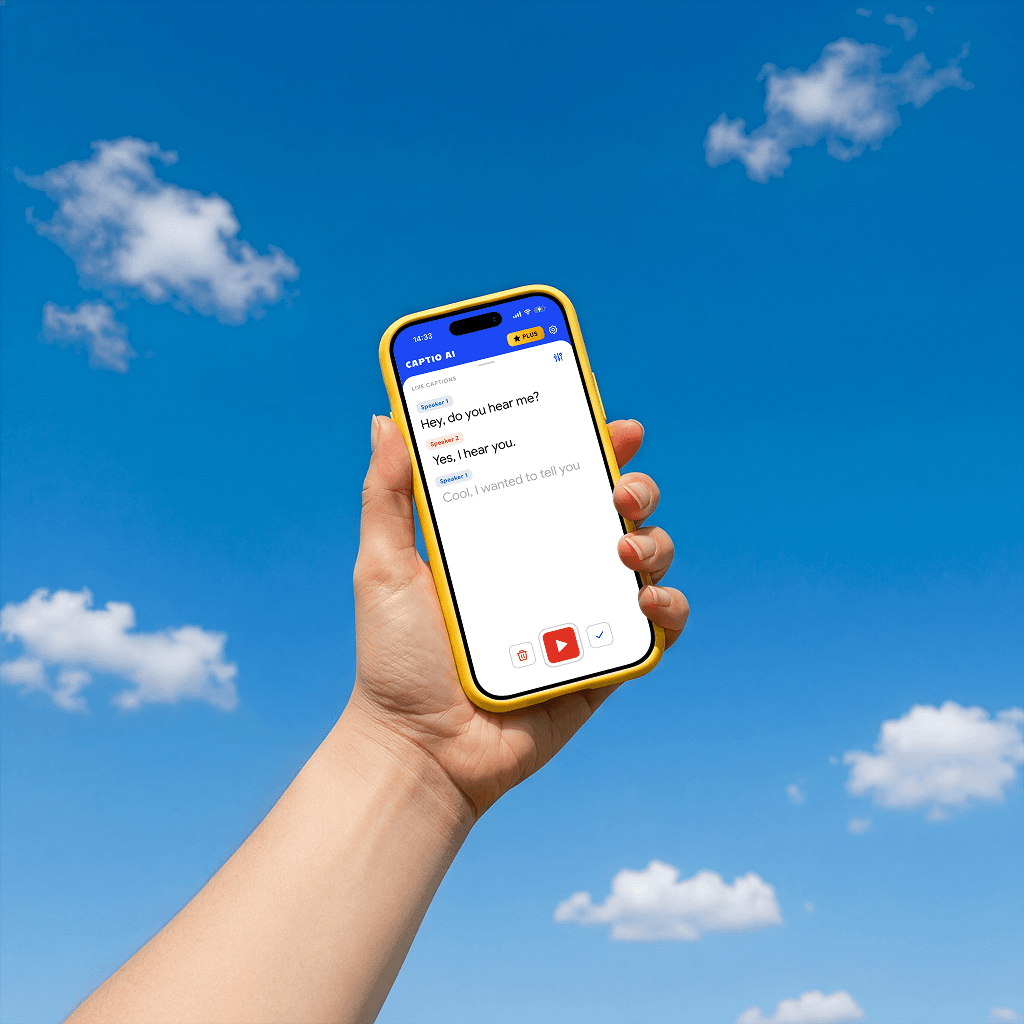
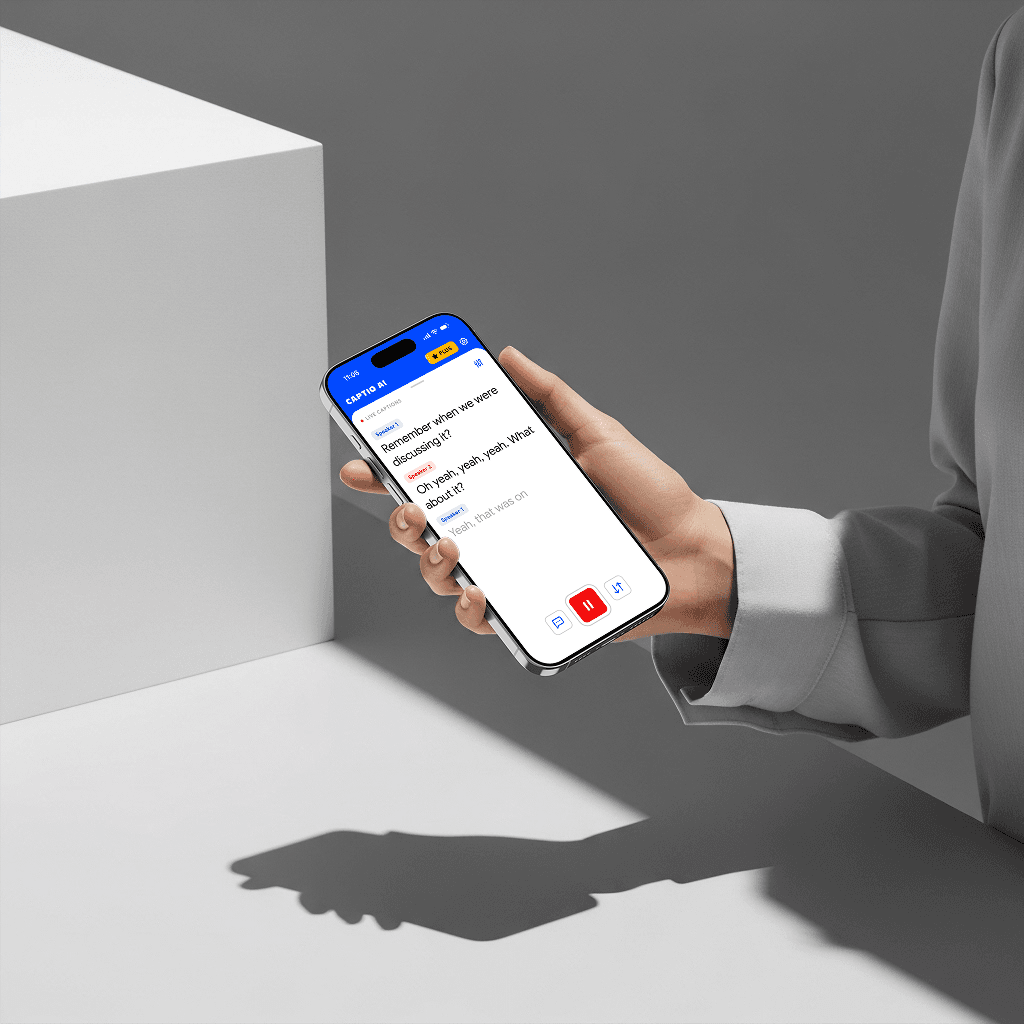
Point the phone toward the nearest PA output or speaker. Captio AI captions whoever is presenting in real time — from the front row or the back of a large conference hall.
Works without venue infrastructure
No hearing loop, no captioning service, no advance booking required. Captio AI works independently via microphone — whether or not the venue has provided any accessibility infrastructure.
Covers what official captioning does not
Official captioning, where it exists, typically covers the main stage only. Q&A sessions, workshops, breakouts, and networking are usually left uncaptioned. Captio AI covers all of it.
Record and review after
Record any session and upload it to Audio Transcription for a full written record. Use AI Summary to extract key takeaways — useful for dense technical content you want to process at your own pace.
60+ languages
For international conferences, foreign-language keynotes, or multilingual panels. Live Translator captions and translates in real time across 60+ languages with no manual switching between speakers.
Works for networking too
The conversations in hallways and at lunch matter as much as the sessions. Captio AI works in any setting — informal, noisy, unstructured — the same way it works in the main hall.
Why Portuguese is hard to understand
Nasal vowels
- Five nasal vowels with almost no lip signal
- Portuguese relies heavily on nasal vowels — the sounds in 'não', 'então', 'informação'. Nasalization is produced at the soft palate and is nearly invisible on the lips. Conference vocabulary is full of these endings, so a deaf attendee watching a presenter misses a contrast that changes the word.
European vowel reduction
- Portugal's Portuguese swallows unstressed vowels
- European Portuguese reduces and deletes unstressed vowels aggressively, compressing words into consonant clusters, while Brazilian Portuguese keeps vowels open. A deaf attendee calibrated to Brazilian speech finds a Lisbon keynote speaker's words centralised and swallowed, hard to segment from the lips.
Brazil–Portugal divide
- Two varieties on an international panel
- A Lusophone conference brings Brazilian and European Portuguese speakers to the same stage, differing in vowels, rhythm, and the pronunciation of many consonants. A deaf attendee re-calibrates for each — the nasal, open Brazilian delivery and the compressed, guttural European one.
Fast carioca speech
- Rapid delivery with palatalised endings
- Brazilian speakers, especially from Rio, palatalise 'de' and 'te' to 'dji' and 'tchi' and deliver at speed. In a fast panel Q&A, the palatalised, quick speech blurs word boundaries and leaves a lip-reader little visual footing.
Portuguese–English code-switching
- Technical English inside Portuguese sentences
- Brazilian and Portuguese tech and academic talks drop English terms into Portuguese sentences without pause — 'o deploy', 'a call'. A deaf attendee lip-reading Portuguese meets English phonology on the key term, then returns to Portuguese, with no visual signal of the switch.
Download for free
Hearing loss and professional access in Brazil and Portugal
Brazil's national household survey (IBGE PNS 2019) counts over 10 million people with some hearing impairment — roughly 5% of the population — and around 2.7 million with severe or total hearing loss. The professional cost is stark: only 28.3% of working-age people with disabilities were in the workforce, against 66.3% of those without. Portugal adds a European Portuguese-speaking population with its own established deaf community. These are the professionals sitting in Lusophone conference audiences.
Brazil and Portugal have vibrant conference and events sectors — the academic congresses of the Brazilian universities, the technology summits of São Paulo, the industry events of Lisbon — all running on spoken Portuguese over PA systems, with English woven in. Brazilian Sign Language (Libras) is legally recognised, but interpreter provision at general conferences is limited and real-time captioning of keynotes, panels, and Q&A is almost never offered. The parts of an event that build careers are the parts with the least access.
Captio AI closes that gap. Point the phone toward the PA and read every Portuguese keynote and panel answer from any seat, record a dense session for the full transcript, and follow the conversations over a cafezinho — so a deaf professional in São Paulo or Lisbon gets the same value from the same conference as everyone in the room.
Download for free
What you hear stays with you.
Gone the moment it ends
Captio AI processes your audio in real time and discards it immediately. Nothing is recorded. Nothing is kept.
Not a product
Your conversations are not something Captio AI sells, shares, or monetizes — to anyone, for any reason.
Not used to train anything
What you say in a doctor's appointment or a job interview never ends up in a training dataset. Not ours. Not anyone else's.

Private by default
Captio AI supports 60+ languages
Download for free
Frequently asked questions
Follow every speaker in Portuguese.
Captio AI is free to start
Download for free