

Japanese live captions and productivity tool for deaf and HoH people.
Follow any Japanese conversation, meeting or lecture. Supports Standard Japanese (Tokyo dialect) and common regional speech.
Download for free


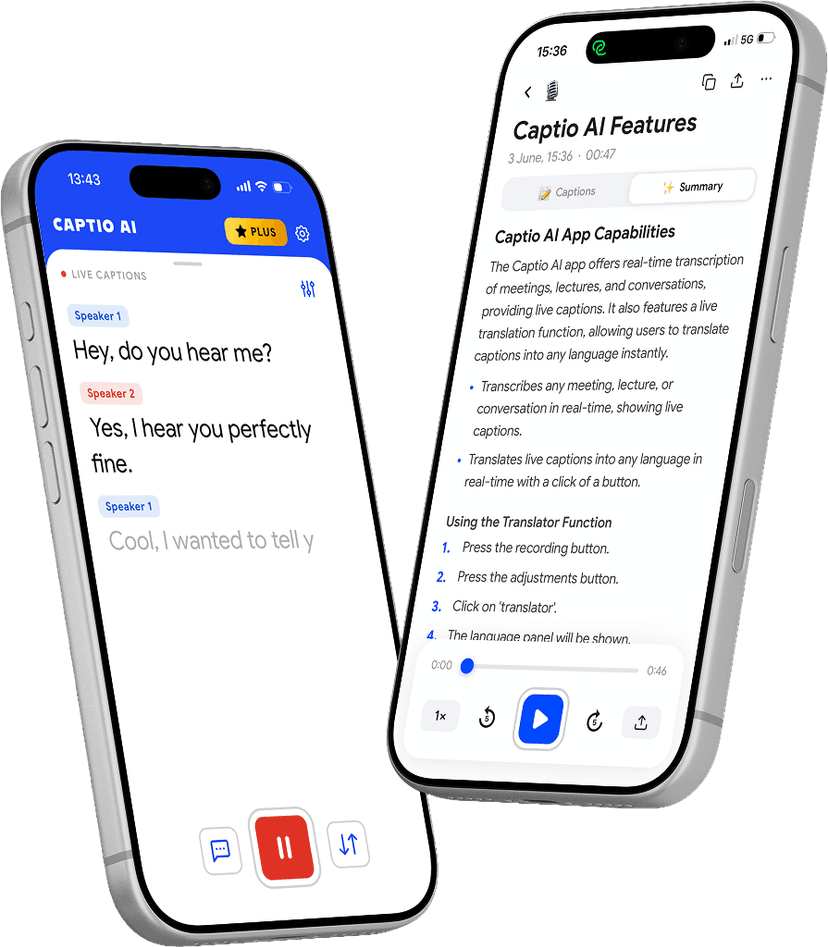
Everything you need to follow any Japanese conversation
Four tools built specifically for deaf and hard of hearing Japanese speakers.
Real-Time Japanese Speech to Text
- Japanese captions, word by word
- Works in noisy places
- Supports Standard Japanese (Tokyo dialect) and common regional speech
- No lip reading needed
Translate Japanese in Real Time
- Translates Japanese as they speak
- Each person speaks their own language
- Handles mid-sentence switches
- Supports Standard Japanese (Tokyo dialect) and common regional speech
Transcribe Any Japanese Audio or Video
- Any Japanese audio or video file
- Organized by speaker
- Supports Standard Japanese (Tokyo dialect) and common regional speech
- Read, copy, search, share
Turn Japanese Transcripts into Summaries
- Key points from Japanese meetings
- Action items extracted
- Works on any Japanese transcript
- Organized into sections
Works in every situation
Designed for the real moments that matter — not just quiet controlled environments.
Most Japanese conversations happen fast, at normal pace, without warning. Captio AI captions every word as it's spoken, so you can follow without asking anyone to repeat themselves.
🤟Communicating with Deaf & HoHHearing people often don't know how to adapt when talking with deaf or hard of hearing Japanese speakers. Captio AI turns their speech into real-time captions, so the conversation can happen naturally on both sides.
💼MeetingsIn Japanese meetings, decisions happen fast and people talk over each other. Captio AI captions every speaker as they talk, so you never miss a decision or a question directed at you.
🎓LecturesJapanese lecturers speak quickly, cover complex material, and rarely repeat themselves. Captio AI gives you a live transcript of everything said, so you can follow the content instead of straining to hear it.
🏥Doctor AppointmentsDoctors speak quickly in Japanese and use clinical language that's easy to mishear. Captio AI shows you everything they say in real time, so you can follow your diagnosis and ask the right questions.
🤝Job InterviewsMissing a question in a Japanese interview means answering wrong or asking for a repeat. Captio AI shows you every word the interviewer says, so you can focus entirely on your answer.
📱Phone & Video CallsJapanese phone and video calls are harder to follow than in-person conversations. No lip reading, often poor audio quality. Captio AI captions whoever is speaking in real time, so you do not need to ask for repeats.
👥Group SettingsIn Japanese group conversations, multiple people talk at once and the thread moves fast. Captio AI keeps up with whoever is speaking, so you can follow without losing where the conversation is going.
🍽️Restaurants & CafesBackground noise in Japanese-speaking restaurants and cafes makes speech hard to follow. Captio AI focuses on whoever is speaking to you, so you can have a real conversation through the noise.
✈️TravelingIn Japanese-speaking cities, airports, and hotels there is no margin for mishearing. Captio AI captions speech in real time, so you can navigate confidently wherever you go.
🎤Conferences & EventsAt Japanese conferences, speakers are far away, acoustics are unpredictable, and you cannot ask for a repeat. Captio AI gives you a live transcript of every speaker, so you can follow the full event from any seat.
📺TV & MediaBuilt-in subtitles on Japanese TV, films, and videos are often wrong, delayed, or missing. Captio AI captions whatever is playing in real time, so you are not dependent on what the content provides.
Download for free
Japanese dialect & accent support
Supports Standard Japanese (Tokyo dialect) and common regional speech.
Hyōjungo dialect
Standard Japanese (標準語) — based on the educated Tokyo variety and used in national broadcasting, education, and formal contexts. Captio AI handles Hyōjungo with full accuracy, displaying captions in native Japanese script (kanji, hiragana, and katakana).
Kansai dialect
関西弁 — spoken in Osaka, Kyoto, Kobe, Nara, and surrounding regions by around 20 million people. Has a distinct pitch-accent system, intonation, and vocabulary from Standard Japanese. The most widely recognized Japanese regional variety. Captio AI handles it accurately in educated conversational speech.
Tōhoku dialect
東北弁 — spoken across northern Honshū: Sendai, Aomori, Akita, Yamagata, and Iwate. Known for vowel merging (the 'zūzū-ben' feature) and distinct intonation — one of the most divergent mainland Japanese dialects. Captio AI handles educated Tōhoku speech well; very heavy dialect features may occasionally reduce accuracy.
Kyūshū dialect
九州弁 — spoken across Kyūshū island: Fukuoka, Nagasaki, Kumamoto, Kagoshima, and Ōita. Has distinct intonation and some vocabulary differences from Standard Japanese, varying by prefecture. Captio AI handles Kyūshū dialect accurately in everyday conversational speech.
Ryūkyū dialect
Spoken in Okinawa and the Ryūkyū Islands. Linguists now classify Ryūkyūan varieties as a separate Japonic language rather than a Japanese dialect due to mutual unintelligibility with mainland Japanese. Captio AI handles Standard Japanese most reliably; Ryūkyūan speech may have significantly reduced accuracy.
Captio AI supports 60+ languages
Download for free
What you hear stays with you.
Gone the moment it ends
Captio AI processes your Japanese audio in real time and discards it immediately. Nothing is recorded. Nothing is kept.
Not a product
Your conversations are not something Captio AI sells, shares, or monetizes — to anyone, for any reason.
Not used to train anything
What you say in a Japanese doctor's appointment or job interview never ends up in a training dataset. Not ours. Not anyone else's.

Hearing accessibility for Japanese speakers
Japan's deaf community uses Japanese Sign Language (日本手話, Nihon Shuwa). JSL is now recognized in national law as a language. Japan also uses Signed Japanese, which follows spoken Japanese grammar rather than JSL's own structure. These are different systems, and many deaf people in Japan draw a clear distinction between them.
JSL developed naturally within the deaf community. Signed Japanese was created as a bridge to spoken Japanese and is often what gets taught in mainstream education settings. Many deaf Japanese people who attended regular schools learned Signed Japanese rather than JSL, which their community does not always recognize as their natural language.
Japanese healthcare and formal settings use a highly formal register (keigo) that is difficult to follow even for hearing people who encounter it infrequently. For hard of hearing people at a hospital or government office in Japan, the combination of fast speech, formal vocabulary, and limited interpreter availability is a common situation. Captio AI captions spoken Japanese in real time regardless of register.
Download for free
Frequently asked questions
Start captioning in Japanese
Captio AI is free to start
Download for free