

Japanese live captions and productivity tool for restaurants & cafes
For deaf and hard of hearing people.
Download for free


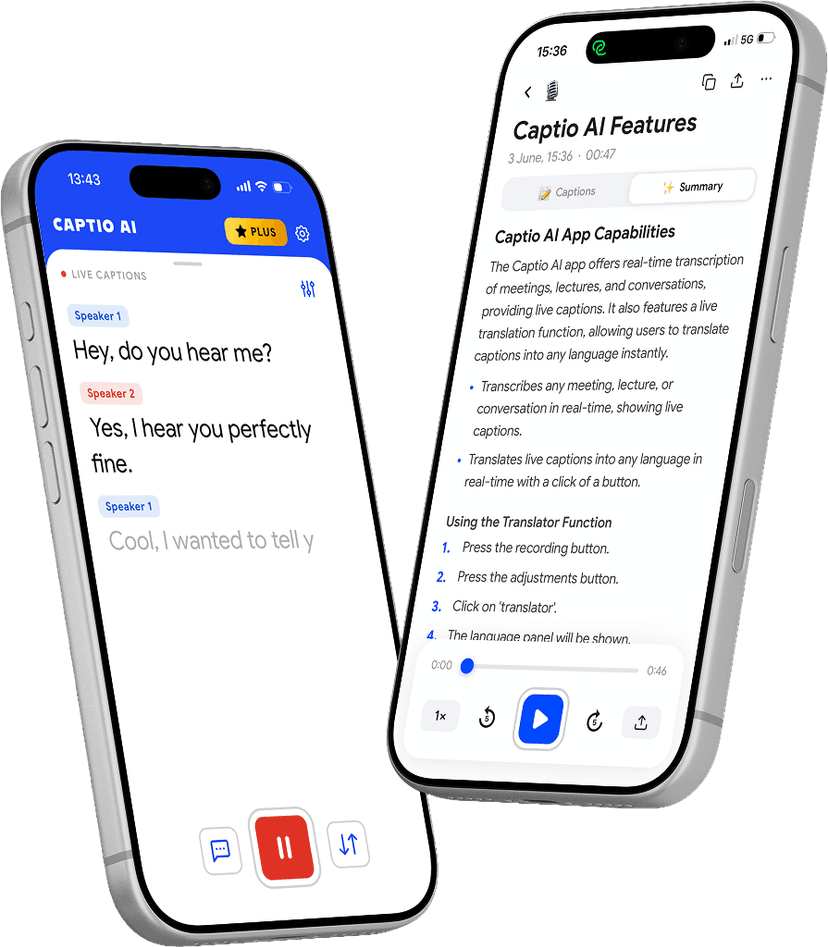
Everything you need to follow Japanese restaurants & cafes
Four tools built for deaf and hard of hearing Japanese speakers.
Follow the conversation through the noise
- Captions the person across the table in real time
- Works through typical restaurant background noise
- Place the phone between you — no adjustment needed
- No lip reading, no facing the speaker
Restaurants abroad or with foreign speakers
- They speak their language — you read in yours
- For waitstaff, companions, or travel dining
- 60+ languages, no setup
- Translates in real time as they speak
Transcribe any recorded conversation
- Record and get the full conversation in writing
- Review anything you missed after the meal
- Organised by speaker
- Any language, any format
Key points from any conversation
- Important points extracted from any recording
- Useful for business lunches and important catch-ups
- Organised into clear sections
- Works on any saved recording
Download for free
Every situation covered
Designed for the real moments that matter — not just quiet controlled environments.
Dinner with friends in Japan unfolds over shared izakaya dishes or a kaiseki course — a back-and-forth of ordering, commenting on dishes, and conversation. Following who is saying what across a loud izakaya floor without captioning is genuinely difficult.
Business lunches in Japan involve high-stakes social signalling. The register is formal, side comments matter, and missing a polite gesture embedded in language — an offer, a deferral — creates real professional risk.
A kissaten or modern café is a frequent meeting spot for quick catch-ups. Orders and conversation flow briskly at the counter, and the background hum of a busy Tokyo or Osaka café adds noise on top of fast Japanese.
Eating out while travelling through Japan — from Sapporo to Fukuoka — means navigating local dialects and regional accents. Captio AI captions whatever regional variety is spoken.
Celebrations in Japan — enkai banquets, birthday dinners, welcome parties — are loud and structured, with toasts, speeches, and cross-table conversation running together. A hard of hearing person at a noisy banquet hall is at the margin of every conversation.
A one-on-one dinner at a quiet Tokyo restaurant carries the quiet pressure of unbroken conversation. Missing a sentence in Japanese — where context and politeness are carried in the final verb form — can shift the meaning of the whole exchange.
Most accurate and fastest models
character accuracy
independent benchmark, 2025
real-time captions
first word appears as you speak
Download for free
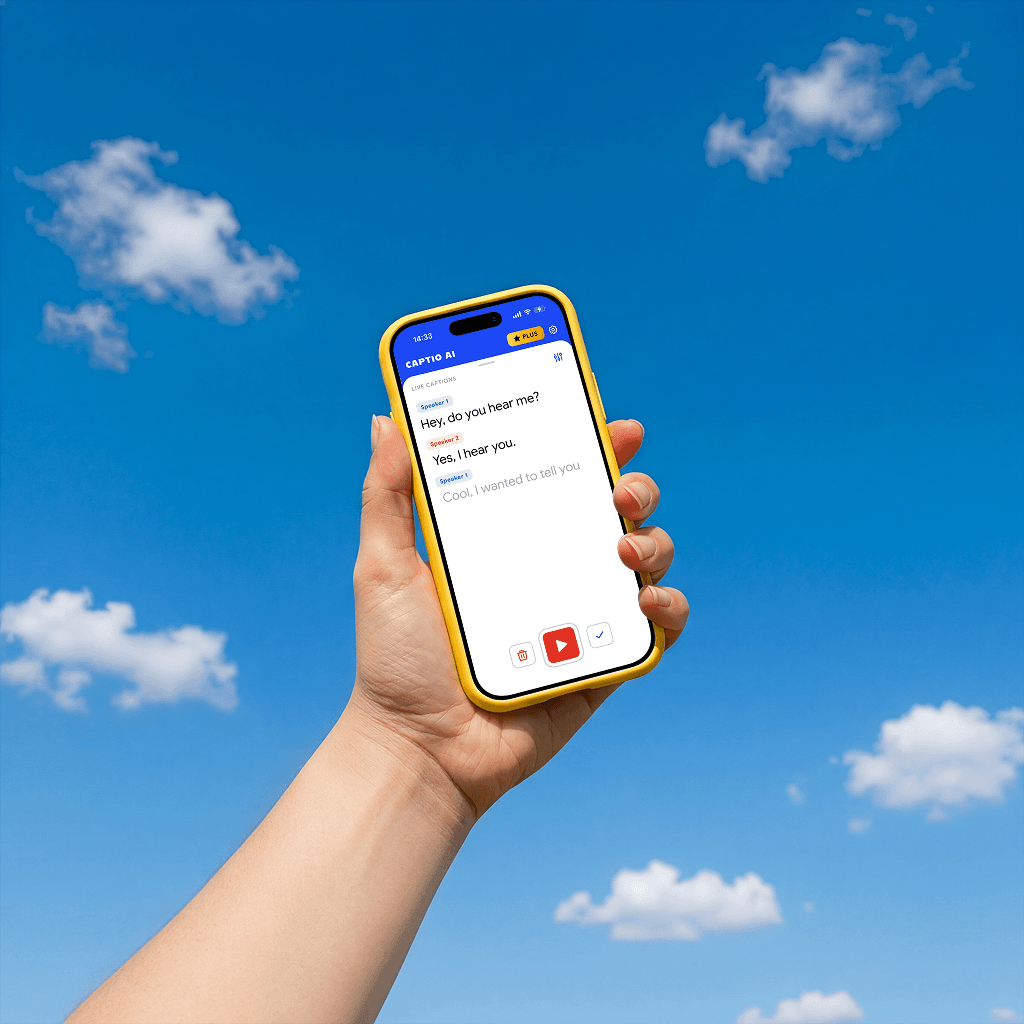
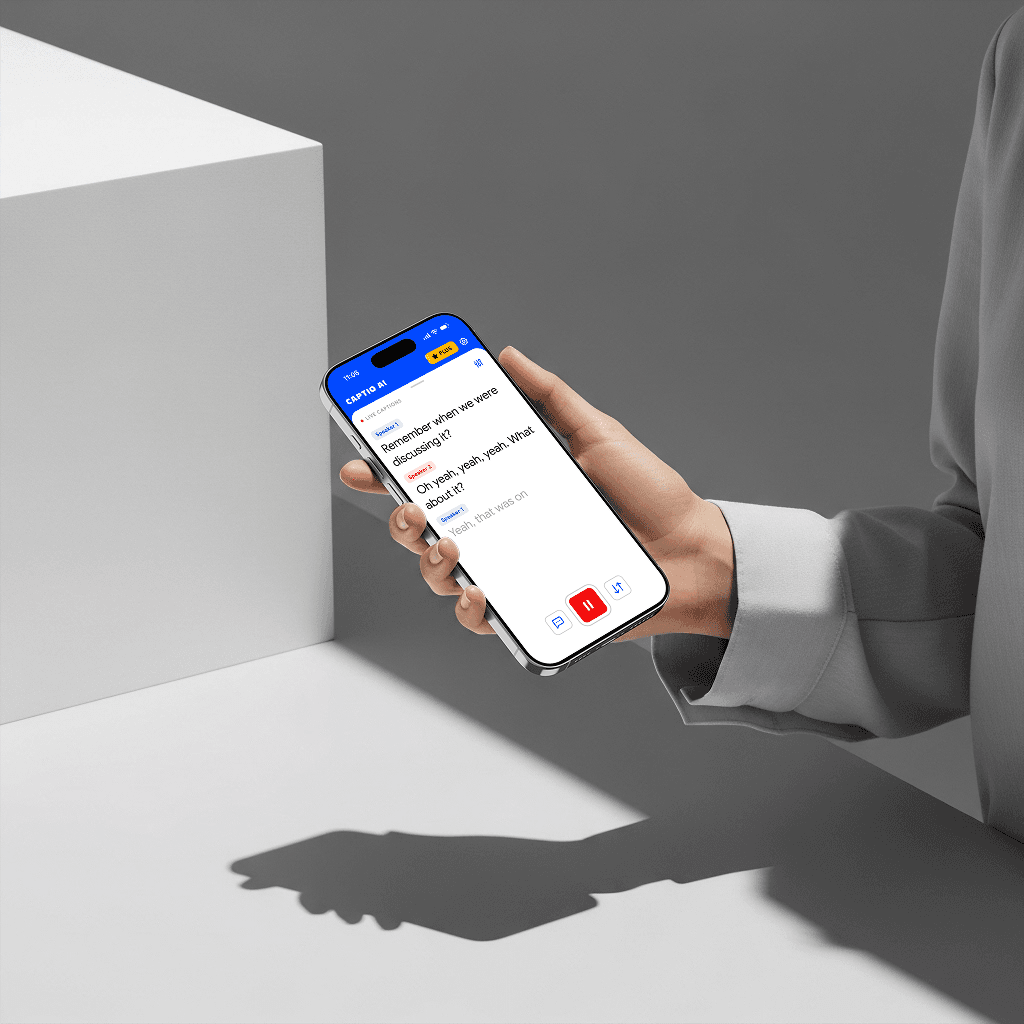
Built for the table — however noisy the room
Follows the person across the table
Point the microphone toward the person speaking and Captio AI captions them through the background noise. You do not need to face them, watch their lips, or lean in.
Works through restaurant noise
Restaurant noise averages 80 dBA — well above comfortable conversation level. Captio AI is built for these real environments, not quiet controlled rooms.
Place it and forget it
Put the phone on the table between you and the other person, microphone facing them. You glance at it as needed. No adjusting between sentences, no managing the setup.
No asking for repeats during the meal
Every word appears in real time. If you missed something, the caption is there — you do not need to stop the conversation and ask anyone to say it again.
Any language
For restaurants abroad, multilingual dining companions, or waitstaff who speak a different language. Live Translator captions and translates in real time with no manual setup.
Discreet
A phone on a restaurant table is unremarkable. Captio AI runs quietly, the screen faces you, and most dining companions adapt naturally once they understand what it does.
Why Japanese is hard to understand
Pitch accent invisible
- Tone changes meaning but leaves no lip trace
- Standard Tokyo Japanese uses a mora-based pitch accent system where a single pitch downstep distinguishes between words spelled identically. 'Hashi' (bridge, chopsticks, or edge) shifts meaning with a high-low pattern carried entirely by pitch — nothing on the lips changes. In restaurant settings where context shifts rapidly, these distinctions collapse without hearing.
Fast moraic rhythm
- Rapid-fire syllables with uniform lip movement
- Japanese speech unfolds in short, evenly timed morae rather than the stress-timed patterns of European languages. This creates a machine-gun rhythm where lip shapes cycle fast and uniformly. Servers reciting the daily set meal at a counter restaurant speak at high speed with minimal facial expression.
Keigo register shift
- Formal restaurant Japanese sounds like a different language
- Restaurant staff use keigo — a formal register with entirely different verb forms, prefixes, and vocabulary from everyday speech. A deaf or hard of hearing person faces an unfamiliar word set that even keigo-fluent diners process slowly. The set phrases ('Irasshaimase', 'Gochisousama') give few contextual cues without captions.
Kansai vs Tokyo split
- Regional dialect reverses the entire pitch pattern
- Kansai Japanese (Osaka, Kyoto, Kobe) reverses pitch patterns relative to Tokyo: words that are high-first in Tokyo are low-first in Kansai. For a lip-reader relying on context from speech rhythm, a Kansai restaurant team is effectively speaking a different phonological system.
Connected speech compression
- Particles and sentence endings disappear at speed
- In casual table Japanese, grammatical particles are swallowed or dropped, and sentence-final forms contract ('desu' → 'su', 'te iru' → 'teru'). The compressed forms bear little resemblance to textbook Japanese, making even high-literacy deaf signers work harder to decode overheard speech.
Download for free
Hearing loss in Japan: dining behind the silence
Japan's JapanTrak 2018 survey estimated hearing loss prevalence at approximately 11% of the population. Among adults over 65, the figures are far higher: 43.7% of men and 27.7% of women aged 65–69 have measurable hearing loss, rising to 84.3% and 73.3% respectively among those over 80. With an estimated 16.5 million people over 65 with hearing impairment, Japan faces a large and growing population navigating daily life — including restaurants — without full hearing.
Hearing aid adoption in Japan is among the lowest in the developed world at approximately 14%, compared to 37–48% in European countries. Cultural factors, stigma, and a healthcare system that does not cover hearing aids for most adults as standard mean that millions of Japanese people with significant hearing loss go unequipped in noisy public settings. The gap between prevalence and provision leaves a large share of Japan's population without tools for social participation in the restaurant culture that defines so much of daily and professional life.
Captio AI captions Japanese conversation in real time — whether a server in Osaka runs through the special set menu in fast Kansai Japanese or a colleague leans across the table at a kaiseki lunch to say something only for you.
Download for free
What you hear stays with you.
Gone the moment it ends
Captio AI processes your audio in real time and discards it immediately. Nothing is recorded. Nothing is kept.
Not a product
Your conversations are not something Captio AI sells, shares, or monetizes — to anyone, for any reason.
Not used to train anything
What you say in a doctor's appointment or a job interview never ends up in a training dataset. Not ours. Not anyone else's.

Private by default
Captio AI supports 60+ languages
Download for free
Frequently asked questions
Have a real conversation through the noise in Japanese.
Captio AI is free to start
Download for free