

Japanese live captions and productivity tool for traveling
For deaf and hard of hearing people.
Download for free


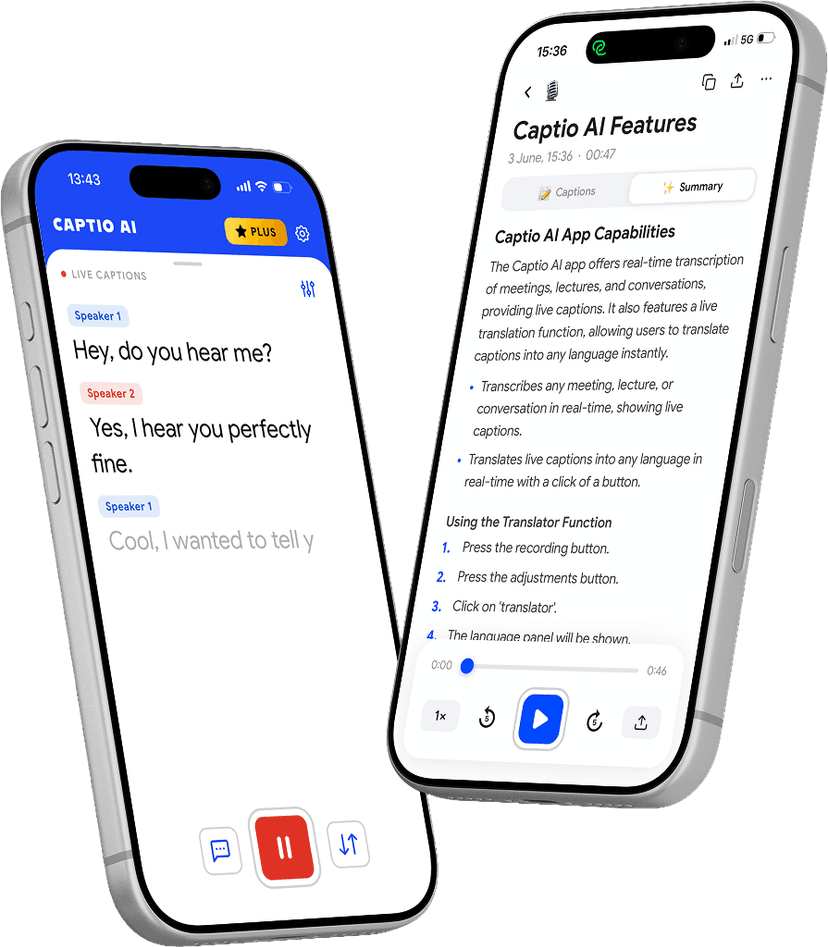
Everything you need to follow Japanese traveling
Four tools built for deaf and hard of hearing Japanese speakers.
Captions any spoken exchange, anywhere
- Airport staff, hotel receptionists, taxi drivers
- Real time, word by word, as they speak
- Works through travel noise and accents
- No setup — open the app and point it
No language barrier, anywhere in the world
- They speak their language — you read in yours
- 60+ languages, no manual switching
- For customs, hotels, restaurants, and local transport
- Translates in real time as they speak
Transcribe any recorded content
- Record a tour guide, a briefing, an important exchange
- Upload and get the full transcript to review
- Any language, any format
- Useful for travel information you want in writing
Key travel information extracted
- Instructions, directions, and key details from any transcript
- Organised into clear sections
- Useful after complex hotel check-ins or guided briefings
- Works on any saved recording
Download for free
Every situation covered
Designed for the real moments that matter — not just quiet controlled environments.
At Narita, Haneda, or Kansai International, gate changes and boarding calls come in Japanese at speed. Captio AI captions every announcement so you never miss a boarding call or a last-minute gate change.
Japan Rail's Shinkansen and local lines announce stations and platform changes in Japanese PA. Captio AI captions ticket window conversations and onboard station announcements so you get off at the right stop.
A hotel receptionist in Tokyo or Kyoto explaining room details, amenities, and local tips in formal Japanese. Place Captio AI on the desk and follow every word of the check-in without asking for repeats.
Asking for directions in Tokyo's backstreets or navigating Kyoto's temple districts. Fast, polite Japanese — Captio AI captions in real time so you understand the first time.
Japanese immigration and customs officers at international arrivals speak formally and precisely. Captio AI captions every question so you respond accurately and confidently.
A guide at Senso-ji, Fushimi Inari, or the Tokyo Skytree delivering Japanese commentary. Captio AI captions so you follow the full story behind every site.
Most accurate and fastest models
character accuracy
independent benchmark, 2025
real-time captions
first word appears as you speak
Download for free
Built for a world that announces everything by sound
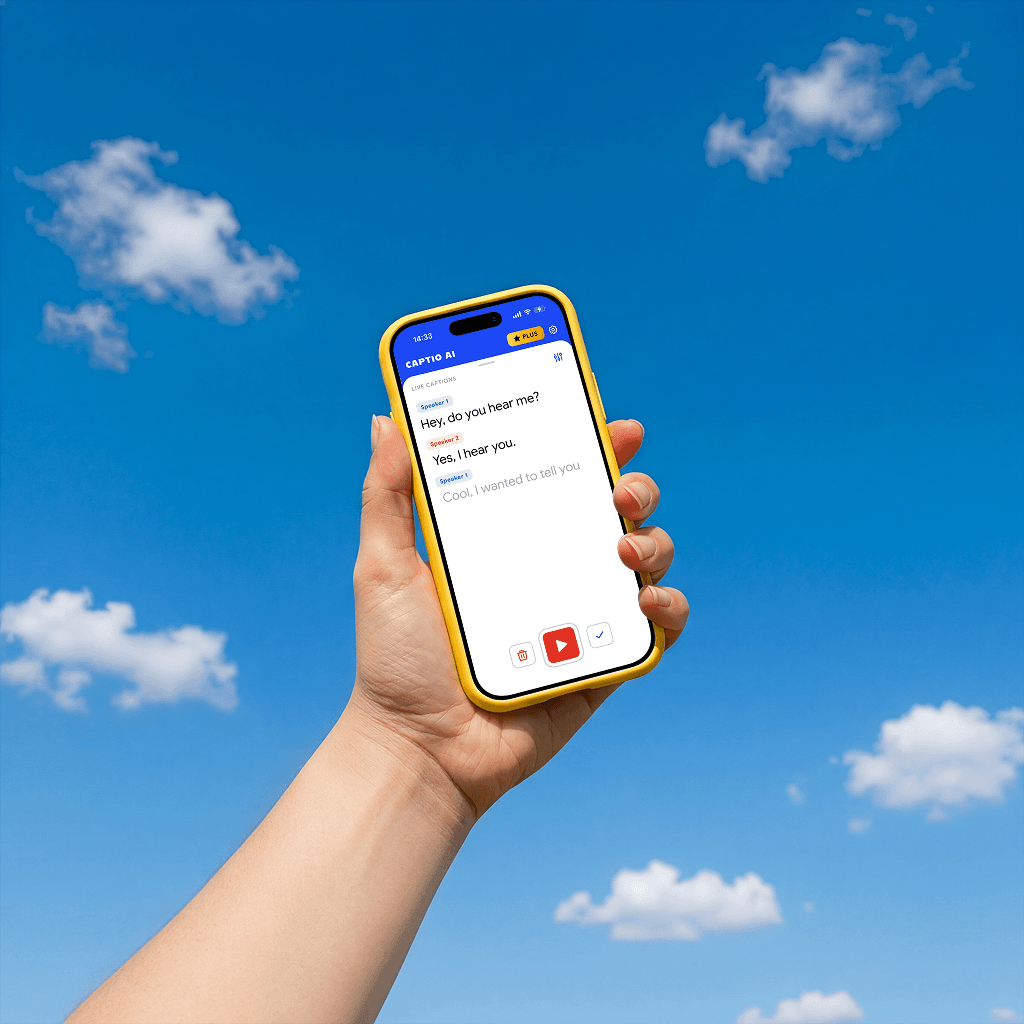
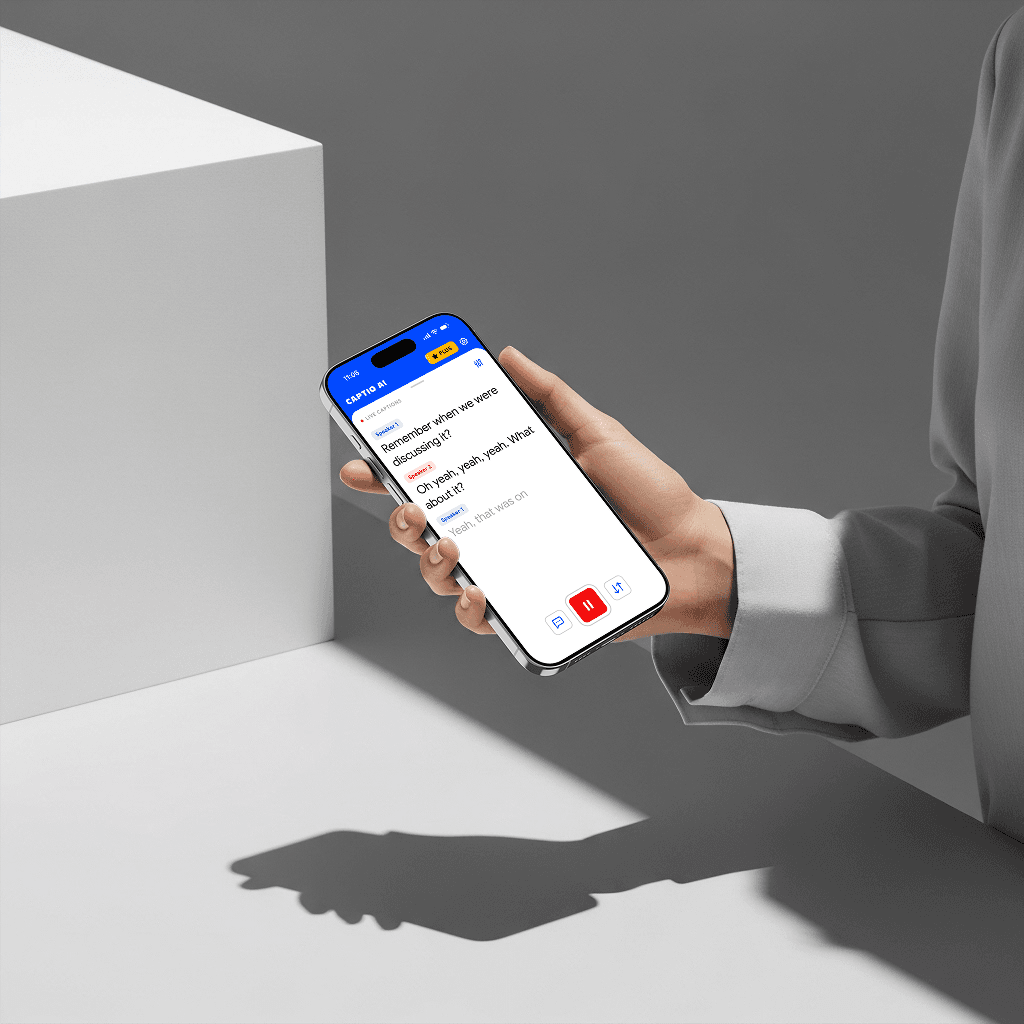
Captions any spoken exchange in real time
Airport staff, hotel receptionists, taxi drivers, tour guides. Hold the phone toward whoever is speaking and read the captions — in any setting, in any country.
60+ languages — no language barrier
Live Translator captions and translates in real time. They speak their language — you read in yours. For every country, every language, no manual setup between interactions.
Works anywhere with a data connection
Wi-Fi or mobile data. A local SIM or roaming plan keeps Captio AI running in any country — airports, hotels, rural areas, and everywhere in between.
Handles travel environments
Noisy airports, busy stations, echoing hotel lobbies. Captio AI is built for real environments — not quiet controlled rooms. It captions through the ambient noise of travel.
Discreet in any public setting
Hold the phone or place it near the speaker. Captio AI runs quietly and draws no attention — useful in customs, immigration, and any formal travel interaction where discretion matters.
Private by default
Travel conversations — customs declarations, hotel bookings, personal exchanges — are never stored or shared. Audio is processed in real time and discarded immediately.
Why Japanese is hard to understand
Minimal lip movement
- Japanese speakers move their lips less than almost any other language
- Research confirms that native Japanese speakers are actually less aided by visual lip cues than speakers of other languages — and show delayed comprehension when lip movement is added. At a Shinkansen ticket window or a hotel desk in Kyoto, a deaf traveler faces a speaker whose lips give almost no useful phonemic signal, even in ideal lighting conditions.
Vowel devoicing
- Vowels disappear between voiceless consonants
- Japanese /i/ and /u/ are regularly devoiced or deleted between voiceless consonants. 'Suki' (like) sounds like 'ski', 'desu' sounds like 'des'. At an airport counter or a customs desk, common words and phrases lose visible vowel segments that a deaf traveler would expect to see on the lips.
Pitch accent
- Meaning carried by pitch — invisible on the lips
- Standard Tokyo Japanese uses a pitch accent system where words differ only by high-low pitch pattern. 'Hashi' can mean bridge, chopsticks, or edge depending solely on which mora are high-pitched. At a hotel check-in or a train station counter, this tonal meaning is entirely invisible to a deaf traveler reading lips.
Kanto-Kansai divide
- Tokyo and Osaka Japanese sound different on every level
- The Kansai dialect (Osaka, Kyoto, Kobe) has a different pitch accent system, different vocabulary, and faster pace than standard Tokyo Japanese. A deaf traveler calibrated to NHK-standard Japanese arrives in Osaka to find hotel staff and station workers using a substantially different prosody and lexicon on the same lips.
Long vowels and geminates
- Phonemic length distinctions invisible at the lips
- Japanese distinguishes long from short vowels (ojisan/ojiisan — uncle/grandfather) and single from geminate consonants (kite/kitte — come/stamp). These distinctions are entirely phonemic and are what separates words at a ticket counter or pharmacy — but they produce no visible difference on a speaker's lips.
Download for free
Hearing loss and travel accessibility in Japan
Japan faces an acute and growing hearing loss burden driven by its ageing population. Data from the Ningen Dock comprehensive health checkup system, published in 2024, found that the prevalence of bilateral high-frequency hearing loss reached 46.5% in males and 20.2% in females in their 70s — sharply higher than in the 60s. Japan's population is among the world's oldest, with nearly a third of its 125 million people aged 65 or older as of 2023. The IFA's 2025 report on ear and hearing in Japan notes the growing pressure this demographic shift is placing on audiological and disability support systems.
Japan's travel infrastructure — the world's most punctual railway network, including the Shinkansen and urban metro systems — communicates critical information primarily through spoken Japanese PA announcements. While visual displays exist at major JR stations and airports, real-time spoken updates (platform changes, service disruptions, boarding zone changes) are delivered by PA and may not appear simultaneously or completely on visual boards. At JR Tokyo Station — one of the busiest in the world — deaf and hard of hearing travelers navigating simultaneous Shinkansen departures from multiple tracks must follow a PA system that delivers information in Japanese at pace.
Captio AI captions Japanese speech in real time — whether a Shinkansen station PA, a customs officer at Narita, or a hotel receptionist in Kyoto — so a deaf traveler in Japan follows every announcement and exchange without relying on audio infrastructure built without them in mind.
Download for free
What you hear stays with you.
Gone the moment it ends
Captio AI processes your audio in real time and discards it immediately. Nothing is recorded. Nothing is kept.
Not a product
Your conversations are not something Captio AI sells, shares, or monetizes — to anyone, for any reason.
Not used to train anything
What you say in a doctor's appointment or a job interview never ends up in a training dataset. Not ours. Not anyone else's.

Private by default
Captio AI supports 60+ languages
Download for free
Frequently asked questions
Navigate confidently in Japanese.
Captio AI is free to start
Download for free