

What are sound descriptions in captions? SDH rules explained
Sound descriptions like [door slams] tell deaf viewers what they cannot hear. The FCC, DCMP and Netflix rules side by side, and which live apps show them.
 Nate from Captio AI7 min read
Short answer
Sound descriptions are short notes in captions, usually in brackets like [door slams], that tell deaf and hard of hearing viewers about sounds that are not speech. US television captions must cover the existence of music, sound effects and audience reaction under 47 CFR 79.1 [3]. The Described and Captioned Media Program says to caption a sound when it is needed to understand or enjoy the media [1].
4 standards3
US television captions must be accurate, synchronous, complete and appropriately placed under FCC rules
5 seconds1
background music shorter than this is not captioned under the Captioning Key
6 sounds7
named in the Captio AI 1.1.5 release notes: doorbell, alarm, crying baby, barking dog, laughter and music
On this page
- What is a sound description in captions?
- What is the difference between SDH, closed captions and subtitles?
- What do US rules require for sound and music in captions?
- How do the DCMP and Netflix rules compare?
- Why does the verb tense of a sound description matter?
- Do live captioning tools describe sounds?
- Where do sound descriptions help in TV, lectures and everyday life?
- What are the limits of sound descriptions?
Sound descriptions are the short notes inside captions that tell you what you cannot hear: a door slams, music plays, an audience laughs. Captions that include them are often called SDH, subtitles for the deaf and hard of hearing. This explainer covers the rules that TV and streaming captioners follow, how they differ, and which live captioning tools write sounds into the text of a conversation today.
What is a sound description in captions?
A sound description is a note in the caption text, usually in brackets, that names a sound other than speech, such as [door slams] or [applause]. The Captioning Key from the Described and Captioned Media Program (DCMP) defines sound effects as "sounds other than music, narration, or dialogue"1. It says they are captioned "if it is necessary for the understanding and/or enjoyment of the media"1.
Without them, a caption file only carries the words. A hearing viewer also hears the phone ring before a character answers it. A sound description gives that cue to a deaf viewer in the same moment.
What is the difference between SDH, closed captions and subtitles?
SDH subtitles are subtitles with extra information for deaf and hard of hearing viewers, while plain subtitles cover only spoken words. The captioning company Verbit says subtitles "are designed for hearing users", and that SDH adds "speaker tags, sound effects and other elements outside of speech"9. It describes closed captions as typically white text on a black background, which sets them apart from SDH9.
The words vary by country, and this is a vendor's explanation, not a standard. In the US, TV rules use the term closed captioning3. The sound rules in the next sections apply whatever you call the file.
What do US rules require for sound and music in captions?
US television captions must include music, sound effects and audience reaction to the greatest extent possible. The FCC rule at 47 CFR 79.1 says captioning "shall provide nonverbal information that is not observable, such as the identity of speakers", and covers "the existence of music" (with or without lyrics), sound effects and audience reaction3.
The same rule sets four quality standards: captions must be accurate, synchronous, complete and appropriately placed3. Synchronous means captions "shall begin to appear at the time that the corresponding speech or sounds begin"3. A [door slams] that appears two seconds late is a quality problem, not only a style problem.
This is a rule for television programming in the US. It does not tell a theatre, a lecture hall or a doctor's office what to do. For those, the Americans with Disabilities Act (ADA) asks for "effective communication", and ADA.gov lists open captioning, closed captioning and real-time captioning (CART) among the aids and services8.
How do the DCMP and Netflix rules compare?
The DCMP Captioning Key and Netflix's English style guide agree on brackets and lower case, and disagree on italics. The table sets the two side by side for the points that change what you see on screen.
| Question | DCMP Captioning Key | Netflix English style guide |
|---|---|---|
| When is a sound captioned? | When necessary for understanding or enjoyment; background sounds only when essential to the plot1 | Plot-pertinent sound effects always, unless the visuals make them clear; only when the sound cannot be visually identified2 |
| Format | In brackets, including the source of the sound1 | Brackets around speaker IDs or sound effects2 |
| Case | Lower case1 | All lower case except proper nouns2 |
| Source of the sound | May be left out if clearly visible on screen1 | Describe the sound, not the visual action2 |
| Italics | Off-screen sound effects italicised, if italics are available1 | Never italicise sound effects, even in a voice-over2 |
| Background music | Bracketed description when essential; music shorter than 5 seconds is not captioned1 | Not covered in the sections reviewed2 |
| Song lyrics | Caption lyrics verbatim1 | Enclosed in a music note (♪) at the start and end of each subtitle2 |
| Tense | Present tense only1 | No tense rule found in the sections reviewed2 |
Two rules from the DCMP matter for readers. Use specific words rather than vague ones, and avoid subjective words such as "beautiful" or "melodic" when describing music, so the note tells you the mood without giving an opinion1. And caption background sound "only when they are essential to the plot"1.
Why does the verb tense of a sound description matter?
Sound descriptions use the present tense because captions run in step with the sound. The Captioning Key says: "Never use the past tense when describing sounds"1. It asks for the present participle for a sustained sound (a phone ringing) and the third person verb for an abrupt one (a door slams)1.
For a deaf viewer this is practical. [phone rings] tells you the sound is happening now and you may want to look up. [phone rang] would suggest you already missed it.
Do live captioning tools describe sounds?
Some do, some do not, and the settings differ. The table lists what each tool's own page says. Sound labels in live tools are an extra layer on top of speech, and none of the pages read promises that every sound is caught.
| Captio AI (iPhone, 1.1.5) | Google Live Caption (Android) | Google Live Transcribe (Android) | Apple Live Captions (iPhone) | |
|---|---|---|---|---|
| Sounds in the caption text | Doorbell, alarm, crying baby, barking dog, laughter, music, like [doorbell rings]7 | Optional labels for sounds like laughter, applause and music; the same page also says it "doesn't work on music"4 | Labels such as "Laughing", "Doorbell" and "Music"5 | Not stated on the page; described as transcriptions of conversations6 |
| How to switch it | Settings, Recognize sounds7 | The "Show sound labels" setting4 | Settings, Additional settings, Show sound labels5 | Not applicable |
| Alert for sounds | The phone vibrates for alerts7 | Not stated | Not stated | Separate Sound Recognition notifies you for 15 sounds6 |
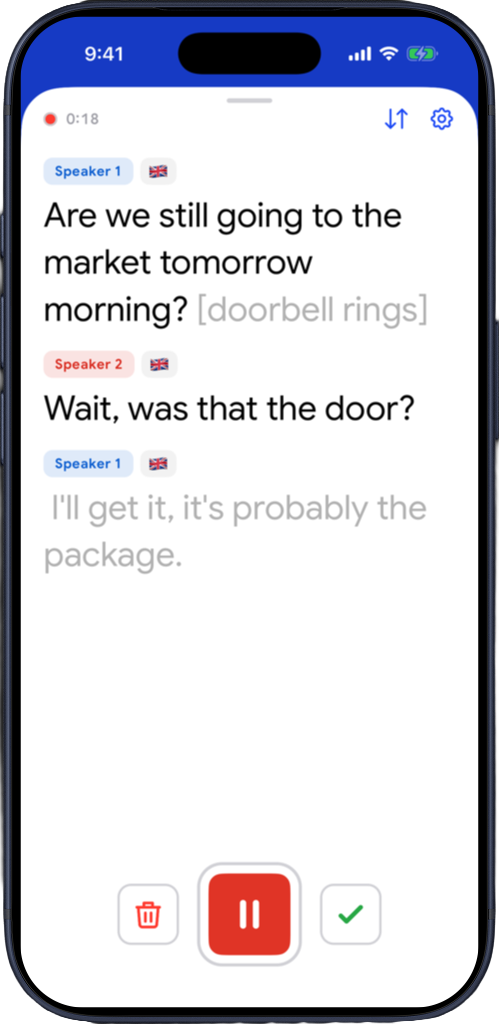
Captio AI, a live captioning app for deaf and hard of hearing people, writes the sound inside the captions of a conversation. Its release notes show the bracket style the TV rules use, [doorbell rings], in the present tense7. Google's pages are the better choice when you use Android, and Apple's Sound Recognition is the better choice when you want an alert with no captions running456. The release notes do not give a full list of sounds or accuracy figures for Captio AI, so test the sounds that matter to you.
Where do sound descriptions help in TV, lectures and everyday life?
Sound descriptions matter most where a sound changes what the words mean. These are the settings the sources support:
- TV and media in the US: the FCC rule requires music, sound effects and audience reaction in captions to the greatest extent possible3. See TV and media.
- Streaming in English: Netflix's style guide asks for plot-pertinent sound effects, unless the picture makes them clear2.
- Lectures and conferences: CART is one of the aids ADA.gov names for effective communication8. The sources read do not say whether CART captioners write laughter or applause. See lectures and conferences.
- Everyday conversations at home: Captio AI 1.1.5 shows a doorbell or an alarm in live captions next to the words7. See everyday conversations.
- Restaurants and group settings: Captio AI 1.1.5 lists laughter and music among the sounds it writes into live captions7. See restaurants and group settings.
What are the limits of sound descriptions?
A sound description is a short note chosen by a person or a program, so it can miss a sound or name the wrong one. TV rules ask for sounds "to the greatest extent possible" and the DCMP asks for judgement about which sounds matter13. Live tools add a second limit: they decide in real time, with no editor.
A caption is also not a safety alarm. For a smoke alarm or a fire, use a device made for deaf and hard of hearing people. For how Captio AI compares with Apple and Android alerts, read how to see a doorbell, alarm or crying baby in live captions. To see who is speaking as well, read how to see who is talking in live captions.
Start Live Captions when you want speech and sounds in one place. Captio AI is for in-person speech. It does not caption phone calls.

Read what people say, while they say it
Captio AI puts live captions on your phone for conversations, appointments, lectures and meetings, in 60+ languages. Free to start. Private by default.
Frequently asked questions
What does SDH mean on a streaming service in the US?
SDH stands for subtitles for the deaf and hard of hearing. They add what a hearing viewer gets from sound: speaker tags and sound effects [9]. Netflix's English style guide, for example, has a rule for speaker IDs and sound effects [2].
Are closed captions and SDH subtitles the same thing on TV and media?
Not exactly. A captioning company, Verbit, says closed captions are typically white text on a black background, while SDH adds speaker tags and sound effects to subtitles [9]. Both are made for deaf and hard of hearing viewers. Plain subtitles cover only spoken words [9].
Do US television captions have to describe music and sound effects?
Yes, to the greatest extent possible. The FCC rule in 47 CFR 79.1 says captioning shall provide nonverbal information that is not observable, such as the identity of speakers, the existence of music, sound effects and audience reaction [3].
Should a sound description on TV captions be in the present or past tense?
Present tense. The Captioning Key says never to use the past tense for sounds, because captions are synchronised with the sound. It uses the present participle for a sustained sound and the third person verb for an abrupt one [1].
Do captions in a lecture or conference show laughter and applause?
The sources read do not say. In US law, real-time captioning (CART) is one of the aids that can give effective communication at an event [8], but ADA.gov does not say whether captioners write laughter. Google's Live Caption has an optional setting for sound labels such as laughter and applause [4].
Does Captio AI describe sounds for a family dinner or a restaurant?
Captio AI 1.1.5 on iPhone shows laughter and music among the sounds in its captions, written like [doorbell rings] [7]. At a family dinner or in a restaurant that puts the sound next to the words. The release notes give no accuracy figures.
Do Apple's Live Captions describe sounds in a conversation at home on iPhone?
Apple describes Live Captions as real-time, on-device transcriptions of conversations [6]. The page does not say they include sound descriptions. Sound Recognition is a separate feature that notifies you when it hears one of 15 sounds [6].
Sources
- 1Captioning Key: Sound effects and musicDescribed and Captioned Media Program (DCMP), 2026
- 2English Timed Text Style GuideNetflix Partner Help Center, 2026
- 347 CFR 79.1 Closed captioning of video programmingLegal Information Institute, Cornell Law School, 2026
- 4Use Live Caption on your Android deviceGoogle Accessibility Help, 2026
- 5Get started with Live TranscribeGoogle Accessibility Help, 2026
- 6Accessibility: Hearing featuresApple, 2026
- 7Captio AI: Live Captions & Transcription (version 1.1.5 release notes)Apple App Store, 2026
- 8Effective CommunicationADA.gov, US Department of Justice, 2026
- 9The differences between subtitles, closed captions and SDHVerbit, 2026
Written by Nate from Captio AI. Published 31 October 2026. Every figure on this page links to its source. Spotted a mistake? hello@captioai.app