

Thai live captions and productivity tool for traveling
For deaf and hard of hearing people.
Download for free


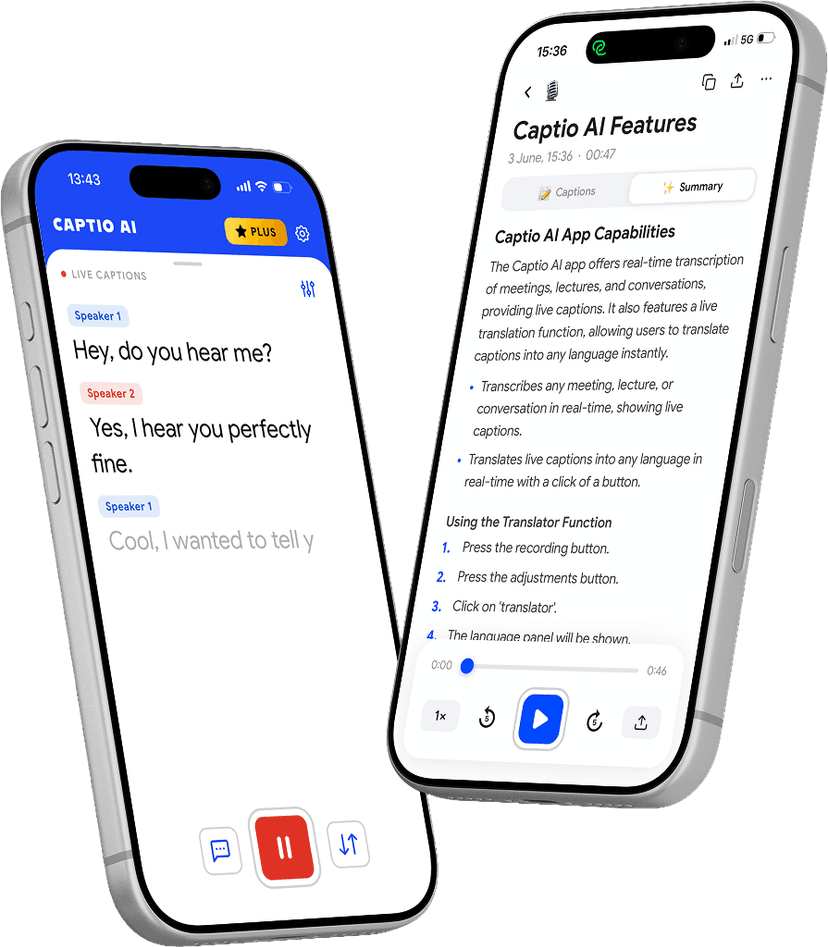
Everything you need to follow Thai traveling
Four tools built for deaf and hard of hearing Thai speakers.
Captions any spoken exchange, anywhere
- Airport staff, hotel receptionists, taxi drivers
- Real time, word by word, as they speak
- Works through travel noise and accents
- No setup — open the app and point it
No language barrier, anywhere in the world
- They speak their language — you read in yours
- 60+ languages, no manual switching
- For customs, hotels, restaurants, and local transport
- Translates in real time as they speak
Transcribe any recorded content
- Record a tour guide, a briefing, an important exchange
- Upload and get the full transcript to review
- Any language, any format
- Useful for travel information you want in writing
Key travel information extracted
- Instructions, directions, and key details from any transcript
- Organised into clear sections
- Useful after complex hotel check-ins or guided briefings
- Works on any saved recording
Download for free
Every situation covered
Designed for the real moments that matter — not just quiet controlled environments.
Gate changes and boarding calls at Suvarnabhumi (BKK) or Don Mueang (DMK) arrive in Thai and English. Captio AI captions both languages in real time so you catch every gate number and boarding instruction without missing a departure.
The BTS Skytrain and MRT in Bangkok announce stations in Thai. At Hua Lamphong railway station or Mor Chit bus terminal, Captio AI captions the ticket window exchange and platform announcement so you find the right service.
A hotel receptionist in Bangkok or Chiang Mai explaining room details, spa schedules, and local tips in Thai. Place Captio AI on the desk and follow every word of the check-in conversation without asking for repeats.
Asking for directions in Bangkok's old city near Wat Pho or navigating Chiang Mai's Night Bazaar on foot. Fast Thai from locals and tuk-tuk drivers — Captio AI captions their reply so you understand the first time.
Thai immigration and customs officers at Suvarnabhumi or land crossings at Nong Khai or Mae Sai speak quickly in formal Thai. Captio AI captions every question so you respond accurately and confidently.
A guide at the Grand Palace, Wat Phra Kaew, or the Ayutthaya Historical Park delivering Thai commentary on royal and Buddhist history. Captio AI captions in real time so you follow every detail.
Most accurate and fastest models
character accuracy
independent benchmark, 2025
real-time captions
first word appears as you speak
Download for free


Built for a world that announces everything by sound
Captions any spoken exchange in real time
Airport staff, hotel receptionists, taxi drivers, tour guides. Hold the phone toward whoever is speaking and read the captions — in any setting, in any country.
60+ languages — no language barrier
Live Translator captions and translates in real time. They speak their language — you read in yours. For every country, every language, no manual setup between interactions.
Works anywhere with a data connection
Wi-Fi or mobile data. A local SIM or roaming plan keeps Captio AI running in any country — airports, hotels, rural areas, and everywhere in between.
Handles travel environments
Noisy airports, busy stations, echoing hotel lobbies. Captio AI is built for real environments — not quiet controlled rooms. It captions through the ambient noise of travel.
Discreet in any public setting
Hold the phone or place it near the speaker. Captio AI runs quietly and draws no attention — useful in customs, immigration, and any formal travel interaction where discretion matters.
Private by default
Travel conversations — customs declarations, hotel bookings, personal exchanges — are never stored or shared. Audio is processed in real time and discarded immediately.
Why Thai is hard to understand
Five tones — all in the larynx
- Thai's five lexical tones are carried by pitch and phonation — nothing on the lips
- Thai has five tones (mid, low, falling, high, rising) determined entirely by pitch contour and phonation type — breathy or creaky voice versus modal voice. At Suvarnabhumi Airport check-in or a hotel desk in Bangkok, two syllables with identical lip and jaw positions are entirely different words depending only on the larynx. The information that distinguishes most Thai vocabulary is invisible in face-to-face communication — a deaf traveler sees indistinguishable lip movements for words that sound completely different.
Unreleased final stops
- Final consonants are held but never released — invisible to a lip-reader
- Thai consonants in final syllable position are never audibly or visibly released. A ticket counter agent at Hua Lamphong train station in Bangkok or an agent at Don Mueang Airport does not push through the final -p, -t, -k — the stop is closed and held, not released. A deaf traveler reading lips sees a word that appears to end in a vowel when it actually ends in a consonant, making dozens of common travel words ambiguous.
High homophony across tones
- Many Thai words look identical on the lips and differ only by tone
- Thai has a high degree of homophony between tone groups: words meaning 'near,' 'far,' 'come,' and 'wood' or 'new,' 'burn,' and 'silk' can share the same consonant-vowel frame and differ only in tone. A deaf traveler asking directions in Phuket Old Town or trying to understand a destination announcement in Chiang Mai Old City faces a situation where the most visually accessible features of speech — lip and jaw movements — tell them almost nothing about which word was just said.
Northern Thai tone system
- Chiang Mai's Kham Mueang has a different tone system from Bangkok Thai
- Standard Thai (Bangkok) has 5 tones, but Northern Thai — Kham Mueang, the language of Chiang Mai — has 6 tones with a different distribution and different realizations. Southern Thai has yet another 5-tone system distinct from Bangkok Thai. A deaf traveler who calibrated to Bangkok Thai arrives in Chiang Mai to encounter a staff member at Chiang Mai International Airport using different tonal phonology — and the visual signal gives no indication the system has changed.
Fast casual speech reduction
- Initial consonants in unstressed syllables delete in fast Bangkok Thai
- In natural fast Bangkok Thai — the variety heard from a tuk-tuk driver in Rattanakosin or a vendor at Chatuchak Weekend Market — the initial consonants of low-stress syllables reduce or delete. A deaf traveler prepared from textbook Thai resources or slow learner-directed speech encounters a reduced phonological form at every real-world travel exchange where the pace of conversation is not adjusted for them.
Download for free
Hearing loss and travel accessibility in Thailand
A Bangkok population health survey (2024) found that hearing loss affects 53.02% of the Bangkok population when all degrees of impairment are included, rising steeply with age — from 1.67% at age 15 to 96.33% at age 75. The prevalence of moderate or greater hearing impairment — the threshold at which daily communication is substantially disrupted — was 2.8%. A national cohort study of 87,134 Thai adults found that 8.5% reported trouble hearing and 0.13% identified as deaf. Critically, Thailand still lacks a reliable national estimate of hearing loss prevalence, which has directly hampered the development of national hearing health policy, according to the same Bangkok survey.
Access to hearing aids in Thailand remains limited: a 2019 survey found that only 9% of Thai adults aged 40–69 with hearing loss had adopted hearing aids. Thailand's national health system made a significant policy step in July 2022, when the National Health Security Board included newborn hearing screening in the Universal Coverage Scheme, meaning every Thai newborn is now eligible for free early screening. However, adult hearing rehabilitation — including hearing aid access and communication support in public infrastructure — lags behind. Thailand's major tourist infrastructure (Suvarnabhumi Airport, the BTS Skytrain, Hua Lamphong train station, and the Chao Phraya Express Boat) communicates critical travel information through spoken Thai PA with no standard real-time captioning for deaf or hard of hearing travelers.
Captio AI captions Thai in real time — whether a boarding call at Suvarnabhumi, a BTS station announcement, or a guide at Wat Phra Kaew — so a deaf traveler in Thailand follows every instruction and announcement without depending on audio infrastructure that was not built with them in mind.
Download for free
What you hear stays with you.
Gone the moment it ends
Captio AI processes your audio in real time and discards it immediately. Nothing is recorded. Nothing is kept.
Not a product
Your conversations are not something Captio AI sells, shares, or monetizes — to anyone, for any reason.
Not used to train anything
What you say in a doctor's appointment or a job interview never ends up in a training dataset. Not ours. Not anyone else's.

Private by default
Captio AI supports 60+ languages
Download for free
Frequently asked questions
Navigate confidently in Thai.
Captio AI is free to start
Download for free