

Afrikaans live captions and productivity tool for traveling
For deaf and hard of hearing people.
Download for free


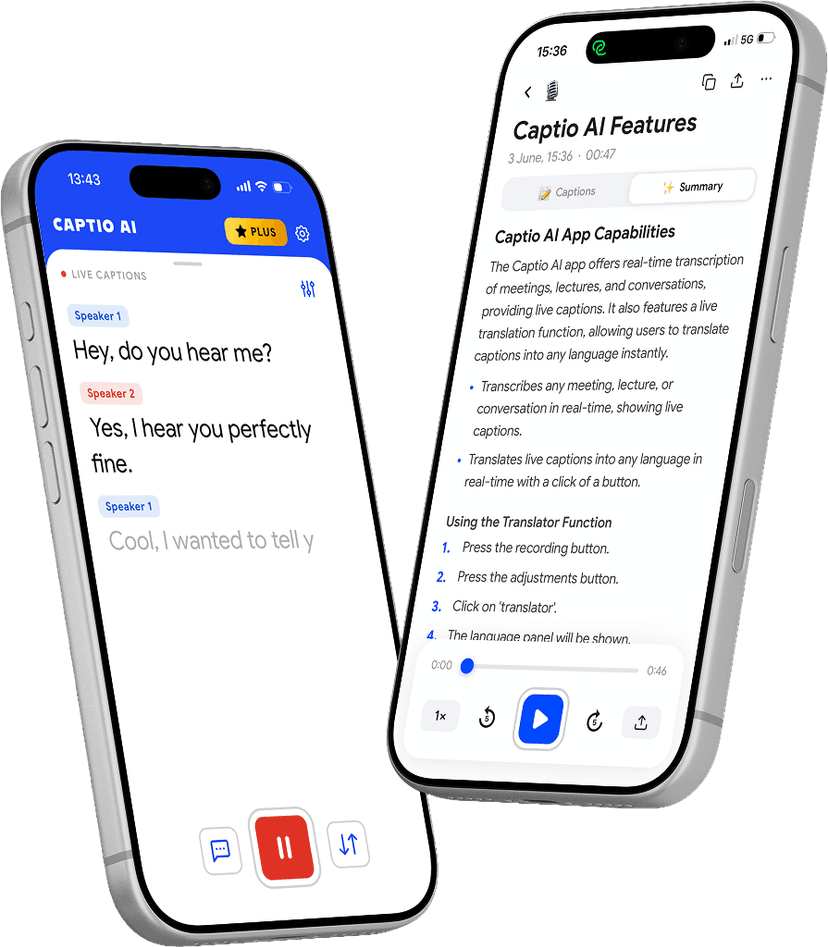
Everything you need to follow Afrikaans traveling
Four tools built for deaf and hard of hearing Afrikaans speakers.
Captions any spoken exchange, anywhere
- Airport staff, hotel receptionists, taxi drivers
- Real time, word by word, as they speak
- Works through travel noise and accents
- No setup — open the app and point it
No language barrier, anywhere in the world
- They speak their language — you read in yours
- 60+ languages, no manual switching
- For customs, hotels, restaurants, and local transport
- Translates in real time as they speak
Transcribe any recorded content
- Record a tour guide, a briefing, an important exchange
- Upload and get the full transcript to review
- Any language, any format
- Useful for travel information you want in writing
Key travel information extracted
- Instructions, directions, and key details from any transcript
- Organised into clear sections
- Useful after complex hotel check-ins or guided briefings
- Works on any saved recording
Download for free
Every situation covered
Designed for the real moments that matter — not just quiet controlled environments.
Gate changes and boarding calls at Cape Town International Airport (CPT) or George Airport come in Afrikaans and English. Captio AI captions both languages so you catch gate numbers and boarding times without missing a departure.
Metrorail's Southern Line and Cape Metro trains announce stops in Afrikaans and English. At Cape Town station or Stellenbosch station, Captio AI captions the ticket window exchange and PA in real time.
A hotel receptionist in Cape Town's City Bowl or in a Stellenbosch wine estate guesthouse explaining check-in details in Afrikaans. Place Captio AI on the desk and follow the full conversation without asking for anything repeated.
Asking for directions in the Cape Winelands or navigating the Garden Route. Fast Afrikaans from locals and farmstay hosts — Captio AI captions their reply so you find your way.
South African customs and border officials at Cape Town International may speak Afrikaans. Captio AI captions every question so you respond accurately and confidently.
A guide at the Cape Winelands, the Cango Caves in Oudtshoorn, or the West Coast National Park delivering Afrikaans commentary on Cape flora and Boer history. Captio AI captions in real time.
Most accurate and fastest models
word accuracy
independent benchmark, 2025
real-time captions
first word appears as you speak
Download for free
Built for a world that announces everything by sound
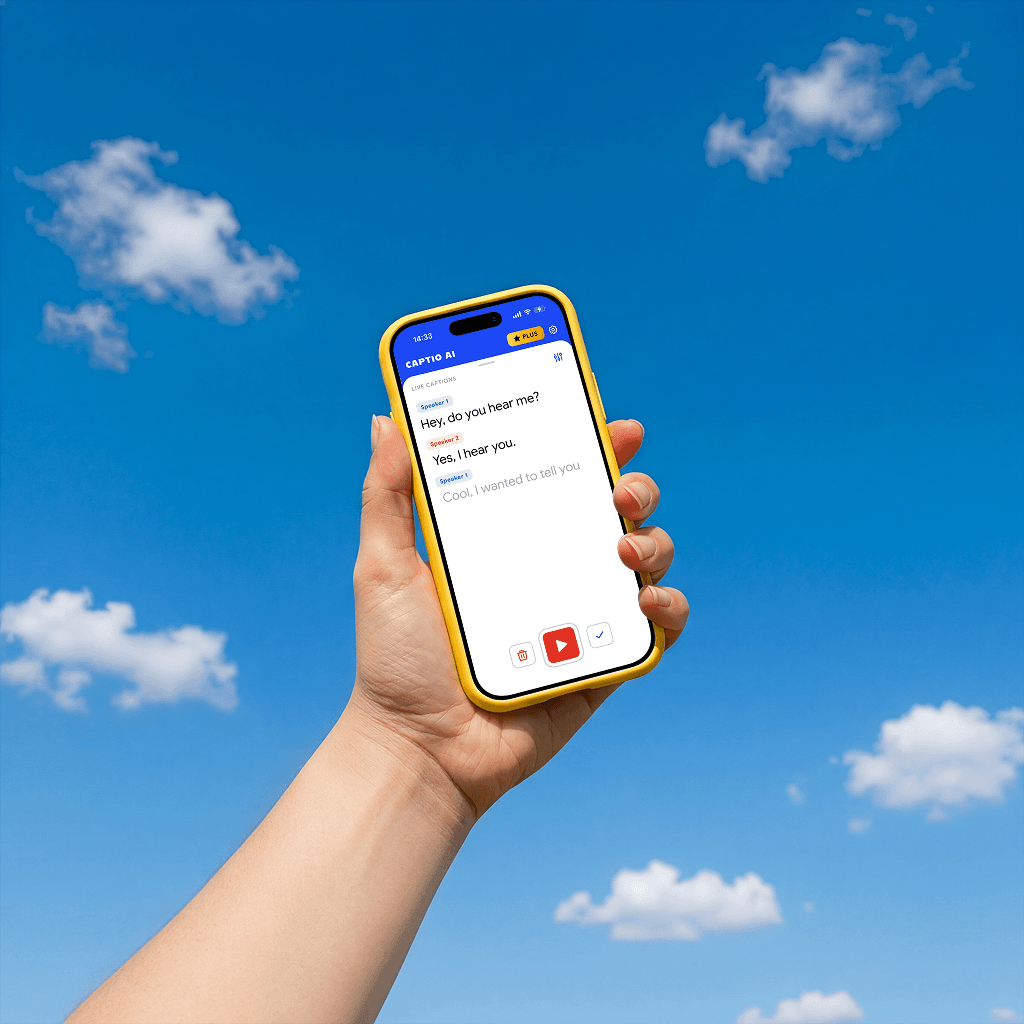
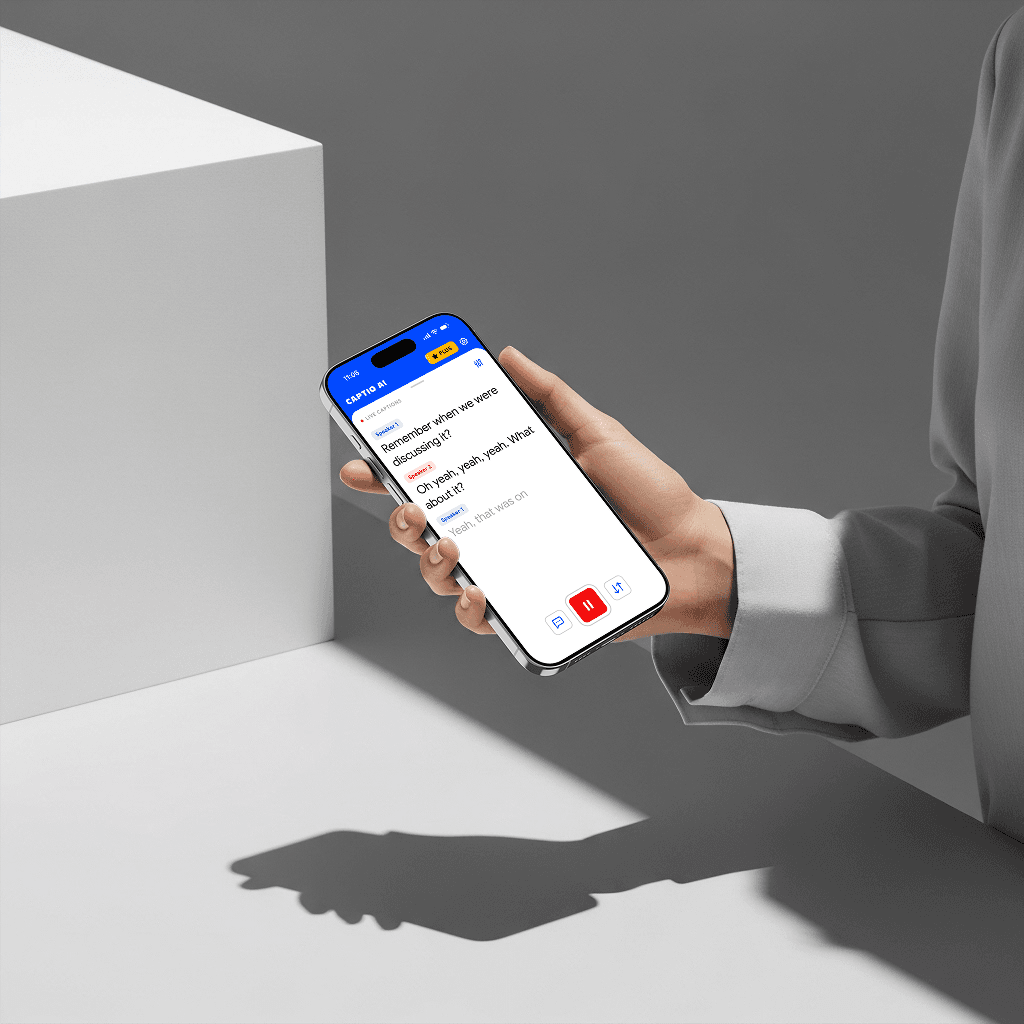
Captions any spoken exchange in real time
Airport staff, hotel receptionists, taxi drivers, tour guides. Hold the phone toward whoever is speaking and read the captions — in any setting, in any country.
60+ languages — no language barrier
Live Translator captions and translates in real time. They speak their language — you read in yours. For every country, every language, no manual setup between interactions.
Works anywhere with a data connection
Wi-Fi or mobile data. A local SIM or roaming plan keeps Captio AI running in any country — airports, hotels, rural areas, and everywhere in between.
Handles travel environments
Noisy airports, busy stations, echoing hotel lobbies. Captio AI is built for real environments — not quiet controlled rooms. It captions through the ambient noise of travel.
Discreet in any public setting
Hold the phone or place it near the speaker. Captio AI runs quietly and draws no attention — useful in customs, immigration, and any formal travel interaction where discretion matters.
Private by default
Travel conversations — customs declarations, hotel bookings, personal exchanges — are never stored or shared. Audio is processed in real time and discarded immediately.
Why Afrikaans is hard to understand
Uvular R
- Cape Afrikaans's uvular r is produced deep in the throat — invisible on the lips
- Many Afrikaans speakers — particularly in Cape Town and the Western Cape — use a uvular r (produced at the uvula or soft palate) rather than the alveolar or trilled r of some other varieties. This uvular sound is produced entirely at the back of the vocal tract with no visible lip or jaw movement. At Cape Town International Airport or a Stellenbosch wine estate, a Cape Afrikaans speaker's r produces nothing visible on their face that corresponds to the consonant — a deaf traveler reading lips sees a vowel where a consonant has just occurred.
Velar/uvular fricative /x/
- Afrikaans /x/ — the g sound in 'nag' and 'ag' — is produced at the throat
- Afrikaans has the voiceless velar or uvular fricative /x/ (written g or ch) in many common words. This sound — produced at the soft palate or uvula with no lip movement — appears throughout Afrikaans vocabulary including basic travel and service words. At a hotel counter in Paarl, a restaurant in Franschhoek, or a game reserve briefing in the Klein Karoo, this phoneme occurs in frequent words without producing any visual cue a deaf traveler can use.
Cape vs Standard Afrikaans vowels
- Cape Malay Afrikaans and Cape Coloured Afrikaans have diphthongized vowels different from standard
- Cape Afrikaans — spoken by much of Cape Town's Muslim Malay community and coloured community — has undergone significant vowel shifts and diphthongization relative to Standard Afrikaans. Many long monophthongs of standard Afrikaans become diphthongs in Cape varieties. A deaf traveler calibrated to standard Afrikaans encounters Cape Malay Afrikaans from a Cape Town guide or hotel worker and finds different vowel shapes on their lips from what standard preparation leads them to expect.
Afrikaans-English code-switching
- Western Cape speakers switch between Afrikaans and English mid-sentence
- In the Western Cape, Afrikaans and English are both dominant languages and speakers switch between them freely — sometimes within a single sentence. At Cape Town Airport, a Stellenbosch wine farm, or a Boulders Beach penguin colony entrance, a staff member may begin a sentence in Afrikaans and finish it in English (or vice versa). A deaf traveler reading Afrikaans lips must suddenly apply English phoneme mappings — with no visual transition.
Afrikaans-Zulu-Xhosa multilingual context
- South African service environments involve multiple languages at once
- South Africa has 11 official languages. In Cape Town, Afrikaans, English, and isiXhosa are all present. At Cape Town International or a Bo-Kaap neighbourhood restaurant, a staff member addressing different customers may switch between Afrikaans, English, and isiXhosa — three phonologically distinct languages — within a single conversation. A deaf traveler tracking Afrikaans lips encounters completely different phoneme sets arriving without linguistic transition signals.
Download for free
Hearing loss and travel accessibility in South Africa
Between 4 and 5 million people in South Africa have a hearing impairment, with hearing impairment ranking as the third most common disability in the country after visual and physical impairment. The National Council for Persons with Physical Disabilities in South Africa (NCPD) reports approximately 600,000 South African Sign Language (SASL) users and an estimated 124,000 people with total hearing loss. A rural study in Limpopo province found hearing impairment prevalence of 19.88% overall and 8.94% for disabling hearing impairment — substantially higher than urban figures. The 2011 census found 2.9% of the South African population over age 5 had mild-to-moderate hearing difficulty, and 0.7% experienced severe difficulty.
South Africa's Afrikaans-speaking population is concentrated primarily in the Western Cape and Northern Cape provinces. Cape Town International Airport is one of Africa's busiest gateways, with the Cape Winelands, Garden Route, and West Coast attracting several million domestic and international tourists per year. Travel infrastructure in Afrikaans-majority areas — Cape Town's MyCiTi bus network, Metrorail's Cape Metro, hotel and wine estate check-in desks — communicates in both Afrikaans and English, but without real-time captioning. South Africa recognized South African Sign Language as a constitutional right in a 2022 amendment, marking a significant step in national deaf rights — but this has not yet translated to real-time captioning of travel infrastructure.
Captio AI captions Afrikaans in real time — whether a boarding call at Cape Town International, a guide at the Stellenbosch wine estates, or a game ranger at a Karoo reserve — so a deaf traveler in South Africa's Afrikaans-speaking regions follows every instruction and question without depending on audio infrastructure built without them in mind.
Download for free
What you hear stays with you.
Gone the moment it ends
Captio AI processes your audio in real time and discards it immediately. Nothing is recorded. Nothing is kept.
Not a product
Your conversations are not something Captio AI sells, shares, or monetizes — to anyone, for any reason.
Not used to train anything
What you say in a doctor's appointment or a job interview never ends up in a training dataset. Not ours. Not anyone else's.

Private by default
Captio AI supports 60+ languages
Download for free
Frequently asked questions
Navigate confidently in Afrikaans.
Captio AI is free to start
Download for free