

Portuguese live captions and productivity tool for traveling
For deaf and hard of hearing people.
Download for free


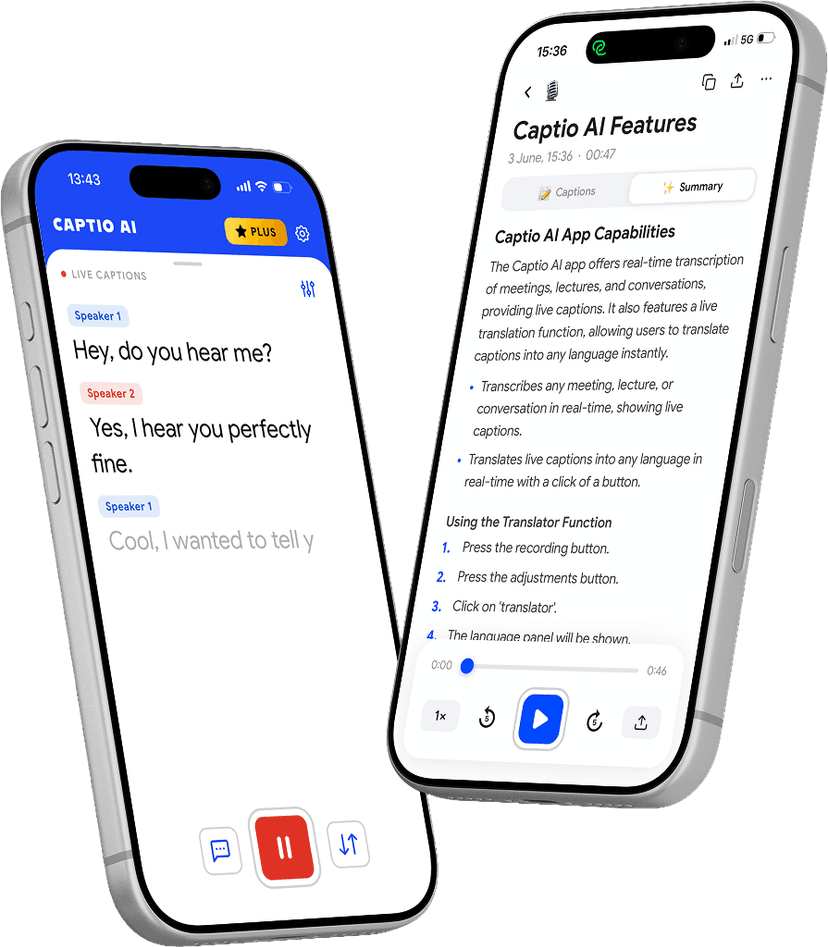
Everything you need to follow Portuguese traveling
Four tools built for deaf and hard of hearing Portuguese speakers.
Captions any spoken exchange, anywhere
- Airport staff, hotel receptionists, taxi drivers
- Real time, word by word, as they speak
- Works through travel noise and accents
- No setup — open the app and point it
No language barrier, anywhere in the world
- They speak their language — you read in yours
- 60+ languages, no manual switching
- For customs, hotels, restaurants, and local transport
- Translates in real time as they speak
Transcribe any recorded content
- Record a tour guide, a briefing, an important exchange
- Upload and get the full transcript to review
- Any language, any format
- Useful for travel information you want in writing
Key travel information extracted
- Instructions, directions, and key details from any transcript
- Organised into clear sections
- Useful after complex hotel check-ins or guided briefings
- Works on any saved recording
Download for free
Every situation covered
Designed for the real moments that matter — not just quiet controlled environments.
At GRU in São Paulo, Porto Airport, or Lisbon's Humberto Delgado, announcements come in Portuguese — fast Brazilian or heavily reduced European. Captio AI captions every gate change and boarding call.
The São Paulo Metro, CP trains in Portugal, or Rio's suburban rail announce platforms in Portuguese. Captio AI captions ticket counter conversations and PA announcements in real time.
A hotel receptionist in Lisbon or Rio explaining check-in details, room rules, and local recommendations. Captio AI captions the full conversation on the reception desk.
Asking for directions in Lisbon's Alfama district or a São Paulo neighborhood. Portuguese spoken at speed — European or Brazilian — Captio AI captions the answer in real time.
Customs and immigration officers at Brazilian or Portuguese airports speak quickly and formally. Captio AI captions every question so you answer accurately.
A guide at Lençóis Maranhenses, the Douro Valley, or the historic center of Évora delivering Portuguese commentary. Captio AI captions so you follow every word of the tour.
Most accurate and fastest models
word accuracy
independent benchmark, 2025
real-time captions
first word appears as you speak
Download for free
Built for a world that announces everything by sound
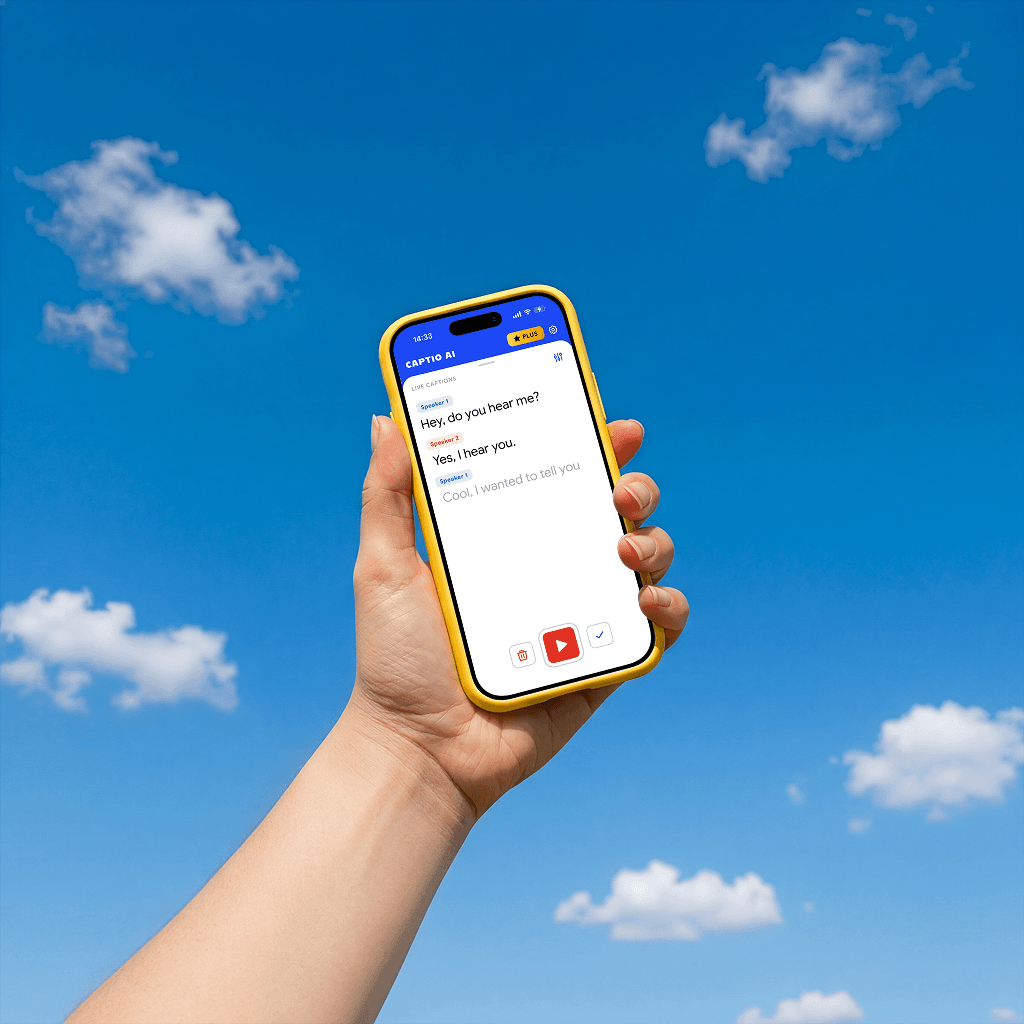
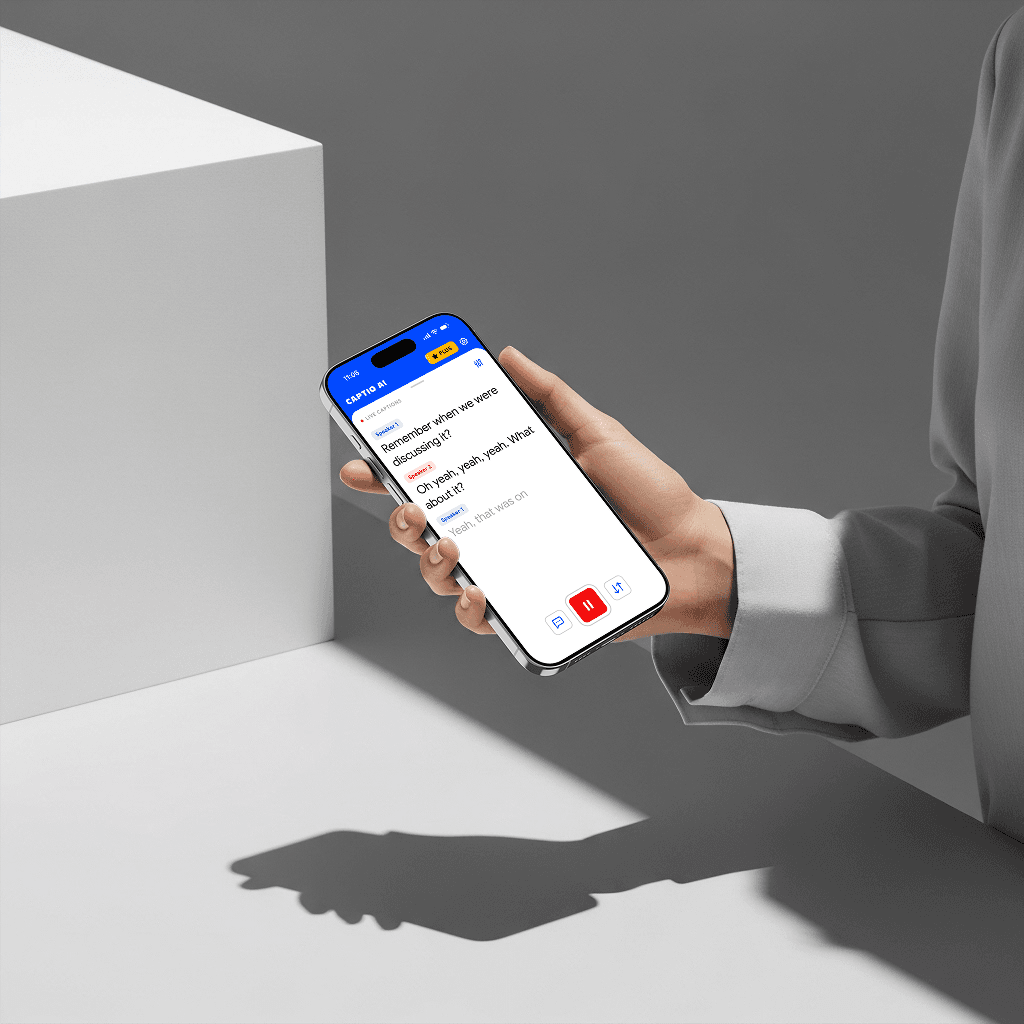
Captions any spoken exchange in real time
Airport staff, hotel receptionists, taxi drivers, tour guides. Hold the phone toward whoever is speaking and read the captions — in any setting, in any country.
60+ languages — no language barrier
Live Translator captions and translates in real time. They speak their language — you read in yours. For every country, every language, no manual setup between interactions.
Works anywhere with a data connection
Wi-Fi or mobile data. A local SIM or roaming plan keeps Captio AI running in any country — airports, hotels, rural areas, and everywhere in between.
Handles travel environments
Noisy airports, busy stations, echoing hotel lobbies. Captio AI is built for real environments — not quiet controlled rooms. It captions through the ambient noise of travel.
Discreet in any public setting
Hold the phone or place it near the speaker. Captio AI runs quietly and draws no attention — useful in customs, immigration, and any formal travel interaction where discretion matters.
Private by default
Travel conversations — customs declarations, hotel bookings, personal exchanges — are never stored or shared. Audio is processed in real time and discarded immediately.
Why Portuguese is hard to understand
European vowel reduction
- Lisbon sounds like vowels have been removed
- European Portuguese is one of the most vowel-reduced languages in the world. Unstressed vowels are swallowed almost entirely — 'obrigado' approaches 'brigadu', 'faculdade' compresses to something close to 'fkuldad'. For a deaf traveler at Lisbon airport or Porto's train station, European Portuguese staff speech can look like consonant clusters with almost no intervening vowels.
EP vs. BP prosody
- Two completely different speaking styles
- Brazilian Portuguese uses full, open vowels and a rhythmic stress-timed pattern. European Portuguese is syllable-timed and heavily compressed. A deaf traveler calibrated to Brazilian Portuguese in São Paulo may find a Lisbon hotel receptionist nearly unreadable — the same words look and sound profoundly different across the Atlantic.
Nasal vowels
- Nasalization invisible at lip level
- Portuguese has five nasal vowels — ã, ẽ, ĩ, õ, ũ — produced at the soft palate with no corresponding change in lip shape. In both European and Brazilian Portuguese, nasalization carries critical phonemic contrast in common travel words, but produces nothing visible at the lips for a deaf lip-reader.
Fast carioca speech
- Rio speech with palatalization and pace
- Rio de Janeiro Portuguese (carioca) has a distinctive /s/ before /t/ and /d/ — producing /ʃ/ and /ʒ/ respectively — giving it a sound quite different from São Paulo or Belo Horizonte Portuguese. Combined with fast conversational pace, the carioca register at a hotel desk or taxi rank in Rio is a distinct lip-reading challenge.
Register gap
- Announcement Portuguese vs. conversation Portuguese
- Airport PA announcements in Brazil and Portugal use formal, compressed language that differs from the casual speech of hotel receptionists, taxi drivers, and market vendors. A deaf traveler must navigate both registers — formal announcement compression and fast colloquial speech — often within the same terminal.
Download for free
Hearing loss and travel accessibility in Brazil and Portugal
Brazil carries one of the largest deaf populations in Latin America. According to Brazilian census data, approximately 10 million people in Brazil are deaf — around 5% of the population — with hearing loss prevalence among the elderly reaching 39–60% in urban studies conducted in Rio de Janeiro. Brazil legally recognized LIBRAS (Língua Brasileira de Sinais) as the official language of the Brazilian deaf community in 2002 — a significant policy milestone — but a study on deaf people's access to primary care found that most participants still reported insecurity and communication barriers during medical and public service appointments.
Research on disabling hearing loss in Juiz de Fora, Brazil estimated a prevalence of 5.2% across the general population, with moderate hearing loss accounting for 3.9% and severe or profound loss for a further 1.3%. Portugal, while part of the EU with stronger disability policy frameworks, still relies on audio announcements at airports and rail stations as the primary passenger information channel, with live visual captioning largely absent outside of broadcast media. For deaf and hard of hearing travelers at Lisbon's Humberto Delgado airport or Porto's Campanhã railway station, critical travel information depends on hearing the PA.
Captio AI captions Portuguese speech in real time — whether a carioca hotel receptionist in Rio, a customs officer at Porto airport, or a tour guide along the Douro Valley — so a deaf traveler in Brazil or Portugal follows every instruction and exchange without relying on audio infrastructure built without them in mind.
Download for free
What you hear stays with you.
Gone the moment it ends
Captio AI processes your audio in real time and discards it immediately. Nothing is recorded. Nothing is kept.
Not a product
Your conversations are not something Captio AI sells, shares, or monetizes — to anyone, for any reason.
Not used to train anything
What you say in a doctor's appointment or a job interview never ends up in a training dataset. Not ours. Not anyone else's.

Private by default
Captio AI supports 60+ languages
Download for free
Frequently asked questions
Navigate confidently in Portuguese.
Captio AI is free to start
Download for free